A scholar of the law asked Jesus, what was the greatest of all the commandments? Jesus responded with two that are inter-related. The first is, “to love God, with all your heart, with all your soul and with all your mind.” And second, “to love your neighbor as yourself.”
Our Christian faith must be rooted in these two commandments. However, following these two greatest commandments we need the right attitude.
The possible failure and difficulty for many of us in practicing our faith is when we limit faith within church laws. Limiting ourselves within the imposed laws or commandments brings us into a legalistic attitude. This attitude believes that Christianity is only about fulfilling laws. When we break a law or a rule, we feel guilty.
This attitude is not what God wants for us. God does not want us to merely feel guilty of the wrong we did. To only feel guilty does not make move forward. It does not inspire growth and maturity in our heart and spirit. Rather, God wants us to feel sorry because our response to Him is lacking and ungrateful. This makes us understand of the gravity of our faults. This brings us towards reconciliation and conversion.
Indeed, we may have laws but God wants us to look what is behind these many laws. This is what Jesus said to the teachers of the law. Jesus revealed to them the meaning behind those laws, and that was love – to love God and to love our neighbor as ourselves.
We are only able to respond to God with love when we ourselves are conscious of God’s love for us, of God’s goodness and generosity in us.
The first reading from the Book of Hosea tells us how God shows mercy and compassion to the erring people. God promised, “I will heal their disloyalty and love them with all my heart.” God as if speaking in human language, shows faithfulness to us despite our unfaithfulness.
This experience of forgiveness, mercy, love and faithfulness from God moves us now to respond to God, to respond in “gratitude and love.” This is the right attitude that we are called to develop.
Jesus invites us today – that as we live our lives as Christians, our response to God should be out of “gratefulness and love” not out of fear or mere obligation. Thus, faith is beyond obligation, it is a human response of love to the God who first loved us, as the late Pope Benedict XVI reminded us.
Our love for God will then be shown in our words as well as in our actions. We express our generosity to those who are in need because we are grateful to God who is generous to us. We show our concern and affection to our friends because God shows his love to us in many ways. We forgive those who have hurt us because God has forgiven us first. Hinaut pa.
Do you have friends? Do you have a true friend? We have many friends. Yet, among them, there would only be a few we find most comfortable with. These friends sometimes know our deepest secrets. They understand our hurts and pains. These friends also know our true dreams and aspirations in life.
The very presence of our friends, especially those who are closest to us make so much difference in life. In times of our joys and success in life, we have our friends celebrating with us. It warms our hearts knowing that there are people who are also happy of our own happiness. In times of pain, loneliness, sickness and failures, we find friends who are faithful and supportive to us. It gives us comfort and assurance that we are not alone.
The Book of Sirach today speaks so well of beauty. It captures the warmth of having true and faithful friends.
Sirach says, “A faithful friend is a sturdy shelter; he who finds one finds a treasure. A faithful friend is beyond price, no sum can balance his worth. A faithful friend is a life-saving remedy…”
Friendship is a gift. Having a true and faithful friend even when we only have one, is a treasure. This calls us to cherish and nurture that friendship. Remember, we need to invest in our friendships with our presence. Emotional investment is also crucial to develop healthy relationships with our friends.
Emotional investment is fundamental to relationships and to friendship. Being open and honest with the people around us allows us to build TRUST, CONFIDENCE, AND LOVE. Without emotional investment in our relationship, we focus only on how the person is useful for us. This benefits only our ego. Yet, such relationship brings out toxicity, an unhealthy relationship with others.
This is what the Book of Sirach warns us about. We should be on guard against those who pretend to be friends. These individuals are not with us in times of distress. Beware of those who tell others about us only to bring shame on us. Be cautious of those who abandon us during sorrowful times. They approach us solely when they stand to gain something.
This toxicity in friendship can also be found in marriage life. Because of the selfishness in one or both spouses, marriage will fail. When one is being used only for personal gain and gratification, then, the relationship is corrupted. The question of divorce became an opportunity for Jesus to confront the hardness of the hearts of men. The discontentment and abuses in a relationship were the reasons of breaking up marriage. Yet, at the very beginning God joined the wife and husband to be together for better or for worse. They were to be together for richer or poorer, in sickness and in health. They were to be together in joy or in sorrow. God intended them to live a life committed in love and faithfulness.
And so, as we are reminded today of the treasure of friendship, there are two invitations for us.
First, be a true friend. We recognize and thank our true friends. Let us, in turn, be true friends. Remember, friendship involves give-and-take. Sometimes, we are the one giving support, and other times we are on the receiving end. Being a true friend is to let our friends know that we care about them and appreciate them. This can help strengthen our bond and develop a healthy and life-giving friendship.
Second, have the courage to confront. Another way to develop a healthy friendship is to confront a friend when needed. It is important to challenge them constructively. We do this constructively. This is a sign of maturity in our friendship.
And so, we pray that the God of Friendship bless our friends and our friendship with one another. Hinaut pa.
When I was a newly ordained priest in Iloilo, there was such a time that while waiting for the mass to begin, I sat in a corner of our church. Few pews away from me, were a couple with their daughter who was probably about 3 or 4 years old. As I observed, she was very playful and while playing she accidentally hit her head on the pew. It was quite hard and painful because there was a loud cry after that. She sought the comfort of her parents. The father took her up. But what surprised me were the words of the father which I cannot forget. He said, “the chair hit you, you hit back then.” The little girl did as she was told and after that she was comforted not to cry anymore because she was able to hit back already. The little girl hushed from crying and rested on the shoulder of her father.
I am sure this is not something surprising to many of us. Some may have done it too to their children or grandchildren and perhaps you yourself experienced this. I have also experienced this at home when I was a little boy – to hit back whenever I am hurt, believing that the pain will fade once I have my revenge.
Indeed, to take our revenge when we are hurt may have been there in our hearts and sub-conscious because that was how we were brought up or perhaps that was how our environment and culture taught us to do. This sounds actually simple yet this has big implications when we are grown up and interact with one another. With this, we may ask now, is the attitude of taking revenge a Christian way?
In the First Book of Samuel, King Saul was in search of David. David had become an enemy to Saul because David became a threat to his kingship. Thus, Saul wanted to eliminate the threat by killing David. However, we were told that David slipped through the soldiers of King Saul and managed to get near to Saul while he was asleep. David had all the opportunity to kill Saul, his enemy, yet, when David had the chance to take his revenge, David spared the life of Saul.
David believed that vengeance and violence against the man that God has chosen was not the answer to a free and good life but rather in showing mercy.
The Psalm which has been attributed to David expressed such attitude of David too. – “The Lord is merciful and gracious, slow to anger and abounding in kindness and the Lord deals with us not according to our sins.”
This story of David prepares us of Jesus’ absurd and seemingly illogical teaching. Many of those during his time, found it radical and crazy. In the Gospel of Luke, Jesus taught his disciples to “love your enemies, do good to those who hate you, bless those who curse you, pray those who mistreat you.” Is it not ridiculous?
We were taught to be vengeful. We were taught to believe that hitting back takes away the pain that we have endured. Yet, Jesus teaches the other way around.
How could we love those who have hurt us? Those who have abused us? Those who betrayed us and caused so much pain in our life? How could we not hate and curse them when we are suffering from what they have done to us? How can we give forgiveness when they do not own the responsibility?
Our immediate response is to retaliate, to take our revenge. Some may result to physical violence which can terrorize the community. And if we cannot express physical violence against them, then, we express it in our words and on how we treat people. But most of all, we linger to hatred, to pain, anger and bitterness.
However, we do not realize that once we let aggression, violence, hatred and anger to dominate our hearts and minds, we, in fact, become prisoners of our own pain. Then, the pain that we endure leads us to feelings of anger, hatred and bitterness. When we linger to these they will lead us to a heart that seeks only revenge. This will be our tendency from our belief that by hurting the person back, our anger and hatred will be satisfied. But then we are wrong because anger and hatred will never be satisfied by violence. Violence only makes us angrier, more hateful and more bitter. The more we linger to these emotions; they become a cycle of violence that never ends.
We create our own cycle of violence, revenge, anger and hatred. We become prisoner of our own pain. All of these will control our life, thoughts and actions towards others. This is how our person and our relationships are so affected that we become toxic. We will never be free because we will try to avoid those who have hurt us and avoid occasions of meeting them. We will begin to become suspicious to our other relationships. Yet, we are afraid of trusting others, of loving others again and even ourselves. We are afraid because we linger to that pain thinking that other people might do it again to us. Thus, we become judgmental and condemning to those who are around us and even of ourselves.
However, it is when we find love and forgiveness in our hearts that we will be free. But remember, this begins in accepting and embracing those painful experiences we have so that we can go on with life.
This tells us, that loving one’s enemies or those whom we hate is an expression of mercy and forgiveness that makes us free. It will not erase the scar of betrayal or abuse or pain or any trauma that we endure; but we will be able to stand up, to wipe our tears, to go on with life and to transform our pain into kindness and forgiveness.
This is what Jesus wants for us. Jesus wants us to be free and not to be prisoners of anger, hatred, bitterness and violence. It is in showing love, kindness and mercy that we actually find peace and reconciliation, justice and freedom.
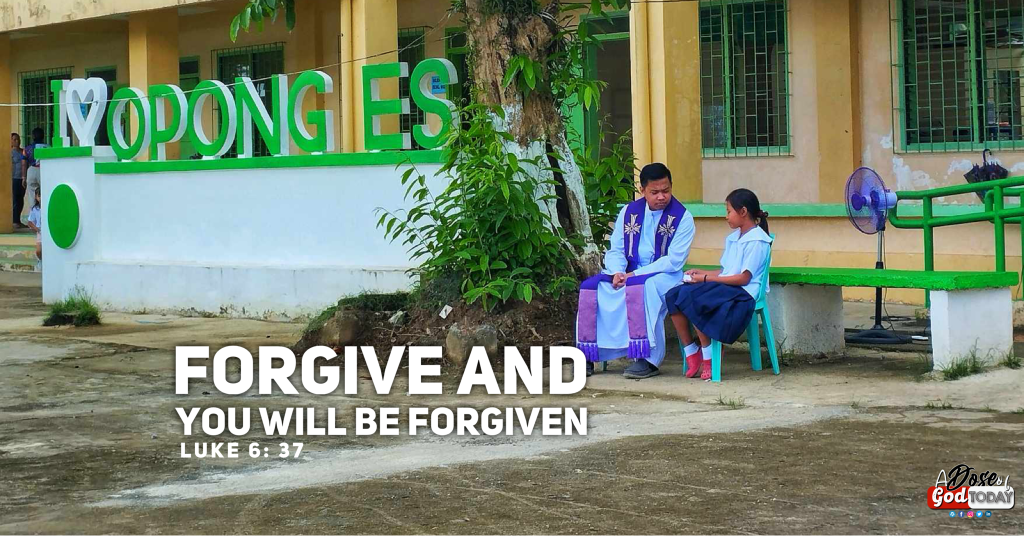
Showing love then, is not about telling the person, that what he/she did was okay and we pretend as if nothing happened. No! Love and forgiveness bring healing to our wounded heart that will make us say to the person, “I forgive you not because of who you are but because of who I am.” This is what the Dalai Lama said. This is a gift from the Lord because we deserve peace and freedom. This also means that I choose to be free and at peace. I choose love and not anger and hatred and I choose God and not evil.
The invitation of Jesus for us now, is an invitation to freedom from hatred, bitterness and violence and freedom to love, to be merciful and forgiving. This the attitude of the heart of a true believer of Christ Jesus. Hinaut pa.
I want you to tap the shoulder of the person beside you and tell that person, “You are great!” We are all great! But wait, what makes us really great? With all our weaknesses and sinfulness, how could we be great?
By ourselves alone, we are never great, but because we have been chosen and loved, we are made great – each of us, no matter how we consider ourselves small and insignificant. Yet, what makes us great are not those things that we have achieved or accumulated in this life. We may boast ourselves because of the achievements in life and what we have reached, however, not one will make us truly great.
Hence, let us revisit the readings on this final Sunday of Advent that wonderfully tell us how we have been made great by God and how we have been chosen and loved.
Prophet Micah, in the first reading, who is also called as the Prophet of Advent, proclaimed to us how God chose the insignificant town of Bethlehem to be the place of the birth of the Messiah. Bethlehem was small compared to other tribes of Judah. However, God chose the small and the humble, not the powerful and the arrogant. From Bethlehem, David was chosen to be king and where the Messiah shall also be born.
This is how I shall offer you now a different perspective in looking and understanding today’s Gospel which is the same Gospel as yesterday. Indeed, God’s favor for the small and the humble reflects in that encounter of Mary and Elizabeth. Mary was chosen to be the mother of the Messiah, a woman from a small town of Nazareth. Likewise, Elizabeth who was old and shamed for being barren, was chosen to be the mother of John who will prepare the way of the Lord.
Neither of them were royalty, nor a daughter or wife of a governor. There were many women who would be more fitting than them if God would follow our worldly standard of greatness. However, God does not choose somebody because of a high status, or of popularity or fame or of wealth or power. God chooses the small and the humble, who are most welcoming of His invitations and most willing to respond to His call. Indeed, God looks at the greatness of each one of us because we are humble and unassuming of power and fame. We are made great because we are chosen and loved.
Certainly, Mary and Elizabeth welcomed God fully in their life because they did not have many possessions. Power, or wealth, or fame, or any other forms of insecurities did not possess them; they were free and open to God.
This reminds us too that when we are possessed by our insecurities, whatever they may be, we are being prevented from receiving the Lord in our life. But once, we make ourselves free from our insecurities, fears and anxieties, from our hatred and resentments, then, we make ourselves open to God’s invitations.
Thus, on the part of Mary, who was greeted by Elizabeth as blessed among women, has made herself completely free for God. Her acceptance of Jesus made her life filled with love and blessings. Thus, we have lighted the fourth candle of Advent that reminds us of love.
And because Mary was filled with love, this moved her to respond immediately to her needy cousin Elizabeth. Mary knew well that Elizabeth needed help and so she responded with willingness.
And again, as we have reflected yesterday, this reminds us that when we are truly filled with love, love makes us more aware of the needs of others. True love and concern overflows from us and thus, making us free to share our love to those who are in need, to people around us. In this way, our way of loving will become free of pretentions and insecurities.
What is more interesting was on how the two women greeted each other. Their encounter tells us the wonder and beauty of those who truly believed in God. Elizabeth was surprised and delighted by God’s visit through Mary. Mary’s willingness and openness to God made her the bearer of God’s loving presence to her cousin Elizabeth. Indeed, Mary’s visit, though simple, was a great gift for Elizabeth.
Indeed, on this fourth Sunday of Advent, we are called to remain free and open to God so that we too shall receive Him fully in our life. And through that, then, hopefully, each of us will also become bearer of God’s presence to others. Never underestimate the gift of presence that you can give to your children, to your family, colleagues and friends even strangers. Be the “PRESENT” to people around you by being truly “PRESENT” in their life. This may be simple, but our presence will be a powerful force of love and concern.
And so, never deprive others of your presence. God has never deprived us of his presence. The Lord is never “paasa” to us because God is always faithful. God took the risk of meeting us even though it will cost him pain, suffering and even death, because each of us is a delight to him. We are so dear to God, remember this. Take also the risk to build deeper, healthier and stronger relationships, selfless and loving relationships.
In these ways, we shall be able to respond to God’s invitation in this Season of Advent, by becoming ourselves LOVE for others, as Jesus is LOVE for us. That makes us great! Hinaut pa.
In every group or organization there is always this desire that in order to express their identity, there should also be uniformity in language, ways of doing or even appearance. And so we create initiations when there are new members and introduce to them those ways and things so that they become like us, identifiable and one with the group or organization.
This is also true in many cultures, as we belong to a particular culture it is almost expected that we follow what is proper to that particular culture. Anyone who does not follow or adhere to the cultural beliefs, ways, costumes and customs are considered an outsider or foreigner. And so people who want to be identified to a seemingly more superior and cool culture, we try copy and mimic their ways so that we can say, “we belong.”
Though there is nothing wrong with this, however, such desire to make everybody else to look like us or to impose on others our ways of doing before they will be welcomed can also be problematic.
This is what St. Paul in his Letter to the Galatians told us about. At that time, there were some Christian Jews who demanded that those Gentiles who accepted the Gospel of Christ must also follow the religious and cultural practices of the Jewish people. This demand became a tension in those times of the first Christians. For them, one is being justified by the law of Moses.
Nevertheless, Paul, a Jew and a Pharisee himself, reminded the Christian Jews that one is justified not by law but by faith. Thus, Paul said, “For in Christ Jesus, neither circumcision nor uncircumcision counts for anything, but only faith working through love.”
There is no need for that kind of uniformity before the non-Jews will be accepted and welcomed. It is Christ Jesus and faith in him that we are justified and welcomed. Moreover, this faith is expressed in love not in indifference or in our superiority and righteousness over others. Therefore, our Christian faith is not kind of affiliation like in organizations or associations that we create. Our Christian faith is rather a relationship expressed in and through love!
This is what Jesus also emphasized in today’s Gospel as he encountered a Pharisee who was rigid and meticulous over man-made religious practices. Jesus directing at the heart of the matter, rebuked the Pharisee with all frankness, “Although you cleanse the outside of the cup and the dish, inside you are filled with plunder and evil!”
The rigidity and meticulous observance of the law was only a cover-up, a façade of a plunderous and evil heart. But Jesus sees that heart and his words pierces through the heart.
Hence, what Jesus asks of us is not uniformity but consistency in our words and actions, not mere observance of the law but charity and integrity, not in merely being obliged but by being in love. We ask the Lord today that indeed, our faith will work through love. Hinaut pa.







 A DOSE OF GOD TODAY