
Tag: lifegiving

  • FASTING TO BE LIFE-GIVING

    FASTING TO BE LIFE-GIVING

    February 19, 2021 – Friday after Ash Wednesday

    Click here for the readings (https://bible.usccb.org/bible/readings/021921.cfm)

    We always understand the religious practice of “fasting”  in reducing our food intake. This religious practice which already begun even in the ancient times still takes a central place in today’s Season of Lent. The Church, in fact, asks us to fast as one of our practices in this season.

    Our readings today actually talk about fasting. Isaiah in the first reading, criticized the people who devoutly did the religious practice of fasting. He criticized them because those people were only concerned of the traditional practice of fasting while refusing to respond to the call that fasting entails.

    According to Isaiah, when fasting remains a religious practice or tradition and does not change our heart, then, it is not true fasting. Fasting will lead us into a change of heart. This is shown in what he said,

    “releasing those bound unjustly,
      untying the thongs of the yoke;
    Setting free the oppressed,
        breaking every yoke;
    Sharing your bread with the hungry,
        sheltering the oppressed and the homeless;
    Clothing the naked when you see them,
        and not turning your back on your own.”

    From what Isaiah told us, to fast in this Season of Lent is not about making ourselves slimmer or to aim in losing weight. These reasons are not what the Season of Lent is about. The call to fast and consciously choose not to eat our comfort food is a discipline that will bring us into at least four practical and significant reasons.

    First, fasting from our comfort food will allow us to learn the value of giving more importance to what we really need and not just on what we want. Our wants could sometimes lead us into unhealthy habits in our diet, thus, to fast will help us confront those unhealthy habits.

    Second, when we fast, we will surely feel hungry. To feel the emptiness of our stomach, will help us to value every food being prepared on our table. This should help us to be more grateful of people around us and of the grace from God.

    Third, such consciousness in the emptiness of our stomach will also help us to realize the hunger that many people are suffering every day. According to Action Against Hunger, there is more than enough food produced in the world to feed the entire population of our planet, but, despite this over supply, there are 690 million people in the world who sleep without anything in their stomach.[1]

    Fourth, by becoming aware of that, fasting then, leads us to respond to those who are in need. In the words of Isaiah, in fasting, we share our food with the hungry, we set those who are unjustly accused to be unburdened, we set those who oppressed to be free, we give shelter to the homeless, we cloth those who are naked. Meaning, fasting indeed entails practical responses that will allow us to become life-giving to others.

    Thus, as we have just began this Season of Lent, please be more conscious also of this religious practice of fasting by also becoming more aware on how we could be more  life-giving to others. But never forget to bring that consciousness into prayer. Fasting without prayer will not make us life-giving.

    So, a practical example would be keeping aside the budget of your food or meal every day and give what you have kept aside to a neighbor or a friend who is in need of material or financial aid. May way all become life-giving in this season of lent. Hinaut pa.


    [1] See https://www.actionagainsthunger.org/world-hunger-facts-statistics
  • Power that gives life and heals

    Power that gives life and heals

    January 13, 2021 – Wednesday of the First Week in Ordinary Time

    Click here for the readings (https://bible.usccb.org/bible/readings/011321.cfm)

    How do we imagine a person having power? We usually understand that a person who has power over others exercises control and dominance. 

    In a community or society, people who have the power rule others into submission. People who are powerful are believed to have wealth which gives them influence, entitlements and high positions. Consequently, these powerful people may also tend to relate with those who are under them as their mere subordinates. Manipulation to advance the self-interest of the powerful and to stay in power is very tempting in this kind of relationship. When a powerful person submits to this temptation, then, most likely the powerful will use force, violence and incite fear towards others in order to preserve and even consolidate his or her power.

    Among couples, a husband who plays powerful may most probably relate with his wife in terms of control. It commonly happens in abusive relationships where a partner places the other into submission through manipulation, deceit, pretension and fear.

    However, all these forms of exercising power are filled with so much insecurity and evil. This kind of power destroys relationships and life of people. This is the power of death, of the devil that the Letter to the Hebrews was telling us about. This is also the power that Jesus destroyed in order to free us from fear and from slavery.

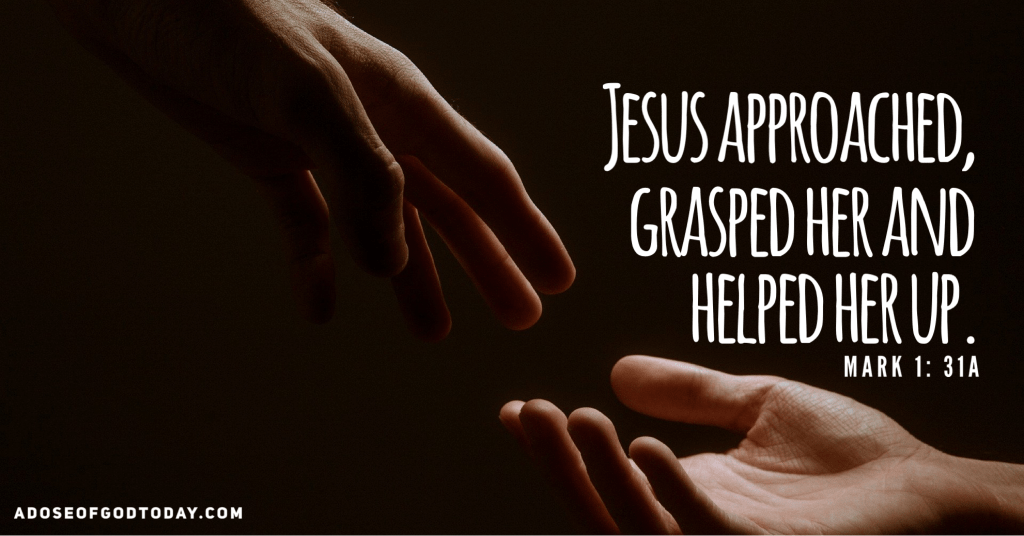
    Moreover, in today’s Gospel, Mark proclaimed to us the life-giving and healing power of Jesus. This power that Jesus showed us transforms life, heals the broken and frees the troubled. This was described to us in that scene when Jesus healed Simon’s mother-in-law. The power of Jesus was described to us three actions.

    The first action was when Jesus approached her. Jesus and his friends were received into the house of Simon and Andrew. By welcoming the Lord into their home, Jesus was also made aware of the sickness of Simon’s mother-in-law. With this awareness in Jesus, he approached the sick woman. This action of Jesus to approach the sick has the intention to manifest God’s presence.

    The second action was when Jesus grasped her hand. Jesus has manifested God’s presence, with this, Jesus also brought God’s touch to the sick woman. God touching her meant God’s compassion towards her. The touch of Jesus was God’s most abiding presence giving her the strength.

    And the third action was when Jesus helped her up. The strength from God was the gift of healing granted to the sick mother-in-law. Because she was lying down and her fever overpowers her, she needed help from another. This very action of Jesus helping her up tells us that God supplements and journeys with us towards our freedom and healing.

    From these three actions, Jesus showed us how our presence, our touch and our concrete action in helping another will manifest power that brings comfort, compassion, healing and even life.

    This is the very reason why after the healing of Simon’s mother-in-law, people with various diseases and those who are ill or possessed by demons flocked towards Jesus. Because the power of Jesus is not of force and violence, people begin to recognize God’s power. In Jesus what we really see is God’s power who wills our joy and desires our healing and to experience the fullness of life.

    For us today, let these three actions of Jesus be our invitations in our relationships. But first, let us welcome the Lord to come to us, to welcome him in our hearts. Then, let us allow the Lord through his instruments to approach us, to hold us, and to help us. They may be our friends or family members or even strangers who have the intention to love us.

    With that, we may also become God’s instruments who will manifest his power in our homes, workplaces and communities by approaching, holding and helping those who are sick, weak and vulnerable.

    May God’s life-giving and healing power dispel every fear, insecurity, selfishness, illness and evil in our hearts, through the intercession of Mary, Our Mother of Perpetual Help. Hinaut pa.

  • A Life-Giving Rest Day

    A Life-Giving Rest Day

    Advertisements

    October 26, 2020 – Monday 30th Week in Ordinary Time

    Click here for the readings (https://bible.usccb.org/bible/readings/102620.cfm)

    Homily

    Jesus could not stand seeing a person suffering. The Lord’s heart is so close to a person that he too feels what the person is suffering from. This kind of attitude in Jesus is conveyed to us in the Gospel. Though it was on a Sabbath and Jews prohibited people from working and doing anything that was considered work, this did not prevent Jesus to touch and heal the woman. Jesus understood very well that the purpose of the Sabbath was not do to any work, but to give life as God the Creator, gave life to all things.  

    However, because of this actions from Jesus, he seemed to be a person that continually scandalized people. He particularly scandalized those who were in the leadership, those who were higher in status in the society.

    Thus, a leader of the synagogue confronted Jesus for healing a woman crippled by a spirit for eighteen years, on a Sabbath day. As Sabbath  was considered to be holy by the Jews, its holiness shall be observed by not doing any work as God rested on the Sabbath after the creation. This man felt scandalized because he believed that it was not appropriate for Jesus to heal someone on a Sabbath day. His strict observance of the law, made him indifferent to the suffering of the woman.

    Yet, such tradition prevented people from doing anything and even from doing what would be life-giving. A healer was forbidden to heal a sick person as a hungry man was not also allowed do to anything to ease his hunger. However, people were more considerate to their hungry animals than to their neighbors in need.

    But then, Jesus knew and felt the many years of suffering of this woman. She suffered long enough. This compassion of Jesus lifted the burden and suffering caused by a spirit to her.

    We might also find ourselves in this situation when we also become a person who complains a lot and tends to only see what is wrong and ugly in everything and everyone. We surely are just filled with malice, bitterness and insecurity.

    Jesus confronted this leader of the synagogue and  wanted him to realize that God would not condemn us for doing God’s desire. God desires to give life to us, to heal us and bring us into freedom.

    Thus, the encounter of Jesus with this woman suffering for many years touched him very much. Jesus tells us that Sabbath will only be more meaningful when one is able to bring healing and life to another. After all, God’s rest day is indeed holy because God gave life.

    This is something that Jesus wanted to communicate to his disciples and to us today – that as we take time to rest, relax and take a break, we may also discover that we are to give life, healing and freedom whenever we are called to.

    Let us remember, Jesus laid his hands on the woman to heal and free her from the spirit that crippled her. We may also dare and be courageous enough to touch others to bring healing and life. Hinaut pa.

    Jom Baring, CSsR