Tag: Kindness

  • SMALL ACTS OF KINDNESS MATTER

    SMALL ACTS OF KINDNESS MATTER

    July 25, 2021 – 17th Sunday in Ordinary Time

    Click here for the readings (https://bible.usccb.org/bible/readings/072521.cfm)

    The total population of the world is now at 7.9 billion and The State of Food Security and Nutrition in the World estimated that there are about 811 million people in the world who went hungry in 2020.[1] Out of that number, the 418 million hungry people are found in Asia. The report also projected that around 660 million will still suffer hunger in 2030 because of the lasting effects of Covid-19 Pandemic on global food security. Moreover, there are about 9 million people die of hunger and hunger-related diseases.[2] And in every 10 seconds, a child dies because of hunger. This is the cause of the 3.1 million deaths of children around the globe every year.

    Here in the Philippines, the recent SWS survey revealed that there are about 4.2 million Filipino families suffering from hunger.[3] And Mindanao has the highest rate of incidence of hunger with 1.2 million families.

    With these statistics available to us, there is a need that we become aware of the suffering that our brothers and sisters are enduring because of hunger. We cannot be blind and indifferent to this need. In fact, our readings this Sunday would actually help us to be more conscious of such hunger and of other forms of hunger around us.

    The first reading from the Second Book of Kings proclaimed to us how a nameless man from Baal-Shalishah brought food to Prophet Elisha. People were starving and they needed food. This was the reason that the man offered his food to the hungry men of God. However, Elisha’s servant knew that that food was not enough for them all. This was the reason why the servant objected Elisha when he demanded that the food must be distributed. But then, there was something Prophet Elisha saw that the servant did not recognize at that moment. Prophet Elisha believed that no matter how little they have, that will be enough for God to work wonders. Certainly, when the food was generously given to the people, they were surprised because there were left overs. The little food that they have shall be multiplied by the Lord. This was what the Prophet believed.

    The confidence in God’s providence and complete trust in God’s power to sustain and provide for His people, manifested also in the Gospel this Sunday. The Gospel of John told us that Jesus was aware of the needs of the people. The Lord was not just conscious of the spiritual hunger of the people but also their physical hunger. This awareness in Jesus moved him to ask Phillip, “Where can we buy enough food for them to eat?”

    Jesus did not just see the hunger of the people. Jesus also felt their hunger. This urged Jesus to do something. However, Jesus needed the participation of people around him. Phillip, just like the servant of Prophet Elisha, could not think of anything since they did not have enough money to buy food for all. Just like the servant of the Prophet, Phillip seemed to be too calculated in his response to the words of Jesus and thus of his response to the needs of the people. Yet, this prevented him only to fully participate in Jesus’ saving action at that moment.
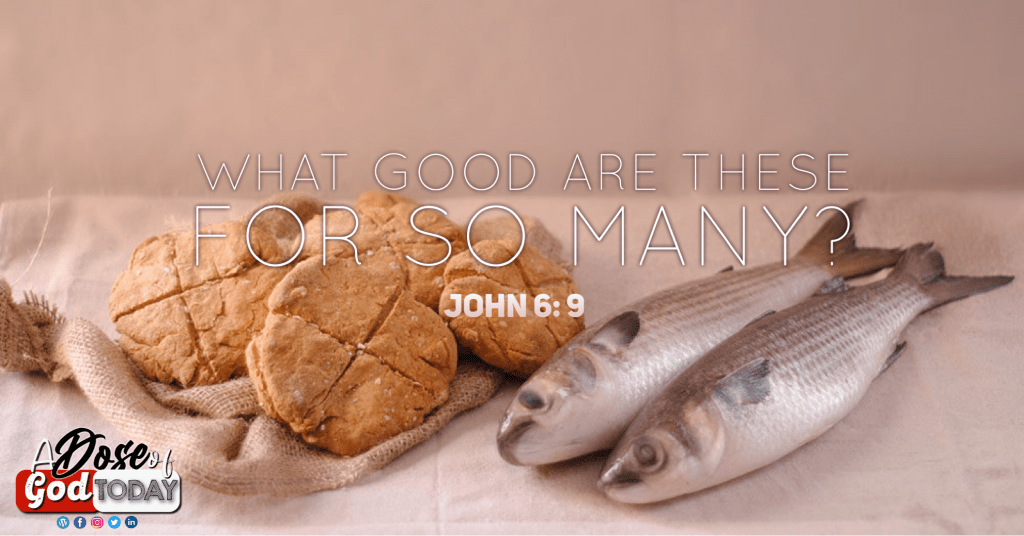
    It was Andrew who brought to Jesus a boy who had five barley loaves and two fish. The appearance of the boy in the story was actually very symbolic. He was nameless and faceless and was just a boy with small food. Yet, that nameless and faceless boy must have volunteered and gave generously his food to Jesus.

    With the boy’s willingness and generosity, his small share became the perfect offering that Jesus needed so that the people will be fed. It was through that boy who had five loaves and two fish that Jesus did something and made everyone to wonder.

    The first reading and the Gospel seemed to have a common ground. There was the small share from a man  who came from Baal-Shalishah and the loaves and fish from the boy. The little things that they had were transformed into many. The small share that they gave became abundant.

    This is where we find God’s invitation for us today as we have also become aware of the pressing hunger in our communities. We are invited by Jesus to offer sincerely the little that we have. We might be thinking that the world’s problem on hunger is too big for us to respond and our share will only be insignificant. Then, having such pessimistic view and calculated in our generosity will only prevent us from participating in God’s saving action, like the servant of Elisha and Phillip. But let us remember, the twenty barley loaves and fresh grain of the man were insignificant to a hundred men and even the five loaves and two fish of that nameless boy were nothing compared to the five thousand men. However, the man did not keep away his food and the boy did not run away to hide what he had, rather, both of them offered generously what they had no matter how small or insignificant those were. Indeed, this tells us that small acts of kindness matter in the presence of the Lord.

    The action of the man as well of the nameless boy were symbols of our vulnerabilities and weaknesses, of our anxieties and fears of having not enough but at the same time the power behind a generous action. To give away the little that we have, makes us insecure, yet, it is actually through the little that we possess that the Lord works wonderfully. When we give something and then we feel vulnerable because that was all we have, no matter how small, is actually the fruit of our generosity. Remember, true generous people will always feel helpless because what they give to others is not something that is only an excess of their possession.

    Thus, the Lord invites us today to be generous with what we have, no matter how small or inadequate in our eyes. Remember, the Lord needs our participation, our small contribution so that he too can work wonders through us and through our small things. With us, Lord will be able to continue to feed the various hungers around us. These many hungers involve hunger for food, for shelter, for a home and family, for friendship, for acceptance, for love and intimacy, or for a deeper relationship with God.

    Let us take time today to be that nameless man and nameless boy who generously offered the little things they had, to make a generous action towards people around us, no matter how small would that be as long as it is given in generosity and kindness, the Lord shall make wonders with us and through us. Hinaut pa.


    [1] https://data.unicef.org/resources/sofi-2021/

    [2] https://www.theworldcounts.com/challenges/people-and-poverty/hunger-and-obesity/how-many-people-die-from-hunger-each-year/story

    [3] https://www.rappler.com/nation/millions-filipino-families-stay-hungry-sws-survey-may-2021

  • THE POWER OF LESS

    THE POWER OF LESS

    July 25, 2021 – 17th Sunday in Ordinary Time

    Click here for the readings (https://bible.usccb.org/bible/readings/072521.cfm)

    Our gospel today is surely something familiar and already known to us all. How could we miss one of the best stories of Jesus’ miracles ever told?  All four gospel evangelists (Matthew, Mark, Luke & John) have each own version of the story of this miracle. However one call this miracle-story – whether as “the multiplication of loaves & fishes”, or “the feeding of the multitude, these unique versions & diverse interpretations share the same plot.

    Basically it is about Jesus & His disciples with crowds of people gathered & now stranded in a far-distant mountain field, perhaps already during midday. Concerned about the people, Jesus ask his disciples for resources to tend & feed these multitude of people. With the less food-resources that they can collect & muster, Jesus instructed the disciples to organize people into small groups, took & blessed the less that they got, and have it broken & shared to the groups. People began to share what they got & have to each other, that in effect, had each other & one-another fed. And eventually made all filled & satisfied, and even able to garner twelve basketful of left-overs. Crisis-solved. Five thousand men (perhaps including or excluding women & children) were fed. A miracle happens. All are happy. Jesus saves the day.

    Perhaps there is more to the story than we may realize. Somehow the story have more lessons now to teach us than it has taught us before & always. Perhaps, we can learn here something about the Power of Less.

    What can Less do to All? What & how can the only Less we can have contribute for many (if not for all)? Ano at Paano ang magagawa ng kakaunti para sa karamihan at kalahatan? We may have something, but how it can help all? Like the man in our first reading, we also raised the practical question: “How can I set this (20 barley loaves & fresh grain) set up for a hundred people?” And somehow like the disciples, common sense tells us that “200 days’ wages worth of food is not enough for each of them to have a little.” And somehow in our pandemic times, we ponder: What & how can my little inconveniences (like wearing mask, face shield, quarantine, social distancing, or vaccine) can contribute in healing our infected & life-threatening world?

    Somehow our condition and reality of LESS may bring us to these realizations.

    First, with less resources, we come to grip with our vulnerability. Suddenly, we come to experience how poor, fragile, limited, dependent & needy we are & we can  be. When we get what we want & have what we need – Fast, easy, accessible, instant & convenient life gives  us an illusion of power, independence & invulnerability in life. But when resources are scarce & abilities are limited, we are humbled to realize our own poverty & neediness.

    With such humility, second, we begin to be thankful & to make the best of what we already have. We become “madiskarte sa buhay”. We learn to cope & live with what less resources we have. We get to know what is enough from what is too much. We know now what is essential & important things in life as well as what we can live & do without. In other words, with less, we become resilient as well as resourceful.

    Third, with less, we are moved to feel with & feel for one another. As we become conscious of our own poverty & our little resources, we come to empathize & sympathize with one another, and we try to help & contribute what little we have with others. In our gospel, Jesus did not only make a miracle of feeding the people. He also makes an example & witness of sharing the little we have with others. What meant to be a relief operation of feeding the people, now turned-out to be an agape, salu-salo because what they have received & got is also shared with others & one another. Less makes us kind & compassionate with one another.

    And yet still, fourth, less makes us rely on the help of others & trust in God’s mercy. In our poverty & humility, we come to realize that without God, we can do nothing. On our own we cannot live. We need God & each other to be & live in a much better & meaningful life.

    LESS can be powerful. It can humbly render us poor, bring us to resiliency & resourcefulness, make us kind & compassionate to share with others, and above all, impels us to rely & trust in God and one another. Though not much, LESS can make a BIG DIFFERENCE in life.

    Perhaps some of us are familiar with the 2007 comedy movie entitled: “Evan Almighty”. It is about a TV-anchorman turned politician Evan Baxter, not unlike Noah, inspired by God, built a big ARK to fulfill his promise campaign to change the world. The story-line evolved around how spectacular & comedic it is to literally build an ark in these modern times in order to change & save our world. Perhaps a primitive & crazy solution for our complicated world. At the end, Evan’s ARK may have saved his city (animals & people) from landslide & flooding. But he realized that what God meant for Evan to build an Ark is not literally a big physical structure of an ark, but as an acronym A.R.K., which means Acts of Random Kindness.

    ARK can change the world. Our little Acts of Random Kindness can make a Big difference. Less can change our world for the better.  With LESS, God can be & we can be.

    Take, Lord, the little resources we have. Bless & share these to others, as we are also needy of their help & of our Father’s mercy. Let these be our small contribution & acts of random kindness that we may have a share of our agape in God’s kingdom now & always.

    So Help us God, So may it Be. Amen.

  • SHARING

    SHARING

    July 25, 2021 – 17th Sunday in Ordinary Time

    + Emmanuel T. Cabajar, C.Ss.R. D.D.

    Click here for the readings (https://bible.usccb.org/bible/readings/072521.cfm)

    A boy gets his lunch left-over boxed up to take home. As he leaves the restaurant he ignores an old man begging. Feeling a sudden guilt, he gives him some coins. “How about the box, I’m hungry?” the old man begs. To part with his burger isn’t that easy, but compassion prevails. The boy gives it to the poor old man who smiles with gratitude.

    In the gospel a boy gives his lunch to Jesus, which allows Jesus to do something extra-ordinary – feeding the crowd. This miracle is repeated at the Last Supper and at every Mass where Jesus gives Himself and makes us sharers in his body and blood. St. Ignatius of Antioch calls this “one bread that provides the medicine of immortality, the antidote for death, and the food that makes us live for ever in Jesus Christ.” This food unites us intimately with Jesus and heals us, body and soul. It gives us strength for our spiritual journey. Do we hunger always for this bread of life?

    The feeding of the crowd demonstrates God’s kindness to us. He gives generously. He gives more than we need so that we may also share with others, especially the most deprived. God multiplies the little that we have, like the boy’s lunch, for the good of others. Do we trust in God’s provision for us? Do we share freely with the poor? Jesus is still looking for simple people, like you and me, who are willing to make selfless sacrifices that He may convert small love offerings into His glory. May our hearts be open to such kindness and generosity!

             Lord, satisfy the deepest longings of our hearts and feed us with the finest food!

             Brothers and sisters, generosity makes us joyfully share our God-given gifts with others. Amen.

  • KINDNESS FLOWING LIKE A RIVER

    KINDNESS FLOWING LIKE A RIVER

    About mid-morning, our sub-team loaded our mission vehicle with 12 pieces of plywood to be delivered to Barrio Bakikis. This was a village in the Municipality of Kapatagan, Lanao del Sur but still part of the Parish of San Isidro Labrador in Balabagan. From the Parish Church, the Barrio was about 8 kilometers with a shallow but wide river to cross.

    It was raining the night before but when we have reached the river, it was still shallow and the water was clear, enough for us to see the sand below. We have to cross the river again, we did it many times before this. Yet, ahead of us was a big truck loaded with sacks of cement already stuck and buried in the sand.

    I wanted to take the risk. To make sure of it, I asked Darwin, our local-youth mission volunteer to check the level of the water. The water was below the knee. It was very shallow.  So, I took the risk and took the right side of the already-stuck-and-buried truck. I was confident then, our mission vehicle is a four-wheel drive. I engaged the gear and drove.

    To my horror, our mission vehicle began to slow down once it was fully in the river. I felt the sand below was soft but deep. It was like mud. My confidence fell down and I knew at that moment, there will be two vehicles stuck in the sand of that river. No matter how I stepped on the gas, the tires got more buried in the sand. I had to stop then, and prepared to get wet.

    It was sunny and the heat was scorching. It was still mid-morning and the rain would usually come late in the afternoon. Yet, I noticed, the longer I stood in the sand, my feet were slowly buried. I realized, the tires of our mission vehicle as well as of that big truck, were slowly being buried into the sand.

    I was very worried and blamed myself for being so confident. People along the river watched us but no one dared to help us, at least not yet at that moment.

    A Christian who recognized me as the new priest, crossed the river with his motorcycle. He volunteered to get help from Barrio Bakikis. He noticed that there were strong and well-built men along the river, but expressed his dismay that they will not be able to help us. They were Mëranaw, an Islamized Indigenous group of people in Mindanao. It was their Holy Ramadhan and they must have been fasting. They could not help us and not willing to help us this time. “They do not have the strength,” he said. This was understandable. I can only blame myself. The man went with Jenel, our postulant to call for a rescue.

    Yet, it was almost an hour, no rescue arrived. The tires were slowly buried in the sand. I became more worried and anxious. Several small and four-wheeled cars have crossed the river already and offered us no help.

    However, something inspiring happened. It began with a young man, he was a Mëranaw, who tried to cross the river with his motorcycle from our side but got stuck too in the middle.

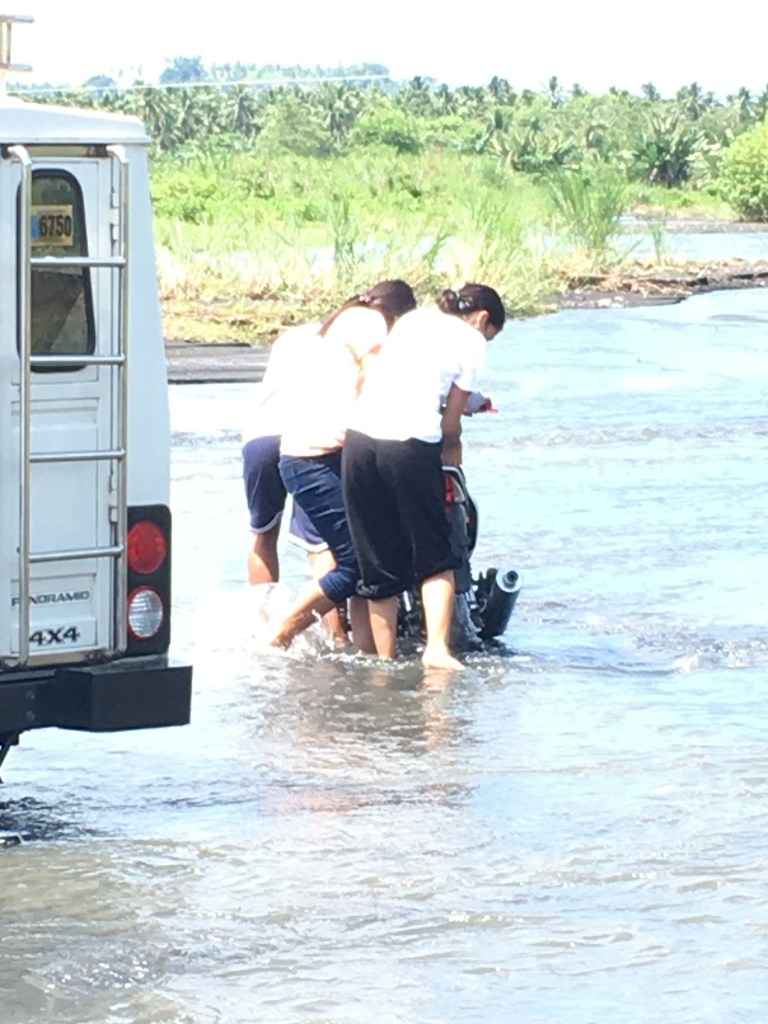
    Immediately, Mimi and Pearllyn, our lady-youth mission volunteers offered help to him. The three of them pushed the motorcycle. But to the disappointment of the man, who did not understand Cebuano, his motor got more buried in the sand. I came and help them too. The only way to rescue it, was by carrying it. And so we carried the motor with all our strength. It was not that big but it was really heavy. Finally, he was able to cross the river.

    To my surprise, he did not go ahead to his destination. He left his motorcycle in dry land and secured it and went back to us. By that time, few men arrived from Barrio Bakikis to help us but they were not enough. The young Mëranaw joined with us and lo and behold, other Mëranaw who were merely watching earlier joined us in the river. The young Mëranaw personally tied the rope and led in pulling our vehicle. Another Mëranaw man volunteered to maneuver our car. Others were at the back to help in pushing and others also were lining up with the rope to pull.

    Simultaneously, the car engine kicked then together we pushed and pulled. We did that in three attempts until we have secured the mission car out of the river. There were more than 20 men who pushed and pulled our mission vehicle, both Muslim-Mëranaws and Christians. Everybody was delighted and everyone shared a victorious smile.

    (Once our vehicle was secured, we also tried to do the same to that big truck. Yet, it was just too heavy and our number was not enough. We tried the same process for a few times, but no luck at all. All we could do was contact a bigger truck to pull it back into the dry land. Later, I was informed that the heavy truck was rescued late-afternoon just before it rained again.)

    I realized, it was indeed, a wonderful sight. Not just because our mission car was rescued finally but I saw a rare event where kindness was overflowing like the river at that moment.

    I realized, kindness can cross barriers, boundaries and differences may it be in our language, culture and faith tradition. Our team experienced kindness from people we did not expect. Indeed, kindness from strangers is inspiring and infectious. As kindness inspires and moves people, kindness also touches our heart and soul. Thus, kindness itself is like a river. It freely flows and flows abundantly.

    From this moving and inspiring experience while being stuck in the river, there are two invitations that we can always remember.

    First. Be kind to everyone even to strangers. To be able to express our kindness to a person in need of help reveals our innate goodness. This makes us more human.

    Second. Let our kindness flow and see how it inspires others and brings changes into our heart and mind. Kindness is not a calculated act of charity and does not even count the cost. It does not expect anything in return because kindness is an expression of a truly generous and happy person.

  • When the Lord opens our heart

    When the Lord opens our heart

    Advertisements

    May 17, 2020 – Monday of the 6th Week of Easter

    Click here for the readings (http://www.usccb.org/bible/readings/051820.cfm)

    “Lydia” is a very popular name among women. Lydia with its Greek origin, actually means “kind.” And among the many Lydias I met, there was one particular Lydia that I could not forget.

    I met “Nanay Lydia,” as what she was commonly called by many, in one of my mission areas when I was still a seminarian. Nanay Lydia was a simple old woman, widowed but surrounded by her children and grandchildren who loved he very much. Despite her poverty, she was the first one to offer her humble home to accommodate us, missionaries.

    It was in her home that I experienced, that joy and contentment in life is very possible even with less material things but filled with love. She was very much cherished by her children and grandchildren. She was highly respected by their neighbors. And as I stayed in her humble house for few days, I received so much kindness from her.

    “Kindness expressed in her grateful response to people around her was her way of life.”

    This attitude from Nanay Lydia is found in her knowledge of the Lord. Her knowledge of the Lord was not out of theological studies but through her experiences of pain and joy, sorrow and comfort, and of death and life. And according to her, she brought all these experiences always into her prayers. This was how she would see things clearly, feel and be comforted of God’s presence in her life. Through her prayers, she listened to God, who also opened her heart.

    This woman reminds me of another Lydia, whom the Acts of the Apostles speaks today. Lydia was one of the women who listened to Paul’s preaching. She was particularly described as a God-fearing woman. However, what was more interesting was her attitude to Paul’s preaching. She listened.

    She welcomed what Paul was saying and by doing that, the Lord opened her heart. It was not her who opened her heart to the Lord. That small inclination from her “in listening” allowed the Lord to come into her heart and opened her heart.

    And when the Lord opened her heart, she began to see clearly how God worked in her life through the preaching of Paul. As a response, she asked for baptism, meaning, she wanted to commit her life to the Lord who opened her heart. Her commitment now was transformed into a generous and grateful action. She welcomed the Apostles, Paul and his companions into her home.

    This is how the Gospel of John is being unfolded to us today also. The Spirit of Truth that Lydia received made her a witness of God’s kindness. Because of the kindness that she experienced from Jesus, reflected in her name, Lydia, she too was inspired to become a witness of that kindness. Her generous and hospitable action to Paul and his companions was a grateful response to God’s kindness.

    Advertisements

    This is the invitation for us today. We are also called to allow the Lord to open our hearts. It is when we listen to God speaking to us through our Sacraments in the Church, through the Bible, through our experiences and daily affairs with the world, that we allow God to challenge us to see God’s surprises in our life.

    Hopefully, as we allow God to open our heart, then, we too will be moved to become a witness of God’s kindness, or goodness or faithfulness to others. Thus, let that be expressed in our actions and words as we struggle today to live in this prolonged community quarantine. This kind of witnessing is very much needed today. This very difficult situation may inspire us then, to become true witnesses of the Resurrected Christ. Hinaut pa.

    Jom Baring, CSsR

    Join 2,850 other subscribers