Tag: Justice

  • Never will I forget a thing they have done!

    Never will I forget a thing they have done!

    September 21, 2025 – 25th Sunday in Ordinary Time

    Click here for the readings (https://bible.usccb.org/bible/readings/092125.cfm)

    Corruption! When we come to think of it, it seems that such a word has become common. We often hear and read it on newspaper, TV, Social Media platforms and other literature. And because it is so common and even rampant in many aspects of our society. Somehow, corruption has become “part of the normal life of society,[1]” the late Pope Francis told us. Many have denounced corruption. Many have promised to fight against it. Yet, it seemed to be tolerable and acceptable in many instances.

    A friend who owned a restaurant in the city, once shared to me how a government office would ask a percentage from them outside the legal fees. Another friend shared how he became an outcast in their workplace after he had reported to the higher ups his officemate of the anomalous transactions that involved money. That co-worker was fired immediately, yet, my friend became unpopular and was blamed for being inconsiderate to a person who lost a job.

    Because such corrupt practices seemed to become normal (for others it is called as SOP – Standard Operating Procedure), this holds true among our government officials and public offices, companies and organizations, Churches and even down to small communities. Again Pope Francis warned us, “all corruption at the social level is simply the result of a corrupt heart.[2]

    Today, the Church has called us to rise and demand accountability from our leaders in the country who have plagued the republic with corruption. The systemic dishonesty and plunder are so much overwhelming. Nakakasuka! Ngilngig! It has to stop because what is happening, is evil!

    With this unfortunate reality in the country, this reminds us that wealth and prosperity are not always God’s blessing. Influence and power to dominate are not signs of God’s presence. These material things when enjoyed by the few at the expense of the poor, of the people, have truly gripped the human heart with so much selfishness, apathy and evil.

    With such situation in our country, in our communities and even in our hearts, let us also turn our gaze into the readings today and realize how the Lord invites us in the face of so much corruption, of evil.

    We have actually a puzzling Gospel reading. The master in the story praised the dishonest steward. But does it mean that Jesus also praised those who are dishonest? Certainly, no! It was not the dishonesty of the steward that was praised neither by the master in the story nor by Jesus. Rather, what was praised was the ‘prudence’ of the steward.

    Let us look again how the steward acted prudently. The steward faced with a crisis, he was about to lose his job for being dishonest to his master. In his mind he couldn’t go on by becoming a laborer by digging or by begging. What he did, then, was to take away the commission that he would usually get from the debtors of his master. That is why he asked one debtor to make 50 for the one who owed 100 measures of oil and 80 for the other who owed 100 bushels of wheat.

    Those debtors would be very happy to lessen the burden of such debt. The steward had just thought about his future so that when he will be fired, there will be people who would hire him for a job out of gratitude (or utang kabubut-on) to him.

    This is what Jesus tells us today, that as Christians, we are challenged to be prudent enough. We are called particularly in using and spending our material possessions in the hope of making our relationships with other people to be better.

    For this reason, we are called to be careful that we may not be ‘possessed’ by our own possessions which will only bring us into the danger of indifference and oppression towards the lowly and the poor. This makes the heart to be plagued by that social illness of corruption in our dealings with others and professional practice.

    In this way, a heart that is being possessed by possession, by material wealth turning to be corrupt – has not just committed a crime, but idolatry. Money, material possession or a luxurious life has become the new god of these people. This is the meaning of the words of Jesus, “You cannot serve both God and mammon.”

    There is also a stern warning that we have heard in the first reading from the Book of Prophet Amos. The merchants were extorting the poor. They hoarded the supplies and raised the prices of commodities. Yet, they too brought at the lowest price what they can buy. However, the Lord is not blind. The Lord has sworn, “Never will I forget a thing they have done!” The Lord shall remember evil done by the corrupt.

    Hence, as believers who have come to the knowledge of the truth, as Apostle Paul tells us in the second reading, we are also called to be fair and to be generous enough as we deal with those who are economically/financially struggling.

    It would be a big help to support local vendors and local businesses. Buy products from local peddlers and local farmers. Show fairness with our own business too. Our material possessions can be best employed also in reaching out to others especially the unfortunate.

    Indeed, these are ways of recognizing God as the generous giver of graces. By being grateful to Jesus our Lord, who has given himself as ransom for all, may it move us then to be generous to the needy. This is a way of building relationships with one another, building friendship and helping one another as a community of believers.

    And thus, being wise in investing to what lasts, to friendships and expressing true concern for others – is the spirit of the Kingdom of God.

    In this way, we will be able to guard our hearts from turning to be corrupt. Hinaut pa.


    [1] Pope Francis, The Way of Humility (Claretian Publication: Quezon City, 2014). 10.

    [2] Ibid., 18.
  • There is more in our Faith

    There is more in our Faith

    January 10, 2021 – Feast of the Baptism of the Lord

    Click here for the readings (https://bible.usccb.org/bible/readings/011021.cfm)

    Are Filipinos more religious because of Covid-19? This is the title of the analysis of Jayeel Cornelio, PhD, a sociologist of religion.[1] This article was published in October 25 at rappler.com. The article discussed significant subjects particularly on the survey done by Pulse Asia last September 2020.

    The survey revealed that 51.8% of Filipinos have become more religious during this pandemic. According to Dr. Cornelio, this is not surprising because of two reasons.

    First, we are known to be one of the most religious societies in the world. And according to Pew Research Center, 96% percent of Filipinos find it “necessary to believe in God in order to be moral and have good values.”

    Second, Dr. Cornelio said, “faith is our immediate resource in times of crisis.” Citing another survey by the Veritas Truth Survey, it revealed that 89% percent of the responders of the survey said that faith is “very important” in the fight against Covid-19.

    From here, the sociologist also concluded that because of the “vulnerable social and economic context,” that is, being a third world country, the pandemic promotes a higher religiosity in us. In his words he said, people in poor social conditions such as having “inadequate health care, high incidence of conflict, and unreliable state agencies”  – people feel that they can turn to nothing else but faith in God.

    Indeed, it is when we become vulnerable and poor that we become more conscious of God’s presence. When we become more aware that we have actually nothing and are nothing in this world, that we also begin to realize of that great presence of God.

    A very comfortable life, a rich and powerful lifestyle can easily bring us into the attitude of indifference. It is indifference that prevents us to recognize that God is with us and continues to be present in the world.

    Moreover, at the end of his article, Dr. Cornelio also wrote that “there is so much more to COVID-19 than simply challenging the core of people’s religious convictions. In the end, it’s not just that Filipinos have become more religious because of this crisis. They are also beginning to seek something ‘more’ from their faith.”

    This sociological analysis brings me now to our very identity as baptized Christians. More than this survey of our religiosity, there is also a need to examine ourselves whether we have grown really in our faith, in our relationship with God and with one another. Our faith is not just about kneeling and standing, holding a rosary and saying our novenas. As Dr. Cornelio said, there is something “more” that we begin to seek from our faith. This “more” is something that I invite you now to pay attention as we celebrate this Sunday the Feast of the Baptism of our Lord Jesus.

    To be able to discern this “more” from our faith, allow me to journey with you through the readings and to see how God reveals His invitations for us today.

    In the first reading, Prophet Isaiah proclaimed the presence of the Servant of the Lord. The servant’s identity were described in three points. First, the Lord said,  “he is my chosen one with whom I am pleased.” This servant is loved very much by the Lord God, thus, God’s presence rests upon him. Second, the servant is to bring justice through compassion and gentleness of his presence and not through violence and force. Isaiah described and said, “a bruised reed he shall not break, a smoldering wick he shall not quench.” This servant is hope for those who are hopeless and are suffering. Third, the servant is to open the eyes of the blind and free prisoners and those who live in darkness. The servant who brings hope also brings peace, freedom and new life.

    The Psalm also stated this, “The Lord will bless his people with peace.” Peace here is living in the presence of God who is present in all creation. And the recognition of God’s presence in everything and in everyone brings us to show respect and love.

    This very promise of God is fulfilled and revealed in the Acts of the Apostles and in today’s Gospel. In the Acts of the Apostles, Peter proclaimed that this servant whom God chose is Jesus of Nazareth. He is anointed with the Holy Spirit and power. This is shown in the ministry of Jesus “in doing good” and in “healing the oppressed by the devil.”

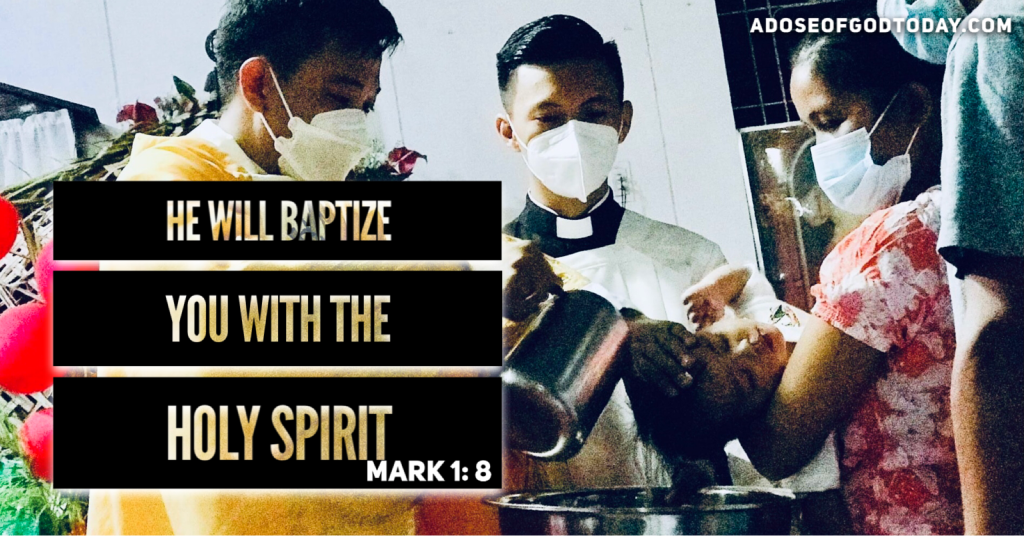
    This is what we also find in the Gospel of Mark. The baptism of Jesus was a revelation to us that Jesus is the servant spoken by Isaiah. The scenarios in the Gospel are also very important told to us in three actions.

    First is the “immersion of Jesus in the water” was an expression of complete confidence in the Father. The Psalm proclaimed to us that “the voice of the Lord is over the waters, the Lord, over the vast waters.”  Here, Jesus allowed the power of His Father to embrace him.

    The second action is the “Spirit descending like a dove.” This is the very presence of God allowing our eyes to behold where it rests. The Spirit of God is in Jesus, the Lord who is among us. This tells us of the presence of God not just above us, but here among us.

    The third action is the voice heard coming from heaven saying, “You are my beloved Son, with you I am well pleased.” This has been proclaimed also by Isaiah.

    Indeed, this feast of the Baptism of the Lord tells us something important about our own baptism which we share in Jesus. This is where we also find the “more” in our faith. The “more” in our faith asks us not to be passive-believers but to be active-believers. The “more” in our faith tells us now of four points. These are invitations that you can bring with you today.

    • First, we are all loved. Never forget that.
    • Second, God’s presence is among us. We do not have to look above and seek God’s presence in the clouds. Look around also. God’s Spirit rests here among us.
    • Third, our baptism compels us to bring justice and peace. Isaiah reminds  us that this will be realized not through violence and force but through compassion and gentleness of our presence.
    • Fourth, to bring justice and peace is to also participate in the ministry of Jesus. This ministry is to open the eyes including our eyes blinded by greed, anger and indifference. And to free our hearts imprisoned by hatred, sin and guilt.

    Thus, the “more” in our faith is to make Jesus more present in our actions and words, and more present in our hearts, homes and communities. Hinaut pa.


    [1] See his article in https://www.rappler.com/voices/thought-leaders/analysis-are-filipinos-more-religious-because-covid-19