Tag: Jesus

  • IDKU

    IDKU

    August 24, 2025 – 21st Sunday in Ordinary Time

    Click here for the readings (https://bible.usccb.org/bible/readings/082425.cfm)

    In her dreams, a lady once found herself at the heaven’s door. She confidently knocks at the door and demands admittance. And she heard God’s loud voice asking, “who are you?” She then replied, “My Gosh, You don’t know me. I am the most influential person in our town. I am the mother of our town’s mayor. I have been known for my generosity, an elder of the church’s lay organization and have sponsored the education of your seminarians and ordination of your priests. I even spearheaded the construction of your church in our town”. God replied, “Sorry, IDKU – I don’t know you”. Angry and disgusted with God, she just stayed outside, grumbling at the doorsteps, while seeing others being admitted inside.

    Coming to her senses, she once again knocks at the door and requests for admittance. She said, “Lord, actually, my life has been a failure. I am separated from my husband. My children have been involved with a lot of questionable activities. I have been an oppressive landlord, abusive lady and known gambler. I am a sinner and have caused other’s to sin. I am sorry, Lord”. God replied, “But still, IDKU, who are you?”

    Confused and ashamed of herself, she again stayed outside and pondered who she really is before God. Then something dawned in her that made her stand, knocks at the door and humbly admits “Now I know who I am, Lord. Despite what happened to me in life, I am still your CHILD.” The door then opened widely and God’s voice joyfully proclaimed “Welcome Home, my daughter. Come in.”

    Along our desire to explore our world & to experience life, there is always a deep longing for us to be at home, and be reunited with God. Even for those who have already settled in foreign lands, there is always the strong desire to come back Home. Same way with those who have settled here in Cebu, there is always a desire to go back homeland – Bohol, Siquijor, Luzon, Mindanao or Europe. Because, for us, home is more than place where you live.

    Home is the place where it feels right to walk around without shoes – where people understand you, who gets you as you are. Home is where when you go there, people have to take you in… regardless. Home is where you are accepted, understood, welcomed, belonged and loved.

    Jesus has always preached to us the Kingdom of God is our heavenly home and the Reign of God’s Kingdom is like homecoming and reunion. Like a fiesta, salvation is the moment where everyone is joyfully welcome and celebrating in God’s kingdom – an occasion where we are at Home and re-united with God.

    Particularly in our gospel today, when asked about who are saved, Jesus emphasizes that salvation is not only for the few but for everyone – everyone then is welcome in God’s kingdom.

    However, in our journey back to our heavenly home, Jesus directs us to strive and be strong enough to enter through the narrow gate. What Jesus meant here is that in life, we must do our best to be more at ease and at Home with our identity as God’s children. For Him, welcomed, saved and redeemed are those who are at Home with their identity as a Child of God. Meaning, it is not what we have done and achieved in life, or even what happened to us in life, but who we are before God, as His children that matters most.

    Welcome and Worthy then are we of eternal life in God’s kingdom when we are strong and discipline enough to accept and be at Home with our identity as God’s Children.

    Remember what Jesus said: “the last will be first, first will be last”. Meaning,  somehow those we consider to be first in life maybe the last one to realize and accept their identity; and those we consider to be last, lost, least in life maybe the first one to realize and accept their identity as Children of God.

    Question is: “who are you now before God?” Does God happens to know you? And do you know yourself before God? Are you hearing Him saying to you, IDKU (I Don’t Know You) or Welcome Home my, child?

    Henri Nouwen, a modern-day spiritual writer said it well, when he reminded us: “We are not what we do… we are not what we have… we are not what others think of us. Coming Home is claiming the Truth (that) You & I (We) are the BELOVED CHILD of God, our Creator.”

  • Dialogue for Peace

    Dialogue for Peace

    A Reflection by Joahna Via Grace Saurez.

    Whenever I went home to my hometown my neighbors would question me where do I study. Their face would be full of shock and horror right after I respond to them. It is because a shy and fragile lady like me would want to stay in a place where danger is imminent. Then, later I would answer, “Public man gud. Tapos, naa pud didto akong program na gusto. (It is a public university, and my wanted program is offered there also)”.

    I am currently studying in Mindanao State University – Marawi Campus. This is located in the only Islamic City in the Philippines where “violence is well-known,” as people outside would say.

    Joahna Via Grace Suarez is an active Youth Leader of the Catholic Student Organization at the Blessed Virgin Mary Chaplaincy, MSU-Marawi.

    Just like them, I also am curious as to why of all universities, I was brought here. Yet, I realized that it was God all along who has called me to be here. God brought me to a Christian community that envisions a reconciling presence among my Muslim brothers and sisters. Without me realizing it, God already sent me a sign a long time ago.

    It was when I was invited to be one of the speakers in a Life and Spirit Seminar in Awao, Monkayo. Before the said event, while I was praying and asking for guidance for my upcoming talk, God answered me by filling me with His love. Considering that that is my first ever experience, I don’t know how can I handle it. It seems new. Later, He sent me an explanation – He wants me to spread His love. I thought that that message is only for that particular moment. Now, I realized, it is for a lifetime.

    Fast forward, last May, our chaplain invited me to this Summer Course on Muslim-Christian Dialogue in Zamboanga City. As a lady who does not want to spend her summer doing the same routine, and does not want to waste the opportunity of acquiring new knowledge, with God’s grace, I was able to join him.

    Honestly speaking, I was not really hopeful of the vision and mission of the course, considering that everyday I am seeing why Muslims and Christians specifically will not have reconciliation. Knowing the recent bombing in Dimaporo Gymnasium in MSU-Marawi last December 3, 2023 where there were a lot of casualties while we were having our Sunday Mass. Other than that, there is always this adjustment in our part as Christians because we are a minority. Furthermore, I often see us doing the effort for interfaith dialogue, while the other party seems indifferent. Witnessing those, made me conclude that it is really impossible. Peace is impossible.

    So, I carry this desire for dialogue to be truly present, not only as a goal in the paper. Thankfully, the Silsilah Dialogue Movement made me see it.

    They made me understand what dialogue truly meant. Dialogue is a two-way process and does not mean compromising, rather, an enrichment of one’s faith. Dialogue does not mean conversion, but growth. And this movement does not meant uniformity, but unity amidst diversity.

    The Summer Course made me understand the religion Islam, because as what Rev. Benson said, “You cannot embrace the other if you are ignorant”. By filling our misconceptions and judgments, I am able to understand them. At the same time, our Muslim brothers and sisters were able to understand our faith through the sessions. It is very wonderful to experience and see the presence of Jesus in them.

    Through the smiles, jokes, and charity, I am able to erase my bad experiences with some of them. It led me to a realization that I should not generalize people based from my experience. Even though, I have more bad experiences with the other party, does not mean all of them are the same. There are still people who’ll welcome you with their smiles, empathize with you when you’re feeling down, joke around to cheer you up, and give you their spare of dessert because they know you wanted it so much.

    I thought that I will be forever surrounded with people that will only pollute the mind of this shy and fragile lady, but thanks be to God because He made me see that there are those who are willing to purify it. Right there and then I realized, I am only looking at a place where the unwanted attitudes are dominant. I forgot to look at the other side, where goodness prevails.

    My encounter with them made me remember the good times with my Muslim classmates. It made me remember that my classmates are also an exception. It made me realize that other’s fault is not their fault because according to them, Islam is a religion of peace, and doing otherwise is not in accordance with their teachings. The tragedy is not due to religion but because of the manipulations of the persons in power to find reasons to their inhumane act which is one that continuously embedding a scar to the humanity. 

    Yes, peace is impossible. But with a willing heart and trust, we can do it. In fact, it is already happening.

    Thanks to Fr. Sebastiano D’Ambra, PIME who opened the curtains and windows, to let me see hope. Through his experiences and words of encouragement, I was moved with deep courage to do the mission towards human fraternity.

    And if you’ll ask me that from hearsays I am hearing, and from all the bad things I see, why do I still continue? I mean from all the things we undergo, why we in the Prelature of St. Mary in Marawi still continue? Because God loves us so much, and He wants us still to share the love.

  • FAITH IN ACTION: MARIAN DEVOTION AND THE FORMATION OF MORAL COURAGE

    FAITH IN ACTION: MARIAN DEVOTION AND THE FORMATION OF MORAL COURAGE

    I have been tasked with responding to the three lectures delivered by our distinguished theologians and professors from the St. Alphonsus Theological Mission Institute (SATMI) in Davao City during today’s Theological Forum. I would like to express my heartfelt gratitude for the wisdom and insights they so generously shared with us.

             Reflection and Sharing: Courage as Defiant Hope in Context

    After listening to the profound insights shared by our esteemed speakers, my reflection seeks to offer a tangible and lived context to the three theological lectures. Rather than a linear summary, I present five short movements—each a facet of my journey as a woman, a Marian devotee, a counselor, and a believer shaped by illness and grace.

    1. Theological Grounding: Courage as Defiant Hope I begin with the lens of feminist theology, drawing from Rosemary Radford Ruether’s reflections on courage—not as mere resilience, but as defiant hope rooted in justice and compassion. As a woman navigating both ecclesial and academic spaces, I find her voice a necessary companion in interpreting courage beyond sentimentality.
    2. Personal Devotion and Formation: A Marian Journey My spiritual formation is inseparable from my devotion to Iloy sa Gihapon nga Panabang. This Marian path has been my compass, especially in moments of uncertainty. Her quiet strength and maternal presence have shaped my understanding of courage as surrender, not passivity.
    3. Faith in Action: Continuing the Mission Inspired by Fr. Victorino Cueto’s concept of debo(mis)yon, and deepened by Sir Neil John Capidos’ sharing, I reflect on how mission must transcend ritual. In my work as a guidance counselor and volunteer, I strive to embody a devotion that heals, accompanies, and liberates.
    4. A Test of Faith: Courage in Illness Illness has been both a crucible and a classroom. In my own journey through physical suffering, I have encountered courage not as triumph, but as trust. It is here that theology meets flesh—where hope becomes incarnate in weakness.
    5. Conclusion: A Courage That Accompanies Ultimately, courage is not a solitary virtue. It is communal, Marian, and missional. It walks with others, listens deeply, and dares to hope even when the path is unclear. This reflection is my humble offering—a testimony to the grace that sustains and the courage that defies despair.

    I. Theological Grounding:

    The reflections on courage by American feminist theologian Rosemary Radford Ruether offer a profound and timely meditation on the nature of moral strength in the face of adversity. Her characterization of courage as “the capacity and power of the will that makes a person strive for what is good” invites us to reconsider courage not as a mere act of boldness, but as a deeply ethical commitment—one sustained by hope and anchored in faith.

    Ruether’s framing of courage as a “defiant hope” resonates powerfully in contexts where individuals or communities face systemic injustice, marginalization, or spiritual trials. This hope is neither passive nor naïve; it is active, persevering, and relentless. It refuses to be extinguished by opposition, precisely because it is rooted in a vision of truth and justice that transcends immediate circumstances.

    What is particularly compelling is the paradox she presents: Christian courage as a form of power that emerges from the powerless. In a world that often equates power with control, status, or aggression, Ruether’s theology reminds us that true courage may arise from surrender—specifically, a surrendering trust in God. This trust does not diminish agency; rather, it transforms it. It empowers individuals to act not out of fear or pride, but out of a deep conviction that their actions are aligned with divine purpose.

    Moreover, the distinction between courage and rashness is crucial. Courage, as a virtue, is not impulsive or self-serving. It is tempered by discernment and guided by a moral compass. In this sense, courage becomes a spiritual discipline—one that requires humility, patience, and unwavering faith.

    As a licensed educator with specialization in guidance and counseling, and values education, and a registered guidance counselor, I find this understanding of courage especially meaningful. It affirms the quiet yet resolute strength of those who choose to stand for what is right, even when doing so is unpopular or difficult. It honors the courage of students who speak truth, of communities who resist oppression, and of individuals who remain faithful in the face of uncertainty.

    Ultimately, Ruether’s insights call us to embody a courage that is both prophetic and pastoral—a courage that speaks truth to power and nurtures hope in others. It is a courage that does not seek recognition, but seeks righteousness. And in doing so, it becomes a living testament to the transformative power of faith.

    II. Personal Devotion and Formation: A Marian Journey

    I would like to provide tangible context to the lectures of Rev. Fr. Edilberto Cepe, CSsR, Sir Neil John Capidos and Sir Danilo Agustin by highlighting my devotion to Our Mother of Perpetual Help—our (my personal) Iloy sa Gihapon nga Panabang—and how she has played a significant role in my personal and professional life.

    My late mother, a Grade 1 teacher and alumna of Iloilo Normal School (now West Visayas State University), introduced our family to the novena of Our Mother of Perpetual Help in the 1950s. From grade school, I memorized the novena and learned to pray the rosary. Every Wednesday, we recited the novena and sang its hymns—a tradition that continues to this day.

    It was providential that our UP High School graduation Mass was held at St. Clement’s Church, with Fr. Patrick Sugrue, CSsR, as presider. Mama Mary, ang aton Iloy sang Gihapon nga Panabang, became my refuge, my companion, my shock absorber, my mother who assures me that “this too shall pass” and “kaya ko ni”, just like my biological mother who loves me unconditionally, during difficult times at UP.

    After earning my BA Psychology degree at UP Visayas in Miag-ao in 1992, I was invited by a Redemptorist priest, Fr. Claro Conde, C.Ss.R. to join the Vocation Team. I served for 15 years—seven at St. Clement’s and eight at the Regional Vocation Office and St. Alphonsus Seminary in Cebu City. These experiences deepened my devotion to Mama Mary and allowed me to live simply and joyfully in mission areas like Kulaman, South Cotabato.

    These formative years shaped my character and values—what Sir Neil John refers to as the “ethics of being.” I agree with his assertion that a virtuous character grows from formation received from parents, mentors, and community, shaped by historical and cultural events, and most profoundly, permeated by divine grace.

    My journey with the Redemptorists exemplifies this. I owe much to my pious mother and conscientious father, whose example laid the foundation for a life of virtue. Remaining open to God’s grace has allowed me to experience His favor through Mama Mary’s intercession.

    III. Faith in Action: Continuing the Mission

    Even after resigning from the Redemptorists, I continued to serve. I worked at the University of San Agustin and at both the Pototan and Main Campuses of West Visayas State University, while remaining actively involved with the Redemptorists through various commissions and as co-founder of the St. Clement’s Pastoral Care and Counseling Ministry with Fr. Bong Puzon, C.Ss.R as our Spiritual Director.

    Why do I do this? In silent reflection, I realized that God was allowing me to continue serving the poor and emotionally burdened—without charge. This is my way of concretizing my faith in action, as Sir Danilo Agustin puts it. Despite my academic responsibilities, I travel from Guimbal to St. Clement’s every Sunday to volunteer as a counselor. I find joy in serving freely.

    In counseling, I witness how faith and spirituality help clients cope with life’s challenges. One woman shared how Mama Mary became an instrument of her healing. Many others attribute their recovery to divine intervention. I see myself simply as an instrument of God’s healing. The courage to be healed and the courage to embrace freedom—these, too, are gifts that faith teaches us.

    IV. A Test of Faith: Courage in Illness

    My faith was tested when I was diagnosed with multiple gynecological conditions: including Gravida Zero Abnormal Uterine Bleeding, Endometrial Polyp, Leiomyoma, Ovarian New Growth (Right), and a probable Serous Cystadenoma in November last year, leading to two surgeries. I underwent an ultrasound and CA 125 test for ovarian cancer. My colleagues called me courageous and strong, noting my peace despite the challenge. Though I sometimes feared for my life, I remained calm and hopeful.

    My solid foundation in faith never wavered. I saw the experience as sharing in God’s paschal mystery. Like Mary, I surrendered everything to a loving God, trusting without full understanding. I hoped for healing so I could continue serving—and true enough, I am recovering well.

    Two days after my discharge from St. Paul’s Hospital, I found myself reviewing the manuscript of six graduate students—each one a candidate for graduation. It felt miraculous, almost surreal, that I was not only able to complete the reviews but also attend their hooding and commencement ceremonies. My body was still healing, yet grace carried me.

    Two months after undergoing a Total Abdominal Hysterectomy with Bilateral Salpingo-Oophorectomy (TAHBSO), I was reinstated at work. Almost immediately, I was called to accompany a student diagnosed with major depression. Her journey was steeped in prayer and faith—an echo of my own. In our session last Tuesday, she spoke of renewed hope for recovery. Her words were not just therapeutic milestones; they were sacred affirmations of God’s intervention and the quiet power of accompaniment.

    In her courage, I saw my own. In her healing, I glimpsed the mercy that had sustained me. Illness, I’ve come to believe, is not only a test of faith—it is also a revelation of God’s fidelity.

    V. CONCLUSION

    My reactions and reflections are grounded in my devotion to Our Mother of Perpetual Help, in my faith and courage to trust in the goodness of God, and in my desire to be available and life-giving—in many ways—as an educator, a guidance counselor, and simply as a fellow human being with a heart and compassion for those who are burdened.

    I pray that in our desire to draw closer to Jesus, Mama Mary’s Son, we may be inspired by her example. Personally, I wish that she continues to shower me with her maternal protection, care, and love, so that I may remain a living witness to God’s faithfulness, manifested to us in the very person of Jesus, as Fr. Bert puts it.

    In the words of Fr. Bert Cepe, C.Ss.R: “Let us then entrust ourselves to Mary, the Mother of Hope and Witness of Faith, so that in our own lives we too may say with her: ‘The Almighty has done great things for me, and holy is His name.’”

    I would like to express my sincere gratitude to Fr. Julius Martin Malacas, C.Ss.R., for the opportunity to share my journey—my story. Truthfully, I felt hesitant at first (nahuya ako tani), but I have come to believe that faith must be loud when it speaks of grace. It must be shared, especially when it reveals how deeply blessed we are by God through the intercession of Iloy sang sa Gihapon nga Panabang. I owe it to the Redemptorists and to my parents—both educators—for sowing the seed of faith in me and nurturing it throughout my life.

    Thank you very much to each and everyone who has listened, accompanied, and prayed with me. May our courage continue to be defiant hope—for ourselves, for others, and for the mission entrusted to us.

  • GOD, our Parent

    GOD, our Parent

    July 27, 2025 – 17th Sunday in Ordinary Time

    Click here for the readings (https://bible.usccb.org/bible/readings/072725.cfm)

    We come to know God as creator. We believe that He creates and still creating everything in the world. We affirm that He creates and wills everything that happens and happening in life. But what kind of creator God is? How do we view and consider Him as our creator?

    Too often, God is regarded as a Builder God, who plans, schemes, designs, engineers, produces, reproduces, develops, improves and maintains all creatures and creation. In other words, he is a single-minded creator who straightforwardly constructs towards the achievement of His objectives and the realization of the finished-product. Meaning, if God say something will happen or will something to happen, it will happen no matter what. 

    While this idea have some basis in the Bible, it can be taken to extremes and lead to a fatalistic view of life like: “God is going to do what He is going to do and wills what going to happen ever since before, and until now and forever… regardless of what I do, what happens to us.”

    God however makes himself known to us differently. Through Jeremiah, He reveals himself to us as a different kind of creator. Instead of a builder, He identifies himself as a potter, who forms and shapes the clay to be a new emerging creation. This means that God is more like an artist in forming and creating us. As his creation, we are hand-crafted by God – “we are in His hand” created by and through his own very hands. We are also not finished-products but a work of art in progress.

    God works with circumstances as they emerge. He may intend to make a vase out of us. But events may cause God to make a cereal bowl instead, for now, and come in near future, a chinaware plate. But one thing for certain: He continually creates, forms and shapes us into more perfect persons that we can be, but patiently…. considering our circumstances and at our own pace.

    God then is more than just a builder, producer or author. As our Lord Jesus makes know to us, He is our formator, parent, mentor, or coach who patiently forms us to the best that we can be at this moment, and continually shapes and reshapes us to the best we will be. 

    In teaching us to pray the words of the “Lord’s prayers” Jesus is not only teaching us what to pray, but also what prayer is & how to pray. In praying the “Our Father” then, Jesus is telling us that prayer is about establishing a personal relationship with God than just behaving a formal etiquette before God. Addressing God properly as “Our father” emphasizes that God is not only our Lord, Creator, Master, above & beyond but above all God is our personal PARENT (Ama, Amahan, Father) whom we love & praise, and we trust & rely on of our human needs for sustenance, mercy & forgiveness & strength amidst the challenges of life.

    Furthermore, in our gospel today Jesus is teaching us that  like a child to a parent, praying  to God is all about our asking, searching, seeking & knocking doors towards a contact, conversation & communion with God. Meaning, to pray to God as Jesus teaches us, is our affectionate love expressions (our  “pamarayeg, lambing o paanga-anga”) with God, our Father. Like any parent, God knows already what we need & wants what is better (even best) for us His children. And all we have to do is to lovingly ask, knock, seek & search what is better for us from Him. And like any parent, God blesses us all His children, and surely God blesses mostly His grateful, loving, trusting & “pamarayegon” affectionate children.

    May we pray more than just out of our formal obligation or etiquette but towards having a personal loving pamarayeg with God, our Father now & always.

    So be it. Hinaut pa unta. Amen.

  • FAITH AND MY NYD JOURNEY

    FAITH AND MY NYD JOURNEY

    Faith is the quiet strength that carries us through life’s most uncertain moments. It is not simply a belief in something unseen, but a deep trust that no matter how unclear the path may be, we are not walking alone. There have been times in my life when doubts, fears, or hardships threatened to overshadow hope—but faith reminded me to keep moving forward.

    A Reflection by Vanezza L. Olivar

    What makes faith so powerful is that it does not require certainty. It asks only for willingness—a willingness to believe, to hope, and to endure. It does not promise a life without struggle, but it offers the courage to face challenges with grace and the resilience to rise again when we fall.

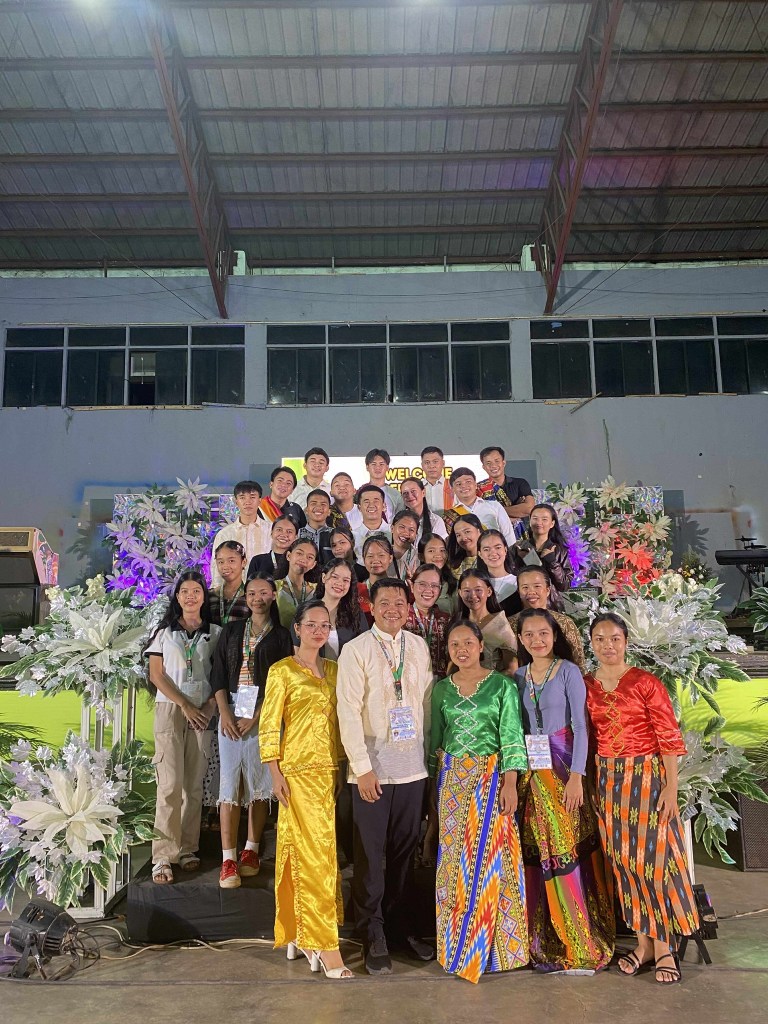
    Despite being the smallest delegation in the recent National Youth Day 2025, faith has been a source of peace. Whether through prayer, reflection, or simply trusting in a higher purpose, I have come to understand that faith is not about having all the answers. Faith in God is about finding strength even in the many questions. Faith leads to light that continues to shine, even when everything else feels dark. Faith does not remove life’s storms, but it anchors us through them. And that, I believe, is the greatest gift I have received.

    The journey of many young people during the National Youth Day 2025 in the Archdiocese of Caceres, was a unique and transformative chapter in life. It has become a time filled with discoveries, challenges, and growth. The opportunities given allowed us to explore who we are, what we believe in, and what we hope to become. Along the way, we encountered both triumphs and failures, each shaping our character and helping us understand the world around us.

    Being youth is often marked by energy and ambition, but it is also a time of confusion and vulnerability. There are moments that I too feel lost or unsure, questioning my own choices and direction. Yet, these very struggles are what built resilience and inspire wisdom. I realized, mistakes are not signs of weakness—they are powerful lessons that guide us toward maturity.

    As I reflect on the journey of being young during this NYD2025, I see it as a time of endless potentials. It is the foundation on which our dreams are built, relationships are formed, and values are developed. It is also a reminder that we are constantly evolving, and that it’s okay not to have everything figured out.

    Most importantly, the youth-journey is not meant to be walked alone. With the guidance of family, mentors, friends, and faith, we find the strength to face life’s uncertainties. As we grow older, we carry the lessons of our youth with us. These are lessons of courage, identity, and hope. In every step, whether forward or backward, there is purpose. And in every young heart, there is the promise of a bright and meaningful future.

    Despite not having the support from my parish, I made it. It’s with God’s guidance and grace. The NYD celebration was certainly not easy to many young pilgrims. But with God’s mercy, I also met individuals who made my prayers into reality. Many helped to heal my wounds of not having the support coming from my home parish.

    In the end, I’ve come to see this pain as part of my own growth. It reminded me of the importance of kindness, the strength in being gentle, and the power of choosing to speak with care. Though hurtful words can leave scars, they also teach us to be more thoughtful, compassionate, and strong.

    But all of those come from my faith and service . And so I end this reflection with this quote, “A heart touched by faith learns to rise after every fall, love after every loss, and believe after every doubt.” DIOS MABALOS! SHUKRAN.