
Tag: Jesus is Mercy

  • God’s Caress of Mercy and Friendship – Part 3

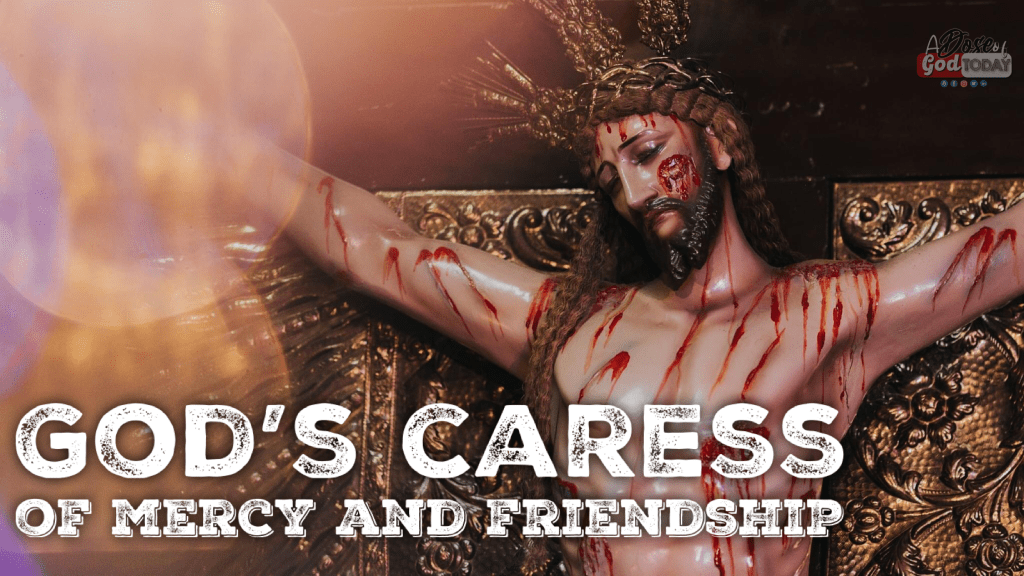
    God’s Caress of Mercy and Friendship – Part 3

    Allowing our God-Friend to caress us with Mercy

    A month before those lockdowns and enhanced community quarantines were imposed, in March of 2020, I was in Mactan-Cebu Airport waiting for my flight back to Davao. While I was sitting and scanning my Facebook wall, in front of me was a baby girl in the arms of her mother. After a while the baby started crying. It was quite annoying because the baby was too loud. But babies cry like that anyhow.

    However, what moved me so much was the response of the older brother who was about 5 or 6 years old. When his baby sister cried, he stopped playing the phone and moved closer to his mother. And then, he started caressing the face of his baby sister and hummed a song I cannot recognize. That caress must have brought comfort to his baby sister because few minutes later, she stopped crying and slept again.

    It moved me so much because that small gesture created an impact of gentleness and affection. To be able to touch in a form of a caress truly expresses gentleness and affection. It brings comfort, peace, restoration, healing, and also reconciliation to a heart that is wounded by failures, trauma, anger, hatred, and sin.

    Indeed, we are invited to allow the Lord to caress us with his mercy.

             Allow me now to read to you a story in the Gospel of Luke chapter 7 verses 12 to 15.

    As he drew near to the gate of the city,
    a man who had died was being carried out,
    the only son of his mother, and she was a widow.
    A large crowd from the city was with her.
    When the Lord saw her,
     he was moved with pity for her and said to her,
    “Do not weep.”
    He stepped forward and touched the coffin;
    at this the bearers halted, and he said,
    “Young man, I tell you, arise!”
    The dead man sat up and began to speak,
    and Jesus gave him to his mother.

    When you get a sprain on your ankle or any part of the body, what usually do you do with it? Is it not that you seek a massage/hilot for healing? When a child stumbles and gets hurt, a parent would console the child by caressing the painful part of the body, isn’t it? When lovers meet together, is it not that they automatically caress one another to show their affection? Among farmers, it is just natural and part of being a farmer to caress many times their livestock and plants. It is in touching them that a farmer makes a connection with his plants and animals. When we visit churches and pray before holy images, is it not that we also touch those sacred statues and images, hoping that our prayers will be granted?

    Moreover, there is certainly power of healing in touching. Yet, touching can also be a form of destruction especially when our touch involves malice and greed.

    Just like for example, when stalactites and stalagmites and other cave formations are being touched by human hands, there is a danger that their growth will be prevented or will be damaged in a split of a second by a simple touch. When touched by many, the oil and dirt in our hands could also turn these white deposits of calcium carbonate into black and destroy their process and formation which were formed for thousands or millions of years.

    When forests are also touched by greedy human hands, our natural resources are depleted and destroyed and could even bring destruction to us and even to unimaginable destruction. This is also true when our government projects, local and national budgets are under the hands of greedy and corrupt officials, then, we get poor infrastructures, poor services, swelling government debts that tax payers will pay, and troubling inflation of basic commodities.

    Additionally, when a husband becomes manipulative and controlling over his wife and children, his touch also becomes destructive and abusive. His caress becomes punches and hurtful words towards the people around him. Or when a wife and mother turned to be self-centered, her caress will also become indifferent, her actions become brutal and words become damaging to the self-image of growing children.

    Certainly, a touch can bring healing and life or it could also bring destruction, pain and death. As Christians, what we are called is to touch others with the intention to bring healing, freedom and life. And we can only do that when our touch is in a form of a caress as God our friend caresses us with mercy. Yet, we can also only caress with mercy when we allow God our friend to caress us and “caress the wounds of our sins[1]” with mercy.

    In fact, the Gospel story that we have read from Luke, tells us of Jesus who witnessed a funeral procession of a young man. This event is actually pregnant with invitations where we shall see how the Lord has come to meet us in order to touch us with mercy and his liberating friendship.

    So, allow me once again to bring you step by step, deeper into this story.

    First, Jesus was coming in to the city while the funeral was going out of the city. This tells us that at the city gate Jesus met this funeral procession. And it was an encounter, a meeting between life and death, of Jesus, the mother and her dead son in a coffin carried by people.

    This tells us too that the Lord, certainly, meets us in a surprising way even when we think and believed there was no hope for us anymore for healing, for freedom and for being happy.

    When suffering and death overwhelm us, in an amazing way, the Lord would surely come to us to give us hope. Even when other people around us would think and believe that we are beyond healing and beyond hope, but the Lord always sees hope in each of us. This was the reason why, Jesus stopped this procession, then he dared and cared to interrupt the people carrying the coffin to its resting place.

    Yes, Jesus dared and cared to interrupt in order to meet us. Believe in that! This is what Jesus is telling us in this first part of this story.

    Second, Jesus saw her! The Lord saw the mother. The mother was inconsolable. She was grieving for her only son. Losing him meant an end of her life too. At that time, a woman had no value in a male-dominated society. A woman cannot live alone by herself. She was already a widow. For that woman to survive she needed her son. Yet, her only protector, strength, and hope was taken away from her.

    With this situation, Jesus was moved with pity. In other Bible translations, it says, “And Jesus had compassion for her.” Jesus felt the helplessness of the mother. He felt her pain of losing a son and of losing her life. For Jesus it was just so unfair. Jesus felt pity also of the young boy for being deprived from the many opportunities that his youth can offer, and that is, to grow, to enjoy life, to meet people, to give life to others, to fulfill his dreams and hopes. And so, in compassion, Jesus told her, “Do not weep.” And this was a promise of joy. It is God’s commitment to life, in order to bring joy.

    Third, the encounter of Jesus with this difficult situation moved him to touch them, to touch their lives. The Gospel tells us that Jesus stepped forward, without hesitation and touched the coffin of the boy and told him, “Young man, I say to you, arise!

    The young man woke up and rose up to the astonishment of the people. Jesus brought the boy back to life and also brought back life to the mother. The touch of Jesus was very symbolic here. Touching the coffin of the dead boy, made Jesus ever connected with the suffering of the people and at the same time he brought hope and life to them. The touch of Jesus surely brought hope and restored the life of that boy and of her mother. His touch was a caress that turned the bitter and painful day into joy and comfort.

    What is more interesting here was how Jesus touched. The Lord actually only touched the coffin and not the body of the boy. The coffin is the image of what limits, prevents and suppresses life. The coffin is after all, a box that hides what is inside. And Jesus touched that coffin, he gave freedom, joy and new life.

    To each of us too, Jesus feels the pain when we are in pain. When we are losing our desire to live, losing our dreams and hopes, losing our optimism and enthusiasm, losing our desire to love and to forgive, to be kind and generous, then, we are certainly trapped in a coffin.

    Yes, we might not be fully aware this time or we might be pretending as if nothing is wrong with us but we too might be already in a coffin because people around us have put us in a box, or we could have put and limit ourselves too in a box.

    Thus, this box or coffin could be our own addictions and unhealthy compulsions and coping. We could be confined within the coffin of anger and hatred, of depression and loneliness, of guilt and shame, of pretensions and self-righteousness. We could also be imprisoned within a coffin of scrupulosity, of corruption and manipulation, of dishonesty and oppression. We could also be in a coffin of pride and arrogance or lying within the coffin of our emotional pain and trauma from abuse, fear and anxiety.

    My friends, the Lord desires our freedom, our joy and peace and the fullness of life for us, thus, Jesus invites us to allow him to touch us, to caress us with his mercy and friendship.

    Again Pope Francis says, the Mercy of God is great, the mercy of Jesus is great; they forgive us by caressing us.[2]

    In this way, hopefully we too will be able to welcome the invitations of Jesus, to ARISE and to GO IN PEACE!

    PRAYER

             God of Mercy and Friendship, you never cease to bring your loving and tender caress into the world. I ask you now, Lord God, to caress my heart and soul once again, that I may also be filled with life, healing and freedom. Grant me also the faith and courage to caress and touch others with mercy and friendship so that I too may bring life and healing to my brothers and sisters. Amen.


    [1] Ibid, xiii.

    [2] Ibid, xvii.
  • God’s Caress of Mercy and Friendship – Part 1

    God’s Caress of Mercy and Friendship – Part 1

    (This is the talk given during the Holy Week Reflection on Holy Monday, April 3, 2023 delivered at St. Clement’s Church, Iloilo City.)

    Are we being punished? Are we being condemned because of our sins? Has God abandoned us? Has God given up on us?

    When Covid-19 hit us in 2020, we were all afraid and anxious. The world seemed to stop, and the many restrictions of our movements contributed so much to our feeling of being isolated and helpless. With this health crisis, economically or financially, we were being challenged in many ways. Many have lost their jobs and the most vulnerable among us were those who worked and earned on a daily basis and the poorest of the poor, the homeless and street children.

    Likewise, every day many were haunted by anxiety of being infected by the deadly virus, or we might have been so worried for those family members and friends who were at the frontline fighting against the virus and ministering the infected. Or we might have been sobbing and grieving in those days because we have lost a family member, a close friend, or a colleague because of the virus.

    In total, there are about 761,071,062 cases worldwide of covid infections,[1] and a total of 6,879,644 deaths worldwide as of March 26, 2023. (Last Update)

    On February 24, 2022, Russia invaded Ukraine and this war brought economic challenges worldwide especially of the inflation of oil which affected us here in the country. This war continues until now which already affected 14 Million people being displaced[2] , with 140,000 infrastructures destroyed, with 15,000 people missing and 42,295 deaths.

    Just last February 6, this year, a 7.8 magnitude of earthquake struck southern and central Turkey as well as the northern and western Syria which affected 24 million people[3], 2.5 million displaced persons and 56,00 deaths.

    At the local level, at least in this post-pandemic time, no natural disaster has greatly affected the whole country except Odette in 2021 or any war that has ravaged the country. Yet, what is alarming, aside from the inflation of commodities is the rise of poverty level in the country. According to the recent DSWD Listahan 3, that survey found out that there are 5.6 million Filipino Families living in poverty.[4] In terms of individual persons, there are 2 in every 5 Filipinos who are poor. This is equivalent to 30 million poor Filipinos which is 27% of the 111 million population.

    These are just some figures and images of suffering in the world and beyond these, there are more pain, suffering, and deaths unknown to us, not covered by statistics or by many news media. There are many who suffer in silence.

    Thus, we ask again, are we being punished? Are we being condemned because of our sins? Has God abandoned us? Has God given up on us?

    Talk 1

             God’s Caress of Mercy and Friendship. This is the over-all theme that I would like to share with you tonight. We understand “caress” as an action that expresses, closeness, affection, love, concern and gentleness.

             As Pope Francis said in one of his homilies, “God forgives not with a decree but with a caress.” And with mercy, “Jesus too goes beyond the law and forgives by caressing the wounds of our sins.[5]

    Mercy has touched the Pope so much that he led us into the Jubilee Year of Mercy in 2015-2016. Thus, Pope Francis affirmed that “mercy is God’s identity card[6].” Indeed, Mercy is the name of God.

             Again, Pope Francis in his Apostolic Exhortation called, Christus Vivit  addressed to the Young People and to the Entire People of God, he wrote, “Friendship is one of life’s gifts and a grace from God. Through our friends, the Lord refines us and leads us to maturity.[7] This is how friendship that we have developed helps us to grow and become the person God wants us to be.

             Moreover, an author, Fr. Ronald Rolheiser, OMI, wrote a section of his book with its title, Friendship is Liberating Too, that, “Friendship can save us. Loving, challenging friends who can melt our bitterness and free us from the need to be angry are as critical within the spiritual life… To neglect friendship is to court bitterness and perversion.[8]

             This explains to us how friendship also plays a role in making ourselves free, free from anger and hatred, from bitterness and corruption that will only bring us into isolation and sadness.

             Hence, as I journey with you tonight, let us refresh our hearts and minds with scriptural texts that would bring deeper into God’s caress of mercy and friendship.

             I would like to invite you now to the story of Jonah.

    Jonah 1:1-3

    The word of the LORD came to Jonah, son of Amittai:

    Set out for the great city of Nineveh, and preach against it; for their wickedness has come before me.

    But Jonah made ready to flee to Tarshish, away from the LORD. He went down to Joppa, found a ship going to Tarshish, paid the fare, and went down in it to go with them to Tarshish, away from the LORD.

    Jonah was quite rebellious to God because he was sent by God to do something, which he did not want to do.  If you remember, Jonah did not like this assignment to go to Nineveh because he hated the people. They were Assyrians, the traditional enemies of Israel who oppressed and attacked them. These Assyrians were known to be brutal invaders.

    That is why, Jonah was so against God’s plan of sending him there to call them for repentance. Jonah was anxious that the people might believe in God and thus, God might show mercy to them and spare them from death.  Jonah wanted this people to die. He wanted revenge against these people whom he thought were Godless. This was all because he was angry and he disgusted those people.

    Yet, this is what really happened. When Jonah called the people to repent, they repented and believed in God and that was why, God showed mercy to them and saved them from death.

    Jonah’s attitude may not be far from many of us who cultivate a narrow and vindictive mentality.[9] Like Jonah we too might have asked God, How could you love worthless, good for nothing people Lord? How could you show mercy to those who do not even recognize you as God? How could I also be merciful to them when they oppressed my people?

    We might also find ourselves wishing suffering and death to those whom we hate, especially those who have caused us so much pain. We might have wished and cursed those people who did something terrible to others too. When a violence and or a crime is done to an innocent, we might have demanded also the same violence and crime to perpetrators. Like Jonah, we too might have believed that justice is attained through a gruesome death to our enemies. Like Jonah, we also could tend to believe that God should not show mercy to those who have hurt us, to our enemies and people who did terrible things to the innocent.

    Yet, with Jonah, the people of Nineveh and God, there is something very interesting here. Jonah was totally honest to God about his thought and feelings against Nineveh. Jonah was comfortable enough to complain to God, to express his dismay and anger over this people. Jonah even tried to escape from God and argue with the Lord. And the Lord God, listened to him, the Lord God accompanied Jonah and allowed Jonah to grow and become mature as a person and as a prophet by being able to recognize his own limitations and biases against others. The Lord challenged Jonah to see beyond himself, beyond his pain and frustrations and to recognize that God’s mercy and friendship are for all.

    Now, this exchange between Jonah and God expressed closeness and intimacy and that is evident in Jonah’s confidence to express himself before God. Is it not friendship at all? It is! Jonah was a friend of God. God is Jonah’s closest friend. And it is in this friendship that Jonah was called, challenged and was transformed. In a way, Jonah was the first to receive that caress of mercy and friendship with God which the Lord wanted Jonah to share with the people of Nineveh.

    This helps me to realize now that God’s mercy and friendship are not limited to any group of people. God is a God of everybody, of bad and good people, of sinners and righteous, of criminals and law-abiding citizens.

    God showed this concretely to us in the person of Jesus, the ultimate sign of God’s mercy and friendship with us. Pope Francis reminds us, “Friendship is so important that Jesus calls himself a friend: ‘I do not call you servants any longer, but I call you friends.’(Jn 15.15)[10]” Thus, in Jesus, the Father tells us that we are never abandoned, that there is always hope and goodness in each of us no matter how broken we are, and sinful we have turned to be. God always sees goodness in us, because we too are God’s friends.

    This is the same invitation that we have heard from Jesus when he addressed the adulterous woman brought by the scribes and Pharisees. Like Jonah at the beginning, the scribes and the Pharisees were filled with so much hatred and anger. This made them to become condemning towards the woman. With this attitude, they refused to give another chance and opportunity for the woman to change and to redeem herself.

             Thus, they wanted to stone her to death as what “the law” told them to do. But what did Jesus do? Listen now to the Gospel of John chapter 8, verses 7 to 11.

             John 8:7-11

    But when they continued asking him, he straightened up and said to them, “Let the one among you who is without sin be the first to throw a stone at her.”

    Again he bent down and wrote on the ground.

    And in response, they went away one by one, beginning with the elders. So he was left alone with the woman before him.

    Then Jesus straightened up and said to her, “Woman, where are they? Has no one condemned you?”

    She replied, “No one, sir.” Then Jesus said, “Neither do I condemn you. Go, and from now on do not sin anymore.”

    This is what Jesus showed to the woman. Jesus said, “I do not condemn you. Go and sin no more.” God has delivered his judgment, showed His mercy and offered friendship. Jesus freed the woman and was commanded to sin no more and not to go back to her old sinful self. She had, surely, found her way to freedom and peace in Jesus.

    Pope Francis in his homily on this Gospel story said, “Jesus forgives. But here, there is something more than forgiveness because Jesus goes beyond the law. Though Jesus was pure and the only person who is worthy to cast the first stone against the woman, but Jesus did not because he showed mercy.[11]

    Mercy, as the Pope says, is difficult to understand. “Mercy does not erase sins. It is God’s forgiveness that erases our sins. But then, mercy is the way in which God forgives.[12]

    Thus, unlike the scribes and Pharisees, Jesus saw more in the person of that woman. The limited awareness and refusal of the Scribes and Pharisees to see more, prevented them to discover that there was always hope in every sinner, and that there was more in a person’s weakness and imperfection. This is how Jesus defends us, sinners from the just condemnation of death.[13] Again, (because) God always sees goodness in us and offers us his friendship that we may be renewed and find peace in his presence.

    PRAYER

             God of Mercy and Friendship, I am confident that it is not your desire to punish and bring us to condemnation, but to caress us with your love. Allow my heart to be ever closer to you, to grow in faith and affection towards you. As you see goodness in me, let me also see the goodness in others that I may learn to caress with mercy and friendship. Amen.


    [1] https://news.google.com/covid19/map?hl=en-PH&mid=%2Fm%2F02j71&gl=PH&ceid=PH%3Aen

    [2] https://www.google.com.ph/search?q=war+in+ukraine

    [3]https://www.google.com.ph/search?q=earthquake+in+turkey+and+syria

    [4] https://www.rappler.com/nation/filipino-families-living-in-poverty-2022-dswd/#:~:text=Sign%20in%20to%20listen%20to%20groundbreaking%20journalism.&text=MANILA%2C%20Philippines%20%E2%80%93%20There%20are%20over,Welfare%20and%20Development%20(DSWD).

    [5] Pope Francis, The Name of God is Mercy: A Conversation with Andrea Tornielli, translated by Oonagh Stransky (New York: Random House, 2006), xii-xiii.

    [6] Ibid, 9.

    [7] Pope Francis, Christus Vivit: Post-Synodal Apostolic Exhortation of the Holy Father Francis to Young People and to the Entire People of God (Philippines: Paulines, 2019), n. 151, 64.

    [8] Ronald Rolheiser, OMI., “Friendship is Liberating Too,” in Forgotten Among the Lilies: Learning to Love Beyond Our Fears (USA: Doubleday, 2005), 34-35.

    [9] Jonah, Introduction, The New American Bible.

    [10] Pope Francis, Christus Vivit, n. 153, 65.

    [11] Jonah, Introduction, The New American Bible, xvi.

    [12] Ibid.

    [13] Ibid.