Tag: Hunger

  • OUR DEEPEST HUNGER IN LIFE

    OUR DEEPEST HUNGER IN LIFE

    August 1, 20210 – 18th Sunday in Ordinary Time

    Click here for the readings (https://bible.usccb.org/bible/readings/080121.cfm)

    To feel hungry is a basic human experience. Thus, I am sure each of us has experienced that feeling of being hungry since we were babies. Babies especially would always cry when they are hungry. A parent’s automatic response to a crying baby is to feed the baby with milk. When the baby starts sucking, the baby also stops from crying. When we become adults, we continue such behavior though we do not cry anymore but feed ourselves with food that can satisfy our hunger.

    This human behavior in us is what we have heard in our readings this Sunday. The Book of Exodus told us the story of the Israelites. Since they fled from Egypt, their life was always uncertain. They were in the middle of the desert where there was no place to plant and cultivate something for their food nor a place to buy their supplies. The people became weary because of their difficult situation until they grew hungry. Moses who led and brought them out of Egypt had almost became a father to them. To him, the people cried out their needs. They cried and grumbled to Moses to provide them food because they were hungry. The Lord, in his goodness, sent food to the desert so that they will be satisfied.

    Our Gospel tells us of the same behavior. The people were in search of Jesus because they wanted Jesus to satisfy their hunger. They followed him after he did a miracle in feeding the five thousand people. The people recognized that Jesus will satisfy their needs. This became an opportunity for Jesus to teach them an important lesson.

    Jesus knew that the people were after him because of their hunger. However, the people were only concerned of an immediate satisfaction. They were limited in that satisfaction of a physical hunger. Thus, they were looking for Jesus to satisfy them immediately. In a way, they have become obsessed or fixated to what Jesus can provide to them. They were after the miracles of Jesus but not in the person of Jesus.

    Jesus understood them. Thus, he reminded them to seek the bread that gives eternal life and not the bread that perishes. This means that the people were invited to seek not those things that only provide instant and immediate satisfaction but the person of Jesus himself.

    This reminds me that we are not different from those people in the Bible. How many times have we sought to satisfy immediately our different forms of hunger? Jesus is not just talking about our physical hunger. Jesus points to us today to recognize our human hungers for acceptance, for recognition, for friendship, for love and intimacy, for justice, for peace and reconciliation.

    We cry out these many forms of hungers just like the Israelites in the Book of Exodus and in the Gospel. We tend to satisfy those longings and hungers immediately. Hence, instead of looking for what is essential and lasting, we resort to the promises of “instant satisfaction” and to an “immediate result.”

    Their consequences will surely be destructive, unhelpful and the corruption of life. Addictions such as in alcohol, drugs, sex or food are ways to satisfy our deepest hunger. Yet, because they only promise an instant gratification and so we hold on to those addictions to numb our hunger for love, for attention and intimacy. Our obsessive fixations in spending too much time in social media, or online games or with gadgets, remove us from the true and personal encounter with people. Because of the lack of human connection, we divert our need into what is temporary, virtual and not real. Our compulsive behaviors in gossiping, in defaming people and in finding the faults and weaknesses of others seemingly give us the image of a good person, righteous than others. However, these behaviors only blind us of our true longing to be recognized and be appreciated.

    Our obsession to be powerful, to exercise dominance and control over the weak and to resort to violent and aggressive actions apparently make us confident, independent and strong. However, they too blind us from that hunger to find our true self and our true potentials.

    Jesus invites us today to recognize our deepest hungers. Just like the Jews in the Gospel, Jesus reminds us today also not to seek to what is only perishable, and to what is only instant and temporary. Because these things will only lead us to addictions, unhealthy fixations and compulsive behaviors that do not give us life but rather death and hopelessness.

    Jesus invites us to recognize him, that is, to recognize God, His love and friendship with us as our food that will satisfy our hunger. He is the bread that gives us life. This Eucharist is the gift and our food that should satisfy our deepest human hunger. That is why, this Eucharist is more than what we think. This is not simply prayers and readings, standing and kneeling, singing and saying amen. This Eucharist is our very relationship with God and with one another. This is all about us and God, you and me and Jesus.

    I would like to invite you then, so that we will be able to make this Eucharist truly life-giving; ask the Lord to help us recognize our different hungers. Be mindful of our compulsive actions, fixations and some forms of addictions because those behaviors in us will tell us of our own hungers and needs. When we become conscious of those, hopefully, it will lead us to seek to what will last, to what is more essential in our relationships and to what will truly satisfy us. And above all, may we find Jesus and his love. Hinaut pa.

  • SMALL ACTS OF KINDNESS MATTER

    SMALL ACTS OF KINDNESS MATTER

    July 25, 2021 – 17th Sunday in Ordinary Time

    Click here for the readings (https://bible.usccb.org/bible/readings/072521.cfm)

    The total population of the world is now at 7.9 billion and The State of Food Security and Nutrition in the World estimated that there are about 811 million people in the world who went hungry in 2020.[1] Out of that number, the 418 million hungry people are found in Asia. The report also projected that around 660 million will still suffer hunger in 2030 because of the lasting effects of Covid-19 Pandemic on global food security. Moreover, there are about 9 million people die of hunger and hunger-related diseases.[2] And in every 10 seconds, a child dies because of hunger. This is the cause of the 3.1 million deaths of children around the globe every year.

    Here in the Philippines, the recent SWS survey revealed that there are about 4.2 million Filipino families suffering from hunger.[3] And Mindanao has the highest rate of incidence of hunger with 1.2 million families.

    With these statistics available to us, there is a need that we become aware of the suffering that our brothers and sisters are enduring because of hunger. We cannot be blind and indifferent to this need. In fact, our readings this Sunday would actually help us to be more conscious of such hunger and of other forms of hunger around us.

    The first reading from the Second Book of Kings proclaimed to us how a nameless man from Baal-Shalishah brought food to Prophet Elisha. People were starving and they needed food. This was the reason that the man offered his food to the hungry men of God. However, Elisha’s servant knew that that food was not enough for them all. This was the reason why the servant objected Elisha when he demanded that the food must be distributed. But then, there was something Prophet Elisha saw that the servant did not recognize at that moment. Prophet Elisha believed that no matter how little they have, that will be enough for God to work wonders. Certainly, when the food was generously given to the people, they were surprised because there were left overs. The little food that they have shall be multiplied by the Lord. This was what the Prophet believed.

    The confidence in God’s providence and complete trust in God’s power to sustain and provide for His people, manifested also in the Gospel this Sunday. The Gospel of John told us that Jesus was aware of the needs of the people. The Lord was not just conscious of the spiritual hunger of the people but also their physical hunger. This awareness in Jesus moved him to ask Phillip, “Where can we buy enough food for them to eat?”

    Jesus did not just see the hunger of the people. Jesus also felt their hunger. This urged Jesus to do something. However, Jesus needed the participation of people around him. Phillip, just like the servant of Prophet Elisha, could not think of anything since they did not have enough money to buy food for all. Just like the servant of the Prophet, Phillip seemed to be too calculated in his response to the words of Jesus and thus of his response to the needs of the people. Yet, this prevented him only to fully participate in Jesus’ saving action at that moment.

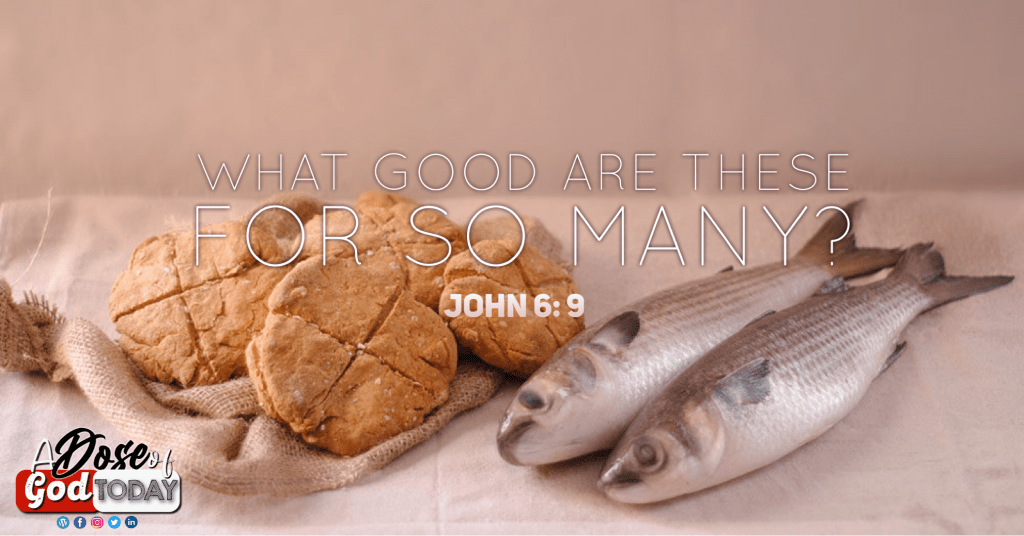
    It was Andrew who brought to Jesus a boy who had five barley loaves and two fish. The appearance of the boy in the story was actually very symbolic. He was nameless and faceless and was just a boy with small food. Yet, that nameless and faceless boy must have volunteered and gave generously his food to Jesus.

    With the boy’s willingness and generosity, his small share became the perfect offering that Jesus needed so that the people will be fed. It was through that boy who had five loaves and two fish that Jesus did something and made everyone to wonder.

    The first reading and the Gospel seemed to have a common ground. There was the small share from a man  who came from Baal-Shalishah and the loaves and fish from the boy. The little things that they had were transformed into many. The small share that they gave became abundant.

    This is where we find God’s invitation for us today as we have also become aware of the pressing hunger in our communities. We are invited by Jesus to offer sincerely the little that we have. We might be thinking that the world’s problem on hunger is too big for us to respond and our share will only be insignificant. Then, having such pessimistic view and calculated in our generosity will only prevent us from participating in God’s saving action, like the servant of Elisha and Phillip. But let us remember, the twenty barley loaves and fresh grain of the man were insignificant to a hundred men and even the five loaves and two fish of that nameless boy were nothing compared to the five thousand men. However, the man did not keep away his food and the boy did not run away to hide what he had, rather, both of them offered generously what they had no matter how small or insignificant those were. Indeed, this tells us that small acts of kindness matter in the presence of the Lord.

    The action of the man as well of the nameless boy were symbols of our vulnerabilities and weaknesses, of our anxieties and fears of having not enough but at the same time the power behind a generous action. To give away the little that we have, makes us insecure, yet, it is actually through the little that we possess that the Lord works wonderfully. When we give something and then we feel vulnerable because that was all we have, no matter how small, is actually the fruit of our generosity. Remember, true generous people will always feel helpless because what they give to others is not something that is only an excess of their possession.

    Thus, the Lord invites us today to be generous with what we have, no matter how small or inadequate in our eyes. Remember, the Lord needs our participation, our small contribution so that he too can work wonders through us and through our small things. With us, Lord will be able to continue to feed the various hungers around us. These many hungers involve hunger for food, for shelter, for a home and family, for friendship, for acceptance, for love and intimacy, or for a deeper relationship with God.

    Let us take time today to be that nameless man and nameless boy who generously offered the little things they had, to make a generous action towards people around us, no matter how small would that be as long as it is given in generosity and kindness, the Lord shall make wonders with us and through us. Hinaut pa.


    [1] https://data.unicef.org/resources/sofi-2021/

    [2] https://www.theworldcounts.com/challenges/people-and-poverty/hunger-and-obesity/how-many-people-die-from-hunger-each-year/story

    [3] https://www.rappler.com/nation/millions-filipino-families-stay-hungry-sws-survey-may-2021

  • God satisfies our deepest hunger

    God satisfies our deepest hunger

    Advertisements

    August 2, 2020 – 18th Sunday in Ordinary Time

    Click here for the readings (http://www.usccb.org/bible/readings/080220.cfm)

    Homily

    Who among us here who have not yet experienced hunger? I am sure each of us have experienced that feeling of being hungry since we were babies. Babies especially would always cry when they are hungry. A parent’s automatic response to a crying baby is to feed the baby with milk. When the baby starts sucking, the baby also stops from crying. When we become adults, we continue such behavior though we do not cry anymore but feed ourselves with food that can satisfy our physical hunger.

    At the beginning of this quarantine and lockdowns, we have also experienced how we have become anxious from running out of food during this pandemic. News reports all over the world told us of panic buying. People were fighting over some supplies, and many essential goods also run out of supply. People bought many things to satisfy not their hunger, but their anxiety of what is to come tomorrow.

    Aside from this, there are also many other forms of hunger in us, such us our hunger for acceptance, for recognition, for friendship, for love and intimacy, for justice, for peace and reconciliation.

    And in our search to satisfy those longings and hungers, we are sometimes led to resort to the promises of “instant satisfaction” and to an “immediate result.”

    Their consequences become destructive, unhelpful and the corruption of life. Addictions such as in alcohol, drugs, sex or food are ways to satisfy our deepest hunger. Yet, because they only promise an instant gratification and so we hold on to those addictions to numb our hunger for love, for attention and intimacy.

    Our obsessive fixations in spending too much time in social media, or online games or with gadgets, can remove us from the true and personal encounter with people. Because of the lack of human connection, we divert our need into what is temporary, virtual and not real.

    Our compulsive behaviors in gossiping, in defaming people and in finding the faults and weaknesses of others seemingly give us the image of a good person, righteous than others. However, these behaviors only blind us of our true longing to be recognized and be appreciated.

    Our obsession to be powerful, to exercise dominance and control over the weak and to resort to violent and aggressive actions apparently make us confident, independent and strong willed. However, they too blind us from that hunger to find our true self and our true potentials.

    That’s why, God in his goodness would always invite us to come to him so that our hunger will be satisfied and our longing will be fulfilled. This is what our first reading told us today. The Book of Isaiah tells us of God’s invitation to come, to eat and be satisfied. God invites his people to come to him, to recognize God as the source and fountain of good and wonderful things in life. This is an assurance of God to the people that indeed, in God they shall be satisfied. Yet, there is something interesting behind this invitation.

    This particular verses in the Book of Isaiah were addressed to the people of Israel who were exiled in a foreign land. And a time has come that they will be restored and will be brought home. However, many of them seemed not to be moved by God’s invitation. People have become comfortable with their life while at exile. They were able to adjust and adopted to a new way of life. Thus, when God’s promise was fulfilled, they have become indifferent, not wanting to be moved by God anymore.

    Thus, this invitation to come to God and be satisfied is also at the same time a challenge and an assurance to us who have become indifferent, complacent but remain anxious of what will happen tomorrow. This is God’s assurance also affirmed in today’s Psalm, “The hand of the Lord feeds us; he answers all our needs.”

    This is what we find in today’s Gospel. Jesus became aware of the needs of the people who followed him on foot. This moved the heart of Jesus with pity that prompted him to respond. Jesus cured the sick and also provided them with food for their empty stomach. This is the great miracle of the feeding of thousands of people. This became possible through the participation of people who were close to Jesus. This is where we discover how God gives us the opportunity to be part of the miracle.

    However, we also see how the disciples expressed their anxiety over their food supply. There were more than five thousand people around and Jesus told them to feed the people themselves. All they had were five loaves and two fish, which might not be enough also for 13 adult men. The disciples must have felt that deep anxiety and confusion if they have to share the little that they had for the people. Surely, what they had in mind was, “these are not enough, so we better keep the food for ourselves.”

    Yet, the miracle happened when those five loaves and two fish were brought generously to Jesus so that others may eat. We are invited by Jesus to offer sincerely the little that we have. We might be thinking that the world’s problem on hunger is too big for us to respond and our share will only be insignificant. But let us remember, the five loaves and two fish were actually insignificant compared to the thousands of people. However, the disciples did not hide the little that they had, but offered generously to the Lord.

    Advertisements

    This action tells us of our own vulnerability and weakness and at the same time the power behind a generous action. To give away the little that we have, makes us insecure, yet, it is actually through the little that we possess that the Lord can work wonderfully. When we give something and then we feel vulnerable, because that was all we have, no matter how small, is actually the fruit of our generosity. Remember, true generous people will always feel helpless because what they give to others is not something that is only an excess of their possession.

    Jesus invites us to recognize him, that is, to recognize God, His love and friendship with us as our food that will satisfy our hunger. He is the bread that gives us life. This Eucharist is the gift and our food that should satisfy our deepest human hunger. That is why, this Eucharist is more than what we think. This is not simply prayers and readings, standing and kneeling, singing and saying amen. This Eucharist is our very relationship with God and with one another. This is all about us and God, you and me and Jesus.

    And so, I would like to invite you then, so that we will be able to make this Eucharist truly life-giving.

    First, ask the Lord to help us recognize our different hungers. Be mindful, then, of our compulsive actions, fixations and some forms of addictions because those behaviors in us will tell us of our own hungers and needs. When we become conscious of those, hopefully, it will lead us to seek to what will last, to what is more essential in our relationships and to what will truly satisfy us.

    Second, be moved to open up and to become generous of ourselves to the needs and hungers of others. Remember, we too are being satisfied and become fulfilled when we ourselves become instruments of God’s action in satisfying and fulfilling the life of those in need. Hinaut pa.

    Jom Baring, CSsR