
Tag: Homilies

  • Time-check. When are we in life Now?

    Time-check. When are we in life Now?

    Advertisements

    May 10, 2020 – Fifth Sunday of Easter

    Click here for the readings (http://www.usccb.org/bible/readings/051020.cfm)

    Not only we are already almost half way through the month but also already half way through the year. And we are yet far from what we have initially planned early for this year 2020. Our global reality of viral pandemic has rendered our initial plans and programs for this year on-hold, hanging and at the verge of scrapping down the drain. Worse, nowadays ours is confusing and ground-shaking times since we find our “life-givens” – our basic presumptions and systems now unreliable (if not crashed).

    Moreover we find ourselves in a situation where and when “no possible way to know what is going to happen tomorrow, we never know”. During these trying times in our lives, as we struggle daily with the “What’s now? What’s next” of our limited, constricted, and uncertain reality, we grapple also for the “Why? How come? What for?”, that could somehow provide us some sense, meaning, and direction to our lives today.

    Corrie ten Boom once said in her book, The Hiding Place: “Every experience God gives us, every person He puts into our lives is the perfect preparation for the future only He can see.” Somehow these words of wisdom could provide us a perspective as to how we can view what we are going through and happening to us these days.
    These words are based on Corrie’s experience of being a Dutch Christian survivor of the horrors of Nazi concentration camp during the Holocaust. In her experience of the worse of human disaster and cruelty as well as the best of Christian faith, Corrie came to realize and believe that as Christian believers, our LIFE now is and can be  God’s preparation of us for the New Life He promised us. Understanding then our present Now as God’s preparation may provide us a much-wider perspective, allow us to go beyond and find meaning to what is happening and we are going through now.  

    Based  on her experiences of the challenges of living life in faith, here she is counselling us now that whatever happens and is happening to us, what we have gone and going through (however it may be) are just but mere  God’s PREPARATIONS for His promise of our much better tomorrow than what we envision to be. In other words, there is more to life than just what we have Now, for Now is just but a preparation for God’s promise of more abundant and better life ahead and anew for us. And we are now just being prepared by God, and God is preparing us for something greater than these things we have now.

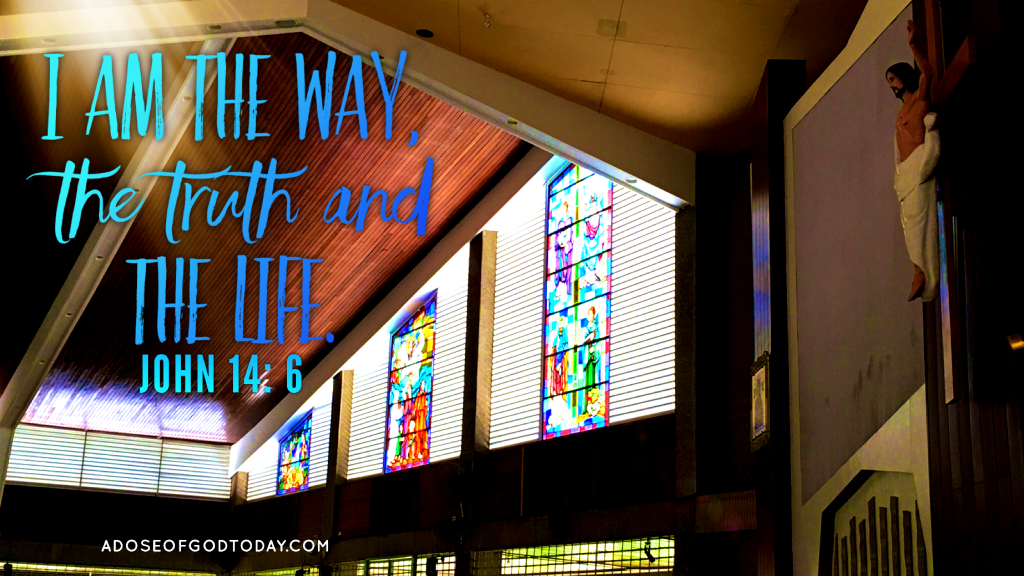
    Somehow Jesus has the same message for us in our gospel today. In admitting that He is the Way, the Truth and the Life, Jesus is preparing us His disciples for the coming life ahead. Jesus said: “I am going now to prepare a place for you”. He is preparing us and we are being prepared by Him. And this is not just about the place prepared for us out “there and after”, but all about ourselves, (you and I, here & now) being prepared for a role, task and mission – a responsibility in God’s plan of more abundant life for all.

    In Jesus, God thus is  preparing us according to His plans and purpose for us. In Jesus, God is calling, forming, training, retooling, and redesigning us now to be suited for the promise of our new life with Him.  

    Jesus as our “Way, Truth and Life” is God’s signs, guidelines, and means of preparing us. The witness of Jesus’ life, death and resurrection with us prepared and still preparing us for the promise of eternal life. And as we, believers of Jesus and our Father are being prepared, the challenges of living life in faith we Christians are going through now may be lived, not as it is, but as a preparation to a witness of better future for the world now and beyond.

    In other words, our experience of Christian life now is and should be lived same way as in holding pre-departure areas in airports and terminal or bus stops’ waiting sheds  in preparation for a journey to a better future destination God is offering us anew, along with the conviction that God and Jesus is not finish with us yet. The journey is not yet over. There is more yet to come for us with God.

    Advertisements

    So for now, take heed Jesus’ advice: “Do not let your hearts be troubled. Have faith in God and in Me also”, since we are being PREPARED for something anew. BRACE ourselves  therefore, for we are part of the preparation in God’s grand plan of things in life.

    May we have the patience and faith to endure and persevere more with what we are going through Now, so that we may be worthy and  better prepared for our responsibility to a much better world ahead, God offering us now. Amen. 

    (By: Fr. Aphelie Mario Masangcay CSsR, a Filipino Redemptorist  Missionary stationed in Gwangju South Korea, though now still stranded in Cebu until further notice for available flights.)

  • Finding Jesus

    Finding Jesus

    Advertisements

    May 9, 2020 – Saturday of the 4th Week of Easter

    Click here for the reading (http://www.usccb.org/bible/readings/050920.cfm)

    One day, a boy opened their fridge and got two cupcakes and two small bottles of orange juice. When his mother saw this, she asked him, “Are you going out to play?” The boy replied, “I am going out, Mom, to find God.” “Well, good luck son. Tell me, then, when you find Him,” said the mother.

                So, the boy set on his journey to find God. He was walking and walking. He saw trees and birds and flowers everywhere. He reached the tall buildings in their city, saw the busy traffic and the crowd of people crossing the street. Yet, not a single person noticed him.

                It was about snack time that he went to a park and found a bench where a homeless woman sat. The woman looked very sad, looking aimlessly. And since the boy was quite tired, he decided to sit and have his snacks. Sitting on that bench, he opened his bag and got his two cupcakes and two small bottles of orange juice.

                The boy, then, shared his cupcakes and orange juice to the homeless woman. The woman accepted his offer gladly, and looked at the boy with a big smile on her face. The boy, then, looked into the eyes of the woman and saw happiness in her. 

                The homeless woman, grateful to this boy, found tremendous generosity from him. While enjoying their snacks the two shared stories and laughed together.

                After the snacks, the boy said his goodbye to the homeless woman and went home. When the boy arrived home carrying a smile on his face, was greeted by his mother. She said, “How was your day, son? Have you met Him (God)?”

                The boy answered joyfully, “God is a woman, mom, and she has the most beautiful smile I have ever seen.”

                Meanwhile, the homeless woman wearing a smile that she couldn’t hide decided to take her walk. Along the way she met an old homeless man. The old man was intrigued as the woman could not hide her joy reflected on her face. So, he asked, “What’s with your smile? You seemed to be filled with joy today.” The woman replied with cheerfulness, “Oh, I just met God today. He was a boy, much younger than I expected.”

    This story shows us an encounter with God, in finding and meeting God in our human and ordinary experiences. This story may bring us into that experience of surprise from God because God reveals his presence in ways we do not expect.

    Our readings today, both in the Acts of the Apostles and in the Gospel of John tell us of this story of the revelation of God in unexpected yet ordinary ways. Consequently, because of such simplicity, people found it difficult to recognize God. Moreover, many refused to recognize God’s presence because of its apparently unadorned and simple God’s self-revelation.

    Let us look at the Gospel of John, Philip, who had been with Jesus for long, impatiently asked the Lord, “Lord, show us the Father, and that it enough.” As if Jesus was not really enough. With this, Jesus had to be honest to Philip, “You still do not know me, Philip, though I have been with you,” Jesus said.

    In a way, we are told that even a close  a disciple of Jesus found it difficult to recognize and to be convinced that the Father is in Jesus, and that they are one. Philip must have been expecting a magical revelation or any spectacular manifestation of God’s presence. However, God’s self-revelation was manifested through the person of Jesus, the Word-made-flesh.

     In the same way, the Jewish people found it ridiculous as the Apostles preached to them the person of Jesus, as God-made-flesh. Jesus was too ordinary, too simple to be believed as God. Yet, they still found his death and resurrection as offensive or a stumbling block. This was how the people showed insults to Paul.

    Advertisements

    This happens to us when our hearts also grow tired and weary. When we are overwhelmed with our anxieties and worries of the situation around us. Then, we might be looking for some spectacular thing to happen and for a magic to appear. But then, we might also lose the opportunity of recognizing God, of the revelation of God’s presence in the most ordinary way.

    This is the call from the story of the boy looking for God. He found God not in a magical way but through a homeless woman who showed the most beautiful smile he has ever seen. Moreover, the woman also met God in a surprising way, in the person of a boy who showed tremendous generosity to her by sharing his snacks and presence with her on that bench.

    Thus, what we are invited today is to see Jesus clearly, to recognize God who is very much involved in our daily life. To see Jesus clearly is to know God dearly. This will help us then, to follow Jesus closely. This is what has been proclaimed to us in the Acts of the Apostles commanded by Jesus, “I have set you as a light, so that you may bring my salvation.”

    We are invited to see Jesus in every person no matter how ordinary they may look like, or how familiar or strange they may be to us. It is in this way that we too shall be able to bring light to them. Again, as it was in the story, the boy experienced the light through the person and the smile of the woman. The woman too, experienced the light trough the presence and the generosity showed by the boy to her.

     Today, as we continue to live and find our way in this age of the pandemic, this may become an opportunity for us also to see Jesus clearly in the person of our brothers and sisters. May we truly become the light that shines in the darkness through our generosity and kindness to those in need, through our sincere and honest words to people around us, and through the gift of our presence to those who need comfort and a friend. Hinaut pa.

    Jom Baring, CSsR

    Join 2,868 other subscribers
  • BE PATIENT IN SUFFERING AS WE DO WHAT IS RIGHT

    BE PATIENT IN SUFFERING AS WE DO WHAT IS RIGHT

    Advertisements

    May 3, 2020 – Fourth Sunday of Easter

    Click here for the readings (http://www.usccb.org/bible/readings/050320.cfm)

    The Jewish converts asked Peter and other apostles in our first reading, “What are we to do, brothers?”

    As today’s Easter people – baptized, repenting and receiving the gifts of the Holy Spirit, we Christian find ourselves confronted still with the same question: “what should we do?” especially now in today’s pandemic times. We do wonder what would be our Christian forefathers advice and say to us now as we deal with our life in today’s changing world.

    Somehow St. Peter offers us words of wisdom and guidance as to how we can and should adjust and adapt with our changing realities. He said to us today: “If you are patient when you suffer for doing what is good, this is a grace before God”. Meaning, “Grace before God” is what we seek in life, as well as what God offers us in life. Jesus in our gospel today reminded us that He came that we might have life and have it more abundantly before God. In Jesus, God thus promises us and wills for us betterment and well being in life. And for St. Paul then, we as God’s children and followers of Christ, to share with God’s grace, we must be PATIENT IN SUFFERING AS WE DO WHAT IS GOOD.

    In other words, as we navigate with our changing world of pandemic, distancing and quarantine along with God’s grace and our Christian faith, our forefathers in faith would advice us today to:

    First, continue to DO GOOD and BE GOOD before God. Jesus in describing us the good shepherd implicitly inviting us to be His good sheep who hears and recognizes His voice, follows Him obediently as He dearly calls us by our name. As Good shepherd, Jesus knows His sheep and we, His sheep knows (should know) Him. Goodness is thus reflected in our intimate, respectful, and responsible relationship with our risen Lord. Same as, Good trees are known by its fruits, Good parents, teachers, coaches, doctors and pastors are also known through their good children, students, players, patients, and faithful. So, do good and be a good Christian, citizen, God’s child, and person before the Lord. 

    Advertisements

    Second, do right and be right in SUFFERING before others.  In today’s high tech, globalized, fast-pacing world, we tend to do things haphazardly. We want things done instantly, rendering us chronically living a stressful, high-strunged & addictive life-style. However, we do need to do right things rightly. This would mean we don’t just do THINGS right, but we have to do the RIGHT things. Here we need to prioritize what is RIGHT essential things and learn to do away with non-essential things in life. And in doing so, we need to contend with the natural painstaking slow-pacing process of things. Meaning, go back to and learn the basics of things, no more shortcuts, palakas, excuses, and to non-essentials. In other words, do RIGHT things rightly and suffer along with it.

    And again, BE PATIENT with Oneself and Others. Nowadays, we suffer a lot in patience. As our world today stood still, slowed-down, and quarantined, we are painstakingly waiting back for our normal active life. But our situation now might be teaching us to learn again and anew how to be and why we need to be patient with ourselves and others in life. In better and worse times, we do need to learn to be patiently waiting in life.

    Why? Because God is not finished with us yet. As promised, Jesus has more abundant life in store for us. God prepares everything for us … in His own pace and timing (not ours). This might entail us a lot of patience and deep faith, BUT God’s life-offer is worth the WAIT.

    So, what can, should, are we to do, during these trying times? BE PATIENT IN SUFFERING AS WE DO WHAT IS RIGHT…. For God is not finished with us YET as well as God’s promise of abundant life is worth OUR WAIT.

    May we always have a patiently waiting and faith-filled Easter-resolved during these pandemic times. Amen.  

    (By: Fr. Aphelie Mario Masangcay CSsR, a Filipino Redemptorist  Missionary stationed in Gwangju South Korea, though now still stranded in Cebu until further notice for available flights.)

    Join 2,868 other subscribers

  • God is at work

    God is at work

    Advertisements

    May 1, 2020 – Memorial of St. Joseph the Worker

    Click here for the readings (http://cms.usccb.org/bible/readings/0501-memorial-joseph-worker.cfm)

    When the creation finished, we were told in the Book of Genesis, “God looked at everything he had made, and he found it very good.” 

    What God has made reflect who God is. It means that God’s goodness and love overflows towards all creation precisely because God who is so good made everything on earth with love.  Yet, God did not stop working and creating after the creation. God continues to be at work in each of us and in everything. And it is God’s desire that we grow more and be transformed according to His Divine plan.

    This is an assurance then, that God’s work in us and in everything means God’s presence. In God’s presence, we shall find that even a dreadful disease such as COVID-19 has no match with a working God who desires for a world that experiences peace and joy.

    This tells us now of the beauty and the value of work. When we work, we give ourselves into what we are working. Hence, we do not merely extend ourselves to what we are working but it is ourselves in that very work. A masterpiece or any work of art, for example, reveals the personality of the artist, or the person of the artist himself/herself. That is why, God found everything very good because God is in each of us, and in everything.

    Today, we also celebrate the feast of St. Joseph the Worker and at the same time celebrating Labor day. This feast of St. Joseph who is the patron of workers and laborers reminds us of the dignity of labor or work and on how our work can serve God and be in service of others. 

    As a carpenter or craftsman, St. Joseph silently dedicated his every work to God. Most likely, as we do not have a direct account from the Bible, this was how Joseph also brought up the young Jesus.

    Indeed, Jesus was made aware of the value and dignity of work through his human experiences of labor with Joseph. Jesus learned to appreciate work and to realize how work affirms and develops a human person into what God desires us to be.

    Advertisements

    This Labor day reminds us too to give respect and honor to every workmanship. May this celebration also remind us of the struggles of those who labored and worked hard to earn their living, which include farmers, carpenters, constructions workers, janitors, garbage collectors, drivers, nannies, domestic helpers, vendors, police, office workers, teachers, nurses, doctors and other professionals and to be in solidarity with them.

    These days of Enhanced Community Quarantine as a protective measure against the COVID-19 Pandemic, work in most sectors of our community has been suspended. Those who earn daily and do not have the security of tenure and other benefits have been affected the most. They have to rely now on the help from the government and from charitable institutions.

    Furthermore, those in the medical field have more weight on their shoulders these days as an unfamiliar virus is infecting many. Many of them were infected too and unfortunately many died of the same infection.

    These days also, we rely on the knowledge and expertise of those in the medical science that through these scientists a vaccine will be developed to fight the virus and save us from this disease. And we pray, that it is progressing. 

    What we realize then, is how a particular work plays an important dynamism in the life of our community. Hopefully, we may also value our own work, whatever that may be and no matter how limited it has become in these days of Community Quarantine. May our work, our profession or ministry will become our own participation in God’s continuing work in us. 

    Mahatma Gandhi said, It is the quality of our work that will please God, and not quantity.Thus, God calls us too that like Him, we may give ourselves to what we are working because the quality of our work also reflects who we are. So, give the best in you. When you fail, make it a learning experience. And when you succeed, be proud of it and thank the Lord for the gift of work and for the gift of your person, who is fearfully and wonderfully made by God.

    May our work then, become an act of loving service to others and an act that multiplies goodness and kindness springing forth from our very person.

    With this, let us take confidence in God who is at work, who shall bring fulfillment to our heart’s desires. Hinaut pa.

    Jom Baring, CSsR

    Join 2,868 other subscribers
  • What kind of bread are you?

    What kind of bread are you?

    Advertisements

    April 30, 2020 – Thursday of the Third Week of Easter

    Click here for the readings (http://www.usccb.org/bible/readings/043020.cfm)

    by Reverend Deacon Joey Valross Trillo, CSsR

    Yesterday, my co-Reverend Deacon, Lemuel, shared a story with me. Once there was a monk who asked their cook, “What do you call a bread with salt? It’s Pan de sal. How about bread with coconut meat inside? It’s Pan de coco. How about a bread with COVID-19? It’s Pan de mic. One more, how about a bread that is full of air? It’s Pan-nuhot.[1]

    Nevertheless, the point is that bread has a lot of varieties. So, if you are bread, what kind of bread are you? 

    Our gospel today talks about Jesus, who identified himself as no other than the Bread of Life. He said that he is the living bread from heaven. He added that whoever eats this bread will live forever. And, the bread He shall give is His flesh, and He will give it for the life of the world. 

    Indeed, Jesus is the Bread of Life, the Eucharist. Whoever comes to Jesus shall never be hungry. This is the case of Philip in the First Reading from the Acts of the Apostles. He consumed the Word who made flesh, Jesus, and lived the life as His disciple. 

    In fact, Philip became one of the seven Proto-deacons. He preached the life of Jesus, catechized several communities, and baptized a lot of converts similar to what we have heard in the First Reading. Philip helped the Ethiopian eunuch in understanding the scripture. Then, he told him the Good News of Jesus, which led the Ethiopian to become a follower of Christ. Hence, we can say that Philip is a kind of bread which nourishes other people.

    At this time of health crisis, What kind of bread are you? Are you the kind of bread who energizes people, the one who empowers the medical front liners and the afflicted through appreciation or good vibes? 

    Or are you a distasteful bread who posts fake news and rants about poor people whom you claimed as stubborn, undisciplined and not worthy for monetary help?

    Advertisements

    Or are you the type of bread that is flavorful, the ones who enjoy your family bondings such as doing TikTok as a family?

    Or perhaps a spoiled bread who discriminates people from the hospitals?

    What kind of bread are you, then?

    Brothers and sisters in Christ, let us ask for the grace to become a bread that nourishes, energizes, and satisfies the needs of others, especially the most abandoned. 

    We pray that like Philip, we may help others to understand the will of God in this trying times; that you and I will give the same joy experienced by the Ethiopian eunuch. In other words, we pray that we may become a bread-like Jesus, the Bread of life. Amen.


    [1] Panuhot has no English medial term. It is a belief among Cebuano-speaking Filipinos that Panuhot is caused by air trapped in the body particularly in the muscles which causes the formation of nodules. Nodules, then, creates pain and weakness in the body.

    Join 2,868 other subscribers