Mary Magdalene went into the tomb and was weeping. Mary was filled with sadness and pain. The tomb reminded her of that painful and scandalous death of Jesus on the cross. Yet, what is interesting in this scenario was the movement of time. In the first verses of the Gospel, we were told that Mary “went to the tomb early in the morning, while it was still dark.” However, at this time, the dawn was breaking. The sun is soon to come out. And what Mary will witness was definitely the glorious victory of light over darkness.
Mary who developed a close relationship with Jesus, was a faithful disciple. She remained at the side of Jesus thus, the reason of her grief and pain. Nevertheless, despite the grief and sadness, Mary did not just go away and give up. She actually refused to give up. The sadness, disappointment and pain that she felt, urged her more to seek Jesus even in times of so much confusion and darkness in her life. But, those emotional and spiritual burdens in her also prevented her to immediately recognize the Lord. Jesus has to call her by name to make her realize that it was him.
Thus, in that desire to seek the Lord even in darkness and seemingly ugly scenario in her life, Mary was filled with the goodness of the Lord. Her friendship with Jesus helped her to seek the Lord and see grace beyond pain and darkness. This is something to learn from the friendship Mary Magdalene had with Jesus. Her friendship was beyond physical attraction and emotional attachment but was built on trust, faith and confidence of being loved by the Lord.
Such experience of fullness is what the Psalm also proclaimed today. “The earth is full of the goodness of the Lord.” This is what Mary was holding on in her heart. She must be a believer on this that indeed the earth is full of the goodness of the Lord. Even though there was so much pain and confusion in her heart, she believed in the goodness of the Lord that fills the earth.
True enough, Mary received this fullness of God’s goodness as Jesus revealed himself to her. This was captured beautifully through her words, “I have seen the Lord.” This is a testimony of a person who believed and experienced fully the goodness of the Lord.
Like Mary, let us also develop and nourish a close and intimate relationship with the Lord that will make us more attuned to his voice and presence. When we are gripped by grief and sadness, or by pain and failures in life, may we find ourselves holding on to hope and in the goodness of what is around us, rather than in giving up or running away from our painful realities. Let us allow the Lord to be with us in those moments, and allow him to encounter his liberating presence in every moment of our life. Hinaut pa.
Truth can indeed be easily manipulated or even covered especially when those who are faced with truth become threatened and disturbed by it. This is what we have heard on this Easter Monday as told to us by the Gospel of Matthew. The truth about the resurrection of Jesus was manipulated by people in power who also desired to advance their personal agenda. The soldiers who were witnesses of the Resurrection were paid not to tell what really happened but to create another story. These soldiers must have been captivated with awe and wonder in the event of the resurrection. Light must have pierced into their unbelieving hearts. However, what was sad in their story was when they were presented with the immediate comfort of money.
They were willing to cover the truth of the resurrection and create fake news for the sake of money. They accepted a corrupt offer to spill the untruth to people rather than to tell others of God’s power and mercy. Why was that? Is money more powerful than God? Certainly not. It is just deceiving and very tempting especially when people need it.
Nevertheless, apart from this sad story, we still have the women who showed to us how the resurrection of Jesus changed their life. The Gospel tells us that they were still fearful yet overjoyed. This means that despite the darkness they have experienced in the past days and the fear that enveloped them, the presence of Jesus filled them with so much joy.
The women did not succumbed to despair and fear unlike the soldiers who succumbed to money and corruption. The women continued to believe in Jesus in spite of the confusions and even in pain and suffering that they witnessed. They never lost their hope in Jesus.
This kind of attitude in them was showed in their action as they went to the tomb early in the morning. The tomb surely would remind them of the death of Jesus, meaning, of sadness and failure, of pain and disappointment. However, even in the midst of all of these, they found a reason to find light in the midst of darkness, to find hope in the midst of hopelessness and to find life in the midst of death.
And true enough, as they desired to see Jesus, they indeed saw and witnessed the glory of resurrection. This was how they also found their mission, and that was to be Jesus’ witnesses to others.
Now, as Jesus called them to tell other disciples about him, each of us now too is called to tell others of Jesus’ presence in our very life. With this, there are two invitations for us on this Easter Monday.
First. Money is not everything though money and riches can be deceiving and tempting when we are in need of it, that it will lead us to become dishonest, corrupt and abusive. This happened to the soldiers who exchanged for money the truth. They settled for their own comforts. However, that did not made them truly rich or satisfied with life. In fact, they are now seen like the “paid trolls” who merely repeat lies and fake news to deceive others and bring others to corruption and death.
Second, preach Christ and preach what is only true. Never be afraid to tell what we have seen, what we have heard and what we have witnessed. Tell others not just through our words but also through our actions that Christ is truly alive. Even a simple gesture of generosity to a person in need or a simple act of kindness to others is a way of sharing that Christ is truly alive in us. Kabay pa.
Power is an ability to influence, to create and transform. It can be either positive or negative. When power is expressed as a positive force via affirmation, then, power builds respect. When is expressed through love, then, power transforms into service and giving of oneself. However, when power is expressed as a negative force, it leads to coercion, manipulation, abuse, exploitation and even to death
Each of us is a bundle of energy, of power. We possess power as long as we live with others because power can only exist and be exercised in the context of community. Hence, power is entirely about relationship because power is an exercise of influence, which can be realized only in the context of community.
We remind ourselves that it is also in the context of our relationships that we discover who we are, our talents and capacities, strengths and potentials, as well as our weaknesses and limitations. It is in the community that we also understand ourselves the “I am.” I am – is the uniqueness of the person whatever his or her status in life. Our person regardless of our social standing, sexual orientation, age, educational attainment or role in the family or community, is called by the Lord to share in God’s fullness of life, living in a community. Our person also is gifted with THINKING, FEELING, and ACTING. These are forms of power which can be expressed positively or negatively within our community
Our thinking, feeling and acting can, indeed, influence others. Through thinking we create ideas, we make plans and decisions. Through feeling or emotions, our thinking and acting can be influenced. Our feeling may dictate our thinking and in the process also affect our actions. Through our actions we initiate movements that may directly and indirectly affect our environment, which include the people around us.
Thus, when we become anxious of ourselves and less aware and knowledgeable of who we are, there is a tendency of insecurity. Insecurity leads us to compensations, which means that what is lacking in us, we try to compensate in other forms. For example, a child who is abused physically or verbally at home, may tend to be a bully at school to exercise dominance. Or a person who is deprived of things, like food, toys, and clothes at home may tend to become a hoarder later on. The person will try to collect and possess more, to feel some sense of security. While trying to satisfy himself/herself, the person may in turn deprive others too.
These are expressions of power that are also being unfolded as we begin the Paschal Triduum of Christ beginning today and will culminate in the Resurrection of Christ. Yet, for now, what I want to focus more is on how power in its positive and negative forms give influence to people and transform us. It is good then, that we become aware on how the power of Satan suppresses life and how the Power of God gives life.
Let us look first at the power of Satan and on how it controls and brings death. The Gospel of John clearly tells us that the devil had already induced Judas, to hand Jesus over (John 13:2). In the same Gospel, it was also described that as soon as Judas took the morsel, Satan entered him (John 13:27). The intentions of the heart and actions of Judas were already leaning towards the evil spirit, hence, it was easy for Satan to get hold of Judas and bring him deeper into darkness and sin. This was how the devil influenced the mind, decisions and actions of Judas.
Judas must have thought that his desires and longings will be fulfilled through these actions and decisions of him. Yet, he was wrong. He was controlled and manipulated. He was not himself anymore. Judas was in total darkness. Satan was controlling him, perhaps, even without fully realizing that the evil spirit was already manipulating him farther away from the grace and light of Jesus and closer to darkness and death. This led him to his pitiful death. This is how the power of Satan controls us and brings us farther away from the grace of God.
However, let us also not forget how Jesus turned upside down this terrible event. Even though that happened to Judas, but Jesus turned that night of betrayal and pain through the power of love and mercy.
This was described to us as Jesus assumed the humble position of washing the feet of his disciples. It was power expressed through service and humility. Jesus tells us that being a person with power as an authority figure or leader is not about controlling others or manipulating others.
As Jesus washed the feet of his disciples, he gives a model of a life-giving way of expressing power and that is through service and love. This tells us too that the power of being a Christian is having the capacity to serve and love without pretention, without manipulation and that does not count the cost. Christian Discipleship is indeed a form of power, a life-giving power.
This call and invitation to exercise power as a Christian Disciple applies to all, regardless of our age, gender and sexual orientation, social status, educational attainment or state in life. Indeed, to be a disciple of Christ is to give life just as Jesus gives his life for us. And this is the true expression of power which is sacramentally given to us through the shared meal on that Last Supper of Jesus. This is what we powerfully remember today.
It cannot be denied that at the Last Supper of Jesus, his Body and Blood were given also to a disciple, a friend and a companion who betrayed him on that night. Yes, even Judas was in that meal. He too received the body and blood of Jesus even though he was not in the “state of grace.” Jesus gave and offered his body and blood for Judas and for us who are also potential Judases[1] today. This is the power of forgiveness, the power of unconditional love, the power self-giving. This is the power of God.
As we enter into the Paschal Triduum, let us also allow the power of serving, of loving, of caring and of compassion to be the very power we express in our relationships, in our roles and leadership, and in our life through our thinking, feeling and acting. Let the power of God transform any forms of control, manipulation, and abuse into life and into love. Kabay pa.
[1] In the words of Bishop Pablo David, DD, Bishop of Kalookan.
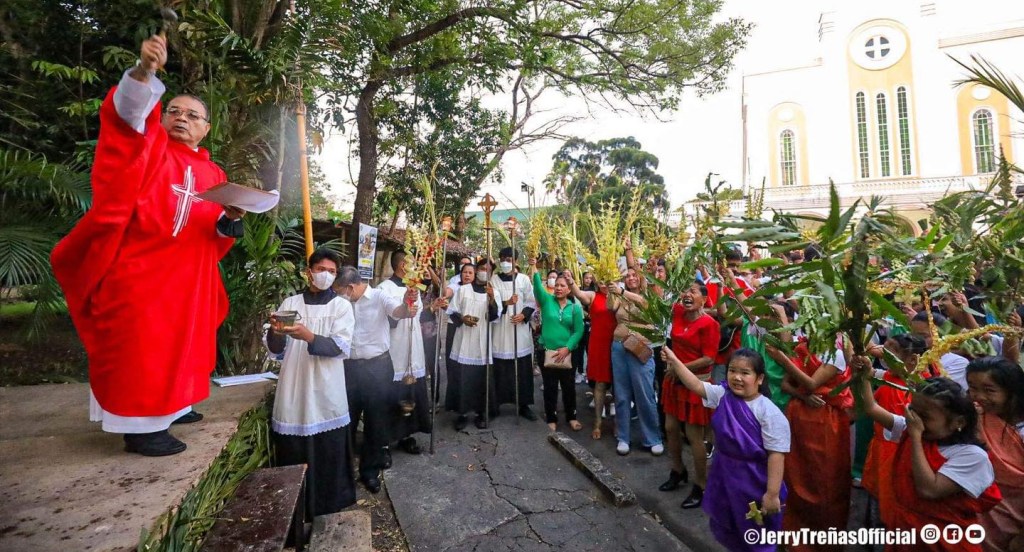
On this Palm Sunday of the Lord’s Passion, we blessed our palms to remind us of Jesus’ triumphant entry in Jerusalem, only to be handed over to death. He was arrested, tortured, abused and humiliated, carried his own cross to Calvary, crucified while onlookers waited for him to die hanging on that cross. The palms that symbolized Jesus, revered to be king, but riding on a donkey, culminated in that shameful and painful death on the cross.
Thus, as we enter the Holy Week and being reminded fn the story of the suffering and death of Jesus, there are three invitations that I would like to share with you today. These three invitations will hopefully guide us in our journey in life with Jesus.
First, REMEMBERING. To remember a painful memory is not easy. When we do this even with our painful memories in the past, of the trauma, shame and guilt that happened to us, we feel discomfort. Some may even try to escape to forget that painful memory. Yet, this is what we do now as we remember, recall and recover the story of Jesus who after preaching to the people the Kingdom of God and making difference into lives of the distressed, the sick, the lonely, the sinners and abandoned, was being betrayed by his own disciple, denied by a friend, and left alone on the cross.
In our remembering, we honor the pain, the shame and the guilt that surround in the story of Jesus as well as in our own stories. As Jesus struggled to find meaning in his suffering as expressed in his words, “My God, my God, why have you abandoned me?” let us also find meaning and God’s presence in our own painful and shameful stories.
Despite the pain and the seemingly absentee-God as we face our own suffering as individuals and as a people, let us also allow the Spirit to bring us further in this journey. This is the second invitation.
The second is RECONNECTING. In remembering the passion and death of Jesus it also allows us to remember our own stories, we may realize how far we gone away from our painful past. In our attempt to forget, cover and bury what was shameful and filled with guilt, we could have pretend as if nothing was wrong or nothing happened.
We let the words of Prophet Isaiah be our prayer, “Morning after morning, he opens my ear that I may hear,” so that we may be able to listen well to the voice of God speaking within us and through our human experiences. As we reconnect with the past, we also reconnect with our emotions that may still be overwhelming for us. We reconnect with ourselves and find our re-connection with God who has been with us all along even in our darkest moments in life.
Photo from JerryTreñasOfficial Facebook
In reconnecting, we bring our heart and mind into prayer, into contemplation even when we are faced with difficult life experiences and situations that may be challenging to comprehend. In prayer and contemplation, we give ourselves to God just as Jesus gave up his spirit to the Father. This is where we are called to grow in our confidence and faith in the Lord who promised to be with us always and who shall never ever leave our side. And this confidence brings us into the third invitation.
The third is RESPONDING. Jesus even at his death proved that God’s power of love and mercy outdone human sin and death. Even in death, Jesus responded to bring life and freedom. The Gospel described that “the veil in the sanctuary of the Temple was torn into two from top to bottom. The earth quaked, rocks were split, tombs were opened, and the bodies of many saints who had fallen asleep were raised.” This was how the death of Jesus made the heaven opened for all and brought hope to the dead.
Hence, as we remember and reconnect, let our heart be filled with God’s presence to empower us by finding healing and freedom, life and renewal. This only means that we won’t allow any painful or shameful memory to dampen our spirit into hiding and pretensions. Do not settle to seek temporary comforts but rather go beyond and seek the Lord. The Lord desires our reconciliation and healing and so let us embrace that grace offered by the Lord to us, as Jesus gave up his spirit for us.
To respond then, is to be able to get out beyond ourselves and become life-giving, spirit-inspiring and heart-renewing. Kabay pa.
Who among us here who have not yet felt or experienced disappointment? Or a failure or a heartbreak? Well, definitely, most of us have these experiences in one way or another. There might be some of us who have also experienced being humiliated, oppressed or abused. Or perhaps who are ill at the moment, or in trouble at work, perhaps lost a job, failure in business or failure in a relationship or having an overwhelming family problem, or who are in great sorrow for losing a loved one.
These realities cause a person to suffer and make our day turn into darkness, our bright tomorrow into hopelessness and our life bitter and horrible. This was the case of Nanay Celia whom I met in Cebu City when I was in the college seminary. She suffered and died of breast cancer. But before she died I had a deep conversation with her. She shared that her husband left her for another woman. When she got sick and she was completely abandoned. She was all alone. She began to be angry with everything and everyone. She got angry with God and cursed God for such suffering she endured. Life was so bitter. She wanted to end everything because she was hopeless.
Yet, not until a group of missionary sisters found her in her house. She was brought to the sisters’ institution. It was in that institution that I met her. She knew that she was about to die but before she died, something changed. The darkness of being abandoned turned into light. Her hopeless life turned into a life filled with hope. Her anger, disappointment and loneliness were all gone because she found love, acceptance and forgiveness through the sisters.
This story is not far from our readings today that concretely portray to us these human realities of failure, disappointment, heartbreak, doubts, and even of being helpless and hopeless. This was how the people of Israel felt at the time of Prophet Ezekiel. The Hebrews were exiled. They were in a land they did not know, where there was no Temple and no God. As a people they were humiliated by their foreign captors. They had no identity and were doubtful of God’s presence in their life.
The same expression was presented to us in the psalms. “Out of the depths I cry to you, O Lord: Lord, hear my voice!” It is a lament of a person who is in great misery, who felt that God seemed to be deaf of his/her pleas, who felt of a God who seemed so indifferent to his horrible situation.
This is what we find also in the Gospel. Martha and Mary, the sisters of Lazarus, were in great misery. They were inconsolable and heartbroken over the death of their brother. That is why Martha, in her sorrow said to Jesus, “Lord, if you had been here, my brother would not have died…” It was a statement of disappointment and even of anger. It was actually a statement of blaming God for not doing anything.
But our readings also today reveal something very important to us. The Book of the Prophet Ezekiel conveys God’s promise of salvation where the Lord shall open the graves and shall have them rise as a people and will be restored to their homeland, Israel. This is entirely connected to our psalm that says, “With the Lord, there is mercy and fullness of redemption.” It means that God is indeed faithful to his promise, he is faithful to the covenant. God will never betray us. The Lord will never abandon us because God is forever with us and for us.
These characteristics of God are most evident in our Gospel. Jesus reveals to us, not just to Martha and Mary but also to you and to me today, that God is never indifferent to our misery, to our feelings. Jesus reveals to us that he is a loving God and a merciful God. He is a God who feels like us who also feels lonely, feels afraid and even worried, anxious and sad. Yes, in the Gospel Jesus was described twice to have been perturbed. He was distressed and troubled because something happened to his dear friend Lazarus. And when he saw the dead Lazarus lying on the grave, (what happened to Jesus?), Jesus wept! He cried like us. He feels sad and in grief like you and me.
What does that mean now? It means that our God is not a God who is so far away who cannot hear our cries or deaf to our prayers. God is not indifferent to our suffering, to our questions and doubts. God understands how it is to lose a loved one, or even to be humiliated, to be lonely and alone. God cries with us when we too are in deep trouble.
This shows, then, the immensity and the greatness of God’s love for you and me. Jesus prayed to the Father to bring Lazarus back to life. Jesus cried out in a loud voice, “Lazarus, come out!” What do these words mean to us now? Jesus also wants us to come out from our own graves. That we too will be healed from our own experiences of pain, bitterness, hopelessness and loneliness where we too seemed to be lifeless in many ways, as expressed in our relationships with others. Coming out from our own graves also means being freed from our own selfishness, arrogance and sins that come in many forms.
We will only be able to come out from our own graves and lifeless situations when we become like the sister of Lazarus, Martha. Jesus asked her, “Do you believe that I can bring your brother back to life?” Mary indeed believed. Each of us is being asked by Jesus, “Do you believe in me? That I am the resurrection and the life?” It is only when we come to realize and believe in the goodness and love of God that God also works wonders in us.
It is only when we come to believe that God is the author of life that we will also value more our life and the lives of others. It is only when we come to believe that God is the God of our life, that we also see the many good things we enjoy in this life despite the many difficulties and hardships we encounter. When we truly believe that God is the resurrection and the life, that we begin to become true Christians who see light in the midst of darkness, who find joy in the midst of sorrow, who capture a smile in the midst of pain, who embrace hope in the midst of impossibility, who find healing in the midst of so much sickness and who find life in death. Kabay pa.






 A DOSE OF GOD TODAY