Tag: Homilies

  • God growing in us

    God growing in us

    Advertisements

    July 19, 2020 – 16th Sunday in Ordinary Time

    Click here for the readings (http://www.usccb.org/bible/readings/071920.cfm)

    Homily

    Who among us here have witnessed the actual growing of a seed, or any plant or of a person? We could have claimed that we have witnessed it just as parents looked closely as their child grows, or just as a farmer tends everyday his plants and animals. Yet, because growing is a process, it takes time and very slow. That is why, we don’t usually see with our own eyes how a seed begins to sprout and becomes a tree, or how a flower begins to grow and bloom or how a person develops physically and grows old. We only notice the gradual changes as time also goes by.

    However, thanks to our latest technology because a camera can capture this process of growing particularly of a plant or changes that happen in our nature. Through a photographic technique called “time-lapse” we can witness how a seed begins to sprout, take its roots and come out from the soil and become a full bloom plant. This always amazes me to see that.

    I want you to watch this short time-lapse of a growing seed in silence to bring yourself also into reflection and into calmness in the midst of noise, stress and anxiety that are around us today. (Click the link below)

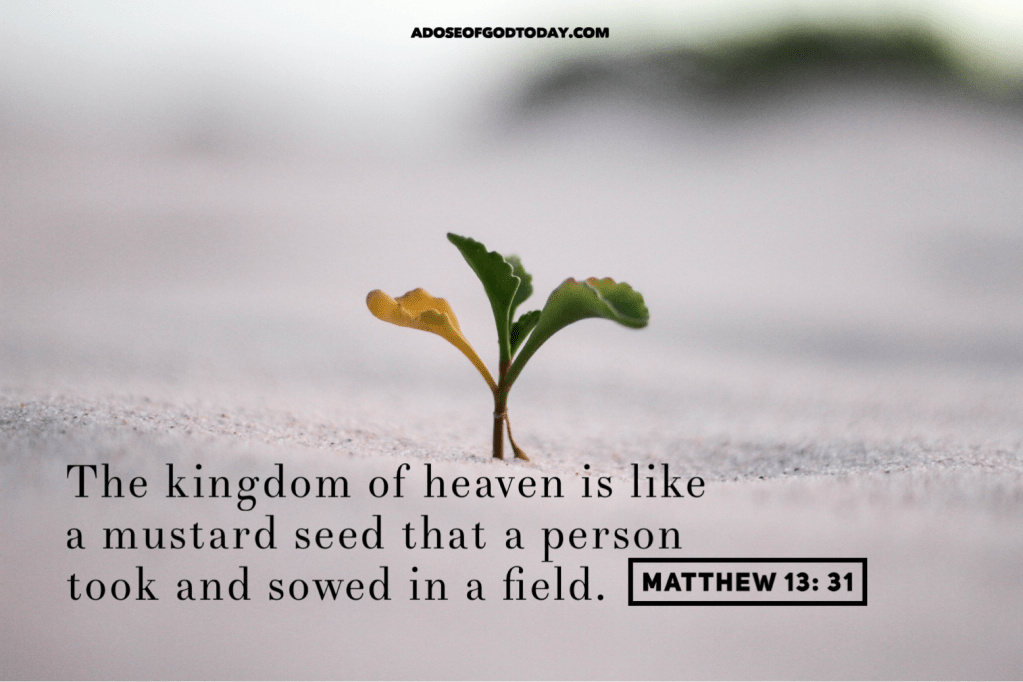
    With this amazement and wonder of the process of growing, this brings me into reflection for this Sunday’s Gospel. Jesus tells the people about the three parables of the Kingdom of Heaven. These are the parable of weeds among the wheat, the mustard seed and of the yeast.

    In all these three parables, what is common among them is the theme of growing. From here, I would like to invite you that we dwell deeper into these three parables and recognize how God invites us today and how God is growing in us.

    I would like to begin with the parables of the mustard seed and of the yeast. Indeed, these are invitations of God for letting us grow, to be mature and to develop.

    We understand GROWING or GROWTH to be dynamic. It involves changes, adaptations, shedding off of what was old and transforming into something new. Meaning, growing is a form of transformation.

    Both parables, tell us of the process of growth in a non-aggressive way because growth is gradual, silent and calm. Moreover, it is empowering and life-giving.

    This reminds us too of the wonder of creation. Creation is silent and relaxed, yet, destruction is noisy, distressful, aggressive and violent. In destruction, there is no growing because it suppresses and destroys. Surely, this is how we would find life distressful, filled with anxiety and worries, because when we do not grow or when we stop growing then, it leads us to destruction.
    And this is not what God wants us. God’s desire is that we develop into our full potential as what has God desired us to be. Thus, we are called to continue growing no matter how our hair have turned into white or our wrinkles have become more visible.

    Likewise, growing also leads us towards maturity. The first parable of the weeds among the wheat leads us into this invitation, MATURITY. Remember, the owner of the good seeds waited for the wheat to mature before weeding out the weeds, that were sowed by the enemy. To weed out the weeds when the wheat are still young, it will endanger the life of the young wheats. The owner has to wait when the wheat becomes mature and ready for harvesting.

    This means that only when we have grown and become mature that we also gain wisdom to recognize what is bad and good, what is unhealthy and healthy, what is from the evil one and what is from God.

    This tells us that the Kingdom of Heaven is already in us because God is with us. The seed has been planted on earth as Jesus was born for us. The Lord is already in our hearts as we are being baptized. Moreover, the Kingdom of Heaven is manifested in us when we also become mature in our faith and relationships with God and with others.

    How do we recognize that we have become mature? It is by being able to recognize the works of God and the works of the evil one, the works of kindness and the works of selfishness and to choose freely God.

    Now, these are the signs as well as the invitations for us to recognize the Kingdom of Heaven and to let God to grow in us.

    First, as the mustard seed grows and the flour reacts with the yeast, the kingdom of Heaven also begins in HUMILITY not in any form of aggression or arrogance. It is humble and simple. Thus, the kingdom of heaven can be very present in a family who makes the effort to pray together, in a couple who expresses their faithfulness despite their differences, in a person who shows true concern and generosity to another who is in need of help.

    Advertisements

    Second, the kingdom of heaven is empowering and life-giving.  The kingdom of heaven is present when our community empowers the weak. A community that discriminates, judges, condemns and indifferent never empowers but it oppresses the weak. However, when our community empowers, then it also gives life. Let us also remember that to be able to give life is to give more chances and opportunities for growth. To give life is to give hope. Therefore, our community is truly a kingdom of heaven when we uphold and protect every life to survive and to mature.

    As we recognize the Kingdom of Heaven in us today, let us also allow the Lord to grow in us, to bring changes and transformation in ourselves, in our attitudes and relationships and in the way we look at things in life. As we continually grow and become mature, we may also become individually, a person for others and also a community for others that gives life, that gives hope and allows chances and growth for the weak and the helpless. Hinaut pa.

    Jom Baring, CSsR

  • Be humble. Recognize your emptiness. Be Grateful.

    Be humble. Recognize your emptiness. Be Grateful.

    Advertisements

    July 14, 2020 – Tuesday 15th Week in Ordinary Time

    Click here for the readings (http://www.usccb.org/bible/readings/071420.cfm)

    Homily

    Jesus was very disappointed at the response of the people. Three places were mentioned to have been the places where Jesus did many wonderful things. These are Chorazin, Bethsaida and Capernaum. Miracles were performed as God’s sign of blessing and presence. However, Jesus found the heart of the people hardened and unrepentant. The people refused God’s offer of friendship.

    They did not want to be disturbed from what they were usually doing. They were just satisfied with the kind of life that they were leading. Thus, God’s invitation for them to change became a threat to what was comfortable, advantageous and beneficial for them.

    This is the reason why Jesus gave the uncompromising warning to these people because of their refusal of God’s offer of salvation, and that is, damnation. However, remember that it is not God’s desire for the people’s damnation. It was the people who chose to be damned and to reject God.

    There might be times where we will find ourselves in this kind of situation. We can easily take for granted the everyday miracles that are happening in our life. As a result, we could become ungrateful in the way we live our life, in the way we relate with others and even in the way we relate with God. And from these, there are three reasons that I see on why we would hold back and refuse God.

    First is the refusal to admit and recognize that there is something wrong in us, in the way we live our life, and in the way we relate with people around us. Unacceptance of our faults means distancing ourselves from our responsibility. This attitude will make us self-righteous and arrogant, making us blind of our own sins. Thus, when we refuse to admit our failures and sins, we point our fingers to others. We would find ways of covering up our sins by bringing up the sins of others or making reasons that we have become the way we are because of the faults of others.

    Second is the confidence of being self-satisfied. When we are filled with ourselves, filled with our selfish desires and wants, we also become self-satisfied. When this happens, we will not realize that we are also in need of God. This attitude comes from the tendency that tries to accumulate more for the self. The forms of accumulation is not just limited with our desire to enrich ourselves with material things but also, praises and recognitions from others, or even forms of compulsive behaviors and addictions. These forms of accumulation make ourselves busy and filled with many things, consequently, preventing God to occupy a space in our life. We would not dare to make a room for God because our heart is full, our mind is occupied and our day is busy.

    Third is being ungrateful. A self that refuses to admit sins and becomes self-satisfied also becomes ungrateful. When we become ungrateful, we easily take for granted the giver of gifts and the worker of miracles, and thus, the presence of God in our life. With this attitude, we also become self-entitled. We become demanding in our relationships. We become critical of those people around us and we tend to only see what is wrong in the other person. We will become stingy of our time and energy and ungenerous of our resources and presence to those who are asking for our help. And most of all, we become indifferent to people around us and indifferent to God, the source of all blessings and miracles. We will easily notice this in us because we will tend to become bitter, impatient and cranky.

    However, as the Lord continues to reveal himself in us, he desires that we become the person God wants us to be. That is why, the Lord never tires in calling us closer to Him, again and again. The Lord has blessed us and shown us many wonders to invite us. Thus, the invitation for us today is to be more aware of the many blessings and miracles God is doing for us today even in the midst of this pandemic.

    Advertisements

    Hopefully, by recognizing God’s blessings and miracles in our life, it will lead us to the three movements that will allow us to see and recognize the Lord in these difficult times.

    First. Humble ourselves by recognizing our failures and our need for mercy and forgiveness.

    Second. Recognize our emptiness and so of our need of God to fill our empty hearts. Never be afraid to be vulnerable and to show our weakness so that God can work miracle in us.

    And finally, be always grateful to the many good things that God has given us even small and simple things. This calls us to be more aware of God’s presence revealed even in ordinary ways and to be sensitive to the needs around us. Hinaut pa.

    Jom Baring, CSsR

  • LISTEN TO HIM

    LISTEN TO HIM

    Advertisements

    July 12, 2020 – 15th Sunday in Ordinary Time

    Click here for the readings (

    Homily

    As we struggle with the day to day challenges CoVID 19 virus has posted us, perhaps we also wonder what would be the best guidance and advice God is giving us at this time. Life amidst CoVID 19 virus has been constricted and stressful. We find ourselves mostly reactive to the reality that we think about whether our actions are in sync with God’s will and plan. So, what would be the best  way for us to be always online with God?

    Our Scripture and Christian faith tradition have a very simple instruction: LISTEN TO HIM.

    We remember many instances in Jesus life that the challenge of us listening to Him has been clearly given importance. At the beginning of His public ministry to proclaim the good news of salvation, Jesus said: “Today these words come true as you listen.” Also during the Lord’s transfiguration, the disciples heard God instructing them: “This is my beloved Son, whom my favor rests. Listen to Him”. And in our gospel today, in telling and explaining to us the parable of the sower, Jesus challenges us “Whoever has ears ought to hear”.

    Our listening is indeed crucial to our faith-life. By listening to Jesus – God’s word for us, as our first reading suggest, we are part of and in line with God’s work of salvation and can benefit from the fruits of His labor. Paul reminds us that being connected with Christ assures us that “the suffering now are nothing compared with the glory to be revealed.” Jesus in our gospel made known to us how blessed and privilege we are for our faith makes us see and hear what “many prophets and righteous people longed to see what you see but did not see it, and to hear what you hear but did not hear it.” Same way as any loving relationship, good listening and communication are very important to our faith relationship with God.

    Simple as it maybe, but we do have some problems with listening. Experience teaches us that in life it is not always easy to listen. We may have heard what has been said but we may have not listened to it. Or, it could happen that the other have not yet fully said what he wants to say or we may not yet have fully listen to him, we are already thinking of what and how are we going to respond to the other. It could also happen that while we are listening to the other, there are a lot of noisy things and concerns that we are also listening to and hearing with. It is very true that we do have limited listening span and selective hearing. Meaning, we listen only in our limited ways, and listen to what we want to hear from what was being said. That is why selective and limited listening or not enough listening would resort to conflict, tensions and misunderstandings. We heard what has been said but do we listen to it? We may have heard it but are we listening to what has been said?

    For instance, our gospel today is not anymore new to us. We are already familiar and have known about the Parable of the Sower. Surely many times we have already heard this parable. In fact, of all the parables that Jesus have already told us, the parable of the sower is among the few parables which he gave an explanation. True we may already heard this parable before and may have already understood its meaning. But did we listen to it? Are we listening to it? If we don’t see and hear it calling us to listen, then we are not listening and don’t get it.

    Long before it was written and read, God’s words are primarily spoken and proclaimed to us and are meant to be heard and listen by us. The mission of Jesus is to speak, preach and proclaim the God’s Word, the Good News of Salvation. Meaning, our rightful response to God’s Word being preached to us is first to listen to it. Only through our listening that we could understand, and in effect benefit and enjoy the fruits of God’s salvation. Like David, if we want to taste and see God’s glory and salvation, we should learn how to listen intently to God’s Message and Plans through Jesus, His word. For those who listen well, they bear much fruits.

    Jesus has thus already done and doing His part in Proclaiming God’s words. Ours now is to do our part in listening and obeying God’s Word. Let anyone of us then who have ears: Listen, and heed what we hear.

    Amidst our now noisy worrisome and depressing pandemic world, may we be more sensitive to listen God’s message & plans, thus be guided and inspired to rightly respond to its challenges for our trying times. Amen.

    (By: Fr. Aphelie Mario Masangcay CSsR, a Filipino Redemptorist  Missionary stationed in Gwangju South Korea, though now still stranded in Cebu until further notice for available flights.)

  • Our God is moved with compassion

    Our God is moved with compassion

    Advertisements

    July 9, 2020 – Thursday 14th Week in Ordinary Time

    Click here for the readings (http://www.usccb.org/bible/readings/070920.cfm)

    Homily

    If someone hit and hurt you, is it not that we also desire revenge and desire that they too will experience pain? Our human tendency is to inflict pain to others when we are being hurt. This is what animals usually do. When we accidentally and even deliberately hurt a dog, the dog may automatically bites us in return as a defense mechanism. Or when we hurt a cat, the cat may scratch us too. They do that without any discernment and they respond because of the danger to protect themselves.

    However, though we belong to the Animal Kingdom but we have the capacity to discern and to go beyond from our animalistic attitudes and selfish human tendencies.

    The Book of Hosea, in our first reading reminds us today about this. Moreover, the way Hosea reminds us is very much interesting. Hosea pictures God like a parent who loves so much His children. As a parent, God felt being betrayed and rejected because His child did not recognize His love. God’s child was ungrateful and childish. God indeed, like a parent was in pain upon realizing how ungrateful and unfaithful his beloved child to their covenant.

    However, it is in this love too that God proves His faithfulness and compassion to his lost and sinful child. God does not respond to human sinfulness out of impulse because of anger. This is not God’s way.

    The Book of Hosea describes to us God’s character in these words, “My heart is troubled within me and I am moved with compassion. I will not give vent to my great anger; I will not return to destroy Ephraim, for I am God and not human. I am the Holy One in your midst; and I do not want to come to you in anger.”

    Such beautiful words and also powerful and comforting. This reminds us again that God sees beyond our sins and beyond our ugly selfish human tendencies. As we are made by God, made through God’s love, God cannot turn against Himself. God sees Himself in us. God’s compassion for us springs from that identity in us.

    We can also do this when we become more discerning. To discern allows us to see as God sees and to love as God loves.

    Thus, do not believe when others express how hopeless a person can be because of his or her sinful way of life. Do not be tempted to believe that the your painful and traumatic experience has made you hopeless. Do not be driven to believe also that this worst situation we have today will be the end. No. This belief and expression of hopelessness is not from God.

    Let us discern more because God sees us and God is moved with compassion. What we are suffering now is not God’s desire. Our suffering is not God’s anger upon us. God will not destroy us. God will rather save us and make us free.

    This is the concrete message of Jesus to his disciples, “heal the sick, bring the dead back to life, cleanse the lepers, and drive out demons.” God’s desire for us is to be liberated, to be free, to have life in its fullness. As God is moved with compassion, God is also moved to respond and be with us.

    This is God’s invitation for us today. As Jesus commanded his friends, each of us too is being sent to go and to proclaim what God reveals to us. Thus, do not allow our fear and anxiety to prevent us in bringing God’s comfort to those who are in need. Do not allow also our anger, hatred and desperation to take control of our life that would lead us to respond out of impulse. Be more discerning then, on how we could express in concrete ways our faith and our love for God and for our neighbor.

    Though it may be difficult to move around and visit the homes of our friends and in our community due to the restrictions of our movements, but then, this should not stop us from being more kind and generous to others. Evangelize others through your good works and attitudes that express God’s characters of being compassionate, patient and merciful. Encourage others in your own capacity, to listen and live God’s word even through our live stream masses via Facebook or radio. Be more active then, in participating in God’s call to tell others of God’s goodness and hope in us. Hinaut pa.

    Jom Baring, CSsR

  • An encounter with the Lord leads to discipleship, mission

    An encounter with the Lord leads to discipleship, mission

    Advertisements

    July 8, 2020 – Wednesday 14th Week in Ordinary Time

    Click here for the readings (http://www.usccb.org/bible/readings/070820.cfm)

    Homily

    An encounter with the Lord leads to discipleship and to be on mission. This is the message for us today. But for us to grasp better the message, let us make a step by step discovery.

    First, the call or the invitation is God’s initiative. It means that it is God who calls us and God chooses us to be His servant, to be his disciple. God’s way of choosing is not through the wealth we gathered, or how much power and influence we possessed. God calls us when we are open to him regardless of our profession, status and state in life. This is how Jesus summoned the ordinary 12 disciples and then sent them to proclaim the kingdom.

    Second, we need the help of our family, friends, and community to lead us to God. An encounter with God, though that can be very personal but it is essentially always in the context of the community. Thus, seek the help of others. It will be easier for us to recognize God when we have a friend who will help us to see God. This is beautifully captured in our Psalm today, “Seek always the face of God.”

    Third, our God-experience or personal encounter with God is the most wonderful experience we will ever have. Because it is so wonderful that we cannot just keep it by ourselves. Our encounter with God leads us to action – it leads us to follow the Lord and leads us to tell others about what we have seen, heard, felt, and experienced with God. The 12 disciples’ personal encounter with Jesus led them to this point where that encounter moved them to action to become healers, witnesses and preachers.

    Each of us today, whoever we are and wherever we are, even in the midst of this pandemic, as Christians we are called to preach Christ, to preach the Gospel by our life that we may become agents of healing and reconciliation, and bring other people closer to God.

    This identity makes us different from the rest of other Christian denominations because the call to follow Jesus and to preach the gospel is not only limited in our Eucharistic celebrations. My faith and your faith, is not only confined within the walls of our Church. Our Christian belief, our confidence in the risen Christ has called us to actively participate and to enthusiastically involve ourselves in all aspects of human life and the whole community not just in the spiritual aspect but also in cultural, social, economic and political aspect of life.

    May we always remember this and become true Christians in the way we live our life, in the way we perform our work and in the way we relate with others and with one another so that we who have experienced God’s goodness will also become instruments in bringing other people closer to the Lord. Hinaut pa.

    Jom Baring, CSsR