Tag: Homilies

  • God satisfies our deepest hunger

    God satisfies our deepest hunger

    Advertisements

    August 2, 2020 – 18th Sunday in Ordinary Time

    Click here for the readings (http://www.usccb.org/bible/readings/080220.cfm)

    Homily

    Who among us here who have not yet experienced hunger? I am sure each of us have experienced that feeling of being hungry since we were babies. Babies especially would always cry when they are hungry. A parent’s automatic response to a crying baby is to feed the baby with milk. When the baby starts sucking, the baby also stops from crying. When we become adults, we continue such behavior though we do not cry anymore but feed ourselves with food that can satisfy our physical hunger.

    At the beginning of this quarantine and lockdowns, we have also experienced how we have become anxious from running out of food during this pandemic. News reports all over the world told us of panic buying. People were fighting over some supplies, and many essential goods also run out of supply. People bought many things to satisfy not their hunger, but their anxiety of what is to come tomorrow.

    Aside from this, there are also many other forms of hunger in us, such us our hunger for acceptance, for recognition, for friendship, for love and intimacy, for justice, for peace and reconciliation.

    And in our search to satisfy those longings and hungers, we are sometimes led to resort to the promises of “instant satisfaction” and to an “immediate result.”

    Their consequences become destructive, unhelpful and the corruption of life. Addictions such as in alcohol, drugs, sex or food are ways to satisfy our deepest hunger. Yet, because they only promise an instant gratification and so we hold on to those addictions to numb our hunger for love, for attention and intimacy.

    Our obsessive fixations in spending too much time in social media, or online games or with gadgets, can remove us from the true and personal encounter with people. Because of the lack of human connection, we divert our need into what is temporary, virtual and not real.

    Our compulsive behaviors in gossiping, in defaming people and in finding the faults and weaknesses of others seemingly give us the image of a good person, righteous than others. However, these behaviors only blind us of our true longing to be recognized and be appreciated.

    Our obsession to be powerful, to exercise dominance and control over the weak and to resort to violent and aggressive actions apparently make us confident, independent and strong willed. However, they too blind us from that hunger to find our true self and our true potentials.

    That’s why, God in his goodness would always invite us to come to him so that our hunger will be satisfied and our longing will be fulfilled. This is what our first reading told us today. The Book of Isaiah tells us of God’s invitation to come, to eat and be satisfied. God invites his people to come to him, to recognize God as the source and fountain of good and wonderful things in life. This is an assurance of God to the people that indeed, in God they shall be satisfied. Yet, there is something interesting behind this invitation.

    This particular verses in the Book of Isaiah were addressed to the people of Israel who were exiled in a foreign land. And a time has come that they will be restored and will be brought home. However, many of them seemed not to be moved by God’s invitation. People have become comfortable with their life while at exile. They were able to adjust and adopted to a new way of life. Thus, when God’s promise was fulfilled, they have become indifferent, not wanting to be moved by God anymore.

    Thus, this invitation to come to God and be satisfied is also at the same time a challenge and an assurance to us who have become indifferent, complacent but remain anxious of what will happen tomorrow. This is God’s assurance also affirmed in today’s Psalm, “The hand of the Lord feeds us; he answers all our needs.”

    This is what we find in today’s Gospel. Jesus became aware of the needs of the people who followed him on foot. This moved the heart of Jesus with pity that prompted him to respond. Jesus cured the sick and also provided them with food for their empty stomach. This is the great miracle of the feeding of thousands of people. This became possible through the participation of people who were close to Jesus. This is where we discover how God gives us the opportunity to be part of the miracle.

    However, we also see how the disciples expressed their anxiety over their food supply. There were more than five thousand people around and Jesus told them to feed the people themselves. All they had were five loaves and two fish, which might not be enough also for 13 adult men. The disciples must have felt that deep anxiety and confusion if they have to share the little that they had for the people. Surely, what they had in mind was, “these are not enough, so we better keep the food for ourselves.”

    Yet, the miracle happened when those five loaves and two fish were brought generously to Jesus so that others may eat. We are invited by Jesus to offer sincerely the little that we have. We might be thinking that the world’s problem on hunger is too big for us to respond and our share will only be insignificant. But let us remember, the five loaves and two fish were actually insignificant compared to the thousands of people. However, the disciples did not hide the little that they had, but offered generously to the Lord.

    Advertisements

    This action tells us of our own vulnerability and weakness and at the same time the power behind a generous action. To give away the little that we have, makes us insecure, yet, it is actually through the little that we possess that the Lord can work wonderfully. When we give something and then we feel vulnerable, because that was all we have, no matter how small, is actually the fruit of our generosity. Remember, true generous people will always feel helpless because what they give to others is not something that is only an excess of their possession.

    Jesus invites us to recognize him, that is, to recognize God, His love and friendship with us as our food that will satisfy our hunger. He is the bread that gives us life. This Eucharist is the gift and our food that should satisfy our deepest human hunger. That is why, this Eucharist is more than what we think. This is not simply prayers and readings, standing and kneeling, singing and saying amen. This Eucharist is our very relationship with God and with one another. This is all about us and God, you and me and Jesus.

    And so, I would like to invite you then, so that we will be able to make this Eucharist truly life-giving.

    First, ask the Lord to help us recognize our different hungers. Be mindful, then, of our compulsive actions, fixations and some forms of addictions because those behaviors in us will tell us of our own hungers and needs. When we become conscious of those, hopefully, it will lead us to seek to what will last, to what is more essential in our relationships and to what will truly satisfy us.

    Second, be moved to open up and to become generous of ourselves to the needs and hungers of others. Remember, we too are being satisfied and become fulfilled when we ourselves become instruments of God’s action in satisfying and fulfilling the life of those in need. Hinaut pa.

    Jom Baring, CSsR

  • God’s presence in the ordinary and familiar

    God’s presence in the ordinary and familiar

    July 31, 2020 – Friday: Memorial of St Ignatius of Loyola

    Click here for the readings (http://www.usccb.org/bible/readings/073120.cfm)

    Homily

    Have you experienced being judged by friends or family members because of your past sins, weaknesses or failures and because you are just too familiar and ordinary for them? Or have you ever judged others too because of their past sins and failures and because they also are very familiar and ordinary to you?

    Though Jesus never failed and sinned, yet, he too experienced judgment and bitterness from people around him. When Jesus went home to Nazareth, he was treated badly by his own people. The good news that he preached and God’s power that he revealed to his neighbors were treated with cruelty and insecurity.

    When Jesus stood in their midst, the people merely saw a carpenter and an ordinary man who once played and worked with them. The people limited Jesus by what he was used to do, in doing carpentry, nothing more and nothing less. They couldn’t accept that there was actually MORE in Jesus.

    Thus, instead of welcoming the power and wisdom that Jesus shared with grace and faith, the people refused to accept because of their insecurities and bitterness. They rejected Jesus because they could not accept that this ordinary carpenter brings God’s presence to them. They questioned him, “Who is this man? Is he not the carpenter, the son of Mary?

    The too-ordinary life of Jesus prevented them to welcome him as God’s revelation to them. Resentment and hate overwhelmed the people which made their hearts, unbelieving. This was the reason why Jesus was not able to perform many mighty deeds for them because God’s grace will only work when it is received with faith. Jesus is after all, not a magician who will attract people’s attention for a short span of time. Jesus reveals God’s presence and power through ordinary means.

    And this is not far from our own experiences too. Many times we may reject what is ordinary and familiar. We ignore God’s grace and invitation to us because we are busy looking for extra-ordinary things, for a magic to appear. That instead of recognizing God’s power in an ordinary sunrise and sunset, we busy ourselves looking for a “dancing sun” or “falling petals from heaven.” Thus, we refuse to believe that there is MORE in the ordinary.

    St. Ignatius de Loyola, founder of the Society of Jesus

    St. Ignatius de Loyola, whose feast we celebrate today, believed that God is always present with us, in all our human experiences. This conviction in Ignatius is found in his deep realization that God works in all things and in all lives, no matter how simple or ordinary it can in the eyes of others. Thus, we can indeed find God, realize God and embrace God when we too have made ourselves more open and welcoming to God’s presence.

    Indeed, miracles happen every day in its most ordinary way even amidst this pandemic. God’s grace is being unfolded even in our everyday experiences. God’s healing power is also revealed to us through our familiar sacraments in the church and through the embrace of people who love us like our parents, siblings, relatives and friends.

    This is the invitation now for us today – that is, to make ourselves more aware of God’s work even in the most ordinary way, to recognize God even among the familiar people, places and events. When we are able to learn this kind of awareness, then, we too shall discover the wonders that God gives us every day, and we shall realize that there is MORE in every ordinary experience, and in every ordinary and familiar person we meet.

    This calls us not to judge quickly to what is familiar and to what is seemingly ordinary, but, to be more welcoming of God’s grace. This reminds us now to be more open to the many potentials of those people who are familiar to us, and not to limit them to their past failures and sins. This calls us too to recognize how God unfolds his grace and his gift of healing through those people who love us. This calls us also to listen to God’s message and invitation through our present situation and through the people who might be God’s prophet today even though they look so familiar and ordinary for us, because there is always more that God offers us today. Hinaut pa.

    Jom Baring, CSsR

  • How to live life the way Jesus wants us to live

    How to live life the way Jesus wants us to live

    Advertisements

    July 22, 2020 – Wednesday; Feast of St. Mary Magdalene, disciple of the Lord

    Click here for the readings (http://www.usccb.org/bible/readings/072220.cfm)

    Homily

    How do you live your life? Are living in your past? Then, that makes you a prisoner of the past. Are you living in the future and of what is to come? Then, that makes you live in anxiety because of uncertainty.

    The only way we could live a life that is fulfilled and contented even in the midst of trials and sufferings is to live in our present. To live in the past whether because of a painful or joyful memory is a baggage that we carry in the present. This distracts us to be more aware of our present moment because we are occupied with what happened with us in the past. When we continue to hold on to what was already past, then we also become bitter and angry in the present. This happens because we prevent new people, new ideas or new invitations to disturb us to move forward.

    Moreover, when we are also overwhelmed with expectations and with what we want to have for tomorrow, we also become restless in our present moment. Our anxieties and insecurities may control how we relate with people and with God. As a result, we could become impatient because we want immediate satisfaction and instant results.

    The woman, whose feast we celebrate today, reminds me of the importance to live in the present, to capture the moment and to be ever grateful of what is here and now. Mary Magdalene, portrayed for many centuries as dirty and sinful woman, never allowed her dark past to control on how she lived with the present. She never let herself be overwhelmed of her future and to be anxious of what was to come next. She was just contented and fulfilled with what God gave her in every moment of her life.

    This made Mary Magdalene to be a dear disciple of Jesus and called as the woman apostle to the apostles. I want to invite you now that we bring ourselves into her story as told to us in the Gospel of John.

    The Gospel on her feast tells us of Mary’s encounter with the risen Jesus. There are three interesting events here that I would like to highlight.

    First, John tells us that Mary went to the tomb early in the morning while it was still dark.  This is very symbolic of Mary’s emotional and spiritual state. The dawn was breaking, an image where darkness is conquered by light. Indeed, Mary who developed a special friendship with Jesus was in grief and deep sorrow because of the death of her Lord and friend. What Mary did was to confront her grief and sorrow with hope, that beyond this overwhelming suffering and death, there is life; and beyond her sinful and dark past, there is hope and mercy.

    Second, as Mary searched for her Lord, she discovered an empty tomb. As she confronted her grief and sorrow, her pain and loss, her sins and failures, she discovered emptiness. This made Mary felt confused. However, it was in that emptiness that she was being filled with God. As she accepted her emptiness, Jesus filled her empty heart with the mystery of Resurrection, with love.

    Third, Mary’s close relationship with Jesus helped her to find herself when she was overwhelmed with pain and confusion. This was manifested as Mary recognized the presence of the Lord in the way Jesus called her name, “Mary!” This brought her into reality and to recognize her dearest friend, Jesus at that moment. And the reality is that Jesus never left her. Indeed, Mary has a special place in the heart of God. No matter what others would think about the sinful past of Mary, God did not condemn her and left her in misery. The Lord came to rescue her and transformed her in the way God wanted her to be. This shows us too how our friendship with Jesus could transform us.

    With this encounter of Mary with Jesus, this made her to proclaim, “I have seen the Lord.” It was because that Mary confronted her darkness, accepted her emptiness and the Lord’s desire to transform Mary, that she was able to see clearly the presence of God working in her life. this made her a witness, a faith-sharer and an apostle to all of us.

    These are the invitations for us today on this feast of Mary Magdalene that we may live in the present moment with joy and peace.

    Advertisements

    So I would like you now to remember these three points for today.

    First, in order for us not to burdened with our past, then confront the darkness in us and seek the light of forgiveness and reconciliation.

    Second, never be afraid to embrace our emptiness and to acknowledge our vulnerability. The Lord comes to us when our heart has a space for him. The Lord fills us with his graces and blessings when we empty ourselves from distractions of our bad habits and selfishness.

    Third, develop a deeper friendship with Jesus. We can only do this when we also develop the habit of prayer of talking our concerns to God but also listening to God’s desire for us. This involves an awareness of the presence of God in my brothers and sisters for they too are reflections of who God is.

    Hopefully, in these ways then, we too in our own ways will be able to proclaim to others, that, certainly, we have seen the Lord. Hinaut pa.

    Jom Baring, CSsR

  • We are God’s family members

    We are God’s family members

    July 21, 2020 – Tuesday 16th Week in Ordinary Time

    Click here for the readings (http://www.usccb.org/bible/readings/072120.cfm)

    Homily

    How important really is your family? How much quality time and presence do you give to your family?

    Our experience of the home quarantine has given us time to be with our families. Many of my friends have expressed how they have spent quality time compared before. I am sure that each of us too have realized many things about the importance of our family relationship.

    This allows me to reflect today on family relationship. For most of us, our families are the source of our joy, security, identity, confidence and assurance. However, for some of us also, our family can be the source of our deepest pain, traumas and bitterness in life. Thus, we cannot deny that it is in the context of our families that we also first experience “being loved” and “being rejected.”

    Moreover, in the growth and development of our Christian faith it is also within the context of our families that we first experience God and we first imagine God. Thus, when I was growing up I was introduced to a God who was rather strict. God was someone that everybody should fear. I was told that this God punishes a naughty boy and rewards a good boy. As a young boy, I tried to be good to avoid God getting angry at me and punish me later on.  Unconsciously, I also became fearful to God.

    What motivated me then, to do good was out of fear from being punished rather than out of love.  I imagined God like an old man holding a stick who is ready to strike a boy who has been naughty. This image of God definitely haunted me. This was my very experience also at home from my parents who were ready to strike me with a stick whenever I become naughty and disobedient.

    However, later on when I became conscious of my faith-relationship with God, then, I realized that God’s true character is not the one that I first thought of. Experiences would actually tell me that God is kind and generous, loving and forgiving. This again is my experience of God with my family. I came to know and became confident that God loves, and in His kindness, God reveals his gift of presence to us in the most intimate way where we could feel Him. When we allow God to reveal himself to us, then God brings healing and reconciliation, freedom and peace.

    This is the assurance proclaimed to us in the Book of Prophet Micah. God is not someone who delights in the destruction of those whom God loves. God delights in mercy and showing kindness to His people. God shows compassion and faithfulness. Indeed, Prophet Micah wanted us to hold on this grace and to be confident with this grace.

    Moreover, talking about family also, this brings me of today’s Gospel. Jesus brought out a new idea of being a family where we too shall experience deeper God’s presence and invitations for us.

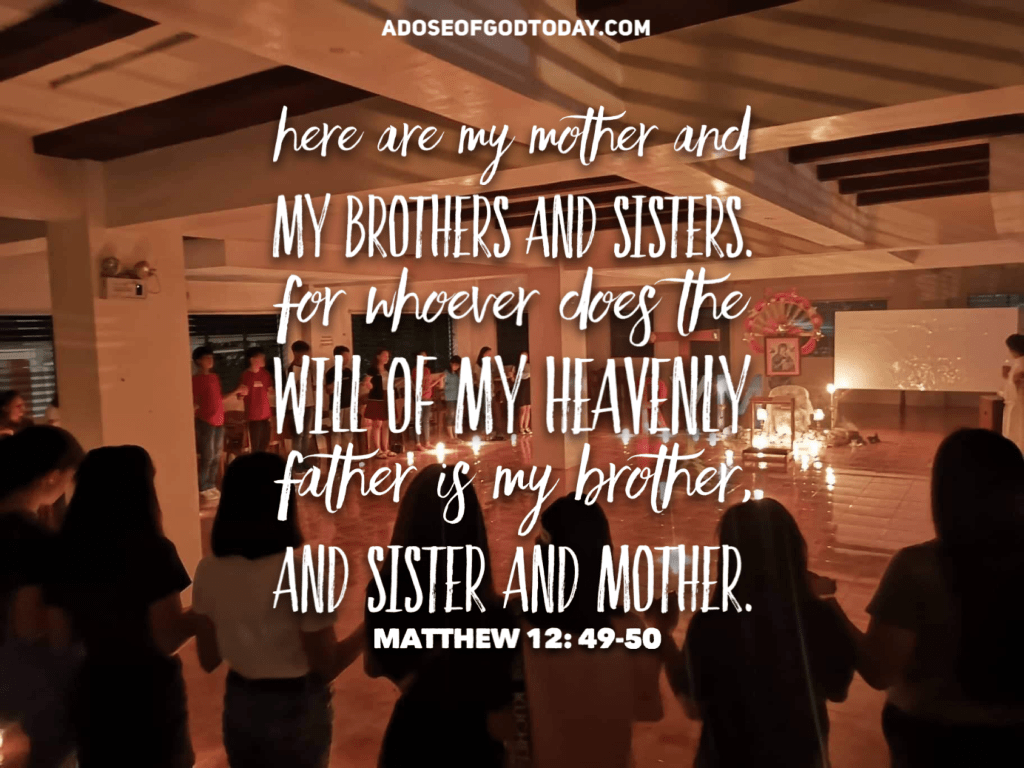
    Jesus asked, “Who is my mother? Who are my brothers and sisters?”  This scenario was a moment for Jesus to teach something very important to those followed him. The response of Jesus was a way of expanding the meaning of family relationship by pointing out the members of his family. These were those people listening to him, gathered around him to do the will of his Father. Of course, Jesus did not reject his immediate family but he expanded the essence of family relationship.

    Obviously, this family is beyond blood relationship. This is toward a deeper spiritual family relationship. This calls us to identify ourselves and others to be part of a bigger family of God.

    But how do we really belong to this family? Jesus told us that it is by doing the will of his Father. And the first step of doing the Father’s will is to LISTEN to the Son. Indeed, it is in listening that we also realize and become aware of God’s invitation for us.

    It is also clear that Jesus pointed out that his mother, brothers and sisters are those who were gathered around him and together listening to him. Certainly, there is wisdom in listening together, as a community or as family because the process of discernment becomes deeper, more realistic, clearer and empowering when we listen together and discern together on what God wants us to be and what God wants us to do.

    Advertisements

    This is what we are basically doing as we gather today in this Holy Eucharist. All of us present physically in this Church and also those of you who are joining us via livestream. As a family, we are called to discern and listen carefully to Jesus and at the same time to the voices of our brothers and sisters who are in pain and suffering in many ways.

    To sum up there are two invitations that I would like you to dwell today.

    First, be in touched with our personal God-experience. This will help us to have grounding in our faith-relationship with the Lord. Be confident with the assurance of Prophet Micah that God delights in our freedom not in our destruction.

    Second, allow ourselves to be part of God’s family by listening to Jesus through the scriptures and experiencing again his presence through the grace of the sacraments and through us and among us.

    Hopefully, this will make us more inclusive and welcoming as a family and discerning as we listen and respond to the voices of those who are in pain, who are oppressed and those who are condemned by others. Hinaut pa.

    Jom Baring, CSsR

  • How to recognize God’s signs

    How to recognize God’s signs

    Advertisements

    July 20, 2020 – Monday of the 16th Week in Ordinary Time

    Click here for the readings (http://www.usccb.org/bible/readings/072020.cfm)

    Homily

    As the pandemic developed and caused great difficulties all over the world, many have interpreted this event as a sign of the apocalyptic days or the end of the world. In fact, many tragic events in the past were also taken as signs of the end of the world. This caused panic and anxiety among those who really believed on this.

    Moreover, it has been our attitude to seek for signs especially when we are confused and filled with unanswered questions. We also ask God to give us signs when we are in the situation of making decisions. We also ask signs from God especially when we become doubtful of His presence and when we experience problems and trials in life. We believe that if God would give us a sign, then, that will make us confident in God.

    However, it has been our experience too, that when we do not receive any sign from God, we begin to doubt more or become angry with God for not listening to us. We may also think that life is so unfair because even a single sign of assurance is not given to us.

    Yet, we remind ourselves today of our tendency to expect impressive signs that will unfold before us. This is actually the problem that we have heard in our readings today. We are reminded of these two attitudes in us namely, our forgetfulness of God’s blessings and coldness towards God’s presence.

    The Book of Prophet Micah reminds us of this first tendency in us, of our short memory and inclination to forget God’s blessings. This is how Yahweh expressed the Divine plea to the people. God reminded the people how they were saved and brought out from Egypt and were released from slavery. Moreover, God sent instruments to guide the people like Moses, Aaron and Miriam. These events and people were signs of God’s blessings yet, the people have forgotten all of these. The people have become ungrateful to God because of their forgetfulness.

    Likewise, our Gospel today reminds us also of our tendency to become cold towards God’s presence. This has been portrayed the way people asked Jesus for a sign so that they will believe in him. The people expected Jesus to do a big and great sign before their eyes before they will recognize God. They thought of Jesus to be some kind of magician. This was the mistake of the people at that time because they asked sign from Jesus, when, in fact, Jesus himself was the greatest sign and miracle that ever happened.

    That is why, Jesus, as if scolding them of their ignorance and indifference, reminded them on how the Ninevites believed in Jonah’s sign and on how the Queen of Sheba believed also in the signs present with King Solomon. However, these people though Jesus was greater than Jonah and Solomon, did not recognize God in the person of Jesus.

    This happens also to us when we tend to be indifferent to what is ordinary. The Jews at that time were not able to recognize God’s tremendous presence in the ordinary life of Jesus. Because Jesus was too ordinary for them, and a mere son of a carpenter from Nazareth, the people refused to believe in Jesus and refused to recognize God in the person of Jesus.

    The Lord reveals himself to us in ordinary and many ways. This is what Jesus is inviting us today, that we may recognize daily God’s blessings and presence in us. But how?

    First, be appreciative and be always grateful even of small graces and blessings that you receive each day. Express in words and actions your gratitude. Be more generous to say sincerely “thank you” to people around you and to God. With this attitude we will always be reminded of the many blessings from God and avoid becoming forgetful.

    Second, be more discerning and listen better on how Jesus reveals himself in ordinary ways. This is also a call to be sensitive to God’s many revelations even in the most ordinary ways. Indeed, God reveals himself and his love for us every day and every moment of our life, in moments of defeat and moments victory, in moments of failures and moments of success, in moments of death and in moments of life. To discern and to listen, then, will make us less judgmental and to become more welcoming of God’s presence in our life.

    In these ways, we may always see and recognize God’s many ways of revealing His signs for us. Hinaut pa.

    Jom Baring, CSsR