Tag: Homilies

  • Painful and Negative Experiences Can Be Opportunities For Growth and Freedom

    Painful and Negative Experiences Can Be Opportunities For Growth and Freedom

    October 16, 2020 – Feast of St. Gerard Majella,CSsR – Redemptorist Brother

    Homily

    When we experience rejections and deprivations in life, is it not that we also experience discouragements? And when there is a series of tragedies happening in our life, we would certainly feel desperate and begin to have a sense of hopelessness. A possible reaction could be self-blame, or blaming others or blaming God because of the unfortunate events in our life. This is a possible reason why there are people who would yield to a very low self-worth and low self-esteem because of such negative experiences. For others, this leads to desperation, depression and chronic loneliness. Others too would go to the other side that leads to a life filled with bitterness and then to that desire to always seek recognition, acceptance, and satisfaction. To compensate what had been deprived, what was lost or lacking, the person may seek them in many ways. When these desires remain unconscious and become unsatisfied, the person turns to be selfish, corrupt and abusive in his or her relationships.

    However, negative experiences can also become opportunities for us to grow more as a person and into how God desires us to be. Our painful experiences of rejections, deprivations and even traumas in life are also doors that will lead us into a life filled with confidence, meaning and freedom.

    This possibility of living life fully is the life shown to us by St. Gerard Majella whose feast we celebrate today. Before St. Gerard was known to be a patron for mothers and particularly in time of pregnancy and for their infants, the young Gerard experienced hardships.

    At a very young age he was deprived of a father. His father died and being the only boy, he became a father to his sisters. Though he was very young, he was forced by that circumstance to work and support his family. Consequently, the hard work that he endured caused his health to fail. He had a very poor health as a young man. However, despite these difficult circumstances, Gerard was never bitter towards others who were better and well-off. He never blamed God for the difficulties he experienced.

    In fact, Gerard desired that he will offer his whole life in the service of God. But then, because of his poor background and poor health, he was rejected by a religious congregation that he wanted to join. Despite this rejection, Gerard never wavered his decision. When the Redemptorists came in his hometown, he was inspired by them and asked to join their group. Again, because of his poor health, he was rejected. But because of his persistence, he was able to join, but the Redemptorists reluctantly accepted him.
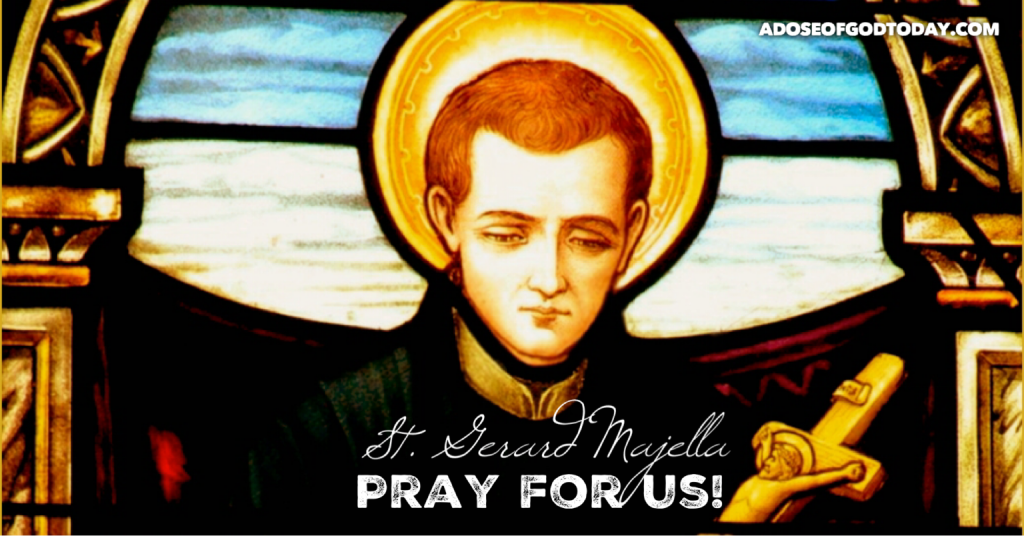
    In terms of intellectual capacity, Gerard was very far from St. Alphonsus, yet, what inspired the people around him was his sincerity. In all the things that Gerard did, he was always sincere, kind and grateful. The words that he expressed were filled with sincerity. Gerard was not after any recognition or just to satisfy his cravings because of the many deprivations in his life.

    Gerard was just happy and sincere because he was very confident with Jesus. His confidence and intimate friendship with the Lord made this poor and sickly Gerard satisfied and filled with gratitude. This is the very attitude proclaimed in our Psalm today, “You are my God, my only good.” Consequently, the very presence of Gerard uplifted and inspired others particularly those who were afflicted with illness, with loneliness, with poverty and other needs. Thus, even in his poverty, Gerard was generous; even in the midst of rejections, Gerard was most compassionate.

    In the same way, Paul expressed this in his letter to the Philippians, he said, “I regard everything as a loss… for his sake I have suffered the loss of all things, and I regard them as rubbish, in order that I may gain Christ and be found in him.”

    This is what Jesus told us in the Gospel today. The life of Gerard was a concrete example after Jesus, of a seed that dies and bears much fruit. Those painful and negative experiences of Gerard were his experiences of dying; his choice to make others happy and to bring others closer to Jesus were his ways of self-denial and denial from his personal cravings. Hence, by his sincere actions and words, Gerard’s life bore much fruit.

    This is the message also for us today. Let us not allow our negative experiences of rejections, deprivations and traumas to bring us farther away from ourselves, away from others and away from the grace of God. Let us rather make them as opportunities for us to grow deeper in the knowledge of ourselves, in our relationship with God and others. As we become sincere and more grateful in our words and actions, we may also become God’s instruments in bringing miracles in your community. Hinaut pa.

    Jom Baring, CSsR

  • How do we react when confronted with our failures?

    How do we react when confronted with our failures?

    October 15, 2020 – Thursday of the 28th Week in Ordinary Time

    Memorial of St Teresa of Avila, Virgin and Doctor of the Church

    Click here for the readings (https://bible.usccb.org/bible/readings/101520.cfm)

    Homily

    One time, I was asked to reconcile a church organization over a conflict that had caused hatred and division among the members. This started when a member took the risk of giving a feedback to their leadership. The person confronted them and told them about their exclusivity. The leadership seemed to favor few members over the others. The person who brought this out could not take this kind of attitude in the organization anymore. It was in the person’s best intention and good faith to improve the relationship within the organization. However, the leadership’s reaction was quite hostile. Instead of welcoming such feedback, they reacted so much to the point of finding the faults of the person who confronted them. Instead of taking it as a challenge to make themselves better, they became more exclusive and at the same time hostile to those who confronted their attitude.

    A person can be hostile when confronted with his or her failure. Even among our friends, we find it difficult to tell one another of our sins and mistakes. Others, because of such confrontation, friendship was broken. Among neighbors especially, when one begins to pinpoint the mistakes of another, this may cause endless hate-speech, gossiping, and even violent reactions. This happened in that organization whose leaders were confronted of their failure to be inclusive.

    Indeed, people who tend to display a strong image with a sense of self-righteousness will be resistant towards his or her critics. This happens to us when we think highly of ourselves that we forget how to be humble and be accepting of negative comments and confrontations.

    When we have grown to be arrogant, we display an air of contempt towards those whom we believed are threatening our good image. Thus, we become hostile and aggressive towards those who confront us and friendly only to those who flatter us.

    These are the attitudes that we find in today’s Gospel. When Jesus confronted the failures and sins of the Pharisees and scholars of the law, they became unfriendly towards him. Jesus pointed out how their ancestors, as leaders, killed the prophets in the Old Testament in order to hide their failures and sins from the people. The Jewish leaders wanted to keep the people away from the truth and away from God.

    Consequently, in order to advance their personal interest, to preserve their privileges, influence, wealth and power in the community, they developed ways of enslaving the people. They created many laws and demanded that the public must follow them literally but they themselves did not; heavy taxes were imposed upon the people but they themselves would not properly pay taxes to the temple; and they developed a gap among their people, stretching the gap between rich and poor, righteous and sinners.

    And Jesus confronted them, pointed out their failures and evil intentions. But they could not accept it. As a revenge to Jesus, they planned to silence Jesus by killing him.

    The Lord has revealed himself to them but still they refused God’s offer of salvation. These people were without faith. They did not worship God but themselves alone.

    Nevertheless, God continues to confront us of our sins and failures because the Lord desires our salvation, our freedom. Our Psalm proclaims today, “The Lord has made known his salvation.” Paul reminds us too in his letter to the Ephesians, “God chose us, to be holy and without blemish before him.”

    This is God’s desire that we will be able to claim also that we are his and called to be holy. The path of holiness involves confrontation of ourselves, of our selfish tendencies and evil intentions. By confronting ourselves and welcoming God and others to correct us, then, we embrace the grace to be transformed. This is the very life that St. Teresa of Avila embraced also. She confronted the way of life of her community that she believed had already departed from its original intention.

    St. Teresa’s journey as a reformer was not easy. She herself became a threat to many, a contradiction to those in power. Thus, she became unpopular, misunderstood, misjudged and opposed. Yet, St. Teresa would say, “God alone is sufficient.”

    God alone is sufficient.

    St Teresa of Avila

    St. Teresa of Avila whose feast we celebrate today reminds us of a person who truly found satisfaction, true comfort and riches in God. Through her closeness with Jesus, she discerned and chose God’s desire for her rather than her personal desires even if that leads to personal conflict and difficulty. She made God as the most essential in her life which made her offer also herself.

    This is what Jesus wants us to be, that we become persons who are not trapped by our mere personal desires. The Lord desires that we become free and truthful to ourselves because it is in this way the we shall also find life meaningful and become life-giving in our relationships with our family and friends and with our colleagues at work.

    Let us allow Jesus to confront us. His confrontations with us may appear in different forms. This could be through a lingering guilt and shame of the past sins that we have done, through a friend and colleague who has the nerve to confront us, and through a family member who takes the risk of making us aware of our sins and mistakes. Through them, we may welcome God’s way of transforming us everyday. Hinaut pa.

    Jom Baring, CSsR

  • What influences my heart?

    What influences my heart?

    Advertisements

    October 14, 2020 – Wednesday of the 28th Week in Ordinary Time

    Click here for the readings (https://bible.usccb.org/bible/readings/101420.cfm)

    Homily

    What motivates me everyday? What are my desires and wants? What drives me to live? These questions would help us to understand better ourselves, our tendencies, as well as our thoughts and the meaning behind our decisions and actions. It is very important to become aware of the influences deep inside our heart. Awareness is a key to a balanced way of life as well as our key towards contentment and becoming happy with what life offers us.

    There is a famous story among the Cherokee Indians (this is just another story of the two wolves, there are also other versions with their twists). A grandfather told his  grandchildren a story of the black and white wolves. He said that inside us, there is a black and a white wolf always fighting. The black wolf is evil filled with anger, envy, greed, arrogance, hatred, and evil desires. On the other hand, the white wolf is good and filled with kindness, goodness, generosity, patience, love, faith, peace and gentleness. One of the grandchildren asked, “Which of the two wins, grandpa?” “It is the wolf that you feed,” the grandfather replied.

    Certainly, our heart will be overwhelmed with anger and hatred, with greed and arrogance when we are also feeding the black wolf in us. In letting the black wolf win over the white wolf, we make ourselves slaves to our selfish tendencies. We make ourselves insecure and indifferent towards those who are around us. Thus, cultivating violence and anger in our heart will make us more violent and angry. Lingering on hatred and pain will also make us more desperate, hateful and sad. Fostering and doing unjust practices, corruption, dishonesty and unfaithfulness will just make us more corrupt, more hungry for power and control.

    Look at those people fighting over a position just to secure their political dream and to assure an influential seat in order to gain control and dominance. As Christians, we can question their integrity in serving the common good particularly in the middle of a crisis. It seems that what is more important is position, influence, power and dominance, control and prestige.

    Jesus pointed this out also among the influential people in the biblical times. The Gospel reminds us how Jesus confronted the pharisees and scholars of the law of their arrogance and self-righteous attitudes. These were the very people who secured influential status in their community but remained indifferent to the suffering of the public, and vicious and greedy. They were more concerned of their comforts and benefits rather that the good things they can give to the people through their status in the community.

    This is something that Paul reminded us in his letter to the Galatians. Paul told us to be always conscious and be guided by the Spirit of God and not to become slaves of our selfish tendencies that will bring us only to further insecurity and desperation. Paul said, “if we live in the Spirit, let us also follow the Spirit.”

    While looking at the bigger picture of our community, let us also look at ourselves and examine the kind of wolf we are under influenced. The Lord does not want us to feed our insecurities and self-serving tendencies, that is, the black wolf in us. What the Lord wants is for us to recognize the Spirit of God dwelling in us, to nurture the spirit by living truly and following the Spirit of God.

    Thus, today, Jesus calls us to feed the white wolf in us by allowing the Spirit of God to influence us, to overwhelm us and inspire our thoughts, decisions and actions. For us to follow the Spirit of God, there are two invitations that I want you to remember.

    First. Think and remember the needs of others. We may have our own concerns in life, but there is no harm to become more aware and understanding of what others are also going through. By being able to see and understand others, we become more connected with them. This allows us to think less of our needs and not to linger more of our desires. We become less self-centered and begin to see the world through the eyes of those are most in need than us.

    Second.  Pray. Pray for courage and the faith to respond to what you see. Do not just simply pray for our personal wants and desires, pray that we may become a life-giving person. It is by praying that we find strength and confidence in God that despite our own struggles, we become certain of His presence. We do not have to make extraordinary projects to help others and express our kindness and generosity. Extend help whenever we are called to. Express our generosity whenever somebody asks for help.

    May these simple invitations guide us to truly live and follow the Spirit of God dwelling in us. Hinaut pa.

    Jom Baring, CSsR

  • Faith Working Through Love

    Faith Working Through Love

    October 13, 2020 – Tuesday of the 28th Week in Ordinary Time

    Click here fore the readings (https://bible.usccb.org/bible/readings/101320.cfm)

    Homily

    As a human response of love, FAITH, (see https://adoseofgodtoday.com/2020/10/09/faith-a-human-response-of-love/) goes beyond obligation or from the letters of the law. What does it mean? To understand this better, let us see a bit deeper the encounter of Jesus with the Pharisee.

    In the today’s Gospel passage, Luke tells us that a Pharisee invited Jesus to dine with him in his house. This Pharisee must have heard a lot about Jesus, his preaching and miracles. He wanted to see Jesus personally and to see the ways of Jesus. However, these group of people, Pharisees, were hostile to Jesus. They were always looking for faults in Jesus that they can use against him.

    The Pharisees were known in the Jewish society at that time of Jesus who observed strictly the traditional and written law of Moses. Indeed, they were known to follow the law up to its most trivial law like in washing before meal and of the dishes. However, these people were filled with pretentions and superiority. They developed such practices to be praised and recognized by the people.

    Thus, the integrity of their faith was in question. The sincerity of their action was doubtful. This was something that Jesus wanted them to realize. Jesus wanted this people to see that our relationship with God is not tied up in following the minutest detail of the law. Having faith is not about making others look us up because of the many trivial rituals we do. To have faith is never about becoming self-righteous and superior from others.

    Hence, Jesus confronted the Pharisee because Jesus knew his heart. The amazement of the Pharisee when Jesus did not observed the prescribed washing before the meal, was born out of disgust to a person who did not follow the law like him. However, this was the chance of Jesus to teach the Pharisee an important lesson.

    Jesus pointed out the plunder and evil in the heart of these people while making themselves good and honorable in front of the public. This means that what they were after was not to please and worship God but to make people worship them.

    What is more important is not our good image before the public but our heart that expresses our goodness, generosity and love.

    This is basically what St. Paul is telling us in his letter to the Galatians. Similar to the Pharisee, the Jewish Christians wanted to retain the law of circumcision for the non-Jewish Christians. They wanted the non-Jewish to submit to this law because they believed that they can only be a true believer if they observe such law like them. This became a conflict in the early Christian Community to which Paul intervened.

    Paul reminded them that “in Christ Jesus, neither circumcision nor uncircumcision counts for anything, but only faith working through love.”

    Only faith working through love! If faith does not do good to others but suppresses and restricts a person to become life-giving, then, it is not faith at all, but a self-serving belief. Because faith is a human response of love to God who first loved us, then, faith naturally expresses love to God and to others. When our actions and thoughts would only serve our ego, for the preservation of our good-image, to seek praise and approval from others, then, it is surely not of faith.

    This is what Jesus calls us today. Let our faith in Jesus express love and only love. Never be afraid to express love because when it is expressed it is surely liberating for us and for others. Hinaut pa.

    Jom Baring, CSsR

  • To see and hear God everyday

    To see and hear God everyday

    October 12, 2020 – Monday of the 28th Week in Ordinary Time

    Click here for the readings (https://bible.usccb.org/bible/readings/101220.cfm)

    Homily

    Will it be possible to see and hear God every day? God’s manifestation in the world and in our life is constant. God may not appear before us, as Jesus did walk among the people before, but God’s presence continues to abide with us.

    St. Ignatius of Loyola believed that we could find God in all things. God in His great and profound love reflects His divine presence in all things, even in events and in our experiences both in sad and joyful moments. Life, then, despite its everyday challenges, is brighter and more wonderful when one finds God in the simple and ordinary.

    Indeed, when we become more conscious of God every single day and in every moment of our life, we become friendlier and gentle. This makes our activities, our daily struggles and demands less stressful because we find delight in small and simple things.

    However, the more we also become anxious, find life stressful and disappointing, when we tend to focus on big and extraordinary things to happen. To become indifferent to what is simple and ordinary, makes us dismissive of God’s every action.

    This is something that Jesus criticized among the people in today’s Gospel. This particular passage in Luke, recounts how Jesus frankly told the people of their indifferent and dismissive attitude towards God’s presence. The people were looking and only after of spectacular signs that Jesus would do. They were more focused on extra-ordinary things to appear and to happen. They actually wanted Jesus to become like a magician.

    Nevertheless, such attitude missed the very presence of God. The people did not recognize the greatest sign who was standing in front of them. Hence, curse to these people because God has already lived among them, yet, did not see and hear the greatest sign.

    The Ninevites whom Jonah hated because they were enemies, believed in him and recognized the many signs, he brought to them. Thus, the people repented and believed in God. The same with another non-believer, the queen of the south also recognized God’s wisdom through Solomon and believed in God.

    These people recognized God though they were non-believers of God. They were, certainly, more inclined to God’s presence than those who claimed were believers.

    Jesus called the people to really “see and hear him” for through him, God walks and teaches them. In the same way, Jesus also calls us today, to see and hear him clearly in our life.

    Our demands coming from school, work, home, and in our relationships should not keep us from recognizing the Lord who constantly work through us. God has many wonderful things prepared for us. Life will be more wonderful too when we learn how to see and hear God everyday.

    For us to learn the way of seeing and hearing God even in simple and ordinary things, I suggest these three simple steps.

    First, pause once in a while and listen. The many inputs from all aspects of our life can crowd our heart and mind. Taking many things at a time could grip us to the point of not being able to respond well. Thus, pause for few minutes to just listen to yourself, to what surrounds you and to God. We can only truly listen too, once we take time to pause. Surely, we will discover more wonders in life when we learn how to pause and listen.

    Second, be surprised to experience simple joys. The routine that we go through every single day could prevent us from becoming more welcoming to the many surprises of God for us. Do not allow your routine to dictate you and get hold of you. The more we bury ourselves with our routine, the more we find life stressful and boring. Yet, let us not be distressed to wait for spectacular signs to happen. Rather, be surprised even with simple gestures of love and affection from your loved ones. Be surprised even with the small creatures around you, with the rain, with the wind, with sunrise and sunset. When we learn this, then, the more we also make ourselves open to God’s many surprises for us.

    Third, record your day. To learn the habit of recording what happened with our day could help us to see and hear more on how God reveals His presence. Yet, this might be too demanding for you to make a journal and write about what transpired during the day, but then, we can still make memories preserved through our smartphone. One can record those simple surprises through photos and videos saved in your smartphones. Thus, if you cannot write, then, take a photo of that something that caught your attention. To be able to do this, allows us to see and hear once again those simple surprises.

    May these simple steps make us more welcoming and open to the Lord’s everyday revelation in us. We may allow God then, to touch us that we may see and hear Him everyday. Hinaut pa

    Jom Baring, CSsR