Tag: Holy Spirit

  • God’s Beloved: I am & we are

    God’s Beloved: I am & we are

    January 10, 2021 – Feast of the Baptism of the Lord

    Click here for the readings (https://bible.usccb.org/bible/readings/011021.cfm)

    Who are you? How do people define yourself? How do you define yourself?

    Henri Nouwen, a known pastoral theologian and spiritual teacher once said: “We are not what we do. We are not what we have. We are not what others think of us. Coming home is claiming the truth that… I am the beloved Child of the Creator.”

    True indeed, we do tend to define our life by what we do, what we have & what others say about us. In defining ourselves, we do tend to claim & know ourselves & others by our talents, abilities, successes as well as our failures & mistakes. We do tend to see ourselves & others by our backgrounds, possessions, privileges, properties, friends, influences, power, as well as limitations, poverty, and misfortunes. We do tend to characterize ourselves & others by the praises, awards, titles, honor, as well as by the insults, gossips, & comments people say about us. We do tend to name our identity, dignity, reputations, & life-purpose by what we do & not do, what we have & we have not, and what other say & not say about us.

    Though much effort & time we have spent in life to identify ourselves & others by our actions, possessions & feedbacks, we do know deep inside that these standards are limited & limiting. These self-classifications are degrading (ka-menos) to our very person & not who we really are. Eventually we have to claim that we are more than and better than what we do, what we have, & what people say about us. Eventually we need to believe & come home to the reality that we (you & I) are God’s beloved. We need to claim & name ourselves as essentially God’s beloved Child.   

    The chance of claiming & naming ourselves as God’s beloved Child is perhaps the most profound realization & blessing we can give to God & ourselves in life. Even Jesus Himself also have to experience and went through the process of claiming & naming Himself as God’s beloved Child.

    Before launching to His mission of evangelization in sharing to the world the Gospel of Salvation, Jesus must have first gone through a lot of soul-searching as to what is His very identity, dignity, reputation & purpose. Human like us, Jesus also grappled with the basic human question: “Who am I?” and reflected with our tendency to define ourselves by our actions, possessions & feedback.

    And on His baptism by the river Jordan, Jesus came to realize & experience who He really is – God’s beloved Child. Jesus needs to hear the words of confirmation from the Father, himself saying, “You are my beloved on whom my favor rests”. Such words emphasize His very spiritual identity before God and the vision of God’s kingdom.  Here, He is reminded in a very deep way of who he really is, of his very being before God and people – that among anything else, He is God’s beloved Son. This is the very affirmation and confirmation of His being before God.  That beyond what he can do, what he can have, & what people would say about him, Jesus has to listen & honor, and claim & name for Himself that He is God’s beloved son, whom God is well pleased.

    Claiming & naming His being God’s beloved child did not only empower Jesus to now & always proclaim God’s grace of salvation to all in our world, but also serve as the content, process & spirit of His mission. As He claimed & named His very identity before God, Jesus also preached, taught & guided us the Good News that beyond what we do, what we have, & what others say about us in life, we are also essentially God’s beloved children – and that is how valuable & significant we are before God.  And same way with Jesus, we only realize & come to term with this reality by our soul-searching, claiming & naming, affirming & confirming, and until be at home & at rest with our True identity as God’s beloved Children. And only then, we can find more meaning & purpose in life when we regard ourselves & others as ultimately God’s children.

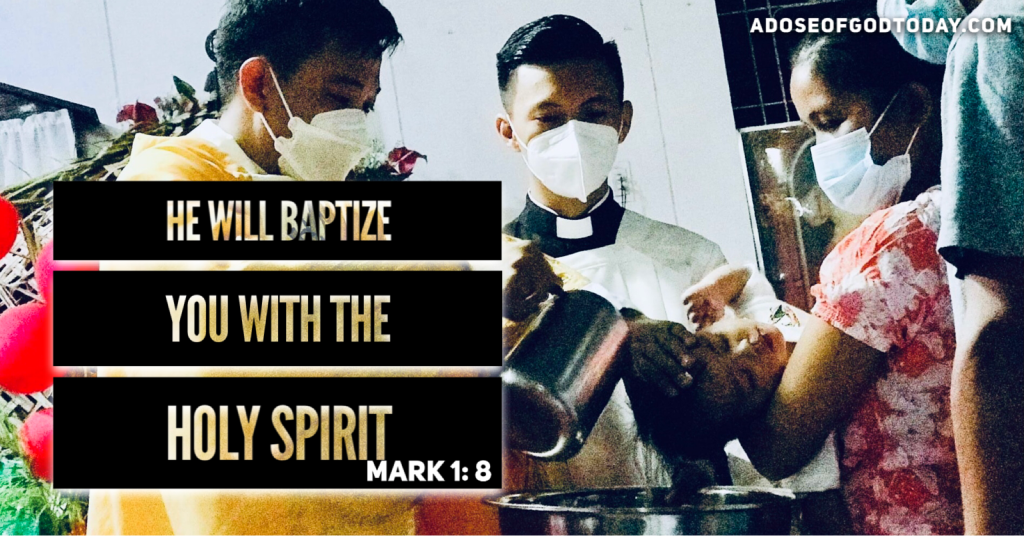
    Today on the Feast Day of the Lord’s baptism, we are reminded of who we are & how significant we really are before God & others, as God’s beloved Children. And we are also reminded on the very day of our baptism when we ourselves are consecrated, affirmed & confirmed to be always God’s beloved Child.

    This year 2021 is also a very important year for the Philippine Church. It marks not only 500 years of Magellan’s discovery of the Philippine Islands in March 16, 1521 but moreso of the first baptism happened in our land and the 500 years – five decades of Filipino Catholic faith. Although for more than three decades we have been colonized by Spanish rules, upon our independence, we did not abandon our Catholic faith but rather remain faithful to our Filipino faith that provides us the cultural values and principles that made us Filipinos as one nation and heritage, and as the only Christian nation in Asia with 86 % Catholic among more than 100 million Filipino people all over the world. In other words, as Filipino nation & society, since then & until now, we identify, define & claim ourselves as baptized Christians, beloved Children of God.

    Perhaps as we begin this New Year amidst pandemic times, the best Message you may hear today is to proclaim to yourself & other that :

    I am God’s beloved – a valued, valuing, & valuable person whom God’s favor rest & God loves now & forever.

    And as Filipino Christians, we proclaim to ourselves & others that:

    We are God’s beloved – a valued, valuing, & valuable people whom God’s favor rest & God loves now & forever. For that is who we are, who you are, & who I am. Amen.
  • There is more in our Faith

    There is more in our Faith

    January 10, 2021 – Feast of the Baptism of the Lord

    Click here for the readings (https://bible.usccb.org/bible/readings/011021.cfm)

    Are Filipinos more religious because of Covid-19? This is the title of the analysis of Jayeel Cornelio, PhD, a sociologist of religion.[1] This article was published in October 25 at rappler.com. The article discussed significant subjects particularly on the survey done by Pulse Asia last September 2020.

    The survey revealed that 51.8% of Filipinos have become more religious during this pandemic. According to Dr. Cornelio, this is not surprising because of two reasons.

    First, we are known to be one of the most religious societies in the world. And according to Pew Research Center, 96% percent of Filipinos find it “necessary to believe in God in order to be moral and have good values.”

    Second, Dr. Cornelio said, “faith is our immediate resource in times of crisis.” Citing another survey by the Veritas Truth Survey, it revealed that 89% percent of the responders of the survey said that faith is “very important” in the fight against Covid-19.

    From here, the sociologist also concluded that because of the “vulnerable social and economic context,” that is, being a third world country, the pandemic promotes a higher religiosity in us. In his words he said, people in poor social conditions such as having “inadequate health care, high incidence of conflict, and unreliable state agencies”  – people feel that they can turn to nothing else but faith in God.

    Indeed, it is when we become vulnerable and poor that we become more conscious of God’s presence. When we become more aware that we have actually nothing and are nothing in this world, that we also begin to realize of that great presence of God.

    A very comfortable life, a rich and powerful lifestyle can easily bring us into the attitude of indifference. It is indifference that prevents us to recognize that God is with us and continues to be present in the world.

    Moreover, at the end of his article, Dr. Cornelio also wrote that “there is so much more to COVID-19 than simply challenging the core of people’s religious convictions. In the end, it’s not just that Filipinos have become more religious because of this crisis. They are also beginning to seek something ‘more’ from their faith.”

    This sociological analysis brings me now to our very identity as baptized Christians. More than this survey of our religiosity, there is also a need to examine ourselves whether we have grown really in our faith, in our relationship with God and with one another. Our faith is not just about kneeling and standing, holding a rosary and saying our novenas. As Dr. Cornelio said, there is something “more” that we begin to seek from our faith. This “more” is something that I invite you now to pay attention as we celebrate this Sunday the Feast of the Baptism of our Lord Jesus.

    To be able to discern this “more” from our faith, allow me to journey with you through the readings and to see how God reveals His invitations for us today.

    In the first reading, Prophet Isaiah proclaimed the presence of the Servant of the Lord. The servant’s identity were described in three points. First, the Lord said,  “he is my chosen one with whom I am pleased.” This servant is loved very much by the Lord God, thus, God’s presence rests upon him. Second, the servant is to bring justice through compassion and gentleness of his presence and not through violence and force. Isaiah described and said, “a bruised reed he shall not break, a smoldering wick he shall not quench.” This servant is hope for those who are hopeless and are suffering. Third, the servant is to open the eyes of the blind and free prisoners and those who live in darkness. The servant who brings hope also brings peace, freedom and new life.

    The Psalm also stated this, “The Lord will bless his people with peace.” Peace here is living in the presence of God who is present in all creation. And the recognition of God’s presence in everything and in everyone brings us to show respect and love.

    This very promise of God is fulfilled and revealed in the Acts of the Apostles and in today’s Gospel. In the Acts of the Apostles, Peter proclaimed that this servant whom God chose is Jesus of Nazareth. He is anointed with the Holy Spirit and power. This is shown in the ministry of Jesus “in doing good” and in “healing the oppressed by the devil.”

    This is what we also find in the Gospel of Mark. The baptism of Jesus was a revelation to us that Jesus is the servant spoken by Isaiah. The scenarios in the Gospel are also very important told to us in three actions.

    First is the “immersion of Jesus in the water” was an expression of complete confidence in the Father. The Psalm proclaimed to us that “the voice of the Lord is over the waters, the Lord, over the vast waters.”  Here, Jesus allowed the power of His Father to embrace him.

    The second action is the “Spirit descending like a dove.” This is the very presence of God allowing our eyes to behold where it rests. The Spirit of God is in Jesus, the Lord who is among us. This tells us of the presence of God not just above us, but here among us.

    The third action is the voice heard coming from heaven saying, “You are my beloved Son, with you I am well pleased.” This has been proclaimed also by Isaiah.

    Indeed, this feast of the Baptism of the Lord tells us something important about our own baptism which we share in Jesus. This is where we also find the “more” in our faith. The “more” in our faith asks us not to be passive-believers but to be active-believers. The “more” in our faith tells us now of four points. These are invitations that you can bring with you today.

    • First, we are all loved. Never forget that.
    • Second, God’s presence is among us. We do not have to look above and seek God’s presence in the clouds. Look around also. God’s Spirit rests here among us.
    • Third, our baptism compels us to bring justice and peace. Isaiah reminds  us that this will be realized not through violence and force but through compassion and gentleness of our presence.
    • Fourth, to bring justice and peace is to also participate in the ministry of Jesus. This ministry is to open the eyes including our eyes blinded by greed, anger and indifference. And to free our hearts imprisoned by hatred, sin and guilt.

    Thus, the “more” in our faith is to make Jesus more present in our actions and words, and more present in our hearts, homes and communities. Hinaut pa.


    [1] See his article in https://www.rappler.com/voices/thought-leaders/analysis-are-filipinos-more-religious-because-covid-19

  • Look at God, and you will be at rest

    Look at God, and you will be at rest

    Advertisements

    May 31, 2020 – Pentecost Sunday

    Click here for the readings (http://cms.usccb.org/bible/readings/053120-day.cfm)

    Corrie ten Boom, a Nazi concentration camp Christian survivor of the Holocaust once said, “If you look at the world, you’ll be distressed. If you look within, you’ll be depressed. If you look at God, you’ll be at rest”.

    Though her words was spoken of World War II’s genocide of European Jews, somehow these words also describe our present reality in today’s pandemic world. When we come to think of it, distressing it is to find that our world we live in now is sick, infected and under serious death-threat.  Worse, as we try to cope with its daily challenges, and as our leaders are doing what they can to protect us from this threat, there are still quite a number of people who are in denial, resorts to blame game and even do stupid acts at the expense of and putting others’ health in jeopardy.

    Also, not only mental health problems and concerns are of rise nowadays, depressing it is to find ourselves  isolated, limited and quarantined. In the midst of our challenging reality, we do find ourselves stressed, restless, and helpless.  From our perspective, distressing and depressing our life these days is and can be. However, as Corrie suggests, if when we go beyond our perspective & try to see it with God’s perspective, we will find consolation and meaning in what is happening in our lives and what we are going through now. Thus, “if you look at God, you’ll be at rest.”

    As our risen Lord made himself known to them in our gospel, Jesus gave His disciples three gifts. First, the gift of Peace: “Peace be with you” – as healing consolation for their troubled and anxious heart during difficult times. Then, the gift of mission “I send you” – as direction and mandate to be His living witnesses in present the world.  And above all, the gift of the Holy Spirit: “Receive the Holy Spirit” – as power, courage and guide to respond to the challenges of faith and life ahead. Peace, Mission & Holy Spirit are our risen Lord’s gifts he left behind for His disciples then & for us now His church, as necessary components to live out and practice our faith in our very lives as His living witnesses to the world today. And behind these gifts is the call to “Look at God”, that is, the challenge to go beyond ourselves, rise above the occasion, and be inspired.

    Meaning, “Looking at God” invites us to go beyond our views of things and discern God’s plan and will for our “is and can-be” distressing and depressing life. “Looking at God” provides us also with identity, meaning & authority to fulfill our very mission and tasks in this life – thus, rising for the occasion to share our unique gift we can offer in this life. And “Looking at God” is to be IN God’s spirit – to be in one spirit, mind and will with God, whenever, whatever, however, wherever life has in store for us.  

    Advertisements

    Moreover, we look at God through our Lord Jesus Christ. Our first reading reminds us that on the day of Pentecost, as they receive the Lord’s gift of Holy Spirit, the frightened disciples of crucified Christ is now transformed into brave heralds of God’s mighty works. As St. Paul insisted, only inspired and empowered people who look at God can say and can go out and proclaim: “Jesus is Lord”.  Jesus thus moves us to look at God and inspire us to be His living faithful and practicing followers.  Interestingly, somehow nowadays many so-called “non-practicing Catholics” have updated their status into “practicing Catholics again” – even without (or with limited) avenue for public worship, not only as a reaction to the challenges of our trying times but more so because they “look at God in Jesus” again and anew for consolation, direction & inspiration in their own very lives.Today we celebrate Pentecost Sunday, which marks the birthday of the Holy Church, and the end of Easter Season for this year. Beyond the distressing and depressing challenges of our life ahead this time, may we be reminded that we are (& our church is) an inspired Church continually looking at God through our risen Lord Jesus. With  our risen Lord, may we go beyond our present predicament, rise for the occasion to be His living witnesses, and always be inspired to share our gifts and proclaim Jesus to our world today. Amen. 

    (By: Fr. Aphelie Mario Masangcay CSsR, a Filipino Redemptorist  Missionary stationed in Gwangju South Korea, though now still stranded in Cebu until further notice for available flights.)

    Join 2,850 other subscribers
  • Waiting for your RATION? Let the Spirit fill you up

    Waiting for your RATION? Let the Spirit fill you up

    Advertisements

    April 23, 2020 – Thursday of the 2nd Week of Easter 

    Click here for the readings (http://www.usccb.org/bible/readings/042320.cfm)

    The reading that we have heard from the Acts of the Apostles tells us of two different attitudes. We have the attitude showed by Peter and the other apostles and the attitude of the Chief Priest and other religious authorities in Jerusalem. These two groups of people expressed different attitudes towards the gift of the Spirit of God.

    We have heard how Peter and his group showed their tremendous confidence to preach about Jesus. Peter who denied Jesus three times and the others who also fled and hid because of fear came out from their hiding places. Through the gift of the Holy Spirit they have been inspired. Though they have failed Jesus and were unfaithful to him at his most difficult moment, yet, these fearful and unfaithful disciples sought forgiveness from Jesus. 

    Hence, despite their fears and doubts, they allowed the Lord to enter into their lives and to give them peace. This openness from Peter and the rest of his group allowed the Lord to come in, to bring change into their lives and give the peace and joy that the resurrection brings.

    Because of this, Peter and his group had become more grateful to God for the tremendous love and faithfulness that they have felt. This gratefulness in their heart moved them to be bold in words and deeds by preaching publicly the life of Jesus.

    Fear no longer paralyzes them. It was peace and joy that overwhelmed their hearts because Jesus was with them.

    Now, this is a manifestation how the gift of the Spirit transformed those who accepted it wholeheartedly. The gift of the Spirit, as the Gospel of St. John tells us, is not rationed, or limited or controlled as what is happening with the food ration distributed to many communities during this time. In God, there is no pandemic or any virus that can prevent the abundance of the gift of the Spirit.

    We might be waiting for our food ration to arrive, but there is this vital gift that is waiting to be received by us. The gift of Easter, this gift of the Spirit that the Gospel tells us is abundantly gifted to us. God does not ration the gift of the Spirit. God gives the Spirit lavishly. Thus, our poverty and not even this pandemic should prevent us from allowing the Lord to fill our hearts with His Spirit. We might be having a financial or economic crisis today, but there should be no excuse of being spiritually destitute these days.

    However, what can prevent the gift of Spirit to fill us and to transform our hearts into the likeness of the Risen Christ, is a hardened-heart. This is stronger than the virus and thicker than a concrete wall. As much as God wants every heart to be filled with the gift of the Spirit, but then God does not impose His power on us. God wants a willing and humble heart. 

    Advertisements

    Thus, the other group of people, the high priest and other religious authorities who remained close-minded, insecure and fearful to what Jesus can bring into their lives continued to reject Jesus. This rejection made their hearts stiff, unable to listen to the invitations of the Spirit. This rejection too prevented the Lord to enter into their hearts to bring peace and joy. 

    Consequently, these people continued to be filled with anger, bitterness, and insecurity. These attitudes towards God made them violent and corrupt. For this reason, they even wanted the apostles to be killed because they wanted to suppress the truth. They wanted to suppress the Gospel of life and of joy.

    This too will happen to us when we continually resist God’s invitation for us to be free, to be renewed and to receive his peace and joy, that is, the gift of the Spirit. These authorities had so much possession, they enjoyed wealth, and influence and power to the point that they did not want to move away or let go of those.

    We are called now that like the apostles we too will be able to let go of our fears and doubts and of those that whatever may prevent us from truly receiving Jesus in our life and in filling in, our hearts with the gift of the Spirit. 

    We may ask, “What are those attitudes, beliefs and even tendencies in me that makes my heart stiff and unwilling to receive the gift of the Spirit?”

    Hopefully, by being able to let go of those, then, we too shall be filled not by ourselves but by the Spirit who will lead and inspire us to share and preach the Gospel of life and the person of Jesus through our words and actions today. Hinaut pa.

    Jom Baring, CSsR

    Join 2,850 other subscribers
  • Have you been Born Again?

    Have you been Born Again?

    April 20, 2020 – Monday of the Second Week of Easter

    Click ere for the readings (http://www.usccb.org/bible/readings/042020.cfm)

    “Have you been born again?,” a Born Again Pastor asked me. Like Nicodemus, I was also stunned by the question. Then, he continued asking me, “Do you accept Jesus as your personal savior?” I said, “Yes.” And then, he told me, “You are now Born Again.” Immediately, he took out his notebook and pen and asked me to write my name on it and the date of the day and date of my birth. And so I did. 

    And I saw in his notebook other names of people with their details. He explained to me that those were the list of people he baptized just like me, a baptized Born Again by him.

    That encounter with a Born Again Pastor, reminds me of the very Gospel we have today. Jesus with his encounter with Nicodemus, a Pharisee said, “Unless one is born from above, he cannot see the Kingdom of God.” Yet, Nicodemus also responded, “How can a man once grown old be born again? He cannot reenter his mother’s womb and be born again, can he?”

    Nicodemus was referring for a physical rebirth of a person. However, Jesus speaks of a spiritual rebirth of a person. Consequently, Jesus invites Nicodemus to be born of the Spirit.

    To be truly born of the Spirit is not just a mere ritual but rather a way of life. In today’s language, we call it, “Lifestyle.”

    Each of us who had been baptized with water and the Spirit, is already “born again.” This is what Jesus speaks to us today. During the Easter Vigil and Mass on Easter Sunday, we were asked to light our candle and renew our baptismal promises. That rite was an invitation for us to be reminded of what we have received in our baptism when we were children, for those who were baptized as babies, and those who were baptized as adults too. Moreover, that rite also points to who we are, our very being, and that is, that we are all Children of God.

    Indeed, through our baptism we were born again and called to live our life filled with the Spirit of God. However, as we have lived our life and carry out our identity as Children of God, we might have not felt the Spirit within us perhaps because we have become “lukewarm” and indifferent, have taken things for granted, have become selfish by advancing our personal desires and wants, or have succumbed to what is only beneficial, easy and comfortable for us at the expense of others. These attitudes are signs that we are not allowing God to fill our hearts with the Spirit.

    To be truly born of the Spirit is not just a mere ritual but rather a way of life. In today’s language, we call it, “Lifestyle.” Thus, it means that it is not just a one-time event but an everyday commitment to live a life filled with the Holy Spirit.

    This is now the invitation for us today. Jesus calls us to re-examine our life on how we have lived our Christian life and carry out our commitment to God. We are called to identify the obstacles that prevent the flow of the Spirit in our life. We may want to start by recognizing the hurts, the pains, the traumas, even fears and doubts, our preconceptions, biases, attitudes and sins that hold us back from allowing the Spirit to inspire us, to mold us and to renew us.

    Hopefully, this may lead us to step forward by consciously making a faith-commitment to the Risen Jesus, who breathes into us the Holy Spirit. May it inspire us to develop a lifestyle that consciously prays, discerns the invitations of God and shows true concern to our brothers and sister.

    May this lifestyle be more active and inspiring especially in these difficult times brought by the pandemic Corona Virus. As we allow the Spirit to fill our hearts in this Easter Season, let us also fill with our kindness and generosity those who are most in need and vulnerable in this time of great crisis. With this, we are truly born again with Spirit. Hinaut pa.

    Jom Baring, CSsR