Tag: Healing

  • Hearts Known

    Hearts Known

    July 1, 2021 – Thursday 13th Week in Ordinary Time

    Click here for the readings (https://bible.usccb.org/bible/readings/070121.cfm)

    Jesus said in our gospel today: “Take heart, son. Your sins are forgiven.” The paralytic & his friends came for healing, but they rather received more than what they bargain for. Instead, they got encouragement & forgiveness from Jesus. Yes, their present immediate concern must be for healing from physical paralysis. But beyond the hopeless bodily outward condition of the paralytic, his friends & himself must have felt the guilt, shame & curse of the inner condition of the paralysis and sickness. Beyond & more than physical healing, deep inside, the paralytic & his friends need & are longing for mental, emotional & spiritual healing. This is what Jesus gave them – not only physical healing but moreso, encouragement & forgiveness, – not only healing of body but more so, healing & health of whole life of the cured paralytic & his friend.

    For the scribes, however, the whole miracle happened is a blasphemy. For the scribes, not only the physical healing of the paralytic but above all the forgiveness of sins are complete violation of their religious law. They saw more the violation rather than the miracle happened. Jesus admonished their actions & attitudes, & showed themselves & the crowd His authority beyond their religious laws. Healing & forgiveness are His’ because He is of God.

    And all of these happened because Jesus saw and knew their hearts. Jesus saw the faith of the paralytic & his friends. Jesus saw the evil thoughts and hearts of the scribes as well. Jesus knew their hearts. And Jesus knows the condition of our hearts as well. Our hearts are known to Him as well.

    A lot of things are happening in our lives nowadays. At the very surfaced level, lots of things going on, lots of pressures & stresses to cope with. We do have a lot on our plates – urgent pressing concerns. But what is the condition of our hearts? How are we deep inside ourselves? Like the scribes, at times, we do have our evil thought & bad hearts. Like the paralytic & his friends, many at times we do feel broken, hopeless, tired & confused with life nowadays.

    Be mindful then that the Lord knows how & where are hearts is. Our hearts are known to Him, for He sees what we deeply need at this time. Same way as he saw the faith of Abraham, He sees also our faith & our heart’s desire. He is with Us indeed, but also He is of God. He has the power & authority to respond for what we really need, – not only our urgent need but the heart’s desire of our whole person & life.

    Perhaps as we go through this day & this week, we ask & reflect on the condition of our hearts these days. What is happening in our hearts these days? We do believe our Lord wants us to be healthy & whole. What is he offering us these days? Encouragements, forgiveness, admonitions & guidance? How is he restoring us inwardly? How is he helping us to stand up tall & alive amidst life-challenges?

    Here we are now, Lord. We come to you as we are. You know our present concerns & our heart’s desire. We do believe in You & that You will what is best & better for us. Make us also see same way as You see us, so that may we be willingly participate with the miracle You are performing for us now & always. Amen.
  • Musta na? Howdy?

    Musta na? Howdy?

    June 27, 2021 – 13th Sunday in Ordinary Time

    Click here for the readings (https://bible.usccb.org/bible/readings/062721.cfm)

    “O, Kamusta na? How are You? Are You Ok?”

    Usually whenever we meet each other, we greet one another with these words. Through these words, we commonly express our concern for each other’s health and wellbeing. We acknowledge as well that human as we are, we are all prone to hurts, diseases, and sicknesses. Even the healthiest of us live with fear of accidents and diseases that can suddenly render us limited on the sidelines. Nobody likes to get sick. But nobody can claim that he/she has never got sick before. Easy for us to say “Bawal magkasakit? (It is not allowed to get sick), but tayo ay nagkakasakit (we do get sick). Sickness cannot be denied. To get sick is part of our human nature. So, since we are subject to sickness, it is natural for us to ask about the health and wellbeing of others, especially those we have not seen for awhile.

    But what does it mean to be sick? Based from our experience, to be sick is more than just an experience of physical illness but a wide range of emotional, mental, psychological, and spiritual diseases and discomforts. Whenever we get sick, we become incapacitated. Normal for us to feel limited, dependent, depressed, irritable, helpless, and sometimes alienated or outcasted from God and others whenever we are sick. We know that it is not easy to get sick, especially when we are used to live our life independently and always in-control. Sickness is indeed a dreadful experience, as what was also described in our Gospel today.

    Our gospel today shows us as well that to be sick may be a horrible human experience but could also be opportunities for growth and a chance for life anew.

    First, sickness can be the opportunity to be converted. Jairus and the woman with hemorrhage came to Jesus. Coming to Jesus is an experience of conversion – a humble turning toward instead of turning away from Jesus. Whenever we get sick, we usually cease from our usual routine, go home and take a rest. It is in sickness that we break from our selfish ways and turn back towards God’s love and concern. Others would say that when we are sick, we desire and come to acknowledge God’s presence and appreciate God’s love in our lives. When we are healthy, we say, “Disco, Disco” but when sick, we say, “Dios ko, Dios ko”.

    Sickness can also be the opportunity to have faith and trust in God and others. Jairus begged to Jesus, “Please come lay your hands on her, that she may get well and live”. The woman aspired “If only I could touch his cloak, I shall be cured”.  To be helpless and dependent of others are not normal for us. We rather be in-control and not needing others. But to be sick is humbling for you really need and have to trust on others. In sickness, we surrender ourselves and humbly ask for God’s mercy and rely on God’s providence, and the help of others.

    Sickness can also be the opportunity to be cleansed and be healed by God. In sickness, we witness God’s mercy, love, goodness, and miracles working in us. That through our faith and Jesus’ concern for us, God’s power and love is made known to all. In our weakness and sickness, God’s power and glory is revealed to you & to all.

    Sickness can be also opportunity to hear once again & anew our vocation and mission life. When the woman was healed, Jesus calls her to “go in peace and be cured of your affliction” which means to be reconciled with herself and others who may have caused her afflictions. The girl is called to “arise” which mean to stand up from despair and have hope in life. Being healed from your sickness is a reminder that you are given another life – another new chance in life to make things right and better than before.

    And lastly sickness can be an opportunity to proclaim our faith. Just like the cured woman and girl, our healing from sickness makes us express and share our faith to others, and through our healing, others will see and witness God’s love revealed through us and come to believe more in Him. 

    To be sick then can be the opportunity to be converted, to have faith and trust in God, to be cleansed and be healed, to renew life-commitments and mission, and to proclaim our faith for others to believe.

    Yes, no one wants to get sick. But whenever you got sick, take it not as disgrace but opportunity for God’s glory to be revealed in You. In other words, “A blessing in disguise”. So, Kamusta na? How are you coping? Perhaps God is healing us & through us, God is revealing something better for all of us in life.

    During these pandemic times, in times of sickness, discomforts, & distress, let our prayer be like that of Jesus, saying: “Father, take this cup of suffering away from me, However, not my will, but Your will be Done.” Always & Forever.

    Siya Nawa. Hinaut pa unta. So be it. Amen.

  • GIVING LIFE BY TOUCHING THE LIVES OF OTHER WITH KINDNESS

    GIVING LIFE BY TOUCHING THE LIVES OF OTHER WITH KINDNESS

    February 14, 2021 – Sixth Sunday in Ordinary Time

    Click here for the readings (https://bible.usccb.org/bible/readings/021421.cfm)

    When I was on my first year college in the seminary in Cebu, I met Nanay Elisabeth, an old lady, sick with leprosy. Despite her illness she was very welcoming. She was in fact the most talkative in their ward. Like a Nanay, she was very affectionate to us seminarians. I usually would come to visit the ward where Nanay Elizabeth was on Saturday afternoons to mingle with leprosy patients and make friends with them.

    The many visits I made formed friendship with them and especially to Nanay Elizabeth who always would offer her leprosy-infected-hand, but healed, for us seminarians to receive her blessing. In one of those visits, Nanay Elizabeth shared her life story which touched me very much.

    Due to her illness, she never got married. Life was so difficult because she was poor. In her younger years, she was into scavenging garbage in Cebu. One early morning, as she approached a garbage bin to collect recyclable materials she found something. She actually found “someone” inside the garbage bin that others might have thought, was a trash.

    Nanay Elisabeth found a newly born baby girl in that garbage bin. She named her Nancy. Nancy, perhaps, a reason why she was thrown away was because Baby Nancy had a cerebral palsy. Nancy was sick and in the minds of many, they might have believed that she was a cursed baby and useless. But what was more heartwarming there, was Nanay Elisabeth’s unconditional love for the baby. The baby was unwanted but for this young woman, Elisabeth, all her love and affection were for Nancy. She brought Nancy home and did all her best to let Nancy feel that she was loved and treasured.

    However, when the signs of leprosy began to appear to Nanay Elizabeth, that became a painful part of her life because she had to leave Nancy to a group of Religious Sisters while she had to be in the leprosarium to be treated. Nanay Elizabeth’s heart ached daily because she longed to see Nancy.

    With some of my classmates, we went to that center where Nancy was, visited her and took pictures of her so that Nanay Elizabeth would have a glimpse of her daughter.

    This is a story and an encounter that proves kindness and love in the human heart that values human life and worth despite its seemingly ugliness. It tells us that no matter how poor we are, wounded or imperfect we are in the eyes of many – we can give life to others by touching the lives of those who need most of our love and kindness.

    This brings me into the story of the Gospel. A leper found love and kindness in Jesus. In the Biblical times, a leper was nobody. A person who has leprosy is removed from the community. It means that the person is forced to leave from the comfort and presence of friends, family and relatives.

    The Jews at that time believed that leprosy was an ultimate punishment for sin. A leper was considered a terrible sinner punished by God and thus unclean, unworthy and worthless person. This became a form of treating a leper as less than human or not human at all.

    Jews would avoid them at all times. This is what we find in the Book of Leviticus that prescribed on what to do with lepers. They are to stay outside the camp, that is, outside from the daily affairs of his/her family and community. A leper has to make known himself by shouting, “Unclean! Unclean!” to warn the people of his presence. Everybody will never get near and come close to a leper for fear of being infected and worst of being considered as unclean too. Though there was a medical explanation for this, as isolation of the infected will protect the community. However, later on, this also fostered a culture of indifference and discrimination to the sick.

    Yet, our Gospel conveys to us a shocking and moving turn of events. A leper should never get near to a Jew and a Jew should also immediately avoid any contact with a leper. But then, it was so shocking for all the Jews to see a leper coming closer to Jesus asking the Lord to cure him. What was more surprising there was the gesture of Jesus towards the leper. Jesus touched the leper!

    The Lord touched a worthless person, an unclean and less human leper. And when that touch of Jesus happened, it destroyed the wall of indifference among the Jews towards the poor leper. The touch of Jesus assured the leper that he was not worthless at all, that he was not less human but, he was loved and cherished by the Lord who longed to see him joyful and healed.

    Jesus was moved to touch the leper because the Lord looked with pity on him. This feeling of pity described in the Gospel is not a “shallow feeling” that we usually have when we see a beggar or a person with difficulty, and we feel pity for him/her, but then we go along with our life and forget about the person. No, it is not that way. What Jesus felt was true pity where he too felt the sorrow and pain of the leper. In fact, Jesus was so distressed and disappointed to see the situation of the leper. This moved him to do something, and that is, to touch the leper in order to cleanse him. By doing that, Jesus broke the barriers of disgust, shame and fear that prevented the leper to be accepted by the community. Jesus changed those negative feelings and indifference with kindness and love.

    This is how the Lord calls us on this day of Feb-IBIG, on this day of love, that we too will recognize persons in our community today who have been left out, abandoned and disgusted by many, so that, like Jesus we may also be able to touch them and show kindness and love.

    As we remember and celebrate today what love can do, let that love in us also counter the growing indifference towards those whom our society identifies as worthless, useless and less human. To counter such injustice and indifference, never ever treat anybody as less human or useless because of their imperfection, because of their sickness or because of their failures in life.

    Let us also not forget that each of us has our own leprosy, imperfections and sins that would qualify us as unclean before God. However, God showed pity upon us and became human like us so that Jesus may touch us to heal us.

    Let us now share to our families and communities the touch of God that we have experienced so that like Nanay Elizabeth who despite her own situation, we too may be able to give life to those who need it, to give joy to those who are sad, and to give hope to those who are hopeless. Hinaut pa.

  • GOD of Second Chances

    GOD of Second Chances

    February 14, 2021 – Sixth Sunday in Ordinary Time

    Click here for the readings (https://bible.usccb.org/bible/readings/021421.cfm)

    “How are you? Fine! And you? OK” (Kamusta na? Ok. Ikaw? Ok lang”).

    Usually, we say these words of greeting to express our concern for the health and wellbeing of others, and in recognition that all of us are & can be subject to hurts, pains, and sicknesses in life. Even the healthiest of us live with fear of accidents and diseases, which can suddenly place us on the sidelines. Nobody likes to get sick. But nobody can claim that they have never been sick in life before. Sickness cannot be denied. To get & be sick is part of our human nature. Normal for us then to ask about the health and wellbeing of others whom we have not seen for a while, and meet once again. 

    But what does it mean to be sick? Experience teaches us that to be sick is more than just an experience of physical illness but a wide range of emotional, mental, psychological, and spiritual diseases. Whenever we get sick, we become incapacitated and limited. We feel dependent, depressed, irritable, helpless and sometimes isolated and alienated from others, and even feel abandoned by God. We know that it is difficult to get sick, especially when we are used to live our life independently and always in-control. Sickness is indeed a dreadful experience, as what was also described in our readings today.

    In our gospel today, we may realize that our life-experiences of sickness, though dreadful and difficult, could also be opportunities and another chance for growth and life.

    First, sickness can be the opportunity to be converted. The leper came to Jesus. Coming to Jesus is an experience of conversion – instead of turning away from, it is a turning back and toward Jesus. Whenever we get sick, we usually cease from our usual routine, go home, and take a rest. It is in sickness that we need to have a break and be with ourselves & with our God in Jesus, as our Psalm would say: In time of trouble, I turn to you, Lord.”

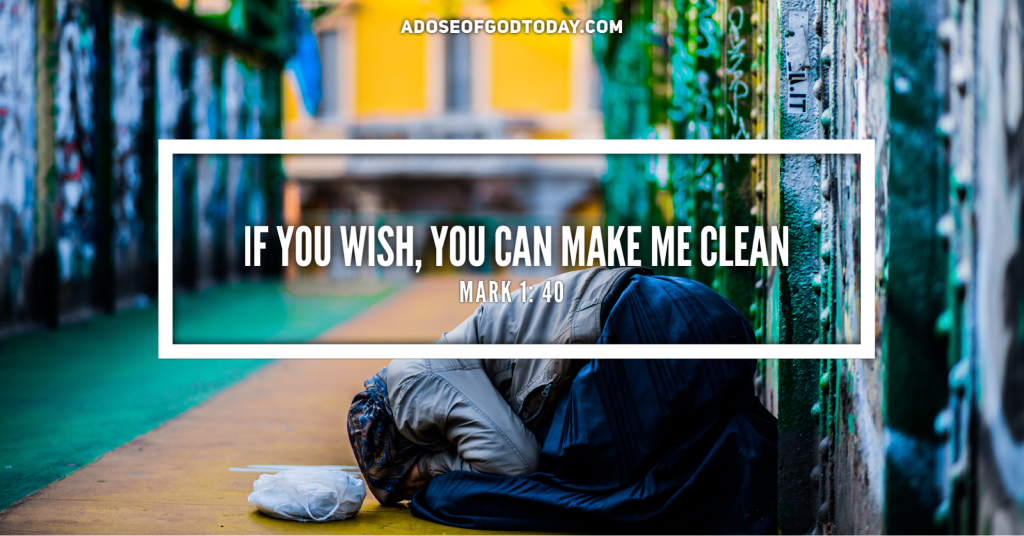
    Sickness can also be the opportunity to have faith and trust in God and others. The leper begged to Jesus, “If you will, you can make me clean”. It is not normal for us to be helpless and dependent on others. We rather be in-control and not needing others. But to be sick is humbling indeed for we really need to stop being independent and on your own, and have to trust on others’ love and care again. In sickness, we thus surrender ourselves and humbly ask for and rely on God’s mercy and providence through others.  Amusingly: “Kon maayong lawas: Disco-disco; kon masakit, “Dios Ko-Dios Ko”. PagMalusog- Disco, PagMay-sakit: -Dios ko. In health: Disco, in sickness: My God”

    Nevertheless, sickness can also be the opportunity to be cleansed and be healed. In sickness, we witness and experience God’s mercy, love, goodness, and miracles working in us – happening to us. That through our faith and Jesus’ concern for us, God’s power and love is made known to us and others. In our weakness and sickness, God through Jesus wills our healing & His power and glory is thus revealed in us.

    Sickness can be opportunity to be reconciled – i.e. to makes things right- with others. Jesus asks the leper to show himself to the priest and offer himself to the Church. Through the sacrament of anointing and reconciliation, we offer ourselves back to God’s church and renew our promises before the Lord.

    And lastly sickness can be an opportunity to proclaim our faith – to share our experience of sickness and healing. Just like the cured leper, our healing from sickness makes us express and share our faith to others. 

    To be sick then can be the opportunities for Christian conversion, faith, healing, reconciliation & mission.

    In other words, getting and being sick can be all about “Second Chances” – another chance for God through others to love and take care of us again, and another chance for us to make things right and better for us & others again & anew.

    Yes, nobody wants to get sick. And we try not to get sick. But whenever we got sick, take it not as disgrace but rather as “a blessing in disguise” – an opportunity and chance for God’s glory to be revealed in Us and through Us.

    In this Eucharist, may our hearts & love be with those who are sick and suffering any illnesses at this time in their homes & at the hospitals. During these pandemic times, may our prayers be also with Jesus who prays to our Father, “Take this cup of suffering away from me, However, not my will, but Your will be Done.”

    So Help us God. So May it be. Amen.

  • TO A SWEET AND LIBERATING EXPERIENCE WITH JESUS

    TO A SWEET AND LIBERATING EXPERIENCE WITH JESUS

    FEBRUARY 14, 2021 – 6TH  SUNDAY  IN  ORDINARY  TIME 

    Fr. Manoling Thomas, CSsR

    Click here for the readings (https://bible.usccb.org/bible/readings/021421.cfm)

    A Norwegian scientist by the name of Gerhard Hansen discovered the biomedical cause of leprosy in 1868. The first effective treatment became available only in the 1940s. The vaccine against leprosy was developed by the scientist and doctor, Jacinto Convit of Venezuela. Today leprosy is curable!

    With this development in the field of medicine and science, many biblical scholars are now quite sure that what the Bible calls “leprosy” in the Book of Leviticus chapters 13-14 and in our Gospel today is not exactly the same “leprosy” that we now know of! Leviticus describes this “leprosy” as “repulsive, scaly condition” similar to a skin disease we call “psoriasis”. But whether it is “leprosy” or “psoriasis”, surely none of us would like to be infected with either of those diseases.

    The divine command to “be holy as the Lord your God is holy” [Lev. 19:2] was interpreted and understood that “holiness” encompass many qualities, not the least important of which was bodily wholeness and integrity! Therefore those physically imperfect e.g. the blind, the lame, the hunchback… [Lev. 21:16-20], were not allowed to approach the Lord. Those afflicted with “biblical leprosy” were isolated and required to live outside “the camp” [13:46].

    In Jesus’ time to be infected with “biblical leprosy” was like being condemned and sentenced to a “living death.” Although still physically alive, yet one was physically isolated, separated, and cut off from one’s loved ones and from the mainstream of society. The leper had to say good-bye to home, the family and friends, and even to the place where one used to live. They had to accept and be ready for rejection and judgment from the rest of society. Lepers were thought of by many as cursed by God. Religiously and spiritually, a leper was considered “unclean” and therefore not worthy to join the community in their religious worship. One would need the written clearance from the religious authorities and had to make the religious offering commanded by Moses, before that leper was allowed to re-integrate with one’s family and community. In today’s Gospel Jesus ordered the leper he cured, to fulfill these requirements so that he could rejoin his family and his community. [Mk. 1:44].

    To be infected with “leprosy” in Jesus’ time was like dealing with a “dark, scary, painful or embarrassing” area in one’s life! This “dark, scary, painful or embarrassing” area can be in the form of one’s struggle with various forms of addiction, or painful trauma from which we feel helpless to get out of! But we have to be freed from it, if we are to experience real peace, total healing, wholeness, and reconciliation in our lives. We have to courageously face and confront that “dark, scary, painful and embarrassing” area. And that is not easy! It was said that one time, after St. Francis of Assisi decided to embrace a leper, he remarked: “What before seemed bitter was changed into sweetness of soul and body.” What you thought of to be a dreadful and a painful confrontation with your “dark and scary past” can end with a sweet and liberating experience!

    The leper took the risk of approaching Jesus and of begging him that he be cleansed! Jesus’ compassion for the leper moved Jesus to violate two important prohibitions in the Law: to allow the leper to approach him, and to touch the leper! Both Jesus and the leper took risks so that real healing, wholeness and freedom would take place! The leper had faith in the power of Jesus! The leper’s faith and Jesus’ compassion enabled the leper to leave the “dark area” of his life and to move on! Would you also like to give Jesus a try?