Tag: Gratitude

  • Be Grateful! Be Generous!

    Be Grateful! Be Generous!

    February 20, 2025 – Thanksgiving Mass (Baccalaureate)

    Mt 7:7-11


    A reading from the holy Gospel according to Matthew.


    Jesus said to his disciples:

    “Ask and it will be given to you;

    seek and you will find;

    knock and the door will be opened to you.

    For everyone who asks receives;

    and the one who seeks finds;

    and to the one who knocks, the door will be opened.


    Which one of you,

    would hand his son a stone

    when he asked for a loaf of bread,

    or a snake when he asked for a fish?

    If you, then, who are wicked,

    know how to give good gifts to your children,

    how much more will your heavenly Father

    give good things to those who ask him,

    do to others what you would have them do to you,

    this is the Law and the Prophets”

    I would like to ask you first to look at the person beside you now, on your right and on your left. Look at that person and say “thank you.”

    It is just fitting for us to say thank you to people around us; especially, to you graduates, to be grateful to people who have been part of your journey as students. And so please take time to express your gratitude to your friends and classmates, to your teachers and the non-teaching staff of this university, to your nanay and tatay and your brothers and sisters here in the Chaplaincy, to your parents and siblings, and of course to God the source of all wisdom and knowledge.

    Now, as you go forward in life with your different paths and career; you will have a new environment, new people to meet, new experiences to behold, new realizations and discoveries that will mold you and mistakes and failures that will continue to teach you lessons.

    As you go forward, I want you to remember always to have an attitude of GRATITUDE, of just being thankful as a person. So, if I would ask you, “With all the pains and joys, successes and failures, sins and graces, how grateful are you today?”

    GRATITUDE makes us see what surrounds us, both the good and the bad. GRATITUDE also allows us to be embracing and accepting of the things and people around us. It is when we are grateful too that we become joyful persons. We shall see the goodness and uniqueness of others. Through this joy within us, we also become aware of God’s tremendous generosity to us despite our weaknesses and sins. In fact, this is what we recognized in our Responsorial Psalm, “We are nourished by the hands of the Lord.” The Lord indeed, is generous and provides what we need.

     And so, as we express our thanksgiving today on this special day of your life, remember that when we become joyful, we also become generous of ourselves towards the people around us, no matter who they are, whether they are our friends or strangers. Such acts of joy and generosity are expressions of a heart that is filled with gratitude.

    However, if our heart is without gratefulness but rather bitter, hateful and vengeful because of our personal failures and failures of others towards us, then, we become close-minded, rejecting, and vicious in the way we relate with one another and even in the way we relate with God.

    And so let us discern together how the Lord invites us today to grow in this confidence of being grateful particularly as we grow in our Christian faith and in prayer as our way of life.

    In Matthew’s Gospel, Jesus tells a parable to his disciples that basically highlights the attitude of persistence in prayer. “Ask and it will be given to you; seek, and you will find; knock, and it will be opened to you. For the one who asks receives, and the one who searches finds, and to him who knocks the door will be opened.”

    Jesus tells us of the generosity of the Father and of His availability for us. It signifies that God wants to give what is best for us and what is wonderful for us. Yet, what Jesus tells us should not be misunderstood also. We might think that we can just ask anything we want according to our selfish desires.

    True prayer keeps us away from our selfishness but brings us closer into God. This means that this relationship found in our prayer is a process of letting go of ourselves and letting God to work in us. This can be possible when we also learn to ask, to seek and to knock. This is an invitation for us to grow in confidence with God despite the many uncertainties that we may face in life, whether in our relationships, in our personal struggles, in our work and in any endeavor we are in at the moment.

    Thus, ask the Lord but we can only ask the Lord once we know what we desire. Hence, name what you desire. Name your problems to be solved. Acknowledge your concerns and recognize your issues. Only then, that we will be able to allow God to work in us.

    Moreover, Jesus would like to remind us that in these many areas of our life they also require more than asking. We too are in need to seek. This means that prayer is also a form of searching what is hidden or what remains undiscovered in us. To pray is not about searching God but to seek ourselves and to let God find us.

    Thus, seek for a deeper insight, seek for understanding and wisdom because God answers us not outside of us but within our own context, experiences and relationships.

    After such understanding and unfolding of mysteries in our life, we also want to move on, to go forward to where God is leading us. This requires now the attitude of knocking, which means seeking entrance, to enter into it. We might have realized that we have been so hurt by a loved one or a friend who betrayed us. And the pain that we have experienced made us inaccessible, scared and resistant to forgiveness. Now, Jesus tells us to knock, to look for an opportunity to take the risk of entering. Indeed, knocking a door is a risk because knocking here does not only mean one knock but a persistent knock repeated many times until the door opens for reconciliation and peace.

    The Lord in his mercy wants us to exercise our freedom, that we can make a choice for ourselves. To knock God’s door will lead us to many opportunities for growth, for peace and freedom. Jesus assures us that as we come before God to boldly and persistently knock, it shall be opened to us. God would willingly and lovingly open his door of forgiveness and affection to embrace us and to welcome us.

    In this way, we become children who are transformed into the likeness of Jesus, who will not throw tantrums when we do not get what we want just for our selfish reasons, but children who are fully aware that God’s desire for us is far better than our own.

    Therefore, as we ask, seek and knock may these become the very attitudes of our heart so that it will be molded into a grateful heart that finds God’s abiding presence and faithfulness in our life.

    Let us be more grateful then of the gifts and blessings that we have already received each day, no matter how small that would be. But if we have received so much also, be more thankful and be more generous.

    Remember, a grateful person is a person who goes forward, because when we are grateful we also become contented of the present, whatever there is. We also become reconciled with the past, whatever that was. And we become hopeful and positive of the future, whatever there will be. So, be grateful as you go forward by building and cherishing your relationships with your family and friends and people whom you will meet along the way of your journey. Be grateful and be generous! Hinaut pa.   

  • IT IS THE GIFT OF GOD

    IT IS THE GIFT OF GOD

    October 21, 2024 – Monday 29th Week in Ordinary Time

    Click here for the readings (https://bible.usccb.org/bible/readings/102124.cfm)

    Reaching a higher status or position in life could make us demanding and entitled to what we have achieved. A child who has been better than his siblings may demand more love, praises and attention from his/her parents for doing more and better. An authority figure or a colleague promoted to a higher position may also demand that he/she should be addressed according to the position he/she has gained, to be treated extra-special than others. A priest or nun may also demand from people or parishioners that he/she must be given this and that for his/her personal use and ministry because of his/her role in the church.

    A heart that has grown to be (self)-entitled demands from others because of the belief that “I have become this! I have become that! – and so I deserve and must be treated and pampered this way and that!

    When we ourselves become this kind of person, this can be very irritating and tiring to people around us. Consequently, we become demanding in our relationships. Our work or ministry is merely grounded on what we can gain and benefit from others. Our good works and performances are always counted as our way of gaining favors. Yet, the heart is in danger of being corrupted by greed. Jesus said in today’s Gospel, “Take care to guard against all greed, for though one may be rich, one’s life does not consist of possessions.”

    The tension and the conflict between those two brothers in the Gospel tell us how greed divides and destroys our relationships. The one who inherited the wealth from his father was the eldest who demanded that everything should only be for him because he was the eldest son. This was the culture before that reinforced the eldest son to be more self-entitled and indifferent.

    Jesus pointed this out also as he presented the parable of the rich man who after being contented only with that he possessed in this world had also become intoxicated by his own wealth and success. The rich man without any concern for others only saved for himself alone. His heart that has also grown entitled has become indifferent and unconcerned of the suffering of the people around him.

    However, Paul in his Letter to the Ephesians reminds us of this tendency in us. This comes from the “desires of our flesh, following the wishes of the flesh and impulses.” Yet, God who is rich in mercy, brought us to life with Christ – because of God’s great love for us.

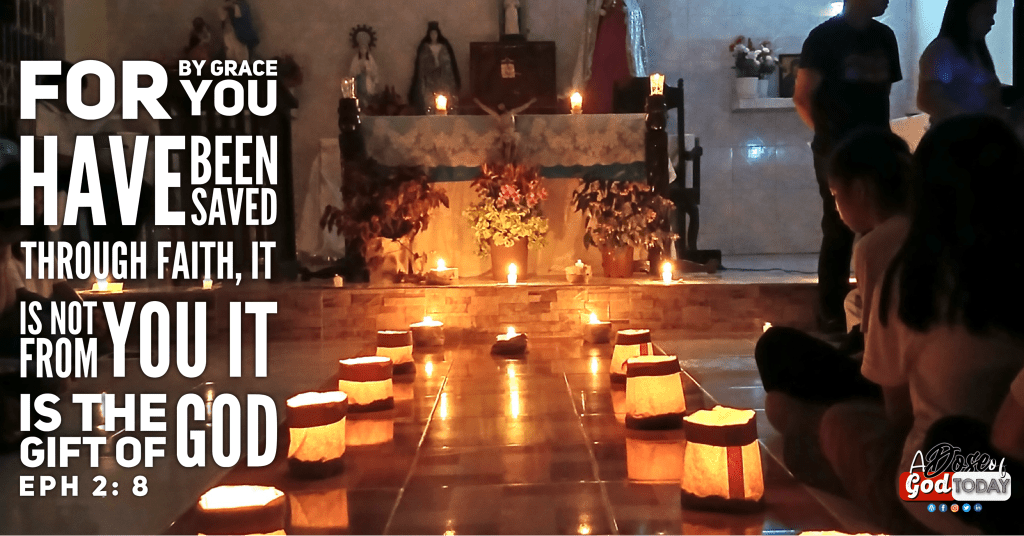
    Paul continued to remind us that this freedom is not caused by us or by any good works we have done. Paul said, “For by grace you have been saved through faith, and this is not from you; it is the gift of God.”

    This means that we are actually not entitled to this gift. Such gift of life and freedom, forgiveness and peace, even our talents, achievements and success, power and wealth we enjoy are God’s gifts! These gifts are God’s initiative because God loves us and kind to us.

    Our Psalm for today even reechoes of who we truly are before God, “The Lord made us, we belong to him.

    It is only right then, that we are actually called to give thanks to the Lord. The Psalm reminds us too, “Enter his gates with thanksgiving. Give thanks to him; bless his name, for he is good: the Lord, whose kindness endures forever, and his faithfulness, to all generations.

    From here, the Lord reminds us that the antidote to our self-entitled and demanding hearts is gratitude! No one is deserving and entitled to the graces and blessings from God. What the Lord grants to us, the life, healing and freedom that we received through faith in Jesus, is not caused by our merits or good works. Everything is God’s grace, because God is good, loving and faithful to us.

    We ask for this grace today, that we become more grateful to the Lord and to the many people around us. Let our gratitude be our ground as we do good things for others. Let our grateful hearts express concretely our faith in Jesus. Let us come near Jesus through the Sacraments of the Church, not because we are obliged, but because we are grateful. Hinaut pa.

  • GOD without Borders

    GOD without Borders

    October 9, 2022 – 28th Sunday in Ordinary Time

    Click here for the readings (https://bible.usccb.org/bible/readings/100922.cfm)

    The common belief among many Jews in Biblical times was that God was only for them. Yahweh chose them to be His people and thus, it was understood that the Lord God would only favor them and no other peoples except them. This belief made them exclusive to the point that outsiders are unwelcomed. More than this, God was as if being monopolized by the people and not wanting the Lord to be outside. This belief proved to be problematic and caused a lot of divisions, hatred and indifference among the people.

    Such form of monopoly can also be present and creeping even in our culture today as Christians among our groups and religious organizations. Like for example, there was a choir-group in a small parish who seemed to be so exclusive and trying to monopolize their services for weddings, funerals and even birthday events in the community. There were even particular songs they claimed that only them should sing and no other groups. They went further by advertising their choir group to the people to advance their singing services. As a result, such actions caused divisions and unnecessary conflicts and tensions in the Parish Community. Their exclusivity and monopoly become toxic.

    This belief and attitude of our heart, indeed, not just limit us but also limit God to be God. Our exclusivity and monopolizing attitude could make us unwelcoming and horribly indifferent towards others.

    This is something that the readings we have today on this 28th Sunday in Ordinary Time are trying to convey to us that God is without borders and our Church and all our communities cannot be exclusive and cannot monopolize God. So, allow me now to journey with you through our readings and see how God calls us today.

    In the first reading from the Second Book of Kings, Naaman who was a commander of a Syrian Army, went to Elisha to be cleansed from leprosy. Naaman was first told about Elisha by his captured-slave, a young girl from Israel. Naaman who was very desperate listened to her and went to Elisha. For the Hebrews at this time, their belief told them that this foreigner did not deserve to be cleansed of leprosy because he was different and an enemy. Yet, though it was not directly through Elisha, Naaman was cleansed as he was instructed by the prophet to plunge into the Jordan river seven times.

    This was something very significant here. Elisha was telling something very important. He did not even touch Naaman but only instructed him. Elisha wanted Naaman to realize the power and grace of God directly working in Naaman. Naaman understood this, hence, he was grateful for that encounter with the Lord. The gratitude of Naaman was overflowing and was transformed into action through his new found faith in God. Though Elisha refused to accept his gift, yet, Naaman in response worship the Lord from then on.

    This healing story of Naaman already tells us that God is not limited among the Hebrew people. God’s grace and favor cannot be monopolized by a particular culture or group. This is something we have heard as well in the Responsorial Psalm that clearly proclaims, “The Lord has revealed to the NATIONS his saving power.” Yes, the Lord’s presence is revealed to many nations not just to one nation, not just to a particular group of people or race or language. But to all.

    Moreover, today’s passage in the Gospel of Luke tells us also of another healing of a group of despised people, the lepers like Naaman. There were 10 of them who asked Jesus’ mercy so that they will be cleansed. Nine were Jews and one was a Samaritan. People won’t come near them for fear of contamination. This was the reason why they stood at a distance and did not dare to come near. Here, we can already notice the indifference among the people against them. These lepers were unwanted and unwelcomed, believed to be cursed by God.

    However, as the 10 lepers were on their way to the priest as instructed by Jesus, they were healed and cleansed from leprosy. This is where we find the turn of events and a seemingly more faces of animosity and indifference. Only one of the ten came back to give thanks to God for the grace of healing received. The nine did not, as Jesus also wondered. Well, we can also suspect that the nine Jewish lepers, they must have not believed that the Samaritan among them will also be healed and cleansed. It must be still in their hearts that bitterness and exclusivity.

    Upon seeing the Samaritan who was also healed, they must have felt bad and turned bitter believing that the Samaritan did not deserve such grace. This could be the reason why they forgot to give thanks to God. Their heart must be heavy and could not accept the reality that God also graces even non-Jews.

    However, God is not limited to any group of people. No one can monopolize the grace of God or claim that God is theirs alone because God remains faithful to all. Yes, God is faithful to all humanity and to all His creatures. This is what Paul reminds us in his second letter to Timothy. Paul who was already old and was in prison at this time reminded his friend Timothy, of God’s faithfulness even when we become unfaithful to the Lord.

    Thus, on this Sunday there are at least two points that I would like you to dwell.

    First, God is without borders. Meaning, we do not have the monopoly of God and of God’s grace. This invites us  then to be more faithful to our identity as Catholics, which basically means, universal or inclusive. Thus, let not our differences become a reason to be indifferent with one another, or become hostile with each other. We are all brothers and sisters, no one should be left alone and be apart from God’s family.

    Second, let our gratitude transform to active faith. Naaman’s gratitude made him worship God and the healed Samaritan Leper’s gratitude made him to give thanks to the Lord. So, let also our gratitude to the Lord become an expression of faith that recognizes God’s inclusive presence and grace to all. Hence, let our faith become inclusive and not discriminating. Let our faith gathers, not divides. Let our faith generates understanding and love, not hostility and apathy to those who are different from us. Kabay pa.

  • As Thanksgiving in Return

    As Thanksgiving in Return

    October 9, 2022 – 28th Sunday in Ordinary Time

    Click here for the readings (https://bible.usccb.org/bible/readings/100922.cfm)

    A man once never thought that he would donate blood in all of his life. Once, however, his child got very ill & hospitalized, and badly needed blood transfusion. Luckily, they were able to get a blood donor for his sick child. Now, as he watched the donated blood dripping through into his child’s veins, he suddenly realized that someone had shared & donated the blood that is keeping and helping his child alive. Straightaway he made up his mind to become a blood donor, himself, and he was as good as his word – regularly as needed donating blood as thanksgiving for the gift.

    Last Sundays’ readings were all about `Faith’. Particularly, in last Sunday’s gospel, we heard the apostles’ request to increase their faith. But Jesus reprimanded them by pointing out to them that God has given them enough faith and no need to ask for more because it is already given. In a way, Jesus directed us now and his disciples then that we cannot demand God to grant us the gift of faith because faith is God’s grace. It is God’s free gift given to us voluntarily of His love, and not out of our requests, wants or needs, or even payment for our good deeds.

    Today’s readings are also about FAITH but faith not only as God’s gift but faith as our response in gratitude and thanksgiving to God’s love.

    Naaman in our first reading, having cured of his leprosy, in return comes to believe in the true God and commits himself to praise the God of Elisha. St. Paul in our second reading resolves to preach the Good News to others despite persecutions, oppositions, and hardships so “that they, too may obtain the salvation given to us in Christ Jesus and share eternal glory” – meaning, that others may also share what is given us. In our gospel, ten lepers were cured of their leprosy, because of their faith in Jesus. But only one Samaritan came back to thank him and praise God – only one is grateful enough for what God has done to his life.  

    All of these would mean that inasmuch as faith is a gift from God, faith is also our commitment to respond in return to God’s generosity and goodness to us. Faith is then our personal decision to commit ourselves in resolving to give something back in gratitude to God’s love and goodness to us. Like that of the man & the healed Samaritan leper, our faith should compel us to do something in response to God’s love and grace-given us.

    Having faith may have saved us, healed us, cured us and… it thus also makes us acknowledge God’s grace in us anew, and challenges us to change our ways and be renewed in our relationship with God. Inasmuch as faith without action is useless, God’s gift of love and generosity to us are also useless without our faith-response. It is not sufficient then to have more than enough faith. But as we receive God’s gifts & miracles of faith in our lives, we need also to express our faith as thanksgiving in return.

    To share in God’s grace then, it is not only a matter of having faith, but also a matter of how we live out and practice our faith in Christ as our response in gratitude to God’s grace. Rather than being worried about how we can avail of, how we can benefit more from & be entitled of God’s grace, we should be more concern on what return can we make to God in gratitude, and how can we reciprocate or “pay-forward” God’s goodness to us with others.

    But still, many would like most to avail of the generosity & benefit from the help of others, but few are willing to give something back in gratitude. Remember, out of ten lepers who were cured, only one came back to thank. Thus, gratitude is so important. Gratitude makes us want to give something back in grateful response for such great gift. Gratitude makes us help others and celebrate-exchange our gifts-received with others.

    As followers of Christ, the Holy Eucharist is our expression and celebration of our faith-response in praise and thanksgiving to God for all the blessings he has given us through His Son Jesus, in life so-far. We are supposed to be a Eucharistic people, a people constantly grateful to God. So, don’t be so pre-occupied with the beautiful things God has given us that we forget to thank the Giver of the gifts, and fail to share such gifts with others. What matters most then is not the gifts but the Giver of the gifts, and how gifts are shared and celebrated – that is how it is freely given and gladly received by one another.

    So perhaps every time and next time you attend Mass, ask beforehand not for what gifts you need and want from God, but instead, ask how God has been generous and good to you lately that made you grateful to celebrate & share with others now here in our celebration of the Holy Eucharist.

    And may our prayer now be: For all that has been… Thanks you Lord. For all that will be… Yes, Lord. Amen.

  • GENEROSITY IN OUR POVERTY

    GENEROSITY IN OUR POVERTY

    November 7, 2021 – 32nd Sunday in Ordinary Time

    Click here for the readings (https://bible.usccb.org/bible/readings/110721.cfm)

    At the beginning of this pandemic, if you can remember, there was a kind of panic buying that happened. When the government announced to impose ECQ then MECQ in major cities, people lined up in markets and supermarkets to secure their food supply as well us vitamins and sanitizers. There was even a time that it was too difficult to buy alcohol, even bread and canned goods. Malls, supermarkets and pharmacies have regulated the purchase of food and medical supplies. There was even a time here in Cebu when the Provincial Government regulated the purchase of oxygen tanks because of panic buying.

    What really drove people to panic buying? What also made people to hoard things? It must be the thought of running out of supply and of fear for not having enough. There might not be enough for us that leads us to get what we need as much as we can, but not minding the needs of others.

    Such attitude can actually still exist even without a crisis. We could believe that we always need to secure something for ourselves. Thus, people who tend to accumulate things, whatever that is, whether food, toys, clothing, gadgets or even attention and acceptance from others could suffer from a feeling of inadequacy and endless insecurity. Because of that feeling of being insufficient and insecure then, it would lead us to accumulate more and even to the point of becoming a greedy hoarder.

    Yet, this attitude of the heart prevents us to become generous and to become persons God desires us to be. However, our feeling of inadequacy and insecurity should not even prevent us. These are ways for us rather to become life-giving and to be truly generous.

    As a matter of fact, true generosity is expressed out of our poverty, out of our insecurities. This is what we have heard in today’s readings. So allow me now to bring you a bit deeper into the scriptures revealed this Sunday.

    In the First Book of Kings, Elijah asked for water to drink and bread from a widow. Remember, at that time, there was famine. Food was scarce. In fact, the widow expressed to Elijah her food insecurity. She only had a handful of flour and a little oil in her jug. Those must not even be enough for her and her son to be fully satisfied. She knew that after consuming that, there will be none anymore. This was the reason why she said to Elijah that their death was coming. Meaning, that will be their last meal for food has gone out.

    But the surprising event was, the widow out of her poverty and food insecurity did not even complain but gave her last bread to Elijah. And a miracle happened, the Lord repaid her generosity. Her flour never ran out and her oil never ran dry. For a year, they were able to eat and they survived from the famine.

    The same expression of generosity was told to us in the Gospel of Mark. Jesus observed how people gave their offerings or tithes and saw the difference between scribes, the rich and powerful people in contrast with a poor widow.

    The scribes or the scholars of the law were merely concerned of getting attention and praise. They want people to recognize and honor them. They sought for that, expressed in their lengthy prayers yet they would amass the remaining properties of the widows and indifferent to their struggles. These people just wanted and desired power, control and dominance. Hence, their contribution to the Temple was something of a show. What they gave was only something from their excess, not from the heart. They were concerned on what they can get and on what was beneficial for them. This was the warning Jesus gave to his disciples. Jesus, actually, denounced the three attitudes of the scribes and the powerful in that society.[1]

    The first attitude Jesus denounced was the desire for prominence and influence rather than the value of giving oneself to serve others. The second was the desire for recognition, esteem and control rather than promoting the good of others through humble service. And the third that Jesus denounced was the desire in attempting to use one’s position, one’s power for self-gain and self-promotion.

    However, in these three desires and attitudes of the scribes and the powerful at that time, there was no true worship of God. They could have been faithful in their attendance in the Temple and in their daily devotion, but then, their hearts were filled of themselves.

    They were not worshipping God. They worshipped themselves. They were not giving something to the Lord. They were investing to get something out of it.

    True generosity and true act of worship can be found in the person of that widow who offered her last two coins to the Temple. Her coins were greater in value than the many given by the rich and powerful.

    Why? Because what she gave was not an excess of her wealth. What she gave was her everything. She just gave all she had. That poor widow gave back to God what she has and gave out of her poverty, completely trusting God’s providence and being contented of what she has on that day. This is God’s invitation for us today that we grow in our desire not to accumulate more, not in our desire to be honored or to gain power and dominance over others, but to grow in our capacity to go beyond ourselves, beyond our poverty and insecurity by giving from our heart.

    Thus, share generously what we have now to those who are most in need and give to God out of our gratitude. We do not have to wait to become materially rich before we give, because even the poorest of among us can give something to others. A gift given out of our insecurity is our best act of generosity. Hinaut pa.


    [1] From the Homily of Bishop Manny Cabajar, CSsR, DD.