When a thing or a person becomes important, essential and vital in our life, we also find it hard to let go of it when time calls us to. Moreover, there are also cases when a thing or a person, or an experience, though not so important and vital in our daily existence, that it becomes inseparable from us. Thus, when it becomes so attached to us emotionally, we find it so difficult to let go.
When I was already about 6 years old, I still carried my baby bottle with me with milk, coffee, water or soda in it. Once, I brought it with me at school during my Kindergarten and my older sister found it out. The next day as I searched for my it in its usual place, I couldn’t find it. The baby bottle was gone. My sister threw it away. That was so cruel!
I was so mad and cried hard for throwing that away. Perhaps, I thought the world was about to end at that time for losing my “dear baby bottle.” The day after that was just okay without it. The next day was fine too. The next days also seemed to be okay.
Now, I realized, I must have been so attached to it that letting go of was surely difficult. In one way or another, others may find it challenging also those that have become so attached to them. These include not just material things. They also encompass our dreams and aspirations in life. Additionally, they include relationships and even our memories.
Letting go is difficult. This is especially true with those we love deeply. We find it challenging due to emotional attachment. Our tendency is to keep those closer to us because we do not like them to leave from us. As a result, when we are confronted with the reality of loss, then, we experience pain. It breaks our heart. We become anxious and fearful.
We may refuse to let go as a response. In the process, we become controlling and suffocating. We might manipulate those people we do not want to let go. We could become paranoid and obsessed. This happens because we linger and attach ourselves to a painful memory. We might also cling to a material thing, a desire, or a person.
How are we invited now with this reality in life?
Going into the process of letting go and the letting go itself is what makes life wonderful. It is in letting go that we actually find more life and express life, to find love and express love. This manifests grace and freedom in us.
This is what Jesus asked from his disciples. The disciples who thought that they have lost Jesus when he was crucified rejoiced at his resurrection. When Jesus told them that soon, he will no longer be with them, they became anxious. He would go back to his father, and the disciples felt fearful. They wanted to keep Jesus closer to them. They believed that they were more confident if Jesus was nearby. They were not willing to let him go.
However, this is not what God wants. Jesus had to leave to join his Father in heaven. He needed to become fully one with his Father. It will only be in this way that Jesus will be able to bring us closer to the Father. With the Father, Jesus opens a way for us to the heart of the Father. By this also, Jesus becomes ever closer to each one of us. Jesus becomes closer than what we can imagine because Jesus will be in our hearts and minds.
Hence, the words of Jesus to his disciples, “A little while and you will no longer see me, and again a little while later and you will see me,” mean that Jesus becomes ever present in each of us.
In this process of letting go of the Lord, then, the disciples also allowed God to work in them. This was how the early Church found grace and freedom in letting go.
Today, we are also asked to let go whatever hinders us to encounter the Lord. We may ask ourselves, “What is it that I continue to linger? What is that attachment that I find difficult to let go for me to grow?”
As we learn to let go, may we be filled with grace and freedom. Hinaut pa.
What scars do you have in your body? And what scars do you have in your heart? What are the stories behind your scars? We both have physical and emotional scars. The physical scars in our bodies are perhaps because of accidents that happened to us in the past. Or other surgical operations that people went through. On one hand, our emotional scars cannot be seen but hidden within our memories which may be evident in the way we relate with others, or in the way we look at our life and the world, or in the way we express ourselves.
Indeed, every scar would remind us of pain or even of joy. Some scars may become insignificant through time. Other scars especially the big and serious ones may remain bothersome to us even though the pains were gone. The trauma that we have been through in the past could sometimes still shaken us at present or even has shaped us to become who we are today.
Emotional scars compared to the physical ones carry more weight and longer time to reconcile and heal. The stories behind our emotional scars can also sometimes bring back old memories of pain and sadness. Yet, it is also possible that those scars we have, whether physical and emotional, can become signs of victory, of growth, of wonder, of beauty and even of grace.
Such possibility of turning our scars into grace is what has been told to us in today’s Gospel. Jesus appeared before his disciples. He greeted them with peace because their hearts were filled with fear and troubles. The very thought of the death of Jesus brought so much sadness and fear into the hearts of the disciples. Because of this, they could not believe that Jesus is alive and in front of them.
In their disbelief, Jesus invited them, to look at his hands and feet. Jesus said, “touch me and see.” Jesus wanted the disciples to touch and see that indeed he bore the scars from the wounds he endured at his crucifixion. To touch and see the scars of Jesus, those signs of wounds and of his death, means to be able to behold the grace of God.
This tells us that the resurrection of Jesus has made those scars, now, as signs of victory, of wonder and of grace. Those scars remind us that Jesus went through suffering and he knows very much the feeling of being in pain, being humiliated, being abused and being maltreated. Those scars revealed the cruelty of sin and evil, of human hatred and indifference. Yet, beyond those scars also is the grace of God that brings new life and new hope for all.
Thus, as the disciples were invited by Jesus to touch and see the scars in his body, the Lord also calls us to look at our own scars. We do have our own scars. Do not deny or hide in forgetfulness those scars in us. The very scars we have, can become opportunities where God shall bring graces to us. Through our own scars, we shall also find healing and life, transformation and hope.
Hiding in forgetfulness and denying that we are scarred and broken will not help us. These attitudes will only bring us into more fear and sadness. Our heart will remain fearful and troubled like the disciples who were in hiding.
As we allow the Lord to work wonders in us and make his grace be revealed through our own scars, may we also experience today the grace of new life through his resurrection. Hinaut pa.
To see the goodness in us as God sees it, can be a struggle. It can be really difficult and might even next to impossible for others. We might recognize the innate goodness in us but we might also forget about it and so fall again into self-pity, guilt and shame.
Time and again, these feelings of shame, guilt and fear may struck us and we will realize how broken and unworthy we are. God has been so good to us and yet, we are sinners, unfaithful to God. This is how we encounter ourselves and so encounter God as well.
But such encounter with the Lord would reveal to us that each of us, does not earn God’s favor and grace. I cannot and will not earn God’s mercy because God grants it freely and generously to you and to me. Friendship with God is also offered freely. We are not forced to accept it. We are rather invited to embrace that friendship. And our friendship with Jesus, cannot be broken,[1] as Pope Francis said. Indeed, it is from this mercy and friendship with Jesus that we are also being transformed, healed and reconciled.
This reminds me of St. Paul’s realization of being transformed by mercy and of friendship. Paul said, 1 Cor 15:8-10.
Last of all, as to one born abnormally, he appeared to me. For I am the least of the apostles, not fit to be called an apostle, because I persecuted the church of God. But by the grace of God I am what I am, and his grace to me has not been ineffective. Indeed, I have toiled harder than all of them; not I, however, but the grace of God [that is] with me.
As Jesus revealed himself to Paul whose name was Saul at the beginning, Paul saw his own shadows. Paul was in fact in disgrace because as a Jew, he felt so righteous, and he persecuted those who believed in the risen Christ. He brought many Christians to prison and even to their death. But his encounter with Jesus turned his life upside down. It began when he was on his way to Damascus and Jesus appeared to him in a vision.
Yet, he found the Lord without condemnation against him, but only with love and forgiveness for him. That encounter with Jesus brought him to see how wrong he was. Moreover, that very encounter of Paul with Jesus, was also the beginning of their friendship. And that friendship led Paul to commit himself to the risen Christ to be an apostle to the Gentiles, and that through the grace of God, not earned but freely given.
Aside from friendship with Jesus, Paul also realized the value, the importance and the holiness that can be found in our human friendships. In his letter to the Philippians, Paul acknowledged how this gift of friendship sustained and saved him. In Phil 4: 13-16, Paul said,
I have the strength for everything through him who empowers me. Still, it was kind of you to share in my distress. You Philippians indeed know that at the beginning of the Gospel, when I left Macedonia, not a single church shared with me in an account of giving and receiving, except you alone. For even when I was at Thessalonica you sent me something for my needs, not only once but more than once.
Indeed, the presence of our friends in our life would truly make difference. Well, it is usually with our friends that we share our deepest thoughts and dreams, our fears and confusions, our pains and sorrows, our joys and successes. Sometimes, our friends know more about us than our immediate family members.
Why? It is because friends allow us to be who we are. We find with our friends a space to be fully accepted and embraced. Friends also unconditionally support us and understand us when our homes do not provide that for us. And this is because of our shared experiences, shared stories and shared dreams. These are some reasons that connect us intimately with our friends and that make our hearts truly grateful.
Paul in this letter to the Philippians recalled such gratitude in his heart for the gift of friendship he had developed with the Philippians. Paul who was in prison and in many difficulties, was comforted by the thought that his friends remembered him and cared about him. His friends sent material resources that he would need. This was not just the first time because even during the travels of Paul to preach in other cities, the Philippians expressed their generosity and support by providing his needs for the journey. Paul said it intimately, “it was kind of you to share in my distress.” The thought of being remembered by friends had given Paul assurance and confidence despite the suffering and persecution he faced.
More than this friendship, Paul also expressed that what sustained him was his friendship with the Lord. Paul expressed it in this way, “I have the strength for everything through him (Jesus) who empowers me.” This friendship with Jesus was the very reason of that friendship he had with the Philippians.
This gives us a picture of our capacity to give oneself, to be generous and kind in order to express our support and love for our friends. Moreover, this also makes our heart to be truly gracious for the gift of friendship we have.
Interestingly, Simon Peter had his own story of encounter also with Jesus. Luke 5: 4-10.
After he had finished speaking, he said to Simon, “Put out into deep water and lower your nets for a catch.”Simon said in reply, “Master, we have worked hard all night and have caught nothing, but at your command I will lower the nets.”When they had done this, they caught a great number of fish and their nets were tearing. They signaled to their partners in the other boat to come to help them. They came and filled both boats so that they were in danger of sinking. When Simon Peter saw this, he fell at the knees of Jesus and said, “Depart from me, Lord, for I am a sinful man.”Jesus said to Simon, “Do not be afraid; from now on you will be catching men.”
This encounter made Simon realize his own sinfulness. Simon was told by Jesus to “put out into the deep waters and lower his nets” even though they had been fishing all night and caught nothing. This tells us that Jesus invited Simon to dwell deeper into his own life and to lower down his comforts, to leave behind his uncertainties and anxieties, fears and guilt. This became possible because of that friendship between Simon and Jesus. The Lord was able to challenge Simon, and Simon trusted because the Lord was his friend. Indeed, when Simon did all those, what he found was God’s goodness and tremendous love and generosity symbolized by the great catch of fish.
This moved Simon to beg Jesus to depart from him because Simon had become aware of his sins, failures, fears and insecurities. However, this realization became the entry point of Jesus to transform Simon. This was how Simon gained another name, Peter, or Rock because he was commissioned by Jesus for a mission.
However, Simon Peter who was an impulsive man also stumbled along the way. During the Passion of the Lord, we recall how Simon Peter denied Jesus, three times. This brought deep sorrow to Peter. Because of his fears, he denied the Lord and refused to be with Jesus in those painful and traumatic moments.
With his leadership, after the death of Jesus, Peter and the other disciples hid themselves because of their fear of the Jews. They were terrified because the same fate might also happen to them. However, most of all, they were frustrated and very disappointed with what happened to Jesus. They believed that Jesus would liberate Israel from oppression and suffering from the Roman invaders. Many disciples must have expected that Jesus will raise an army and start a revolution. They could have dreamed that one day they will be seating on a golden throne near their master. However, all those dreams and desires were shattered because Jesus was condemned by his fellow Jews and was crucified by the Roman soldiers.
Peter and the other disciples left their old life to follow Jesus. But Jesus was condemned to death, what will happen to them now? Peter surely also asked this question. “What will happen now?” Jesus is dead and they have no one else to follow.
Thus, this failure that caused them so much frustrations and fears moved them to go back to fishing – to their old self, to their old habits, and not stepping forward because their dreams were shattered, expectations broken and hope was taken away.
Nevertheless, God has his own way of calling us back again. Let us remember how Jesus called back his friends after they retreated to their old selves. Let us read this Gospel passage.
John 21:3-7
Simon Peter said to the other disciples, “I am going fishing.” They said to him, “We also will come with you.” So they went out and got into the boat, but that night they caught nothing. When it was already dawn, Jesus was standing on the shore; but the disciples did not realize that it was Jesus. Jesus said to them, “Children, have you caught anything to eat?” They answered him, “No.” So he said to them, “Cast the net over the right side of the boat and you will find something.” So they cast it, and were not able to pull it in because of the number of fish. So the disciple whom Jesus loved said to Peter, “It is the Lord.” When Simon Peter heard that it was the Lord, he tucked in his garment, for he was lightly clad, and jumped into the sea.
Now, Jesus appeared on the shore but the disciples did not recognize him. That night they caught nothing. This only tells us that when we also succumbed into darkness and sin then we will surely lose our way just as what happened to Simon Peter. But Jesus would never give up on his friends. Remember that!
Lord is ready to meet us wherever we are now. The Lord shall come and meet us in our dark moments, in times of our depression, sadness and sickness, even in times of great confusion and doubts, and in times of failures and frustrations. The Lord is always ready to do that because he wants us to live free from those.
Now, what was also interesting was on how the beloved disciple recognized Jesus. In fact, it was him who first recognized Jesus and told Peter about it. This tells us also, that once we have become intimate with Jesus, our heart will always desire for Jesus. This beloved disciple of Jesus, who had become so familiar with the Lord, recognized Jesus with joy.
This inspired Peter to respond immediately and to come near to Jesus. Again, this was symbolically done. Peter let go again of his boat, that is, of his old self. He jumped confidently into the sea of past failures and frustrations because he knew that Jesus was waiting for him on the shore. This was how Peter showed us that there is indeed “grace beyond our failures and God’s mercy beyond our sins.” Peter embraced that grace joyfully by encountering Jesus on the shore. Again, it was not earned but freely given.
There is also another moving encounter of Peter with Jesus that gives us more perspective on how mercy and friendship with God will transform us. Allow me to read to you this biblical event in the Gospel of John 21:15-17.
Jesus said to Simon Peter, “Simon, son of John, do you love me more than these?” He said to him, “Yes, Lord, you know that I love you.”He said to him, “Feed my lambs.” Jesus then said to him a second time, “Simon, son of John, do you love me?” He said to him, “Yes, Lord, you know that I love you.”Jesus said to him, “Tend my sheep.” Jesus said to him the third time, “Simon, son of John, do you love me?” Peter was distressed that Jesus had said to him a third time, “Do you love me?” and he said to Jesus,“Lord, you know everything; you know that I love you.”[Jesus] said to him, “Feed my sheep.
During the funeral wake of my Papa, my mother told me about a conversation with my 5-year-old niece. She playfully asked my parents, “Tatay, do you love Nanay?” Asking my Papa if he loved Mama. And then she asked in the same way her grand mom, “Nanay, do you love Tatay?” This happened just a week before Papa died in 2019.
In the eyes of my niece, perhaps what she was doing was a mere play of asking questions and relaying the answer to both of her grandparents. Yet, the question entails commitment and faithfulness.
The question of Jesus to Peter essentially involves commitment and faithfulness. The three questions of Jesus were not of condemnation and judgment against the unfaithfulness of Peter. However, the question, “Do you love me?” was an affirmation that Peter was loved and forgiven.
Thus, the question of Jesus, “Simon, Son of John, do you love me more than these?” refers to that attitude of Peter. Jesus was basically asking Peter, “Simon, do you love me more than your fishing career? More than your fears and doubts? More than your sins and guilt? More than your insecurities? More than your dreams, desires and personal wants?”
Positively, Peter understood what Jesus was asking. Jesus asked three times to tell Peter of the great responsibility and also of the joy of the meaning of loving his dear friend, Jesus. To feed or tend the lambs and sheep basically means, “Take charge to care and love others.” This reminds us of Peter’s capacity to care and love others as Jesus did on the cross.
To each of us today, the Lord also asks us, “Do you love me more than these? More than your insecurities and fears, more than your personal wants and ambitions?” Then, the Lord also asks us to take the risk of loving him, who is our dear friend, by being able to love others, to become courageous and confident in loving others. Remember, it is in taking the risk of committing ourselves to love others that we too shall find our true selves.
The Lord knows that each of us has that capacity to love and take care of others. Never be afraid then, never be afraid to love. Never be afraid to express your care and affection towards others. It is in this way that like Peter, we will be able to follow Jesus, who invites us today, to express our love and care to others in the most concrete ways as we have experienced it from our dear friend, Jesus.
These are stories of encounter with a merciful God and of friendship that led to transformation and to a mission. Indeed, real encounter with God’s mercy and friendship would strip us from our pretensions and masks. Such encounter makes us true and without pretensions to see how sinful and unworthy we are before God.
Yet, it is in this moment of openness and honesty that we find God more merciful and forgiving to us. Let us remember this, it is when we own and claim our weakness, sinfulness and failures to God that we are also being strengthened, forgiven and empowered by the Lord.
Thus, for this second part of the recollection, these are the invitations for us.
First, we are called to be fully aware of our own sinfulness and failures, to take responsibility of our sins. Thus, stop blaming others. This, certainly, needs an amount of humility and honesty from us.
Second, we are invited to allow the Lord to transform us through his mercy, friendship and forgiveness. We can seek God’s mercy and affection then, by our constant devotion to the Eucharist, in receiving his grace in the Sacrament of Reconciliation and by reflecting and seeking wisdom from the Bible.
Third, we are called to let God empower us by allowing God to make us His own instruments of mercy, friendship and reconciliation. God calls us and empowers us in the way we live our life now. We are called to become God’s witnesses as parents, as professionals, as leaders in our community, as workers or vendors, as children and friends, as students and as young people, as senior citizens.
PRAYER
God of Mercy and Friendship, you have constantly reveal to the world your unconditional love. Through your Son, our Lord Jesus, this love is fully manifested. Grant me now the courage to love and to commit my whole life in loving and in giving so that I may become your own instrument of mercy and friendship in my own home, among my friends and in my community. Amen.
Do I feel inadequate? Do I feel insecure in one or many aspects of my life? Do I feel lacking in confidence and self-trust? Do I feel lacking in faith? The feelings of insecurities and insufficiencies from ourself could have come from our tendency to compare oneself from what others have and dwelling so much to the things we do not have. We could also have this belief when we too are constantly told that we are hopeless and that nothing is good about us. This can be very true to people especially with those who were subjected to humiliation and abuse that happened at home, at school, at work or even in our communities.
This affects so much a person to the point that he/she can no longer see and recognize anything good in himself/herself or even outside the self. Certainly, when we fall into this trap, there is a need for us to be helped and to be reminded of who we are really. This is an invitation to discover and re-claim our person and the graces that we all have according to the measure of Christ’s gift.
This is the good news for us today. St. Paul in his letter to the Ephesians, addressed and reminded the Christian in the city of Ephesus of the graces they have received from the Lord. Christ who is the source of gifts, graces us individually. St. Paul described it further, “he (Christ) gave gifts to all… that he might fill all things.”
What Paul tells us is God’s desire that we may all be filled through his gifts. This is something we can discover and ought to recognize and claim. We have been graced indeed, particularly of God’s presence, of the gift of faith and of the gift of friends and community.
Hence, Paul reminds us also to grow in our knowledge of the Son of God, in Jesus. In knowing Jesus and recognizing how the Lord works in us, then, the more we shall also discover his gifts, his invitations for growth and come to know more ourselves. Knowing Jesus then, is also an invitation to our self-maturity, to our own growth in mind, in heart and in spirit. This is the significance of Paul’s hope, that we may not remain infants who are easily carried away by human trickery, deceit and abuse.
The hope to fully grow and therefore, become fruitful is the invitation that we also have in today’s Gospel parable of the fig tree. The owner who expressed hopelessness in the fruitless tree wanted it to be cut down. Yet, in the person of the gardener, he intervened and promised to cultivate the tree. The gardener saw hope in the fig tree. Indeed, there was still hope for the fruitless tree. Perhaps, the tree was not taken care of in the past many years. It was left uncultivated and unfertilized. The promise of the gardener is an act of giving more attention to the tree, of taking care of it and of not giving up on it.
This is also an invitation for us. We may come to give more attention to the gifts the Christ has given us, to cultivate, nourish and develop our gifts, whatever they are. We may also consciously know Christ more and encounter the Lord in our life and in the life of others so that we may grow in our knowledge of him and in our knowledge of ourselves so that we may have our fill and the fullness and fruitfulness of life. Kabay pa.
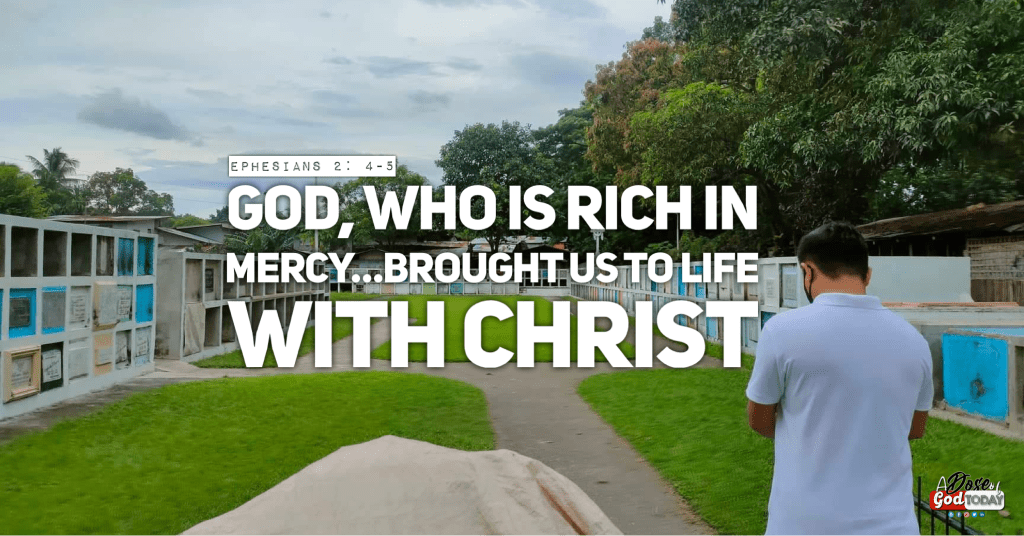
This is who we are – UNDERSERVING yet we are graced and loved by God who would do everything to liberate and empower us from whatever that is preventing us to live life to the full. This is how Paul captured such image of ours before God in his letter to the Ephesians, “you were dead in your transgressions and sins… but God who is rich in mercy, because of the great love he had for us… brought us to life with Christ (by grace you have been saved).”
Let us become more conscious of this and claim such grace from the Lord. This act is indeed God’s initiative, out of that great love we are shown mercy and brought to life. We realize how each of us matters in God even though we are not deserving in anyway. Paul further tells us, “For by grace you have been saved through faith, and this is not from you; it is the gift of God; it is not from works, so no one may boast.”
Yes, it is a sheer gift of God! A gift that offers us freedom and peace, reconciliation and the fullness of life with Christ.
This is how we also understand the parable of Jesus in today’s Gospel from Luke. Jesus did not condemn people who are rich materially. The warning of Jesus is directed towards a heart that has become dependent on possessions to the point that greed consumes the person. Total dependence on material possessions or whatever possessions we may have or “things that possessed us,” lead our hearts to greed. Greed keeps us away from others and from God because it worships not the Lord but something and someone else. Greed corrupts the hearts and destroys our relationships.
This makes any person to be distanced from the grace of God, away from the company of true friendship and love from the community because the person grows to be vicious and self-centered. This is what the Lord wants anyone to be free from. When we become dependent and totally occupied by something else rather than by our relationship with God and with one another, then, we become prisoners of our own human desires and selfish tendencies. This is the transgressions and sins that Paul tells us.
Jesus invites us to invest and be rich in what matters to God. This means that as God has shown us mercy because of his great love for us, we are offered and given life with Christ. This is the fullness of life.
Thus, what matters to God is for us to replicate what we have received, that is, to show mercy to our brothers and sisters, to express concretely our love for each other and to God and to become life-giving persons. The fullness of life is not being experienced alone but can only be experienced within the context of our community. Hence, it is by being able to give life, inspire life and heal life in our families, group of friends, workplaces, organizations and communities that we shall also truly experience the fullness of life with Christ. Kabay pa.









 A DOSE OF GOD TODAY