
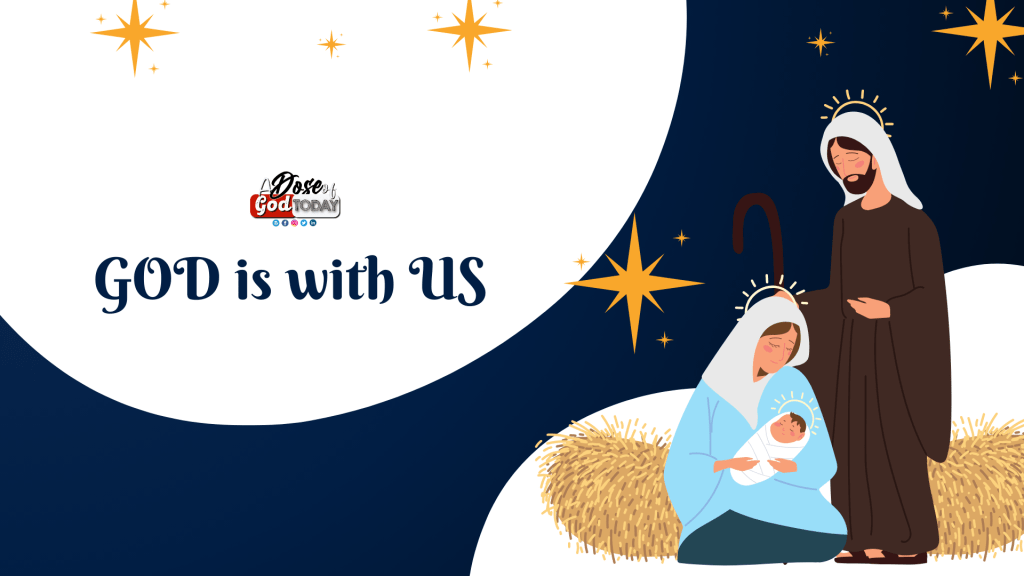
December 24, 2025 – Vigil Mass of the Nativity of the Lord
Click here for the readings (https://bible.usccb.org/bible/readings/122525-Vigil.cfm)
Every Filipino knows that Christmas is not complete without family. Even those who live far away will try their best to come home. Some travel for hours, others for days. We brave traffic, long lines, delayed trips, and empty wallets, just to sit again at the same table. And when we finally arrive, there is always that familiar scene: food that overflows but for some it may seem never enough but somehow feeds everyone, relatives teasing each other, stories repeated every year, and laughter that makes the house feel alive again. Sometimes it is chaotic, sometimes noisy, sometimes even tiring but we still say, “Lahi ra gyud ang Pasko kung kumpleto atong pamilya.”
Tonight, as we celebrate the Vigil Mass of the Nativity of the Lord, the Church tells us something very simple and very deep that Christmas is God coming home to us. Not as a guest who stays for a while, but as family who chooses to stay, who chooses to be with us.
The first reading from Isaiah speaks of joy and restoration. The people had suffered exile, loss, and shame. They felt abandoned. But God speaks to them with tenderness. He tells them that they will no longer be called forsaken, no longer desolate. God delights in them. God rejoices over them like a bridegroom rejoices over his bride. This is not the language of a distant God. This is the language of love. God does not just fix things from afar. He commits Himself. He binds His joy to the joy of His people.
The Psalm continues this promise. God speaks of a covenant that will last forever. His kindness will not be taken back. His faithfulness will remain. For a people who experienced broken promises from leaders, from systems, even from family, this assurance mattered deeply. God is saying, “I am not leaving. I am staying with you. I am here for you.”
Moreover, in the second reading from the Acts of the Apostles, Paul retells the long story of God’s faithfulness. As God chose the people, God also raised leaders. God guided them patiently, even when they failed. And from this long history, God brings forth a Savior, Jesus. This reminds us that Christmas did not happen suddenly. It was prepared through generations of ordinary people. Some of those were faithful, some weak, some confused but all held by God’s mercy.
This brings us to the Gospel of Matthew. Instead of beginning with angels and shepherds, Matthew starts with a long list of names which we have already heard on the Second Day of Misa de Aguinaldo. At first glance, it may sound boring. But if we listen carefully, this genealogy tells us something powerful. God chose to enter a family line that is imperfect. There are saints and sinners, kings and outsiders, faithful men and broken ones. This is not a clean story but a very human story.
In this lineage we have Joseph, a man of silence and gentleness. He does not speak a single word in the Gospel. But his actions speak loudly. When he learns that Mary is pregnant, his world collapses. He is hurt, confused, and afraid. He plans to walk away quietly. But God meets him in a dream and asks him to do something difficult. He was called to trust, to stay, to take Mary into his home, and to name the child, Jesus.
And Joseph obeys. He chooses love over pride. He chooses responsibility over comfort. He chooses faith over fear. And because of that choice, God enters the world not in a palace, but in a home with him and in with Mary.
Here is the heart of Christmas: God does not save us from a distance. God enters our story and becomes part of our family. Thus, Emmanuel, the God-with-us, is not an idea. It is a reality lived in the middle of human weakness, confusion, and our ordinary life.
This is why Christmas speaks so deeply to us Filipinos. We know what it means to hold families together despite poverty, distance, and wounds. We know what it means to forgive, to adjust, to endure, just so the family remains whole. And tonight, through the birth of Jesus our Lord, God tells us, “That is exactly how I love you.”
But Christmas is not only meant to touch our hearts. It is meant to change how we live. It is meant to transform us.
In our country today, many families are struggling. In fact, in the recent SWS Survey as of September 2025, the study found 50% of Filipino Families considered themselves poor.[1] In addition to that, there are also some tables are missing loved ones because of migration, sickness, conflict, or recent deaths. Many homes carry unspoken wounds like misunderstandings, resentment, and long silence. There are families divided by politics, money, and pride. There are also homes where joy has been replaced by survival.
Into all of this, God still comes. Not to judge, but to heal us. Not to condemn, but to stay with us. But God also invites us to respond. We are not meant to stay passive.
And Joseph teaches us that welcoming Jesus means making space, even when it is inconvenient. Isaiah reminds us that God delights in restoring what is broken. The genealogy reminds us that God works through imperfect families. And Jesus’ birth tells us that love becomes real when it chooses to commit and stay.
So tonight, Christmas asks us one honest question, Is there room for God to be born in our family, not just in our decorations, but in our relationships?
God comes home to us so that our homes may become places of mercy, patience, and hope. When we forgive, God is born. When we choose to stay instead of walk away, God is born. When we protect life, dignity, and truth, God is born. When we choose honesty and uphold what is just, God is born.
Indeed, Christmas is God choosing to stay with us, so that we may learn to stay with one another.
As we celebrate tonight , exchange our joyful Christmas greetings and gifts, and gather around our tables, may we remember that the greatest gift is already here. God is home with us.
And so, I leave you one invitation. This Christmas, choose one relationship in your family where you will take the first step toward healing through forgiveness, listening, or simply by being present. Let that be your way of welcoming Christ into your home. Hinaut pa.
[1] https://newsinfo.inquirer.net/2132072/half-of-filipinos-consider-themselves-poor-sws-survey-shows
 A DOSE OF GOD TODAY