Tag: Generosity

  • In GENEROSITY

    In GENEROSITY

    November 10, 2024 – 32nd Sunday in Ordinary Time

    Click here for the readings (https://bible.usccb.org/bible/readings/111024.cfm)

    Once on a Sunday mass, after I preached in our Redemptorist church in Dumaguete about the boy  in the gospel on the multiplication of Loaves (our so-called accidental hero), a small boy went up in the sanctuary during the offertory bringing with him his offering. He did not quite know where to put his fifty pesos offering. So, when I noticed him coming up, I postpone preparing the altar. Instead, I fetched the boy and led him to our collection box.

    For me, it was a moving experience. Here I was, preaching about the boy in the gospel who gave up everything (his two loaves of bread and five fishes) to Jesus as his generous contribution for the people’s need, and calling people to share something themselves for the mission of the church. And right there after, a little boy coming up in the sanctuary, offering his everything generously (n.b. for a four year old boy, a fifty pesos bill is not only something but everything) for the mission of the church. Such gesture for me is not only something (because that little boy and his family heard my homily and responded to it), but EVERYTHING because it is Good News manifested right before my very eyes. Gospel preached & responded as witnessed right before me.

    As you might notice, for the past Sundays, we have been reflecting about Christian Values fitting for Christian discipleship.

    Blind Bartimaeus reminded us of the importance of seeing again & anew God’s will in our lives. Then, Jesus emphasized the commandment of loving God, others and ourselves as our right faith response to God’s grace & blessings. Then, particularly today, we reflect about Generosity.

    Moving from the whole issue of what is the greatest commandment, here in our gospel today, Jesus discussed with his disciples about the whole issue of who or what can truly please God. By comparing the rich and the widow’s offering, Jesus pointed out to His disciples that what matters most is not what but HOW we give our offerings to God.

    The rich people gave from the excess or surplus of their plenty – out of duty & obligation as well as  others may notice them, while the poor widow contributed from her poverty and helplessness everything that she has as her sacred offering & humble contribution for others.

    As Jesus upholds, “Truly I say to you, this poor widow put in more that all those who gave offerings. For all of them gave from their plenty, but she gave from her poverty and put in everything she had, her whole livelihood.”

    For Jesus then, what could truly please God is our Generosity. God is please with generous people who wholeheartedly contributed and gave up & share everything they got for the betterment of others, (if not all).

    This is clearly portrayed by the poor widow who gave her family’s food to Elijah in our first reading; by the temple offerings of the poor widow in our gospel, by that boy in the multiplication of loaves, by that little kid who offered his five pesos for the mission and by Jesus who laid down his life for the redemption of many. They all wholehearted gave up and share everything they got to the point of denying themselves for the good of others. Well, that is Generosity, that is Christian charity and love.

    And generosity usually happens whenever we have sympathy & empathy towards others. Whenever we have the heart to feel with others (sympathy) & to feel for others (empathy), generosity happens in our lives & grace abounds. We give credit to the spirit of generosity as we face the challenges of pandemic & natural disasters (like the recent typhoon Kristine). In our generosity via our sympathy & empathy with one another, somehow we are able to withstand in faith these trying times.

    And so, what truly pleases God is not what we offer Him but How we generously offer Him our gifts with others. We have much to learn from the window’s mite for in her gratitude for God’s graces, she generously offers & shares her everything in empathy & sympathy with others. Remember then: God appreciates a grateful beneficiaries & acknowledges generous sharers of His Gifts with others.

    We pray then with St. Ignatius of Loyola as he described what Generosity is, through his Prayer for Generosity.

    Dearest Lord, teach us to be generous. Teach us to serve You as we should. To give and not to count the cost. To fight and not to heed the wounds. To toil and not to seek for rest. To labor and ask not for reward. Save that of knowing that we do Your Most Holy Will.

    Amen. Hinaut pa unta.

  • DO NOTHING OUT OF SELFISHNESS

    DO NOTHING OUT OF SELFISHNESS

    October 31, 2022 – Monday of the 31st Week in the Ordinary Time

    Click here for the readings (https://bible.usccb.org/bible/readings/103122.cfm)

    Not all generous people are truly grateful. Yet, grateful people are always generous.  What does it mean? One’s generosity can be colored by our selfish intentions or motivated by our self-interest. Like for example, we can be generous to people in our workplace especially to the higher ups because we want them to like us, a way, of perhaps, securing a good position or promotion. Politicians can be publicly generous of their resources, time and presence particularly when election is coming up, well, because that is self-promotion. We can pamper a person we like so much, giving gifts and treats because we want the person to like us in return.

    These forms of generosity or kindness are acts of selfishness that only seek to advance self-interest. In fact, Paul in his letter to the Philippians, exhorts the community and warns them of this tendency. He said, “Do nothing out of selfishness or out of vainglory… regard others as more important than yourselves, each looking out not for his own interest.”

    This kind of spirit is very essential in a Christian community that exists in a worldly and self-centered society. Paul also realized that selfishness is not the way of Christians because this tendency leads to corruption of life and of faith. It is only by being a person for others, being a community for others that believers of Christ will truly grow in the faith and in their relationship with one another.

    Moreover, Jesus in today’s Gospel taught a leading Pharisee on how he should express his kindness and generosity. This Pharisee must be influential and rich in that community and Jesus saw how the guests were filled with the same influential and wealthy people. Thus, Jesus challenged him to express his kindness and generosity to people who need most. This was Jesus’ call to the Pharisee to move out of selfishness and to be truly generous and not for the sake of advancing self-interest.

    Hence, the Lord also invites us today to grow in our gratitude to God and to others. Only in this attitude of the heart that we shall also be able to go beyond from the tendency to look only for ourselves and own benefit. Gratitude in our heart will make us kind and generous to people who around us who need most our help and presence. This is our true expression of faith. Kabay pa.

  • GENEROSITY IN OUR POVERTY

    GENEROSITY IN OUR POVERTY

    November 7, 2021 – 32nd Sunday in Ordinary Time

    Click here for the readings (https://bible.usccb.org/bible/readings/110721.cfm)

    At the beginning of this pandemic, if you can remember, there was a kind of panic buying that happened. When the government announced to impose ECQ then MECQ in major cities, people lined up in markets and supermarkets to secure their food supply as well us vitamins and sanitizers. There was even a time that it was too difficult to buy alcohol, even bread and canned goods. Malls, supermarkets and pharmacies have regulated the purchase of food and medical supplies. There was even a time here in Cebu when the Provincial Government regulated the purchase of oxygen tanks because of panic buying.

    What really drove people to panic buying? What also made people to hoard things? It must be the thought of running out of supply and of fear for not having enough. There might not be enough for us that leads us to get what we need as much as we can, but not minding the needs of others.

    Such attitude can actually still exist even without a crisis. We could believe that we always need to secure something for ourselves. Thus, people who tend to accumulate things, whatever that is, whether food, toys, clothing, gadgets or even attention and acceptance from others could suffer from a feeling of inadequacy and endless insecurity. Because of that feeling of being insufficient and insecure then, it would lead us to accumulate more and even to the point of becoming a greedy hoarder.

    Yet, this attitude of the heart prevents us to become generous and to become persons God desires us to be. However, our feeling of inadequacy and insecurity should not even prevent us. These are ways for us rather to become life-giving and to be truly generous.

    As a matter of fact, true generosity is expressed out of our poverty, out of our insecurities. This is what we have heard in today’s readings. So allow me now to bring you a bit deeper into the scriptures revealed this Sunday.

    In the First Book of Kings, Elijah asked for water to drink and bread from a widow. Remember, at that time, there was famine. Food was scarce. In fact, the widow expressed to Elijah her food insecurity. She only had a handful of flour and a little oil in her jug. Those must not even be enough for her and her son to be fully satisfied. She knew that after consuming that, there will be none anymore. This was the reason why she said to Elijah that their death was coming. Meaning, that will be their last meal for food has gone out.

    But the surprising event was, the widow out of her poverty and food insecurity did not even complain but gave her last bread to Elijah. And a miracle happened, the Lord repaid her generosity. Her flour never ran out and her oil never ran dry. For a year, they were able to eat and they survived from the famine.

    The same expression of generosity was told to us in the Gospel of Mark. Jesus observed how people gave their offerings or tithes and saw the difference between scribes, the rich and powerful people in contrast with a poor widow.

    The scribes or the scholars of the law were merely concerned of getting attention and praise. They want people to recognize and honor them. They sought for that, expressed in their lengthy prayers yet they would amass the remaining properties of the widows and indifferent to their struggles. These people just wanted and desired power, control and dominance. Hence, their contribution to the Temple was something of a show. What they gave was only something from their excess, not from the heart. They were concerned on what they can get and on what was beneficial for them. This was the warning Jesus gave to his disciples. Jesus, actually, denounced the three attitudes of the scribes and the powerful in that society.[1]

    The first attitude Jesus denounced was the desire for prominence and influence rather than the value of giving oneself to serve others. The second was the desire for recognition, esteem and control rather than promoting the good of others through humble service. And the third that Jesus denounced was the desire in attempting to use one’s position, one’s power for self-gain and self-promotion.

    However, in these three desires and attitudes of the scribes and the powerful at that time, there was no true worship of God. They could have been faithful in their attendance in the Temple and in their daily devotion, but then, their hearts were filled of themselves.

    They were not worshipping God. They worshipped themselves. They were not giving something to the Lord. They were investing to get something out of it.

    True generosity and true act of worship can be found in the person of that widow who offered her last two coins to the Temple. Her coins were greater in value than the many given by the rich and powerful.

    Why? Because what she gave was not an excess of her wealth. What she gave was her everything. She just gave all she had. That poor widow gave back to God what she has and gave out of her poverty, completely trusting God’s providence and being contented of what she has on that day. This is God’s invitation for us today that we grow in our desire not to accumulate more, not in our desire to be honored or to gain power and dominance over others, but to grow in our capacity to go beyond ourselves, beyond our poverty and insecurity by giving from our heart.

    Thus, share generously what we have now to those who are most in need and give to God out of our gratitude. We do not have to wait to become materially rich before we give, because even the poorest of among us can give something to others. A gift given out of our insecurity is our best act of generosity. Hinaut pa.


    [1] From the Homily of Bishop Manny Cabajar, CSsR, DD.

  • GENEROUS HEART

    GENEROUS HEART

    November 7, 2021 -32nd Sunday in Ordinary Time

    Click here for the readings (https://bible.usccb.org/bible/readings/110721.cfm)

    I remember once on a Sunday mass, after preaching about the boy (our so-called accidental hero) in the gospel about the Multiplication of Loaves, a small boy went up in the sanctuary during the offertory bringing with him his offering. He did not quite know where to put his five pesos offering. So, when I noticed him coming up, I postpone preparing the altar. Instead, I fetched the boy and led him to our collection box.

    For me, it was a moving experience. Here I was, preaching about the boy in the gospel who gave everything (his two loaves of bread and five fishes) to Jesus as his generous contribution for the people’s need, and calling people to share something themselves for the church mission.  And right there after, a little boy coming up in the sanctuary, offering his everything (n.b. for a three or four year old boy, a five peso coin is not only something but everything) for the mission of the church. Such gesture for me is not only something (because that little boy and his family heard my homily and responded to it), but EVERYTHING because it is Good News manifested right before my very eyes. Gospel as witnessed.

    As you might notice, for the past Sundays, we have been reflecting about Christian values fitting for Christian discipleship. Blind Bartimaeus reminded us of the importance of seeing again God’s will in our lives. Then, Jesus emphasized the commandment of Loving God, others and ourselves as our right faith response to God’s grace.  Then, particularly today, we reflect about Generosity.

    Moving from the whole issue of what is the greatest commandment, here in our gospel today, Jesus discussed with his disciples about the whole issue of who or what can truly please God. By comparing the rich and the widow’s offering, Jesus pointed out to his disciples that what matters most is not What but HOW we give our offerings to God. The rich people gave from the excess or surplus of their plenty so that others may notice them, while the poor widow contributed from her poverty and helplessness everything that she has as her sacred offering. As Jesus upholds, “Truly I say to you, this poor widow put in more that all those who gave offerings. For all of them gave from their plenty, but she gave from her poverty and put in everything she had, her whole livelihood.”

    For Jesus then, what could truly please God is Generosity. God is pleased with generous people who wholeheartedly contributed and gave up everything they got for the betterment of others, (if not all). This is clearly portrayed by the poor widow who gave her family’s food to Elijah in our first reading; by the temple offerings of the poor widow in our gospel, by that boy in the multiplication of loaves, by that little kid who offered his five pesos for the mission and by Jesus who laid down his life for the redemption of many. They all wholehearted gave up and shared everything they got to the point of denying themselves for the good of others. Well, that is Generosity, that is Christian charity and love.

    And generosity usually happens whenever we have sympathy & empathy towards others. Whenever we have the heart to feel with others (sympathy) & to feel for others (empathy), Generosity happens in our lives & grace abounds. We give credit to the spirit of generosity nowadays as we face the challenges of pandemic times. In our generosity via our sympathy & empathy with one another, somehow we are able to withstand in faith these trying times.  

    We pray then with St. Ignatius of Loyola as he described what Generosity is, through his Prayer for Generosity. 

    Dearest Lord, teach me to be generous. Teach me to serve you as I should. To give and not to count the cost. To fight and not to heed the wounds. To toil and not to seek for rest. To labor and ask not for reward. Save that of knowing that I do Your Most Holy Will. Amen. Hinaut pa unta.

  • SMALL ACTS OF KINDNESS MATTER

    SMALL ACTS OF KINDNESS MATTER

    July 25, 2021 – 17th Sunday in Ordinary Time

    Click here for the readings (https://bible.usccb.org/bible/readings/072521.cfm)

    The total population of the world is now at 7.9 billion and The State of Food Security and Nutrition in the World estimated that there are about 811 million people in the world who went hungry in 2020.[1] Out of that number, the 418 million hungry people are found in Asia. The report also projected that around 660 million will still suffer hunger in 2030 because of the lasting effects of Covid-19 Pandemic on global food security. Moreover, there are about 9 million people die of hunger and hunger-related diseases.[2] And in every 10 seconds, a child dies because of hunger. This is the cause of the 3.1 million deaths of children around the globe every year.

    Here in the Philippines, the recent SWS survey revealed that there are about 4.2 million Filipino families suffering from hunger.[3] And Mindanao has the highest rate of incidence of hunger with 1.2 million families.

    With these statistics available to us, there is a need that we become aware of the suffering that our brothers and sisters are enduring because of hunger. We cannot be blind and indifferent to this need. In fact, our readings this Sunday would actually help us to be more conscious of such hunger and of other forms of hunger around us.

    The first reading from the Second Book of Kings proclaimed to us how a nameless man from Baal-Shalishah brought food to Prophet Elisha. People were starving and they needed food. This was the reason that the man offered his food to the hungry men of God. However, Elisha’s servant knew that that food was not enough for them all. This was the reason why the servant objected Elisha when he demanded that the food must be distributed. But then, there was something Prophet Elisha saw that the servant did not recognize at that moment. Prophet Elisha believed that no matter how little they have, that will be enough for God to work wonders. Certainly, when the food was generously given to the people, they were surprised because there were left overs. The little food that they have shall be multiplied by the Lord. This was what the Prophet believed.

    The confidence in God’s providence and complete trust in God’s power to sustain and provide for His people, manifested also in the Gospel this Sunday. The Gospel of John told us that Jesus was aware of the needs of the people. The Lord was not just conscious of the spiritual hunger of the people but also their physical hunger. This awareness in Jesus moved him to ask Phillip, “Where can we buy enough food for them to eat?”

    Jesus did not just see the hunger of the people. Jesus also felt their hunger. This urged Jesus to do something. However, Jesus needed the participation of people around him. Phillip, just like the servant of Prophet Elisha, could not think of anything since they did not have enough money to buy food for all. Just like the servant of the Prophet, Phillip seemed to be too calculated in his response to the words of Jesus and thus of his response to the needs of the people. Yet, this prevented him only to fully participate in Jesus’ saving action at that moment.

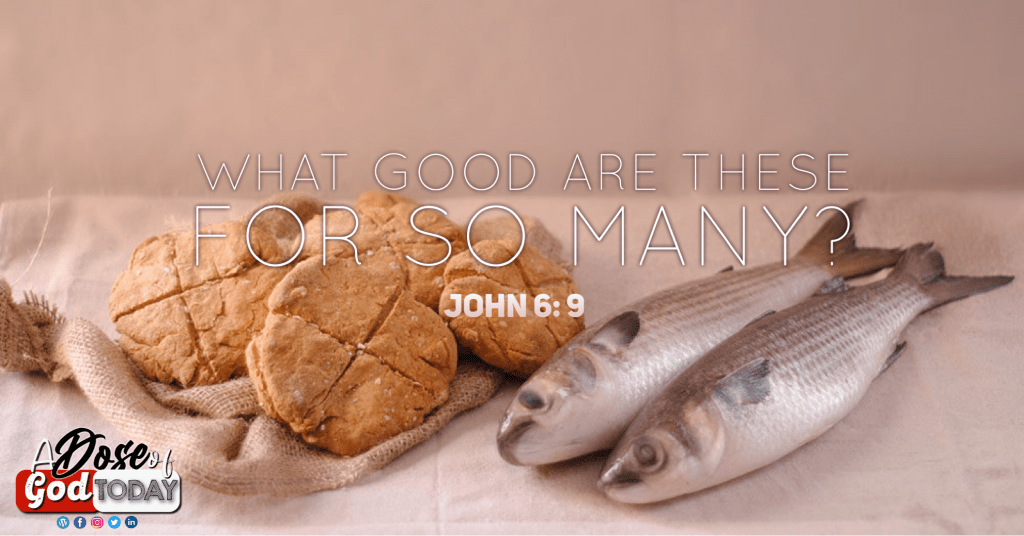
    It was Andrew who brought to Jesus a boy who had five barley loaves and two fish. The appearance of the boy in the story was actually very symbolic. He was nameless and faceless and was just a boy with small food. Yet, that nameless and faceless boy must have volunteered and gave generously his food to Jesus.

    With the boy’s willingness and generosity, his small share became the perfect offering that Jesus needed so that the people will be fed. It was through that boy who had five loaves and two fish that Jesus did something and made everyone to wonder.

    The first reading and the Gospel seemed to have a common ground. There was the small share from a man  who came from Baal-Shalishah and the loaves and fish from the boy. The little things that they had were transformed into many. The small share that they gave became abundant.

    This is where we find God’s invitation for us today as we have also become aware of the pressing hunger in our communities. We are invited by Jesus to offer sincerely the little that we have. We might be thinking that the world’s problem on hunger is too big for us to respond and our share will only be insignificant. Then, having such pessimistic view and calculated in our generosity will only prevent us from participating in God’s saving action, like the servant of Elisha and Phillip. But let us remember, the twenty barley loaves and fresh grain of the man were insignificant to a hundred men and even the five loaves and two fish of that nameless boy were nothing compared to the five thousand men. However, the man did not keep away his food and the boy did not run away to hide what he had, rather, both of them offered generously what they had no matter how small or insignificant those were. Indeed, this tells us that small acts of kindness matter in the presence of the Lord.

    The action of the man as well of the nameless boy were symbols of our vulnerabilities and weaknesses, of our anxieties and fears of having not enough but at the same time the power behind a generous action. To give away the little that we have, makes us insecure, yet, it is actually through the little that we possess that the Lord works wonderfully. When we give something and then we feel vulnerable because that was all we have, no matter how small, is actually the fruit of our generosity. Remember, true generous people will always feel helpless because what they give to others is not something that is only an excess of their possession.

    Thus, the Lord invites us today to be generous with what we have, no matter how small or inadequate in our eyes. Remember, the Lord needs our participation, our small contribution so that he too can work wonders through us and through our small things. With us, Lord will be able to continue to feed the various hungers around us. These many hungers involve hunger for food, for shelter, for a home and family, for friendship, for acceptance, for love and intimacy, or for a deeper relationship with God.

    Let us take time today to be that nameless man and nameless boy who generously offered the little things they had, to make a generous action towards people around us, no matter how small would that be as long as it is given in generosity and kindness, the Lord shall make wonders with us and through us. Hinaut pa.


    [1] https://data.unicef.org/resources/sofi-2021/

    [2] https://www.theworldcounts.com/challenges/people-and-poverty/hunger-and-obesity/how-many-people-die-from-hunger-each-year/story

    [3] https://www.rappler.com/nation/millions-filipino-families-stay-hungry-sws-survey-may-2021