Tag: Friendship

  • Friendship brings comfort in our distress

    Friendship brings comfort in our distress

    Advertisements

    November 7, 2020 – Saturday of the 31st Week in Ordinary Time

    Click here for the readings (https://bible.usccb.org/bible/readings/110720.cfm)

    Homily

    When we are in distress, in pain and in great confusion because of some difficult situation in our life, the people who come to share our troubles will surely bring comfort in us. Even when our friends cannot be present with us physically, but, their expression of being with us spiritually also brings confidence in our distressed hearts.

    While Paul was in prison, the people who became his friends never left him. The Philippians who were converts of Paul’s mission travels, remembered him. They had been Paul’s supporters in joys and sorrows. And when Paul was captured by those who were hostile against the Christians, the Philippians made sure to bring aid to Paul in whatever way they can. Paul was being persecuted. His prison cell must had been a terrible place to stay. However, to be alone in there could have been more lonesome and grim.

    That is why, Paul expressed in his letter to his friends, the Philippians, his gratitude to them. Indeed, his friendship with them brought comfort in his distress. Paul said, “It was kind of you to share in my distress.” To be remembered by friends and to have friends who are ready to empathize with us certainly brings confidence in us. Thus, more than the material gifts he received, Paul rejoiced for the gift of friendship with them.
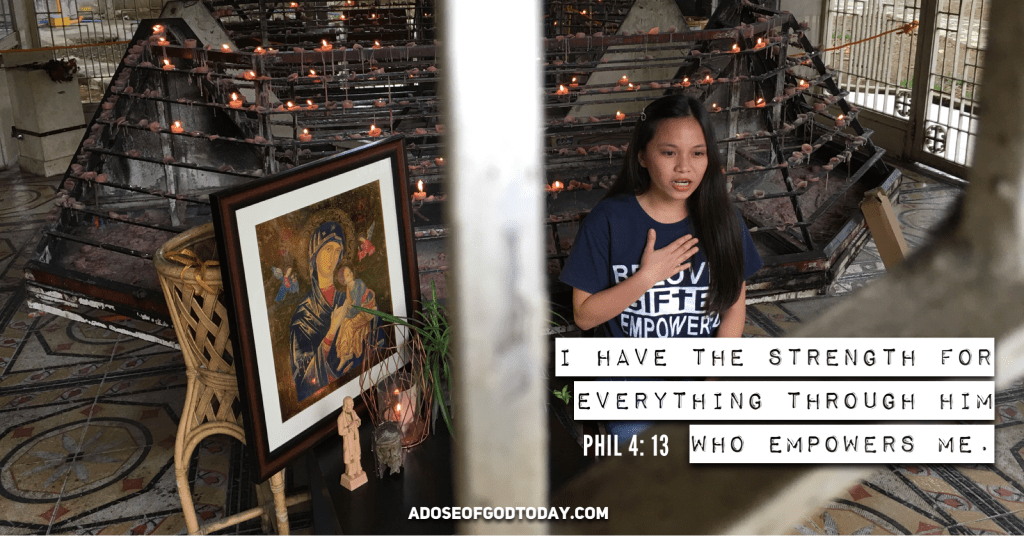
    Moreover, Paul also recognized that what gave him more strength was his friendship with the Lord. Paul expressed with confidence, “I have the strength for everything through him who empowers me.” This is also Paul’s invitation to the Philippians, that they too will grow more in their friendship with the Lord Jesus who shall give them the strength for everything.

    The Lord, indeed, gives us the strength for everything. Paul learned how to adjust in every situation in his life and how to make every difficult situation bearable because of his faith and confidence in Jesus, the Lord.

    This is the invitation for us today, that we become generous givers and gracious receivers of gifts. The Philippians became generous givers to Paul because they had been gracious receivers from Paul’s teaching and preaching. Paul, as well, became a gracious receiver of friendship from them because he had been a generous giver to them.

    This is the very value that Jesus reminds us in today’s Gospel, that we may not be possessed by our resources but become charitable. To become truly charitable is to become trustworthy even in small matters because we do not allow our hearts to be corrupted by the desire to have more and to keep more for ourselves alone.

    Hopefully, we may grow in our consciousness of becoming aware of the needs of others and to be more generous in giving our ourselves to those friends who need help. We may also grow to have a welcoming and humble heart to receive the help from our friends and become grateful more of our friendship. Hinaut pa.

    Jom Baring, CSsR

  • Growing in Friendship with God everyday

    Growing in Friendship with God everyday

    Advertisements

    November 1, 2020 – Solemnity of All Saints

    Click here for the readings (https://bible.usccb.org/bible/readings/110120.cfm)

    Homily

    There is something I want to ask you now. I want you to close your eyes for few moments and in silence, remember the face of your best-friend, that great friend or friends of yours whom you are most comfortable with, that great friend who is always ready to listen and comfort you, that great friend who knew your deepest secrets and pain in life, who has been with you through thick and think, in joy and sorrow.

    Our friends are indeed, gifts to us. Through them and with them, life becomes more colorful, entertaining as well as comforting. As we discover the person of our friends, we too, through them discover more ourselves. That intimacy and affection shared with our friends become the source of our strength especially when life seemed to be not favorable to us. Though, we may not see every day those close friends of ours, yet, our friendship with them stays.

    With this experience of friendship, this reminds me of the saints, whom we remember today. Saints who are also called as friends of God have this special bond with the Lord. Surely, each saint had their own friends too and through their human experience of friendship, they developed their friendship with God.

    “This friendship with God made each saint to be more familiar with God’s voice, more aware of the promptings of the Holy Spirit, and responsive to the invitations of the Lord.”

    Thus, the presence of the Saints in the Church brings us into an awareness on how God works every day in our life. The life of a saint and all those who have lived a holy and joyful life is a manifestation on how God transforms human life creatively and wonderfully through friendship.

    This means that living a holy life is a constant calling of friendship with God. We may struggle to identify God’s voice in the midst of so many voices. What makes a person holy then, is his/her daily commitment in choosing God and allowing God to transform him/her every day. This tells us that saints also experienced mistakes, failures and sins. They too are haunted by their own insecurities and guilt, unfaithfulness and inconsistencies, selfish desires and demons. Yet, every time they fell down, they rose up and chose God again. Indeed, this makes the saints to become closer to God because they grew in friendship with God by knowing themselves and recognizing God every day.

    This tells us of that desire of the human heart to long for God. Indeed, our very life finds its purpose and meaning with God. This is what our Psalm proclaims to us, “Lord, these are the people who longs to see your face.” Our longing for God also explains our deepest hunger and thirst for intimacy and love. God satisfies our deepest longing which sometimes human connection cannot satisfy. Yet, our human experiences of friendship point and bring us to God.

    This is the invitation for us today, that each of us, like all the saints whom we remember today, will grow in friendship with God by knowing ourselves through our weaknesses and strengths and recognizing God who touches every moment of our life.

    Moreover, the Gospel of Matthew which reminds us of the Beatitudes, are the very attitudes of those who are growing in the friendship of God. We become blessed and discover more graces when we begin to realize that we are not the center of everything, but God. The attitudes of dependence and confidence in God, of gentleness and mercy and the desire to be a person for others are fruits of that friendship with God.

    “Thus, difficult situations are turned into graces. Failures are turned into opportunities and windows for mercy. Friendship is turned into door of conversion and blessing.”

    Again, in the first letter of John, we are reminded that we are God’s children, and this is who we are. We are God’s beloved sons and daughters. It is God who claims that we are His. Hence, we too can confidently say now, I am God’s beloved and God is my dearest friend!”

    Allow this powerful words and our powerful God to transform us today and the rest of our life just as saints were transformed!

    Whatever difficulty we are experiencing at this moment, never lose hope with yourself or with God because God never loses his hope in us. Believe in your friendship with God.

    Hopefully, by being more aware of our identify as God’s children, we too shall grow every day in our friendship with God and with one another. Remember this too, “a true friend of God recognizes the face of God with others,” with our brothers and sisters and with the rest of God’s creation. Hinaut pa.

    Jom Baring, CSsR

  • Jesus prays for me today, and so I pray for others too

    Jesus prays for me today, and so I pray for others too

    Advertisements

    May 26, 2020  – Tuesday of the 7th Week of Easter

    Click here for the readings (http://www.usccb.org/bible/readings/052620.cfm)

    During these days of Covid-19 pandemic when Churches were forced to close and people to be quarantined at home, we have also realized how we need each other’s prayer. Prayer gives us comfort in these difficult times. Prayer helps us develop a close and intimate relationship with the Lord despite the deprivation of the public celebration of the sacraments.

    To pray for one another has given us hope too. To pray has helped us to grow in our faith and widen our consciousness to respond to those in need. 

    Today’s Gospel reminds us of the intimacy Jesus shared with his Father. This is evident in the way the Lord Jesus prayed to his Father in heaven. There is tremendous confidence in Jesus and at the same time, that oneness he has with the Father. This is expressed by Jesus saying, “everything of mine is yours and everything of yours is mine.” This is how the glory of Jesus is also the glory of the Father. Hence, the suffering and pain of Jesus at his passion and even death is also shared intimately by the Father.

    All of these have been revealed to Jesus’ friends who were also dear to the Father. Jesus treasures this friendship. And as a friend, Jesus manifests his concern by expressing his desire to pray for them. 

    Jesus is about to leave physically in the world. But it does not mean that Jesus will abandon his friends. In fact, Jesus prays for his friends. “I pray for them,” said Jesus. This means that Jesus remembers his friends in his thoughts.

    Being in the thoughts of Jesus also means that Jesus makes his person present in the life of his friends. It is a promise of faithfulness and of constant presence of God in our life, in each of us.

    Advertisements

    Today, Jesus reminds us too, that he prays for us and with us. Jesus joins us in our prayer. The Lord is there every time we pray. The Lord makes himself ever present the moment we also dispose ourselves in prayer. We can say this confidently, Jesus prays with me because he remembers me and he is with me.

    Being remembered by Jesus in his prayers, let us make an effort too, to pray for others today. Pray for your friends, for your family members and those who really need our prayers. Prayer will make us more conscious of others as we become one with them in their hopes, joys and suffering. Prayer moves us also to respond and to be in solidarity with those who are in need of our help. In prayer, we also become more present with God as we grow in our confidence and faith in Him who calls us and loves us. Hinaut pa.

    Jom Baring, CSsR

  • Having friends? Or being a friend?

    Having friends? Or being a friend?

    Advertisements

    May 15, 2020 Friday 5th Week of Easter – Memorial of St. Isidore the Farmer

    Click here for the readings (http://www.usccb.org/bible/readings/051520.cfm)

    How many friends do you have in your Facebook account? Or in your other social media accounts? Certainly, those who have fb account or accounts have hundreds of friends. Others even have a thousand or more friends. Well, a Facebook account has a limit of 5000 friends. But, do we really consider every person there, in our account, as a “friend?”

    Today, the word “friend” is differently understood. Our friends in our social media accounts are actually our contacts. However, having those “friends” does not mean that we have a personal relationship with them. Perhaps, to some people, but mostly, we don’t, because among the thousands of friends we have, many can be are acquaintances at school, at work, business or during our summer vacations and trips.

    It has become so common to have such tendency to accumulate friends, to make and have friends, to be socially connected with others through the internet, and to be identified by the people to whom we make contacts.

    Aside from this, there is also another form making friends which can be toxic. It means that such form of relationship is only based on advancing one’s self-interest. Such form of friendship is commonly called as “alliance.” Such alliance protect and promote one another’s interest no matter how selfish and oppressive it could be. It does not look on how one will be able to give life to other in a self-sacrificing manner. It is inclined on what and how I could benefit, gain favor and advance my interests and agenda.

    Thus, we might have become more conscious of having friends, affiliate or make an ally ourselves with others rather than “being a friend.”

    To have friends and to be a friend have different natures. To have friends has the tendency to be self-absorbed, self-conscious and selfish because this attitude looks inward. However, to be a friend is an action that comes with commitment. It is self-giving and self-sacrificing. Hence, this attitude is other-oriented and life-giving.

    This is the kind of friendship that Jesus is talking about in the Gospel. Jesus calls each of us to be his friends. The friendship that Jesus offers is self-giving and self-sacrificing. Jesus commits himself to us as our friend. His commitment is summed up in his love for you and for me by offering himself to the cross on our behalf. 

    Thus, the friendship of Jesus is not about using us or so that he may get something from us. His friendship with us is about giving oneself. Through this friendship, he calls us as his friends, not slaves, not mere acquaintances or contacts, or allies.

    This is how we remember today St. Isidore, a Spanish Farmer who was a friend to many, to humans and to animals. His simplicity and hard labor became a way where he grew in his friendship with the Lord. It was said that he would always spend much time in the Church to commune with Jesus. And as the story about him circulated, an angel would instead plow the field while Isidore was in the Church. Other miracle stories became popular also as Isidore would give his bread to the hungry without running out of supply of bread.

    These stories tell us that such friendship with Jesus makes us more aware of the needs of others. Moreover, to become a friend of Jesus makes us a friend to everybody. With Isidore, he was a great friend who gave life to people and to the nature.

    St. Isidore, the Farmer (image from Aleteia.com)

    This is Jesus’ invitation to each of us now, that you and me will grow in that friendship with Him. Thus, we are called to develop our personal and intimate friendship with Jesus through our constant “chats” expressed through our prayers and this Eucharist. Friendship grows when we come to know each other both our pain and joys, failures and dreams. 

    And because this friendship gives life, our friendship with Jesus should also inspire us “to become real friends with others.” Yes, you and me who are friends of Jesus are called to be a friend of everyone and to express the same love that we have felt from Jesus by giving ourselves too, to “shout out” the goodness that the Lord has revealed to us and “to post what’s on our mind and heart” so that others may know and grow also in their friendship with Jesus.

    In times such as this pandemic, our friendship could be one of the best comforts we could offer to those who are distressed, anxious and in need. Thus, maximize also this Community Quarantine by making sure that you parents will become best friends of your children, and children to their parents, siblings to siblings, and to the rest of the people around you.

    So, friends of Jesus – go and be a friend to others!

    Hinaut pa.

    Jom Baring, CSsR

    Join 2,850 other subscribers
  • Friendship with Jesus leads to commitment

    Friendship with Jesus leads to commitment

    April 27, 2020 – Monday of the Third Week of Easter

    Advertisements

    Click here for the readings (http://www.usccb.org/bible/readings/042720.cfm)

    The Gospel reminds us today to recognize also the giver of gifts rather than the gifts and blessings only that we receive. We are called then to develop a deeper and personal relationship with God and not to material wealth and possessions to our successes and achievements or titles which will only fade away later in our life. 

    This is the reminder of Jesus to the Jews when they have failed to recognize him as the Lord and Messiah. The people were only after the bread but not to the person of Jesus. They were looking for him because their stomach were satisfied. Thus, they have failed to know Jesus and to believe in him.

    This is what Jesus said to the people, “you are looking for me not because you saw signs but because you ate the loaves and were filled.” Meaning, the people were merely looking for Jesus because they were more inclined on what they can gain materially from Jesus.

    This is an attitude that only goes towards self-satisfaction, an inward looking relationship. The problem then of this attitude is that, the self does not venture towards taking risks or to let the self be challenged. It is rather more concerned of being fed, of being given attention like a baby. However, the self does not want to commit to go beyond comfort, or to go beyond what is familiar. It stays to what is only self-beneficial.

    Advertisements

    Hence, having this kind of attitude and fostering this kind of self, prevent us to become who we are called to be by the Lord. As Jesus wants the people to believe in him as the one sent by the Father, Jesus also calls us to believe in him. Believing in Jesus is not just about making the sign of the cross, and saying our memorized prayers. To believe in the Risen Christ is more than that. It is about a relationship.

    This is what the first reading from the Acts of the Apostles tells us. Stephen, who was one the chosen deacons to serve the orphans and widows of the Christian Community, was filled with grace and power. He did great wonders and signs among the people. To believe then in the Risen Christ is to be convinced of God’s power that transforms us. Moreover, Stephen’s faith and commitment to the Lord made him confident too in his ministry. This was how he exercised with grace and power because he did not serve himself, he served others.

    Consequently, the Jewish leaders at that time hated him. The leaders created stories in order to condemn him. They twisted the truth because they refused to be challenged to go out from their comforts. Those leaders just wanted the community to serve them and to feed their ego. 

    However, through the person of Stephen, we are reminded that our faith and commitment to the Risen Christ will indeed transform us. This transformation in Jesus gives us grace and power as we allow ourselves to go beyond from our comforts and self-serving egos.

    Indeed, Stephen’s friendship with the Lord became his source of strength and confidence in the midst of trials.

    This is now the invitation for us today – we are called to build a closer relationship with Jesus, a friendship with Jesus, because faith is basically a relationship founded in a commitment. We do not believe in God just because we want to be treated like babies, feeding us and pampering our egos. This commitment in Jesus then, would hopefully lead us to into self-transformation that gives life to others, that works wonders in the lives of our brothers and sisters.

    The very situation we are in now is an opportunity for us to work wonders in the lives of others particularly those who are in great need these days of Enhanced Community Quarantine and Lockdown. May the grace and power of Easter make us more creative and generous too in reaching out to our brothers in sisters

    Having this awareness of God’s friendship in our life, this will hopefully bring us also into the assurance of God’s love and faithfulness that even in times of trials, of loss and poverty, of pain and loneliness, of illness and suffering and even death – we will be assured with our relationship with a God who is ever with us, faithfully journeying with us. Hinaut pa.

    Jom Baring, CSsR

    Join 2,850 other subscribers