Tag: Forgiveness

  • Life and Freedom in forgiveness

    Life and Freedom in forgiveness

    Advertisements

    September 13, 2020 – 24th Sunday in Ordinary Time

    Click here for the readings (https://bible.usccb.org/bible/readings/091320.cfm)

    Homily

    A friend shared her troubles. There have been nights of anguish and sorrow that she was enduring in the past months. The difficult situation of the lockdown and the movement and work restrictions in the City added to her emotional suffering and even heightened the way she’s handling her troubles. There’s so much anger, hatred and self-blame in her heart. Something has triggered her painful memory of the past that relived the physical and emotional abuse she suffered from her father. That painful memory brought fresh anguish and sorrow, as well as those feelings of anger, hatred and self-blame.

    These emotional suffering became episodes of attacks to the point of having sleepless nights and empty feelings during the day. As she said, she could not find a way on how to reconcile things, find peace and realize forgiveness. Her traumatic memory was just too painful to forget.

    Though that memory happened in a distant past but it remains fresh in her mind every time she remembers that. Indeed, this happens when a traumatic memory is merely buried in forgetfulness and covered by pretensions that as if nothing had happened. However, not unless that past of horror is accepted, embraced, confronted and be forgiven and not forgotten, only then, a person achieves peace and reconciliation.

    How important really then, is forgiveness? Is it possible at all to forgive without forgetting?

    This Sunday’s Gospel, the response of Jesus to the question of Peter regarding the number of times to forgive others and the parable he gave to his disciples tell us of God’s invitation to forgive and its important in the way we live our life as Christians and in our desire to live in freedom.

    We have heard Peter how he asked Jesus about how many times he should forgive. For the Jews a righteous man should forgive those who have hurt them for four times. However, Peter exceeded that and made it to seven. He thought he has more than enough. Nevertheless, Jesus responded to him that not just seven times but seventy seven times. The number actually does not matter. What Jesus is saying is that, forgiveness has no limit.

    Why is that? Why forgive without limit? It is even so difficult to forgive even once especially when the person who hurt us is someone we love and someone we trust. As what my friends shared to me, most of our pains are sometimes rooted from our relationships especially when we are betrayed or abused or deceived by a family member or friends.

    The pain and suffering that come from those broken relationships create deep wounds in us. And will forgiveness be possible then? Yes, it is. And forgiveness will always be a call for each of us.

    Hence, unless we find forgiveness in our hearts that begins with accepting and embracing those painful experiences and go on with life, then, we will not be free.

    Remember, forgiveness will make us free. It will not erase the scar of betrayal or of abuse or of deceit in our life but we will be able to stand up, to wipe our tears and go on with life.

    Forgiveness then is not about telling the person, that what he/she did was okay and pretend as if nothing happens. No! Forgiveness is to heal our wounded heart that will make us say to the person, “I forgive you not because of who you are but because of who I am.” This is what the Dalai Lama said.  This means that to forgive is not about to forget. To forgive is not to allow that painful memory to hurt us again in the present and to be freed from grip of violence.

    Forgiveness, then, also is not really for the person who hurt us or those who caused us the pain but rather it is all about us. The pain that we endure will lead us to feelings of anger, hatred and bitterness.  When we linger to these they will lead us to a heart that seeks revenge. This will become our tendency from our belief that by hurting the person back, our anger and hatred will be satisfied. But then, we are wrong because anger and hatred will never be satisfied by violence. Violence will only make us angrier, hateful and bitter person. The more we linger to our pain, anger and hate; they become a cycle that will never end. The Book from Sirach reminds us about this, that wrath and anger are hateful things that we sinners love to hug them tight.

    Advertisements

    This is how a person can create a cycle of violence, of revenge, of anger and hatred mostly directed towards ourselves. We will become prisoner of our own pain. All of these will control our lives, our thoughts and actions. We will never be free. We will begin to become suspicious to our other relationships. We will be afraid of trusting others, of loving others again and even ourselves. We are fearful because we linger to that pain thinking that other people might do it again to us. Hence, the cycle begins.

    This, indeed, is the attitude of an unforgiving person portrayed by Jesus in the parable. The person who was all cleared by the king from his debts became unforgiving and unkind to his fellow servants. Despite the kindness and the forgiveness shown by the king to him, he turned to be filled with hatred and resentment towards those who were indebted to him. He was violent, vicious and hateful. Thus, while causing pain and damage to others because of being unforgiving, he too later on was punished and suffered more.

    This is what Jesus is saying to us now and he wants us to forgive many times because a single un-forgiveness will only make us prisoner of our own pain and hatred. Jesus wants us to be free and not prisoners of anger, hatred, and bitterness or of violence. Jesus invites us to find life and freedom in forgiveness.

    In this way, we may always find reconciliation with God and with those who have hurt us so that in return, we too shall also be forgiven by those we hurt in one way or in many ways. Hinaut pa.

    Jom Baring, CSsR

  • Be Forgiven BY Being Forgiving for God

    Be Forgiven BY Being Forgiving for God

    Advertisements

    September 13, 2020 – 24th Sunday in Ordinary Time

    Click here for the readings (https://bible.usccb.org/bible/readings/091320.cfm)

    Homily

    “To err is human, to forgive is divine.” Easy for us to say these words at times to make excuses for our wrongdoings and to ask forgiveness for our mistakes. However, we also say same words of excuse to refuse forgiveness to those who have wronged and hurt us. “What can I do, I’m only human.” “Pasensya lang, tao lang po.” These words in fact describe not only our human frailty but also our difficulties of forgiving others. Perhaps asking forgiveness is much easier than giving forgiveness. But nevertheless to forgive is indeed difficult, especially whenever it is associated with “forgive and forget”.

    When his disciples asked Jesus how often should we forgive those who have sinned against us, they are just expressing our difficulties in practicing and upholding the value of forgiveness in our lives. Yes, like the disciples we see the value of forgiveness in our lives but we also know how frustrating forgiveness is and can be. In response to this, somehow Jesus in our gospel teaches and offers us something more about forgiveness.

    When he said “not seven times but seventy-seven,” Jesus is telling us to forgive indefinitely. Forgiving others then is not about numbers (counting faults, sins, mistakes and forgiveness) but all about sharing – GIVING your compassion and forgiveness (awa at patawad) without counting the cost or prize. Meaning, though human it is for us to err and to forgive is divine, nevertheless it is also human to forgive. Frail human as we are, we CAN also forgive and be forgiving of others. Difficult and frustrating it may be,  we can humanely and divinely give and share forgiveness with one another. 

    In our parable today about “the forgiven yet unforgiving servant,” Jesus is also teaching us that forgiveness is more than just “forgive and forget”. For Jesus, forgiveness is all about settling account, paying back, being patient, and regaining trust and respect. Meaning  to forgive is not about forgetting but all about evaluating, i.e. to put value and importance to the action-done, the experience-happened and the relationship-built. In other words,  Bigyang halaga at hinidi binabaliwala lamang. So, to forgive is then not about forgetting but rather about remembering – to put value on the whole experience of reconciliation from mistakes as part/member of ones life. It is a decision to give value, importance and responsibility to your action, experience and relationship.  And not to get out, get rid, and get away from our own mess, but to give God, each other and yourself another chance to grow and live life. For instance, the master forgave the servant because the master gives value and respect to the mercy-asked, promised-made and the relationship-renewed between him and the servant.  However the same forgiven servant was unforgiving because he did not value and respect his fellow servant. That is why to forgive is also  for both the aggrieved and aggressor to remember the wrongdoings-done, lessons-learned & restored trust from the mistake. Thus forgiving is about remembering for the sake of healing while forgetting the resentment. 

    Above all, our gospel today directs us to “Be forgiving as we are as we have been forgiven by God”. Let our reason then for forgiving others should be not ourselves (just to feel good) or be others (just to appease them) but be God, who forgives and loves us first and always. Forgive then not for our’s or other’s sake but for God’s sake, as Paul reminds us today that we live and die not for oneself but for God. Forgiveness is God’s grace we received and ought to be shared to others. Let our forgiveness be our offering of gratitude for God’s mercy and forgiveness – in thanksgiving for being ourselves forgiven.

    In the Lord’s prayer, Jesus taught us to ask our Father to “Forgive us AS (same way as) we forgive those who have sinned against us”. This is our cry to the Father to give us another chance in life as we try our best to give ourselves and other’s another chance also in life. Yes, forgiveness is divinely-granted but also humanly-shared for God, not to be forgotten but be remembered for its value in life.

    Pandemic times make us also conscious not only of the mess, struggles and challenges we are in, but also our own mistakes, shortcomings and wrong-doings in life. We realize that we also need not only God’s love, protection and guidance but also His forgiveness and mercy at this time as well. And we can fully enjoy all His graces by also being humanly and divinely enough forgiving and loving to those who have wronged, failed, and hurt us. In other words, we are mercifully forgiven by our being forgiving….. we are loved by our loving.

    Human as we are, yet are blessed and forgiven, may we be and ought to be for God’s sake forgiving to others especially to those who are needing of His compassion and mercy at this time.  So be it. Amen.

    By  Fr. Aphelie Mario Masangcay, CSsR (a former Filipino Redemptorist Missionary for Filipino Migrants in South Korea who, due to immune compromised diabetic condition, stationed back home  in the Philippines for now).

  • FORGIVENESS: A RADICAL LOVE

    FORGIVENESS: A RADICAL LOVE

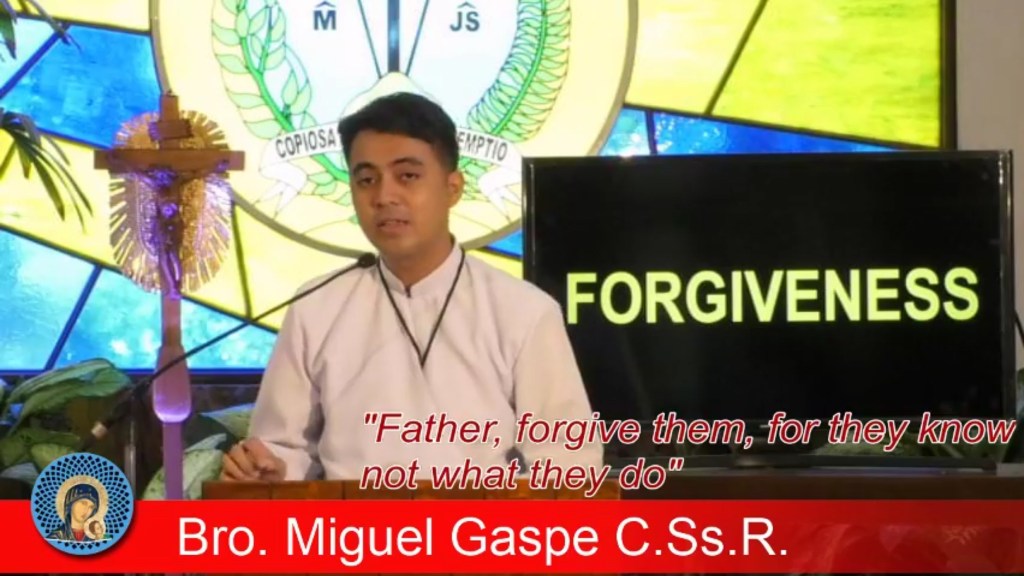
    FATHER, FORGIVE THEM, FOR THEY KNOW NOT WHAT THEY DO (Luke 23:34)

    The first of the Seven Last Words of Jesus on the Cross.

    Shared by Bro. Miguel A. Gaspe, CSsR on Good Friday, the Siete Palabras.

    Click here for the link of the Video (https://www.facebook.com/OMPHRedemptoristDavao/videos/2986892808037601/)

    Forgiveness, indeed, is of God, and it is only through His grace that we may be able to give it to persons who have wronged us. 

    “Radical Love” is a documentary on forgiveness and healing of Ms. Cherry Pie Picache. Cherry Pie, is a Filipino actress, best known for her dramatic roles in Movies and Television. The film captures her experience of meeting her mother’s murderer five years after the dreadful event. One of the highlights in that film features the most heart-wrenching scene where Cherry was able to forgive her mother’s murderer. As she underwent the process of healing, she affirmed how difficult and challenging it is to forgive the person who literally “broke her life.” 

    In her words, “It took me a lot of courage, strength, and prayers from God to be able to forgive the person who murdered my mother.” Painful though it is, She took the road of forgiveness for her to be healed and move on. Her story is indeed exceptional, but for many who are drenched in pain, grief, and revenge, to forgive is such a rare thing do. What does it mean to forgive and how to forgive?

    We look back to the scene where Jesus uttered these words, Jesus at this hour was on the brink of death, nailed to the Cross with the Roman soldiers at his feet. As he addressed these men, we could picture how exhausting the scene was. By this time, these Roman soldiers had been executing many criminals and had seen death day after day.  They are reduced to mere functionaries. They have no choice and freedom to do what is just and right at that moment as they were only following orders.  Familiarity with violence and brutality causes these soldiers to be numb and deaf with their emotions. Their society has allowed them to be stripped of their dignity as human persons gifted with freedom and compassion. It is in this human frailty and desperate condition where Jesus uttered to them, “Father, forgive them for they do not know what they are doing?

    Like us, Jesus understands what it means to be a human person. He showed in his life that a human person is a being created, loved, and cared for by God.  Jesus believes that in every human person, there lies within goodness. Despite our weaknesses, short-comings, and sinfulness, each has the capacity to go beyond our human conditions. Each of us is called towards goodness. Each of us can share this innate goodness to our fellow beings. When Jesus addressed “Father, forgive them…” these are not words of condemnation and self-righteousness. Instead, these are words of prayers addressed to his Father. Even in suffering, He went beyond our underlying tendency for revenge and offered a path for us to be reconciled with God, our Creator. Forgiveness, for Jesus, is an act of prayer and unselfish concern for the good of the other.

    Does forgiveness also mean to forget? I think we are familiar with the phrase “to forgive is to forget.” Forgiveness, to some, may come in the non-recognition of the wrong done. Or to forget, others would condone the transgression in exchange for shallow healing and reconciliation. But if we look into the truth of its meaning, forgiveness in Greek means “to send away.” A word used for commercial language meaning “to release from an obligation or to cancel one’s debt.” That is why in other translations of the “Lord’s Prayer,” sin or transgressions is equated with debts. In Matthew, it says, “forgive us from our debts as we forgive our debtors.” To cancel one’s debt includes a thorough acknowledgment of the debt owed by that person.  In other words, from every transgression we commit with ourselves and with others is a debt we owed to God. And this debt has to be paid in full. 

    Here comes the Good News. The debts we owed to others, to our environment, and God, are now paid in full, with and through, Jesus our Lord. His life, death, and resurrection are in itself the entire process of what it means to forgive and be forgiven. Forgiveness is a process where it involves acceptance of undergoing pain, anger, and grief which in the end will lead to an experience of “resurrection.” What it requires is our openness and obedience to the movements of God’s Spirit already working within us. 

    In the film’s last scene, as Cherry was able to meet the Convict, both of them were in tears. She could not imagine doing such an impossible thing of finding the grace to forgive. What is most striking in their encounter was that she was able to bless and pray for the healing of her mother’s murderer. She forgave not only for her good but to the person who wronged her, who is significantly in need of healing as well. 

    Watching that scene made me realize that it only brought into reality what Jesus’ words on the Cross truly meant. Forgiveness, indeed, is of God, and it is only through His grace that we may be able to give it to persons who have wronged us. 

    My brother and sisters, today is a time of grace, let these words of Jesus penetrate in our hearts. Let his words be a reminder that God, our Father, is madly in love with us despite and in spite of our human conditions. And in realizing this truth, may we see that innate goodness which moves us to a genuine reconciliation with our brothers and sisters in Christ. My friends, let us ask to our Father for that grace.