Do we find ourselves rejoicing at the faults of others? Are we delighted upon learning that our sister or brother has failed? Do we feel victorious when others are found guilty and shamed?
When we find ourselves rejoicing, being delighted and feeling victorious over the sins, guilt and shame of others – this tells us that something is also wrong with us. Our heart becomes an accuser to people who failed. We feel righteous because we are not like them. Then, we make “labels” to others. These are forms of “name-calling or stereotyping” to magnify their guilt and shame. We become rejecting and condemning. We demand evil for evil.
Yet, in the deepest of our hearts, are we indeed sinless, guiltless and blameless? Or do we only hide our own failures and sins by magnifying those of others?
This very kind of attitudes that may be creeping in our hearts as well as in our culture have been revealed to us today. On this Fifth Sunday of Lent, the Lord invites us to look deeply into our hearts. And so let us explore the readings and embrace God’s mercy and forgiveness.
The scribes and the Pharisees brought a woman to Jesus who committed adultery. This whole affair of the scribes and Pharisees with Jesus was filled with malice and hatred directed both towards the woman and also to Jesus himself.
In that culture, women were the only ones who can commit adultery. Men can’t. Women were perceived to be deceiver and caused of sin. This was the reason why the man was not in the picture.
This culture was influenced by their machismo and patriarchal society. Hence, it was only the woman who was brought in the middle of the people. The intention was to shame her and not to bring justice. She was also brought there in an effort to kill her by stoning her to death.
Such condemnation was so cruel. Yet, despite its cruelty and violence, people found delight and joy over it. They even demanded for such savagery because it was what the “law” mandated them to do.
With the leadership of those influential scribes and Pharisees, they condemned this woman. With this attitude, they refused to give another chance and opportunity for the woman to change and redeem herself.
They demanded punishment from Jesus who could also confirm such penalty according to the Law of Moses. This was where their malice and hatred towards Jesus was also to be found. They were trying to find fault in Jesus so that they too can accuse him of blasphemy and then condemn him to death. The thought of it gave them satisfaction.
However, the event was turned by Jesus in the way they did not expect it to be. Jesus said, “Let the one among you who is without sin be the first to throw a stone at her.” At this, Jesus redirected the condemning fingers of Scribes and Pharisees towards them. By saying that, Jesus brought them to themselves, to look at their sinfulness. To recognize who sick their hearts were.
It was very interesting at how the gathered people responded. They began to look at themselves and found that each of them was sinful. Each one was not worthy to carry out such punishment towards the woman. Each one was also guilty.
What was more interesting was the way St. John described to us the first initiative of the elders to leave first. The elders of that community left the gathering first because they realized that the length of their life also meant more sins committed.
This Gospel scenario invites us now to look closely at ourselves and to examine better our intentions, thoughts and actions. We are invited also to be more understanding of those who failed but not in the sense of condoning such failures and sins. We are invited to be merciful rather than condemning.
This is what Jesus showed to the woman. Jesus said, “I do not condemn you. Go and sin no more.” The beauty of the Gospel lies here. God has delivered his judgment and showed His mercy. Jesus freed the woman and was commanded to sin no more and not to go back to her old sinful self. She had, surely, found her way to freedom and peace in Jesus.
Pope Francis in his homily on this Gospel story said, “Jesus forgives. But here there is something more than forgiveness because Jesus goes beyond the law. Though Jesus was pure and the only person who is worthy to cast the first stone against the woman, but Jesus did not because he showed mercy. ”
Mercy, as the Pope says, is difficult understand. “Mercy does not erase sins. It is God’s forgiveness that erases our sins. But then, mercy is the way in which God forgives. ”
Thus, unlike the scribes and Pharisees, Jesus saw more in the person of that woman. The limited awareness and refusal of the Scribes and Pharisees to see more, prevented them to discover that there was always hope in every sinner, and that there was more in a person’s weakness and imperfection. This is how Jesus defends us, sinners from the just condemnation of death. And it is because God always sees goodness in us.
We are all invited now to let go of the stones from our hands and in return embrace a family member, or relative or a friend whom we know have sinned against us. Only then that reconciliation will also begin in us. Hopefully, as we enter the Holy Week next week, may our hearts be ready to celebrate the Easter joy of Christ. Hinaut pa.
When I was a newly ordained priest in Iloilo, there was such a time that while waiting for the mass to begin, I sat in a corner of our church. Few pews away from me, were a couple with their daughter who was probably about 3 or 4 years old. As I observed, she was very playful and while playing she accidentally hit her head on the pew. It was quite hard and painful because there was a loud cry after that. She sought the comfort of her parents. The father took her up. But what surprised me were the words of the father which I cannot forget. He said, “the chair hit you, you hit back then.” The little girl did as she was told and after that she was comforted not to cry anymore because she was able to hit back already. The little girl hushed from crying and rested on the shoulder of her father.
I am sure this is not something surprising to many of us. Some may have done it too to their children or grandchildren and perhaps you yourself experienced this. I have also experienced this at home when I was a little boy – to hit back whenever I am hurt, believing that the pain will fade once I have my revenge.
Indeed, to take our revenge when we are hurt may have been there in our hearts and sub-conscious because that was how we were brought up or perhaps that was how our environment and culture taught us to do. This sounds actually simple yet this has big implications when we are grown up and interact with one another. With this, we may ask now, is the attitude of taking revenge a Christian way?
In the First Book of Samuel, King Saul was in search of David. David had become an enemy to Saul because David became a threat to his kingship. Thus, Saul wanted to eliminate the threat by killing David. However, we were told that David slipped through the soldiers of King Saul and managed to get near to Saul while he was asleep. David had all the opportunity to kill Saul, his enemy, yet, when David had the chance to take his revenge, David spared the life of Saul.
David believed that vengeance and violence against the man that God has chosen was not the answer to a free and good life but rather in showing mercy.
The Psalm which has been attributed to David expressed such attitude of David too. – “The Lord is merciful and gracious, slow to anger and abounding in kindness and the Lord deals with us not according to our sins.”
This story of David prepares us of Jesus’ absurd and seemingly illogical teaching. Many of those during his time, found it radical and crazy. In the Gospel of Luke, Jesus taught his disciples to “love your enemies, do good to those who hate you, bless those who curse you, pray those who mistreat you.” Is it not ridiculous?
We were taught to be vengeful. We were taught to believe that hitting back takes away the pain that we have endured. Yet, Jesus teaches the other way around.
How could we love those who have hurt us? Those who have abused us? Those who betrayed us and caused so much pain in our life? How could we not hate and curse them when we are suffering from what they have done to us? How can we give forgiveness when they do not own the responsibility?
Our immediate response is to retaliate, to take our revenge. Some may result to physical violence which can terrorize the community. And if we cannot express physical violence against them, then, we express it in our words and on how we treat people. But most of all, we linger to hatred, to pain, anger and bitterness.
However, we do not realize that once we let aggression, violence, hatred and anger to dominate our hearts and minds, we, in fact, become prisoners of our own pain. Then, the pain that we endure leads us to feelings of anger, hatred and bitterness. When we linger to these they will lead us to a heart that seeks only revenge. This will be our tendency from our belief that by hurting the person back, our anger and hatred will be satisfied. But then we are wrong because anger and hatred will never be satisfied by violence. Violence only makes us angrier, more hateful and more bitter. The more we linger to these emotions; they become a cycle of violence that never ends.
We create our own cycle of violence, revenge, anger and hatred. We become prisoner of our own pain. All of these will control our life, thoughts and actions towards others. This is how our person and our relationships are so affected that we become toxic. We will never be free because we will try to avoid those who have hurt us and avoid occasions of meeting them. We will begin to become suspicious to our other relationships. Yet, we are afraid of trusting others, of loving others again and even ourselves. We are afraid because we linger to that pain thinking that other people might do it again to us. Thus, we become judgmental and condemning to those who are around us and even of ourselves.
However, it is when we find love and forgiveness in our hearts that we will be free. But remember, this begins in accepting and embracing those painful experiences we have so that we can go on with life.
This tells us, that loving one’s enemies or those whom we hate is an expression of mercy and forgiveness that makes us free. It will not erase the scar of betrayal or abuse or pain or any trauma that we endure; but we will be able to stand up, to wipe our tears, to go on with life and to transform our pain into kindness and forgiveness.
This is what Jesus wants for us. Jesus wants us to be free and not to be prisoners of anger, hatred, bitterness and violence. It is in showing love, kindness and mercy that we actually find peace and reconciliation, justice and freedom.
Showing love then, is not about telling the person, that what he/she did was okay and we pretend as if nothing happened. No! Love and forgiveness bring healing to our wounded heart that will make us say to the person, “I forgive you not because of who you are but because of who I am.” This is what the Dalai Lama said. This is a gift from the Lord because we deserve peace and freedom. This also means that I choose to be free and at peace. I choose love and not anger and hatred and I choose God and not evil.
The invitation of Jesus for us now, is an invitation to freedom from hatred, bitterness and violence and freedom to love, to be merciful and forgiving. This the attitude of the heart of a true believer of Christ Jesus. Hinaut pa.
“To err is human. To forgive is divine.” Surely we have heard & familiar with this quotation before and could easily agree and resonate with it. “To err is human.” This is true for us, especially whenever we have hurt others, whenever we cannot forgive others, or whenever we have failed others. And our usual excuses are: “what can I do, I’m but just human”, or “I’m sorry. I’m not God who forgives. I’m just human and a sinner”.
True, human as we are, we do wrong and commit sins and mistakes, through which we could easily hurt others. Due to our human weaknesses, we can hurt others, and others could also hurt us. Most of us could attest that it is but human and normal for us to do wrong and commit sin, thus can hurt and be hurt by others. And in the midst of this, we do need ourselves consideration, understanding, forgiveness and love.
However, based from our own experience, it is difficult to forgive others, especially our enemies who have hurt us. Just like Abisai in our first reading, usually when opportunity comes, it is normal for us to take revenge or even in return hurt our enemies. Usually, it is not easy for us to forgive people who have hurt and wronged us. And we recognize we do need God’s Help and Grace for us to forgive them. For us then, to forgive is a divine or holy or godly behavior and action.
Jesus said in our gospel today, “Love your Enemy. Do good to all those who persecute and hate you. Forgive them and God will forgive you”. Hearing these words, easy for us reply: “Yes. Easier said than done”. Nice words, good to hear, easy to say but hard to heed. It would be easy for Jesus to say and do those things because He is holy, godly and divine, but for us human, that difficult.
We must consider that when Jesus said these words, he also experienced and felt the pain, hurt, and suffering caused by his enemies. Like us, Jesus also has his own enemies, who have wronged & hurt him. There were also people who hated him, rejected him and even caused his death. And for Jesus, it is also difficult to love our enemies. He knows and understands how difficult to heed these words – to practice what he preached.
But still, Jesus challenges us to carry out this command because he knows that human as we are, we can and are capable of forgiving others. Though difficult, it does not mean that we are not capable of loving our enemies. Though difficult, we can and it is possible for us to love and forgive so because we have the ability to forgive and love others. Human as we are, we also have the freedom and potential to forgive others. Though difficult, compared to animals, we human do have the freedom and option to forgive or not to forgive those who have hurt us. Meaning, to forgive and love our enemies is not only divine but also human.
God indeed is the source of love and forgiveness. It is divine and godly to forgive and love our enemies. But God’s forgiveness and love is revealed through us – in and by our own decision and openness to receive and share God’s love to others. Meaning, though we are weak and slow to forgive others, like David, we can still decide and offer love and forgiveness to them by also accepting their own weakness and limitations, and by giving them the opportunity to repent and change their ways.
As Christians, we believe Jesus has saved us from our sinfulness. By His birth, death, and resurrection, he redeemed us and has forgiven us of our sins and wrongdoings. We are now then called to also forgive those who have sinned against us, as we have also been forgiven. Human and Christ as he is, Jesus forgives us. Human and Christian as we are, we can also love and forgive our enemies.
Whenever we are hurt and are suffering from the sins caused by others, it is better for us to reflect and ask ourselves: “If God can grants me His mercy and forgiveness, how come I cannot forgive my enemies? God loved and have forgiven me, a sinner, how can I not love but hate my enemies?
If of any consolation, consider that forgiveness is not only given to us & what we receive from others, but also forgiveness is something we give to others. Forgiveness then is something more we GIVE For ourselves, and To ourselves than giving to others, for as we ask Our Father to forgive us our sins, we are also to forgive those who sinned against us.
Remember as our Lord said “For the measure with which you measure will in return be measured out to you.”
(A Moment of Reflection: A Talk – with Christ the King College de Maranding, Campus Ministry Office)
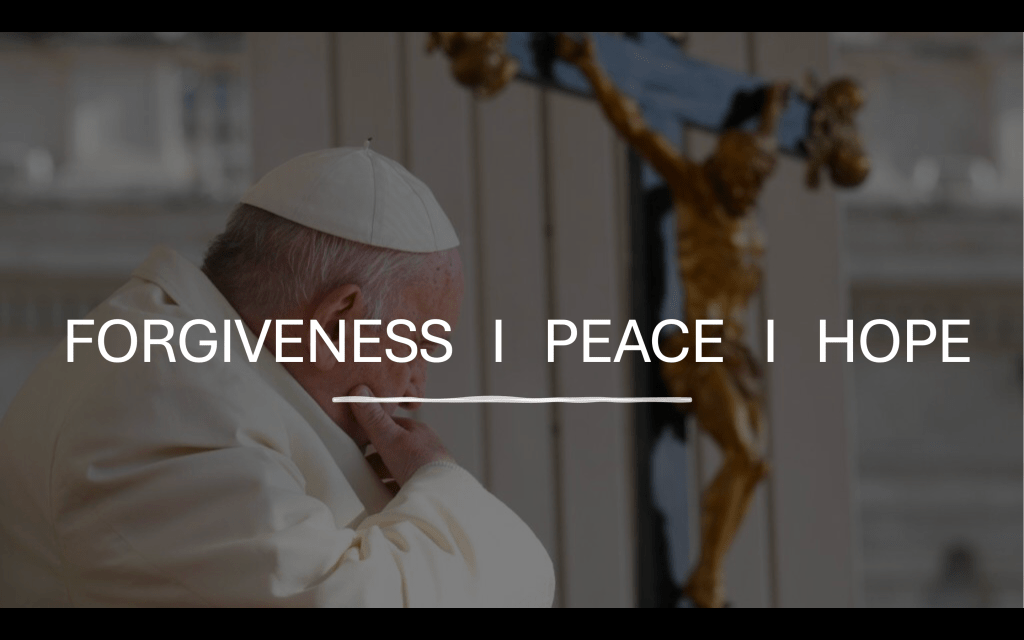
There are three important words that I want you first to remember as we reflect today the message of Pope Francis on the occasion of the World Day of Peace published on January 1, 2025.
First, FORGIVENESS. Second, PEACE. And third, HOPE.
These three words served as the central theme of the message of Pope Francis addressed to world leaders and to all people of good will, including you and me. We have to understand then that the challenges and invitations set by Pope Francis are not only applicable to people who play important role in political, economic and cultural arena of our society. The call towards the path of peace is call to all.
Hence, the theme of Pope Francis’ message reminds us now, “FORGIVE US OUR TRESPASSES: GRANT US YOUR PEACE.”
As I join you in this short recollection, watch first this short video of the message of Pope Francis.
From that short video presentation, it tells that Pope Francis invites us to look at the challenges that our world is facing today. These challenges are particularly those that endanger the survival of humanity and the whole creation because of human greed and manipulation for power, wealth and control.
But how shall we look at these realities?
We can actually look at it from the perspective of anger and hatred because of the injustices yet, that will only lead us to the cycle of violence. We can end up towards arm struggle and rebellion. Nevertheless, it will not lead us to peace but only towards more suffering and despair.
We can also look at it with apathy and indifference. Well, the many issues and realities happening around the world are not directly experienced by us. Each of you here is not living on a war zone. You are not unemployed. You don’t have children who are undernourished, experiencing severe hunger on a daily basis. You don’t have overwhelming debt that will take you more than a lifetime to pay. And so, passivity and looking at these realities with indifference would be very easy for us to do. Yet, such attitude would only make our hearts calloused and numbed at suffering of others even with those who are nearest to us.
Pope Francis proposes to look at the realities of the world, as well as of our own experiences of suffering from the perspective of hope, of having a heart full of hope.
Now, for us to better understand and have a good grasped of what the Pope reminds us, let’s have a step by step moments of reflection of his message. The entire message is actually divided into four sections. In each section, let us also recognize its relevance in us, in our own context, work and status especially to you as a team of Campus Ministry in your college.
Going back to that proposal of Pope Francis to look at the realities of the world from the perspective of hope, it triggers us to also ask, how? How do we look? And where should we start? This brings us into the first section of the message.
The First Section
LISTENING TO THE PLEA OF AN ENDANGERED HUMANITY (A CALL TO LISTEN)
Pope Francis brings to our awareness as he greets every man and woman, and especially to those whom felt more connected – the downtrodden, those burdened by their past mistakes, those oppressed because of being judged by others, those who are desperate and hopeless.
This is each of us! These are the experiences of many and perhaps of those students under your care. The many burdens they carry and issues they face in their own lives. This means that suffering is experienced by everyone. This is the significance of the sound of a ram’s horn (in Hebrew, jobel) calls us to listen.
This is why the Jubilee Year of Hope becomes more relevant to each of us, individuals and as a community of faith. This is an invitation again for us that our hearts be filled with hope. This hope leads us and moves us to aspire and work for forgiveness and reconciliation, for freedom and healing.
That is why, the Jubilee Year of Hope is meant to echo throughout the land (cf. Lev 25:9 – to every hearts and to every homes and communities) so that God’s justice will be restored in every aspect of life.
We are called to listen and recognize now the many “desperate plea for help.” These include the exploitation of our natural and human resources in the guise of progress and profit. Pope Francis affirmed what St. Pope John Paul II called as “structures of sin” committed not only by principal agents but also by many of us who participate indirectly because of our support or because of our indifference.
Indeed, this is a call for us to listen – to heed the plea for help of the suffering humanity for example the “inhuman treatment towards migrants, environmental decay, confusion caused by disinformation, refusal to engage in any form of dialogue, and the immense resources spent on the industry of war.” These are all “distinct yet interconnected” to each other. Do we also find these in our context? Maybe not all, but perhaps some of these.
By acknowledging the forms of suffering in our own context, then, it calls us to work for justice. And what Pope Francis wants us to realize as well is “the cultural and structural changes” from us so that change will endure and will not be passive. This brings us now to the second section.
Second section
2. A CULTURAL CHANGE: ALL OF US ARE DEBTORS (A CALL TO HUMILITY)
After looking and recognizing at the many realities present in our communities, Pope Francis leads us to also realize the many gifts that are already in us. Yet, the many resources that we enjoy are not meant for us alone or for the “privileged few” in the case of the those whose hearts have become so wealthy and entitled.
Pope Francis wants us to grow in gratitude, he said, “without gratitude, we are unable to recognize God’s gifts.” Certainly, we won’t be convinced as well that we are actually gifted. We will not be confident of what we have, as well of the potentials and talents that we already have. Meaning, without gratitude, it leads us to bitterness and despair. Look at how a person, you might have encountered one already, whose heart have grown ungrateful – the person becomes so stingy of many things and so mean to people around him or her.
Indeed, when we become ungrateful this also leads us to easily get irritated or even feel unfair at the blessings of others. It makes us entitled but corrupt, even when we have received so much, in our practices because our heart is not convinced that what we have are God’s grace.
We have to understand then, that God’s grace cannot be earned. It is a pure gift not because of our good deeds and qualities but undeserved and unmerited. That is why, the Lord would not abandon the sinful humanity, or no matter how sinful we have become, because God’s infinite mercy is a gift. In fact, God reaffirmed this “gift of life by the saving forgiveness offered to all through Jesus Christ.”
This is how we discover the central teaching of the “Our Father.” As Jesus told us to pray : “Forgive us of our trespasses,” the Pope reminds us to recognize our collective sins that we are all indebted to the Father and with one another.
Hence, we rely now on the mercy of God who forgave our debts, through Jesus. And through him, the gift of life, being renewed gives us hope for one another. In consequence, Pope Francis appeal echoes to every heart – “the appeal for solidarity, but above all for justice.”
Hope becomes more alive in us now because it opens us up and lead us towards that cultural and structural change. The cultural change happens in our way of life, in the way we relate with one another and in the way we look at the world from the perspective of hope. Eventually, through this cultural change then structural change happen and begin to recognize that we are all brothers and sisters, we have a shared and diversified responsibilities and that we are not enemies or business competitors.
This leads us now to the third section.
Third Section
3. A JOURNEY OF HOPE: THREE PROPOSALS (Call to Action)
This change in us begins in our hearts. This also fuels and renews our hope, of our journey of hope, as being emphasized in this Jubilee 2025. Acknowledging God’s constant grace and mercy to all, makes us again realize God’s infinite generosity and love because we are forgiven.
Yet, let us not also forget the challenging words in the Lord’s Prayer, “as we forgive those who trespass against us.” Forgiveness becomes a reality in us as we also learn to forgive others. From such grace, hope and peace shall overflow in our hearts. That overflow will only become concrete from our own experience of forgiveness and generosity,
In fact, Pope Francis also said, and I quote, “Hope overflows in generosity; it is free of calculation, makes no hidden demands, unconcerned with gain, but aims at one thing alone: to raise up those who have fallen, to heal hearts that are broken and to set us free from every kind of bondage,” end of quote.
This is the best gauge for us as we express our generosity to others. And so let us be mindful also of our attitude when our generous actions (things that we give like of materials resources, presence, our personal time and talents) are fueled by our personal agenda or selfishness then, our generosity is not from hope. Rather, it is from corruption.
From here Pope Francis leads us to the path of peace with three proposals as our call to action.
First, Forgiveness of International Debt. “Reducing substantially, if not canceling outright, the international debt which seriously threatens the future of many nations”, said Pope Francis. This is a call to world leaders especially of rich countries to be in solidarity with neighboring nations.
Second, Abolition of Death Penalty. This means that we are called to have a firm commitment to respect for the dignity of human life from conception to natural death. Through this commitment, we promote a culture of life that gives every man and woman the hope of forgiveness and rehabilitation, freedom and healing.
Third, To Establish a World Fund aimed at Eliminating Hunger. This is to use a “fixed percentage from armament investments to establish a global fund to eradicate hunger, facilitate educational activities in poorer countries to promote sustainable development, and to combat climate change.” This means that, certainly, war is for profit, for business and thus, it is an industry. Political conflicts or ideological beliefs or territorial disputes can easily be manipulated by profit-oriented groups in order to create war and so gain immense profits. Yet, what the world needs are not bullets but food and water, education and home.
These three proposals though aimed at the world leaders and all those who play significant role in our global village, however, ourselves and those at the grassroots remain significant so that we may be able “to pave new paths of peace together in our communities.”
This brings us to the final section.
Final Section
4. THE GOAL OF PEACE (Towards Freedom)
Pope Francis quoted Saint John XXIII who convened the Second Vatican Council in 1962, “true peace can be born only from a heart ‘disarmed’ of anxiety and the fear of war.”
This means that the goal towards peace is first directed at our own hearts that are perhaps trapped in despair and hopelessness because of our failures, or hearts thickened by indifference and selfishness, or hearts traumatized by abuse and oppression, or hearts covered with pretensions that everything is okay but not realizing the realities around, or hearts filled with worries and anxieties because of the thought of “nothing might be left for me, then I have to accumulate more” or the thought of “nothing is for me, I am pitiful” or having a heart that is constantly threatened by tensions, conflicts and wars. Then, our hearts are indeed troubled.
Yet, know that the Lord brings us peace, grants us pardon and gives us freedom. What we are called to do now is to disarm our heart from whatever shackles of pain, trauma and imprisonment it is suffering from.
Pope Francis wonderfully expressed the call towards freedom in these words, and I quote, “May we seek the true peace that is granted by God to hearts disarmed: hearts not set on calculating what is mine and what is yours; hearts that turn selfishness into readiness to reach out to others; hearts that see themselves as indebted to God and thus prepared to forgive the debts that oppress others; hearts that replace anxiety about the future with the hope that every individual can be a resource for the building of a better world.”
Indeed, each of us now is a resource in building a better world. Your position as educators puts you now at the pedestal in your own context to realize peace. Pope Francis even continued to express that “disarming hearts is a job for everyone.” So that, as we heed the call to disarm our hearts, then, it will inspire us and give us hope to also become a catalyst in disarming the hearts of people around us even through our simple gestures “such as a smile, a small gesture of friendship, a kind look, a ready ear, a good deed” or having an understanding heart over a troubled student, or having a welcoming hand shake for anxious new students, or un-judging (without judgment) attitude towards a colleague who is emotionally sensitive.
These are small steps, simple gestures yet will also become powerful and effective as we hope to build a community in loved with peace.
And so as I end this reflection let us pray together the prayer for peace composed by Pope Francis at the end of his message.
PRAYER FOR PEACE by Pope Francis
Lord, grant us your peace!
Forgive us our trespasses, Lord,
as we forgive those who trespass against us.
In this cycle of forgiveness, grant us your peace,
the peace that you alone can give
to those who let themselves be disarmed in heart,
to those who choose in hope to forgive the debts of their brothers and sisters,
to those who are unafraid to confess their debt to you,
and to those who do not close their ears to the cry of the poor.
Amen.
Points for Reflection towards the Path of Peace
Look and Listen: Recognizing the Cry for Help in my own context
As an educator/religious/seminarian – what are the different pleas/cry for help that I can identify which I encounter with myself, with my students or community?
Embracing our Gifts leads us to Gratitude and Generosity
What resources/gifts/talents do I have that I can offer for others and for my community?
Call to Action: A Commitment to make
What do I need to change in me? What do I need to disarm from my heart? (attitudes, beliefs or perspectives)What concrete actions I can commit to promote peace?
“To err is human, to forgive is divine”. At times easy for us to say these words to make excuses for our wrong-doings and to ask forgiveness for our mistakes. However, same words of excuse we also use at times to refuse forgiveness to those who have wronged and hurt us. “Pasensya lang, tao lang po.” Words that verily describe not only our human frailty but also how difficult it is for us to forgive others who have wronged us. Perhaps asking forgiveness is much easier than giving forgiveness, but nevertheless to forgive is indeed difficult, especially whenever it is associated with “forgive and forget”.
When his disciples asked Jesus how often should we forgive those who have sinned against us, they are just expressing our difficulties in living out and upholding the value of forgiveness in our lives. Yes, like the disciples we see the importance of forgiveness into our lives but we also know how difficult and frustrating forgiveness can be.
In response to our questions and difficulties with forgiveness, Jesus in our gospel teaches and offers us something more about forgiveness. When he said “not seven times but seventy times seven”, Jesus is telling us to forgive indefinitely. Forgiveness then is not about counting (counting faults, sins, mistakes and forgiveness) but about sharing, giving what you have – without counting the cost or prize. This would also mean that though it is human for us to err and to forgive is divine, nevertheless it also human to forgive. In other words, frail human as we are, we can also forgive and be forgiving of others – how difficult and frustrating it may be. We can still humanely and divinely share forgiveness with one another.
And in the parable of “the forgiven but unforgiving servant”, Jesus is teaching us that forgiveness is more than just “forgive and forget”. To forgive for Jesus is all about settling account, paying back, and being patient. Meaning to forgive is not about forgetting but about to evaluate or put value and importance to the action-done, experience-happened and the relationship-build. In other words, Bigyang halaga at hinidi binabaliwala lamang. So, to forgive is then not to forget but rather to remember (to make and value the experience as part-member of ones life.). It is a decision to give value, importance and responsibility to your action, experience and relationship – and not to get out, get rid, get away from our own mess, but to give God, each others and yourself another chance to grow and live life. It is also to remember the wrongdoings-done and learn lessons from the mistake. Thus to forgive is perhaps to forget the resentment but moreso, to remember the lessons-learned for the sake of healing & growth.
And the message of the parable directs us to “Be forgiving as we are and have been forgiven by God”. Let our reason for forgiving and sharing forgiveness be not ourselves (to feel good) or be not others (to appease) but be God, who forgive and love us first and always. Forgive then not for our’s or other’s sake but for God’s sake. Forgiveness is God’s grace we received and ought to be shared to others. Let our forgiveness be our offering of gratitude for God’s mercy and forgiveness.
In the Lord’s prayer, Jesus taught us to ask our Father to “Forgive us As we forgive those who have sinned against us”. This is our cry to the Father to give us another chance in life as we try our best to give ourselves and other’s another chance also in life, how difficult it might be. Yes, forgiveness is divinely-granted and also humanly-shared, not to be forgotten but be remembered for its value in life.
Human as we are, yet are blessed and forgiven, may we be and ought to be forgiving for God’s sake to others especially to those who have wronged and hurt us.






 A DOSE OF GOD TODAY