Tag: Food

  • FILIPINO CHRISTIAN FOODIE

    FILIPINO CHRISTIAN FOODIE

    August 8, 2021 – 19th Sunday in Ordinary Time

    Click here for the readings (https://bible.usccb.org/bible/readings/080821.cfm)

    We Filipinos love to eat. Western people could not understand that why we Filipinos (usually with such small stature/build) love to eat. It is said that we eat at least seven times a day. With the usual breakfast, lunch, and dinner, we also have snacks, merienda, timo-timo before dinner, and midnight snacks. This is because eating for us is not only about food but also about sharing. Meaning, we eat not only for the sake of the food-intake but also for the companionship, togetherness, fellowship, relationship, and community it brings.

    We gain a lot of wisdom about life from our eating activities. For instance, we hear people saying: “You are what you eat”. This does not mean literally – that if you eat pork, you are a pig; or if you eat vegetables, you are vegetable. No, it simply means that our food-intakes influence and affect not only our blood chemistry and physical health, but also our lifestyle. Meaning, what we eat mirrors our lifestyle and our lifestyle is revealed in our diet. So, healthy people most likely eat healthy food; sick people are most likely lived with poor diet. In the same way, diabetic, arthritic, or hypertensive must follow low-sugar, low-salt, or low cholesterol diet and eat healthy food; otherwise, they remain diabetic, arthritic or hypertensive with consequent complications. So, there is some wisdom in the saying: “Be careful of what you eat, because you are what you eat.”

    In our gospel today, Jesus says: “I am the living bread that came down from heaven; whoever eats this bread will live forever. Here Jesus clearly proclaims and reveals Himself as the Bread of Life – thus, he is the very bread or manna from heaven that nourished and sustained the Israelites during their exodus in the desert, as well as the very angel that took care and restored the physical and moral strength of Elijah in the time of his persecution.

    For the Jews, the word: Bread of Life is very important to their Jewish faith because it signifies the manna from heaven – the very food that maintains, sustains, and nourishes them during exodus and times of persecution. It also represents Yahweh’s direct interventions and mediations in their lives. Meaning, the Bread of Life is the whole dynamic between the food, the giver of the food, and the giving of the food.

    Photo from https://www.atlantaeats.com/blog/fantastic-filipino-food-around-atlanta/

    Based from their faith in the Bread of life, Jesus before them claims himself and proclaims that HE is the bread of life. This means that He, Jesus is now the whole dynamic of God’s salvation for humanity. Thus, He is our food – the manna from heaven; also our giver of the food; and God’s giving of the food. He is the Way – savior; Truth – salvation; Life – dynamic sharing of God’s salvation. He is our Gift, Giver, and the Giving-sharing of Salvation.

    Moreover, as he proclaims that He is the Bread of Life, he also offers Himself to them and to us now: Take this bread and eat “for whoever eats this bread will live forever.” As bread of life, Jesus wants us to take Him, i.e. to receive, accept and believe in Him for in Him we inherit eternal life. At the same time, he wants us to eat Him, i.e. to assimilate and integrate Him in communion into our lives. If in eating, we are what we eat, in salvation, we become in and with Jesus Christ when we integrate and commune with Him. In others words, we are Christian because we together at the Lord’s Eucharist, receive & eat (take on) Jesus always, as our bread of Life into our very lives now.

    By believing in Jesus as the Giver of the salvation, as well as by integrating Him as the Gift of salvation, and by us taking part in the Giving of the salvation – by the agape, (taking, sharing, and eating) of the Bread of Life, Jesus brings and grants us eternal life, now & always.

    Lord, pandemic times have rendered us hungry and deprived of our Eucharistic food. Lockdowns, isolations & quarantine limit our movements and participation in the celebration of the Holy Eucharist. Not only for our daily food nourishment, we are also hungry nowadays for our spiritual food & nourishments. May our hunger now for You, as our bread of life, inspire us to value, long and hope for your ever-present offer of eternal life for us.

    So Help us, God. So May it be. Amen.

  • OUR DEEPEST HUNGER IN LIFE

    OUR DEEPEST HUNGER IN LIFE

    August 1, 20210 – 18th Sunday in Ordinary Time

    Click here for the readings (https://bible.usccb.org/bible/readings/080121.cfm)

    To feel hungry is a basic human experience. Thus, I am sure each of us has experienced that feeling of being hungry since we were babies. Babies especially would always cry when they are hungry. A parent’s automatic response to a crying baby is to feed the baby with milk. When the baby starts sucking, the baby also stops from crying. When we become adults, we continue such behavior though we do not cry anymore but feed ourselves with food that can satisfy our hunger.

    This human behavior in us is what we have heard in our readings this Sunday. The Book of Exodus told us the story of the Israelites. Since they fled from Egypt, their life was always uncertain. They were in the middle of the desert where there was no place to plant and cultivate something for their food nor a place to buy their supplies. The people became weary because of their difficult situation until they grew hungry. Moses who led and brought them out of Egypt had almost became a father to them. To him, the people cried out their needs. They cried and grumbled to Moses to provide them food because they were hungry. The Lord, in his goodness, sent food to the desert so that they will be satisfied.

    Our Gospel tells us of the same behavior. The people were in search of Jesus because they wanted Jesus to satisfy their hunger. They followed him after he did a miracle in feeding the five thousand people. The people recognized that Jesus will satisfy their needs. This became an opportunity for Jesus to teach them an important lesson.

    Jesus knew that the people were after him because of their hunger. However, the people were only concerned of an immediate satisfaction. They were limited in that satisfaction of a physical hunger. Thus, they were looking for Jesus to satisfy them immediately. In a way, they have become obsessed or fixated to what Jesus can provide to them. They were after the miracles of Jesus but not in the person of Jesus.

    Jesus understood them. Thus, he reminded them to seek the bread that gives eternal life and not the bread that perishes. This means that the people were invited to seek not those things that only provide instant and immediate satisfaction but the person of Jesus himself.

    This reminds me that we are not different from those people in the Bible. How many times have we sought to satisfy immediately our different forms of hunger? Jesus is not just talking about our physical hunger. Jesus points to us today to recognize our human hungers for acceptance, for recognition, for friendship, for love and intimacy, for justice, for peace and reconciliation.

    We cry out these many forms of hungers just like the Israelites in the Book of Exodus and in the Gospel. We tend to satisfy those longings and hungers immediately. Hence, instead of looking for what is essential and lasting, we resort to the promises of “instant satisfaction” and to an “immediate result.”

    Their consequences will surely be destructive, unhelpful and the corruption of life. Addictions such as in alcohol, drugs, sex or food are ways to satisfy our deepest hunger. Yet, because they only promise an instant gratification and so we hold on to those addictions to numb our hunger for love, for attention and intimacy. Our obsessive fixations in spending too much time in social media, or online games or with gadgets, remove us from the true and personal encounter with people. Because of the lack of human connection, we divert our need into what is temporary, virtual and not real. Our compulsive behaviors in gossiping, in defaming people and in finding the faults and weaknesses of others seemingly give us the image of a good person, righteous than others. However, these behaviors only blind us of our true longing to be recognized and be appreciated.

    Our obsession to be powerful, to exercise dominance and control over the weak and to resort to violent and aggressive actions apparently make us confident, independent and strong. However, they too blind us from that hunger to find our true self and our true potentials.

    Jesus invites us today to recognize our deepest hungers. Just like the Jews in the Gospel, Jesus reminds us today also not to seek to what is only perishable, and to what is only instant and temporary. Because these things will only lead us to addictions, unhealthy fixations and compulsive behaviors that do not give us life but rather death and hopelessness.

    Jesus invites us to recognize him, that is, to recognize God, His love and friendship with us as our food that will satisfy our hunger. He is the bread that gives us life. This Eucharist is the gift and our food that should satisfy our deepest human hunger. That is why, this Eucharist is more than what we think. This is not simply prayers and readings, standing and kneeling, singing and saying amen. This Eucharist is our very relationship with God and with one another. This is all about us and God, you and me and Jesus.

    I would like to invite you then, so that we will be able to make this Eucharist truly life-giving; ask the Lord to help us recognize our different hungers. Be mindful of our compulsive actions, fixations and some forms of addictions because those behaviors in us will tell us of our own hungers and needs. When we become conscious of those, hopefully, it will lead us to seek to what will last, to what is more essential in our relationships and to what will truly satisfy us. And above all, may we find Jesus and his love. Hinaut pa.

  • Enough

    Enough

    August 1, 2021 – 18th Sunday in Ordinary Time

    Click here for the readings (https://bible.usccb.org/bible/readings/080121.cfm)

    It could happen that once in a while some wayward beggars would come to us & ask for some “bahaw” or left-over food to eat. Once I gave some enough food for a day to a beggar. As he received the food, he asked: “Walay kape ug saging man lang?” (How about some coffee & fruits for extra?). Though this irritated me, it also made me think: “If I’m going to give, why not give all – the full package deal with all the extras? Why only give enough for the day? Why not for the whole week?

    But as we all know, human as we are, we are not easily contented. Hard for us to be fully satisfied. We want more. We need more than we already have. Like that wayward beggar, we want some extra: extra rice, sauce, toppings, privileges, discount, bonus, payment and others, but effortless & easily, if possible, quickly. So, when is the limited resources that I have now, enough for me? When is the less that I have, enough for me to share with others who are in need? So, when is enough is enough?

    Somehow at the very heart of our readings today is the question about ENOUGH.

    In Exodus, we hear that after escaping slavery from Egypt, the people of Israel found themselves free but hungry in the desert. They needed food for the journey & they grumbly complained about their predicament. To the point of blaming Moses &  even preferring to be slave again in Egypt but nourished, rather than free but starving in the wilderness. Yahweh heard their cries & addressed their needs. God rained down bread from heaven for them, and they only have to gather enough bread for their daily portion.  Great! But they also asked: “What’s this?”. And perhaps may also have asked: “only this, fine flakes?” It might be from heaven, but why only biscuits/flakes? Why not pizza or burger? No extra drinks? And why gather only enough for the day? Why not save & reserve for tomorrow?

    In the same way in our gospel today, after they were fed and have their fill at the multiplication of loaves, the people followed Jesus because they want more. They never had enough. They need more extra from Jesus. In their mind, they would think: “Since you, Jesus have already fed us, what more can You offer us? What shall we do to have what You can give us? Do we need to work for food?

    Over and beyond our human need for survival & God’s saving act is the question of our Faith and Trust in God. The manna from heaven and the miracle of feeding thousands of people is not about the Gift, but about our faith in the Giver. What matter most then is not having enough or more than enough Food and blessings to receive, but more so about us believing & trusting in God’s way of taking care of us. It is all about having enough faith & trust in God’s work of giving us life to its fullness.   

    Through the manna from heaven, Yahweh gave the people enough manna provision for the day – not  pizza for the whole week, because as Yahweh said, “I will test them, to see whether they follow my instructions or not”. The graces before us now then is a test in our faith with God rather than rescue operation to satisfy our immediate & urgent needs. In the same way, there is more to the miracle of Jesus than just the feeding of the multitude. It is a challenge for the people-then & us-now, as Jesus said: to “BELIEVE in the one God sent”. In the same way as God sent manna from Heaven, God sent us His son, Jesus not just to satisfy our cravings, our needs & hunger for more, but more so to offer us fullness & meaningful life. Here, Jesus clearly proclaiming to us now: “I am the bread of life; whoever comes to me will never hunger, and whoever believes in me will never thirst.”

    Simply put: In life , Jesus is Enough for Us. He is all that we need in life, nothing more, nothing less. Only required of us now is to accept Him, as God-sent  bread of Life, and believe His life & witness as God’s work of salvation, is enough and more than enough for us, and for all.

    This is what St. Alphonsus de Liguori, the founder of the Redemptorists whom we also honor today believes. For St. Alphonsus, “With Him, there is fullness of redemption” – with Jesus, we got & have abundance grace & blessing. In other words, Jesus is enough & more than enough for us. And Jesus & all his offer of graces are given for all and not only for the few. All has a share in God’s blessing of Redemption – and this is what St. Alphonsus and we Redemptorists, & all of us Christian, believe & proclaim to all people in the world, most especially to the poor, neglected & most abandoned: Jesus, the bread of Life is enough for us & for all.

    When Jesus taught us to pray “Give us each day our daily bread”, he doesn’t want us just to express our needs, since the Father knows already what we need. But he wants us to express our faith in God that we believe and abide with whatever the Father wills for us. Thus, when all is said and done, it was not the manna that sustained the Israelites in the desert, it was not the bread and fishes in the Jesus’ time, it was not our daily bread that sustains us today. What sustained them and us today is our faith and trust in God.

    No matter how difficult life may be, for those who trust in God, and live a day at a time, rest assured, God’s blessing of manna from heaven falls everyday with Jesus always with us. Lord, our bread of life, Your Love & your grace is Enough for us. Continue to nourish & give us life especially now during these trying times of pandemic. Amen.

  • SMALL ACTS OF KINDNESS MATTER

    SMALL ACTS OF KINDNESS MATTER

    July 25, 2021 – 17th Sunday in Ordinary Time

    Click here for the readings (https://bible.usccb.org/bible/readings/072521.cfm)

    The total population of the world is now at 7.9 billion and The State of Food Security and Nutrition in the World estimated that there are about 811 million people in the world who went hungry in 2020.[1] Out of that number, the 418 million hungry people are found in Asia. The report also projected that around 660 million will still suffer hunger in 2030 because of the lasting effects of Covid-19 Pandemic on global food security. Moreover, there are about 9 million people die of hunger and hunger-related diseases.[2] And in every 10 seconds, a child dies because of hunger. This is the cause of the 3.1 million deaths of children around the globe every year.

    Here in the Philippines, the recent SWS survey revealed that there are about 4.2 million Filipino families suffering from hunger.[3] And Mindanao has the highest rate of incidence of hunger with 1.2 million families.

    With these statistics available to us, there is a need that we become aware of the suffering that our brothers and sisters are enduring because of hunger. We cannot be blind and indifferent to this need. In fact, our readings this Sunday would actually help us to be more conscious of such hunger and of other forms of hunger around us.

    The first reading from the Second Book of Kings proclaimed to us how a nameless man from Baal-Shalishah brought food to Prophet Elisha. People were starving and they needed food. This was the reason that the man offered his food to the hungry men of God. However, Elisha’s servant knew that that food was not enough for them all. This was the reason why the servant objected Elisha when he demanded that the food must be distributed. But then, there was something Prophet Elisha saw that the servant did not recognize at that moment. Prophet Elisha believed that no matter how little they have, that will be enough for God to work wonders. Certainly, when the food was generously given to the people, they were surprised because there were left overs. The little food that they have shall be multiplied by the Lord. This was what the Prophet believed.

    The confidence in God’s providence and complete trust in God’s power to sustain and provide for His people, manifested also in the Gospel this Sunday. The Gospel of John told us that Jesus was aware of the needs of the people. The Lord was not just conscious of the spiritual hunger of the people but also their physical hunger. This awareness in Jesus moved him to ask Phillip, “Where can we buy enough food for them to eat?”

    Jesus did not just see the hunger of the people. Jesus also felt their hunger. This urged Jesus to do something. However, Jesus needed the participation of people around him. Phillip, just like the servant of Prophet Elisha, could not think of anything since they did not have enough money to buy food for all. Just like the servant of the Prophet, Phillip seemed to be too calculated in his response to the words of Jesus and thus of his response to the needs of the people. Yet, this prevented him only to fully participate in Jesus’ saving action at that moment.

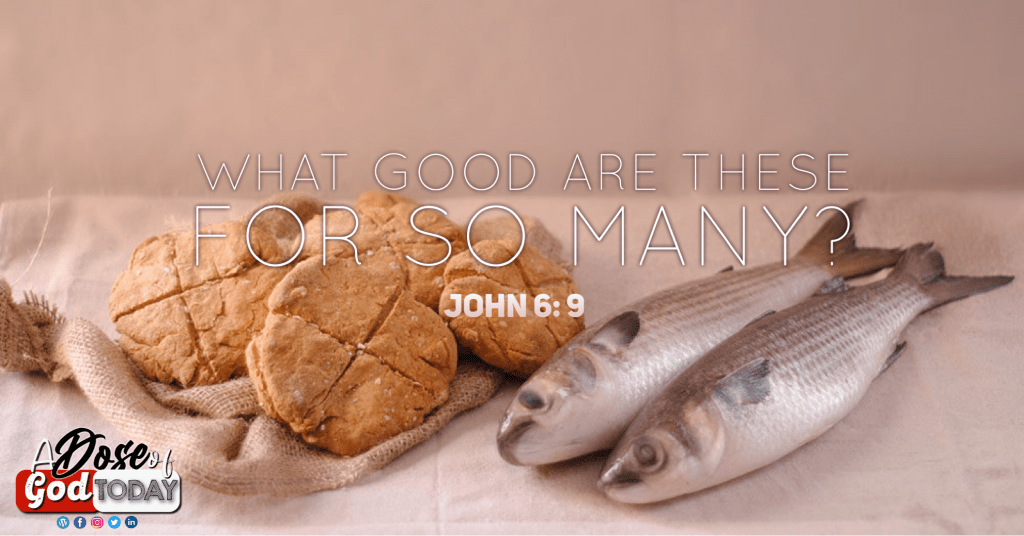
    It was Andrew who brought to Jesus a boy who had five barley loaves and two fish. The appearance of the boy in the story was actually very symbolic. He was nameless and faceless and was just a boy with small food. Yet, that nameless and faceless boy must have volunteered and gave generously his food to Jesus.

    With the boy’s willingness and generosity, his small share became the perfect offering that Jesus needed so that the people will be fed. It was through that boy who had five loaves and two fish that Jesus did something and made everyone to wonder.

    The first reading and the Gospel seemed to have a common ground. There was the small share from a man  who came from Baal-Shalishah and the loaves and fish from the boy. The little things that they had were transformed into many. The small share that they gave became abundant.

    This is where we find God’s invitation for us today as we have also become aware of the pressing hunger in our communities. We are invited by Jesus to offer sincerely the little that we have. We might be thinking that the world’s problem on hunger is too big for us to respond and our share will only be insignificant. Then, having such pessimistic view and calculated in our generosity will only prevent us from participating in God’s saving action, like the servant of Elisha and Phillip. But let us remember, the twenty barley loaves and fresh grain of the man were insignificant to a hundred men and even the five loaves and two fish of that nameless boy were nothing compared to the five thousand men. However, the man did not keep away his food and the boy did not run away to hide what he had, rather, both of them offered generously what they had no matter how small or insignificant those were. Indeed, this tells us that small acts of kindness matter in the presence of the Lord.

    The action of the man as well of the nameless boy were symbols of our vulnerabilities and weaknesses, of our anxieties and fears of having not enough but at the same time the power behind a generous action. To give away the little that we have, makes us insecure, yet, it is actually through the little that we possess that the Lord works wonderfully. When we give something and then we feel vulnerable because that was all we have, no matter how small, is actually the fruit of our generosity. Remember, true generous people will always feel helpless because what they give to others is not something that is only an excess of their possession.

    Thus, the Lord invites us today to be generous with what we have, no matter how small or inadequate in our eyes. Remember, the Lord needs our participation, our small contribution so that he too can work wonders through us and through our small things. With us, Lord will be able to continue to feed the various hungers around us. These many hungers involve hunger for food, for shelter, for a home and family, for friendship, for acceptance, for love and intimacy, or for a deeper relationship with God.

    Let us take time today to be that nameless man and nameless boy who generously offered the little things they had, to make a generous action towards people around us, no matter how small would that be as long as it is given in generosity and kindness, the Lord shall make wonders with us and through us. Hinaut pa.


    [1] https://data.unicef.org/resources/sofi-2021/

    [2] https://www.theworldcounts.com/challenges/people-and-poverty/hunger-and-obesity/how-many-people-die-from-hunger-each-year/story

    [3] https://www.rappler.com/nation/millions-filipino-families-stay-hungry-sws-survey-may-2021

  • SHARING

    SHARING

    July 25, 2021 – 17th Sunday in Ordinary Time

    + Emmanuel T. Cabajar, C.Ss.R. D.D.

    Click here for the readings (https://bible.usccb.org/bible/readings/072521.cfm)

    A boy gets his lunch left-over boxed up to take home. As he leaves the restaurant he ignores an old man begging. Feeling a sudden guilt, he gives him some coins. “How about the box, I’m hungry?” the old man begs. To part with his burger isn’t that easy, but compassion prevails. The boy gives it to the poor old man who smiles with gratitude.

    In the gospel a boy gives his lunch to Jesus, which allows Jesus to do something extra-ordinary – feeding the crowd. This miracle is repeated at the Last Supper and at every Mass where Jesus gives Himself and makes us sharers in his body and blood. St. Ignatius of Antioch calls this “one bread that provides the medicine of immortality, the antidote for death, and the food that makes us live for ever in Jesus Christ.” This food unites us intimately with Jesus and heals us, body and soul. It gives us strength for our spiritual journey. Do we hunger always for this bread of life?

    The feeding of the crowd demonstrates God’s kindness to us. He gives generously. He gives more than we need so that we may also share with others, especially the most deprived. God multiplies the little that we have, like the boy’s lunch, for the good of others. Do we trust in God’s provision for us? Do we share freely with the poor? Jesus is still looking for simple people, like you and me, who are willing to make selfless sacrifices that He may convert small love offerings into His glory. May our hearts be open to such kindness and generosity!

             Lord, satisfy the deepest longings of our hearts and feed us with the finest food!

             Brothers and sisters, generosity makes us joyfully share our God-given gifts with others. Amen.