Tag: Faith

  • Pope Francis’ Message: Forgiveness, Peace, and Hope

    Pope Francis’ Message: Forgiveness, Peace, and Hope

    (A Moment of Reflection: A Talk – with Christ the King College de Maranding, Campus Ministry Office)

    There are three important words that I want you first to remember as we reflect today the message of Pope Francis on the occasion of the World Day of Peace published on January 1, 2025.

                First, FORGIVENESS. Second, PEACE. And third, HOPE.

                These three words served as the central theme of the message of Pope Francis addressed to world leaders and to all people of good will, including you and me. We have to understand then that the challenges and invitations set by Pope Francis are not only applicable to people who play important role in political, economic and cultural arena of our society. The call towards the path of peace is call to all.

                Hence, the theme of Pope Francis’ message reminds us now, “FORGIVE US OUR TRESPASSES: GRANT US YOUR PEACE.”

                As I join you in this short recollection, watch first this short video of the message of Pope Francis.

    From that short video presentation, it tells that Pope Francis invites us to look at the challenges that our world is facing today. These challenges are particularly those that endanger the survival of humanity and the whole creation because of human greed and manipulation for power, wealth and control.

                But how shall we look at these realities?

    We can actually look at it from the perspective of anger and hatred because of the injustices yet, that will only lead us to the cycle of violence. We can end up towards arm struggle and rebellion. Nevertheless, it will not lead us to peace but only towards more suffering and despair.

     We can also look at it with apathy and indifference. Well, the many issues and realities happening around the world are not directly experienced by us. Each of you here is not living on a war zone. You are not unemployed. You don’t have children who are undernourished, experiencing severe hunger on a daily basis. You don’t have overwhelming debt that will take you more than a lifetime to pay. And so, passivity and looking at these realities with indifference would be very easy for us to do. Yet, such attitude would only make our hearts calloused and numbed at suffering of others even with those who are nearest to us.

    Pope Francis proposes to look at the realities of the world, as well as of our own experiences of suffering from the perspective of hope, of having a heart full of hope.

    Now, for us to better understand and have a good grasped of what the Pope reminds us, let’s have a step by step moments of reflection of his message. The entire message is actually divided into four sections. In each section, let us also recognize its relevance in us, in our own context, work and status especially to you as a team of Campus Ministry in your college.

    Going back to that proposal of Pope Francis to look at the realities of the world from the perspective of hope, it triggers us to also ask, how? How do we look? And where should we start? This brings us into the first section of the message.

    The First Section

    1. LISTENING TO THE PLEA OF AN ENDANGERED HUMANITY (A CALL TO LISTEN)

    Pope Francis brings to our awareness as he greets every man and woman, and especially to those whom felt more connected – the downtrodden, those burdened by their past mistakes, those oppressed because of being judged by others, those who are desperate and hopeless.

    This is each of us! These are the experiences of many and perhaps of those students under your care. The many burdens they carry and issues they face in their own lives. This means that suffering is experienced by everyone. This is the significance of the sound of a ram’s horn (in Hebrew, jobel) calls us to listen.

    This is why the Jubilee Year of Hope becomes more relevant to each of us, individuals and as a community of faith. This is an invitation again for us that our hearts be filled with hope. This hope leads us and moves us to aspire and work for forgiveness and reconciliation, for freedom and healing.

    That is why, the Jubilee Year of Hope is meant to echo throughout the land (cf. Lev 25:9 – to every hearts and to every homes and communities) so that God’s justice will be restored in every aspect of life.

    We are called to listen and recognize now the many “desperate plea for help.” These include the exploitation of our natural and human resources in the guise of progress and profit. Pope Francis affirmed what St. Pope John Paul II called as “structures of sin” committed not only by principal agents but also by many of us who participate indirectly because of our support or because of our indifference.

    Indeed, this is a call for us to listen – to heed the plea for help of the suffering humanity for example the “inhuman treatment towards migrants, environmental decay, confusion caused by disinformation, refusal to engage in any form of dialogue, and the immense resources spent on the industry of war.” These are all “distinct yet interconnected” to each other. Do we also find these in our context? Maybe not all, but perhaps some of these.

    By acknowledging the forms of suffering in our own context, then, it calls us to work for justice. And what Pope Francis wants us to realize as well is “the cultural and structural changes” from us so that change will endure and will not be passive. This brings us now to the second section.

    Second section

    2. A CULTURAL CHANGE: ALL OF US ARE DEBTORS  (A CALL TO HUMILITY)

      After looking and recognizing at the many realities present in our communities, Pope Francis leads us to also realize the many gifts that are already in us. Yet, the many resources that we enjoy are not meant for us alone or for the “privileged few” in the case of the those whose hearts have become so wealthy and entitled.

      Pope Francis wants us to grow in gratitude, he said, “without gratitude, we are unable to recognize God’s gifts.” Certainly, we won’t be convinced as well that we are actually gifted. We will not be confident of what we have, as well of the potentials and talents that we already have. Meaning, without gratitude, it leads us to bitterness and despair. Look at how a person, you might have encountered one already, whose heart have grown ungrateful – the person becomes so stingy of many things and so mean to people around him or her.

      Indeed, when we become ungrateful this also leads us to easily get irritated or even feel unfair at the blessings of others. It makes us entitled but corrupt, even when we have received so much, in our practices because our heart is not convinced that what we have are God’s grace.

      We have to understand then, that God’s grace cannot be earned. It is a pure gift not because of our good deeds and qualities but undeserved and unmerited. That is why, the Lord would not abandon the sinful humanity, or no matter how sinful we have become, because God’s infinite mercy is a gift. In fact, God reaffirmed this “gift of life by the saving forgiveness offered to all through Jesus Christ.”

      This is how we discover the central teaching of the “Our Father.” As Jesus told us to pray : “Forgive us of our trespasses,” the Pope reminds us to recognize our collective sins that we are all indebted to the Father and with one another.

      Hence, we rely now on the mercy of God who forgave our debts, through Jesus. And through him, the gift of life, being renewed gives us hope for one another. In consequence, Pope Francis appeal echoes to every heart – “the appeal for solidarity, but above all for justice.”

      Hope becomes more alive in us now because it opens us up and lead us towards that cultural and structural change. The cultural change happens in our way of life, in the way we relate with one another and in the way we look at the world from the perspective of hope. Eventually, through this cultural change then structural change happen and begin to recognize that we are all brothers and sisters, we have a shared and diversified responsibilities and that we are not enemies or business competitors.

      This leads us now to the third section.

      Third Section

      3. A JOURNEY OF HOPE: THREE PROPOSALS (Call to Action)

        This change in us begins in our hearts. This also fuels and renews our hope, of our journey of hope, as being emphasized in this Jubilee 2025. Acknowledging God’s constant grace and mercy to all, makes us again realize God’s infinite generosity and love because we are forgiven.

        Yet, let us not also forget the challenging words in the Lord’s Prayer, “as we forgive those who trespass against us.” Forgiveness becomes a reality in us as we also learn to forgive others. From such grace, hope and peace shall overflow in our hearts. That overflow will only become concrete from our own experience of forgiveness and generosity,

        In fact, Pope Francis also said, and I quote, “Hope overflows in generosity; it is free of calculation, makes no hidden demands, unconcerned with gain, but aims at one thing alone: to raise up those who have fallen, to heal hearts that are broken and to set us free from every kind of bondage,” end of quote.

        This is the best gauge for us as we express our generosity to others. And so let us be mindful also of our attitude when our generous actions (things that we give like of materials resources, presence, our personal time and talents) are fueled by our personal agenda or selfishness then, our generosity is not from hope. Rather, it is from corruption.

        From here Pope Francis leads us to the path of peace with three proposals as our call to action.

        1. First, Forgiveness of International Debt. “Reducing substantially, if not canceling outright, the international debt which seriously threatens the future of many nations”, said Pope Francis. This is a call to world leaders especially of rich countries to be in solidarity with neighboring nations.
          1. Second, Abolition of Death Penalty. This means that we are called to have a firm commitment to respect for the dignity of human life from conception to natural death. Through this commitment, we promote a culture of life that gives every man and woman the hope of forgiveness and rehabilitation, freedom and healing.
          1. Third, To Establish a World Fund aimed at Eliminating Hunger. This is to use a “fixed percentage from armament investments to establish a global fund to eradicate hunger, facilitate educational activities in poorer countries to promote sustainable development, and to combat climate change.” This means that, certainly, war is for profit, for business and thus, it is an industry. Political conflicts or ideological beliefs or territorial disputes can easily be manipulated by profit-oriented groups in order to create war and so gain immense profits. Yet, what the world needs are not bullets but food and water, education and home.

        These three proposals though aimed at the world leaders and all those who play significant role in our global village, however, ourselves and those at the grassroots remain significant so that we may be able “to pave new paths of peace together in our communities.”

                    This brings us to the final section.

        Final Section

        4. THE GOAL OF PEACE  (Towards Freedom)

        Pope Francis quoted Saint John XXIII who convened the Second Vatican Council in 1962, “true peace can be born only from a heart ‘disarmed’ of anxiety and the fear of war.”

        This means that the goal towards peace is first directed at our own hearts that are perhaps trapped in despair and hopelessness because of our failures, or hearts thickened by indifference and selfishness, or hearts traumatized by abuse and oppression, or hearts covered with pretensions that everything is okay but not realizing the realities around, or hearts filled with worries and anxieties because of the thought of “nothing might be left for me, then I have to accumulate more” or the thought of “nothing is for me, I am pitiful” or having a heart that is constantly threatened by tensions, conflicts and wars. Then, our hearts are indeed troubled.

        Yet, know that the Lord brings us peace, grants us pardon and gives us freedom. What we are called to do now is to disarm our heart from whatever shackles of pain, trauma and imprisonment it is suffering from.

        Pope Francis wonderfully expressed the call towards freedom in these words, and I quote, “May we seek the true peace that is granted by God to hearts disarmed: hearts not set on calculating what is mine and what is yours; hearts that turn selfishness into readiness to reach out to others; hearts that see themselves as indebted to God and thus prepared to forgive the debts that oppress others; hearts that replace anxiety about the future with the hope that every individual can be a resource for the building of a better world.

                    Indeed, each of us now is a resource in building a better world. Your position as educators puts you now at the pedestal in your own context to realize peace. Pope Francis even continued to express that “disarming hearts is a job for everyone.” So that, as we heed the call to disarm our hearts, then, it will inspire us and give us hope to also become a catalyst in disarming the hearts of people around us even through our simple gestures “such as a smile, a small gesture of friendship, a kind look, a ready ear, a good deed” or having an understanding heart over a troubled student, or having a welcoming hand shake for anxious new students, or un-judging (without judgment) attitude towards a colleague who is emotionally sensitive.

                    These are small steps, simple gestures yet will also become powerful and effective as we hope to build a community in loved with peace.

                    And so as I end this reflection let us pray together the prayer for peace composed by Pope Francis at the end of his message.

        PRAYER FOR PEACE by Pope Francis

         Lord, grant us your peace!

        Forgive us our trespasses, Lord,

        as we forgive those who trespass against us.

        In this cycle of forgiveness, grant us your peace,

        the peace that you alone can give

        to those who let themselves be disarmed in heart,

        to those who choose in hope to forgive the debts of their brothers and sisters,

        to those who are unafraid to confess their debt to you,

        and to those who do not close their ears to the cry of the poor.

        Amen.

        Points for Reflection towards the Path of Peace

        Look and Listen: Recognizing the Cry for Help in my own context

        As an educator/religious/seminarian – what are the different pleas/cry for help that I can identify which I encounter with myself, with my students or community?

        Embracing our Gifts leads us to Gratitude and Generosity

        What resources/gifts/talents do I have that I can offer for others and for my community?

        Call to Action: A Commitment to make

        What do I need to change in me? What do I need to disarm from my heart? (attitudes, beliefs or perspectives) What concrete actions I can commit to promote peace?

        1. GOD IN OUR HOMES

          GOD IN OUR HOMES

          January 19, 2025 – Sunday, Feast of the Sto. Niño

          There would be times that I noticed how parents would discipline their children when they bring them to Church. There was even a time when I sat at the back before the mass and when a mother saw me, she said to her child, “Pagpuyo diha, hilom, kay naa si Father oh, masuko na siya.” Or sometimes parents would say to a naughty child with these words, “ayaw pag sigeg kiat, si Jesus naa sa krus oh, masuko na siya, monaug gyud na ron kay kusion ka!”

          Parents or those guardians of children would seem to incite fear to the little ones by introducing to them that the “Priest” would easily get angry, and the God will easily punish a naughty child.

          And this weird kind of discipline, though might have been really the experience of some in the past of having priests who easily get angry, reminds us now of the Gospel on this feast of the Sto. Niño.

          The child Jesus remained in the Temple and did not join Mary and Joseph in the caravan. This tells us that the 12 years old Jesus already felt the joy of the presence of his Father in Heaven while being at the Temple. Jesus realized that he also needed to live in his Father’s house because he also felt that it was as well his home. The Temple of God is indeed, Jesus’ home.

          Thus, Mary and Joseph saw that the child Jesus was in fact doing good and well with the teachers of the Temple despite their worries and anxieties of the event. Yet, this also gives us the reality that children also need a home where they will be joyful, will feel loved and a home that will give them opportunities for growth in health and wisdom.

          Hence, allow me now to share with you some surveys and studies that tell us about the situations of many children today.

          According to the World Health Organization[1], there are 6 in every 10 children or 400 million children, under the age of 5, who regularly experience physical and psychological violence, from their own parents and caregivers or guardians.

          Moreover, there is also 1 in 5 women and 1 in 7 men who experienced sexual abuse when they were children. In consequence, such trauma would result to lifelong physical and mental health problems especially when such shameful and painful experience is not processed and reconciled.

          These are only few of the concrete situations that many children are subjected to suffering, violence and unhealthy environment. In fact, there are many children who did not experience a peaceful and loving home because of irresponsible parents. There are many who suffer because of abuse from those people around them.

          Yet, as a Church and a Christian community, we also hope and desire that our children will have a home filled with love and freedom, life and joy. This desire is what we have heard from the readings we have today on this feast of the Sto. Niño.

          In the first reading, Prophet Isaiah proclaimed about the coming of the light, because those who walked in darkness will see the light, and those who live in gloom will be enlightened.

          In Isaiah’s prophecy, the Lord shall dispel the darkness of sin and failures, of our suffering and sadness. And in the midst of these, the Lord has come to bring light and freedom for us. Indeed, his light is our hope. This is what we also journey this time of the Jubilee Year 2025 of which we are all invited to become Pilgrims of Hope. The presence of the child Jesus, the Sto. Niño is God’s manifestation of forgiveness, of God’s mercy, of freedom and gift of life.

          In our devotion to the Sto. Niño, we are reminded of the presence of God who is among us, and who shows his power through the image of a child – through the gentle and humble image of the Child Jesus, who also calls us to grow in friendship with him.

          Indeed, Isaiah tells us of a child who is born for us and will be given to us. He is the Wonder Counselor, the Almighty God, the Eternal Father, the Prince of Peace. This is the Sto. Niño who is given to us.

          And so, we know that we have already been gifted of the presence of God. Let us allow then, God’s presence to dispel all forms of darkness in our hearts, of the pain that we feel because of violence, of the evil of indifference and corruption. Let us also allow the Magnet of Love (ang Bato Balani sa Gugma), the Sto. Niño to embrace us and to bless us now.

          With these, there are 2 challenges for us on this feast of the Sto. Niño.

          First, make a home of acceptance and love. Remember, we can make big and comfortable houses, but what is more important is for parents, for every family, rich or poor, to be able to create a welcoming and loving home. Let not our homes become a home of judgments and home of rejection, or source of unbearable pain and trauma.

          Second, allow God to be at home – so that our children will also be assured of the presence of God and that they will know God. Allow also the Lord that He will have a big space in our homes, that the Lord will become an important part in our dreams and hopes, in making decisions in life, in our concerns and problems as well as in our joys and sufferings – so that in all the days of our life, God’s presence will bless us. Hinaut pa.


          [1] https://www.who.int/news-room/fact-sheets/detail/child-maltreatment

        2. In HUMILITY

          In HUMILITY

          January 5, 2025 – Solemnity of the Epiphany of the Lord

          Click here for the readings (https://bible.usccb.org/bible/readings/010525.cfm)

          A man once asked a wise priest: “Father, how come unlike before God seems to be not talking or speaking to us anymore?” The priest replied: “It is not that God is not anymore talking or speaking to us. But rather it is that nowadays nobody are humble enough to stoop down to listen to Him. Nowadays…nobody… are humble enough… to stoop down … to listen to Him. Bihira nalang ngayong panahon ang mga tao na lumalapit sa Kanya na may pagpakumbaba upang marinig Siya at makinig sa Kanya. Niining panahon pipila nalang ang mapaubsanon nga nangaliyupo sa pagpaminaw Kaniya

          True enough that there are times in our lives that God seems to be silent and absent to us. But during those moments of our frustrations and hopelessness with God, perhaps it is better to consider not His seeming absence or silence, but rather perhaps that we have reach already too far and high in life that we don’t anymore get near and low enough to listen to Him. Siguro napakataas at napalayo na ng ating narating na hindi na tayo lumalapit at may pakumbabang makinig sa Kanya at marinig Siya.

          For the past Sundays, during Advent and these Christmas Seasons, we come to know a number of people who became involved in the birth story of Jesus and happened to encounter God and begun to know God’s will for them in life. Mary met God through angel Gabriel and became the mother of Jesus. Through a dream, Joseph became responsible foster-father of Jesus. Zecharias became the father of John, after meeting an angel in his old age. Elizabeth became pregnant with John also in her old age after his husband encounter with the angel. Shepherds saw and learned from an angel that God’s gift to all has been borne in Bethlehem and they became witnesses (godfathers’ or ninong) of baby Jesus. And now in our gospel, the three kings come to know where baby Jesus, God-promised they have been searching, through an omen of  bright-guiding star. All these people and their experiences are telling us that God had made Himself and His will know to them, and God will always continue to make manifest Himself and His will to us until now.

          Same way as before, we might experience once again God and His will for us now, if and when we honor our dreams, listen to God’s word and witness His works actions in us shown to us by his angels or messengers. God still continues to manifest or reveal to us in many ways through the faith and actions of our community and church as we share each other God’s word, good advice, kind and loving service with others, and responsible guidance and parenthood of our elders and leaders. Even in a special way for us Filipino Catholic, we sense God through our kalooban and pangdama. Kilala ko siya dahil dama ko Siya. Malapit ang loob ko sa kanyang salita at gawa.

          Today, in the Solemnity of the Epiphany of the Lord, marks the end of Christmas Season. Today is to remind us that more than about the three Kings, God is still making Himself and His will know to us. He is still reaching out and communicating to us in many many ways. He is still talking and speaking to us, like before. All we need to do is to be humble enough to stoop down to listen and be sensitive to Him and His ways of revealing Himself to us.

          Moreover, Epiphany also reminds us that once we become humble enough to sense, hear, and honor God and His will to us now, we must change our ways. After meeting the baby Jesus, the magi went back in their journey following different path. This would mean that once we listen and honor God’s will for us, life will never be the same again, for it has to change for the better. Simply, God’s revelations requires our humility to follow & obey His better plans for us.

          As we say goodbye to Christmas season, may we be more sensitive to God’s continuing revelations to us (His ways of making Himself and His will know to us) and be more humble & open enough to be changed and be responsible for the gift of life God is offering us now and always.

          So be it. Amen.

        3. PARENTING 101

          PARENTING 101

          December 29, 2024 – Feast of the Holy Family

          Click here for the readings (https://bible.usccb.org/bible/readings/122924.cfm)

          In every Wednesday novena to Our Mother of Perpetual Help, one intention we pray is that we may learn to adapt to our growing children. Parenthood, as we all know, is not only about raising children but also adjusting to our growing children. Thus to parent a child is more than just caring for the growth of the children; it is also adjusting and learning in the process, as children grow in maturity and age.

          As Redemptorist missionary involved in parish, retreat, mission and migrant ministry. For many years, though not a parent myself, I came to be aware of the difficulties of parenthood. In as much as adapting to life-changes is difficult, how much more adapting to growing children. In confessions and counseling sessions with faithful people, I become conscious of the hurts & pains suffered by both parents and children alike in their difficulties with parenthood.

          Parents hurt by their children’s disobedience, i.e. going against their will; children blaming their parents for their misfortunes in life. All because of our limitations in parenthood. Parenthood indeed is not an easy task rightly so that we pray to OMPH that we may learn from our experiences of adapting to the growth of our growing children.

          Today, we honor the Holy Family, the family who parented the child Jesus. Our gospel tells us that like any other family, the Holy Family also experienced the difficulties of parenthood. Joseph and Mary followed the proper traditions of raising the child Jesus. They did their best. But as we all know, they also experience how Jesus became disobedient to them, going against their will.

          Surely parents here could relate with Joseph & Mary, and know the hurts, pains and anxieties they experience when children start to grow up and be on their own. Like my mother would say, when we, her children became independent from her, “Kung puede palang ibalik sa tiyan.” (If I could only bring you back in my womb…) It is the same way with the experience of a chicken hen that raises ducks as her chicks. When the duck-chicks, which by nature a swimmer, start to swim and float on a pond, the mother hen would be extremely worried because she cannot swim and she gets anxious that her chicks will get drowned.

          This is also what and how Joseph and Mary experienced parenting Jesus. When the child Jesus began to grow up in age & maturity, his parents also experienced the difficulties of parenthood. However, the Holy Family’s experience could teach us more about parenting, in view of adapting to our growing children.

          First, parenthood is a family matter, not only of parents. To parent a family is not only about the husband and wife tandem in raising their children but it is more on the dynamic teamwork between parents and children. If it was difficult for Mary and Joseph to raise and adjust with Jesus, it was also difficult for Jesus to grow up in his own family. In as much as being parent is difficult, we also know that growing up maturely (to be on our own) is difficult. If Jesus only obey his parents’ will,  we wonder: would we be able to benefit from and share with the salvation God has given us through Jesus, who did not remain a child of Mary and Joseph but become our Christ, our Savior? Surely Jesus had been an obedient Child to His parent, but above all, Jesus became an obedient adult Christ to our God, the Father.

          Second, parenthood is also about trusting in God’s way of raising and forming all of us His children. Inasmuch as we are tasked to parent to our little ones, raising and adapting to their growth, we must never forget that ultimately God is our Father – our ultimate Parent, and we are all His children. If we want the best for our children, God also knows, wants and does what is best for each one of us. God knows what was best for us when we were children, surely, he knows what is best for us when we become mature adult parent to His little ones. So trust and have faith in God’s will, in God’s way of parenting us.

          Photo from YoungCatholic.com

          To parent a child is to work together then with one another as family of parents and children as well as to work with and in deep faith and trust of God’s way of parenting us. Perhaps these days we consider:  “What kind of parent we have been? What is your parenting styles? Have you been a CARPENTER parent who designs, measures, builds up & wills what is best for your children? Or are you a GARDENER parent who prepares, tends, & cares for God’s child in you growing to be a blooming, budding & fruitful blessing for all, God intended our children to be? What need to be improved then, as we learn to adapt to our growing God’s children with us?

          Christmas challenges us Christian to be responsible parents of Jesus in our lives today. Parenting our growing children is also our way of being responsible to Jesus, God’s Word made flesh in us. As we celebrate the feast of the Holy Family, we pray that the Holy Family will continue to inspire all Christian families and communities in parenting our growing children. Amen.

        4. Filled with Grace and Power

          Filled with Grace and Power

          December 26, 2024 – Thursday, Feast of St Stephen, First Martyr

          Click here for the readings (https://bible.usccb.org/bible/readings/122624.cfm)

          Christmas is a joyful season. The music, decorations, the variety of food and the many gatherings during this season give the festive and joyous atmosphere. Yet, the liturgy today, just a day after the birth of Jesus reminds us how faith and commitment to the Word-made-flesh will make us a contradiction to many.

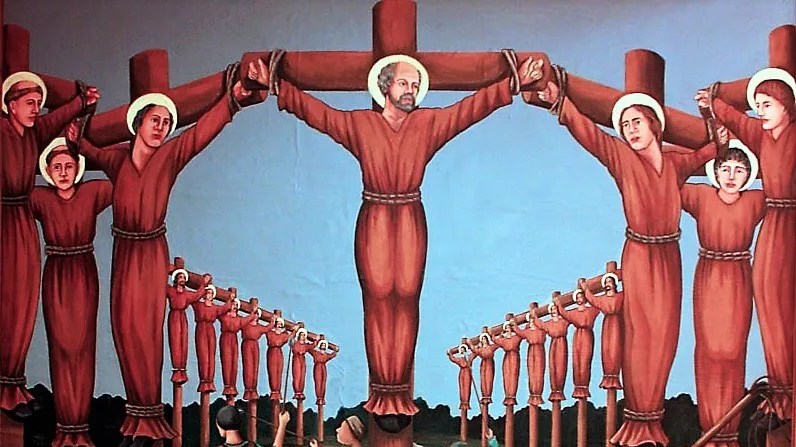
          Indeed, yesterday we celebrated the joyful birthday of a child and today we celebrate the cruel death of an innocent man. In some ways, the birth of Jesus led to the death of Stephen, one of the first deacons of the church and the first Martyr. Stephen was put to death because of his faith in Jesus, declaring him to be the glorious Son of Man standing at the right hand of God.

          St. Luke describes Stephen dying with two prayers on his lips. First, a prayer of surrender, “Lord, Jesus, receive my spirit.” Second, a prayer of petition for his executioners, “Lord, do not hold this sin against them.

          When Jesus was dying on the cross, he had two similar prayers on his lips as well, a prayer of surrender, “Father, into your hands I commend my spirit” and a prayer of petition for his executioners, “Father, forgive them for they know not what they are doing.” We can see that Jesus prays to the Father while Stephen prays to the risen Lord.

          Mary’s child is now the risen Lord and can be prayed to as we would pray to God. In the church, we often pray to the Father through Jesus, but we are also invited to pray directly to Jesus. Stephen died as Jesus died because he was “filled with the Holy Spirit.”

          We have been given the gift of the same Holy Spirit, and it is the Spirit who empowers us both to live like Jesus and to die like Jesus. On this feast of Saint Stephen, we pray for a fresh outpouring of that Spirit into our lives in this Season of Christmas that we may also be filled with grace and power like him. Hinaut pa.