
Tag: Faith in action

  • Faith: A Human Response of Love

    Faith: A Human Response of Love

    Advertisements

    October 10, 2020 – Saturday of the 27th Week in Ordinary Time

    Click here for the readings (https://bible.usccb.org/bible/readings/101020.cfm)

    Homily

    Faith, as Pope-Emeritus Benedict XVI said, is a human response of love to God who first loved us. This human response is neither bound to obligation nor a mandate because of law as what St. Paul told us in his letter to the Galatians. He said, “through faith you are all children of God in Christ Jesus.” We become God’s children because we have opened ourselves to God’s offer of life and freedom. We become children because we too are made heirs of the kingdom of God.

    Moreover, faith is not something that is abstract or a mere allegiance to God. Since faith is a human response of love, it is alive, active and life-giving.

    Thus, the Gospel tells us how faith transforms a person. And so, the woman in the gospel praised Mary, the mother of Jesus for having a great son like him. Likewise, Jesus even praised Mary not just on this basis of her motherhood, but rather for being able to listen to the Word of God, pondering upon it and observing it.

    St. Anselm even affirmed that because of the great devotion of Mary to the Word of God in listening and pondering everything in her heart, the Word was made flesh within her.
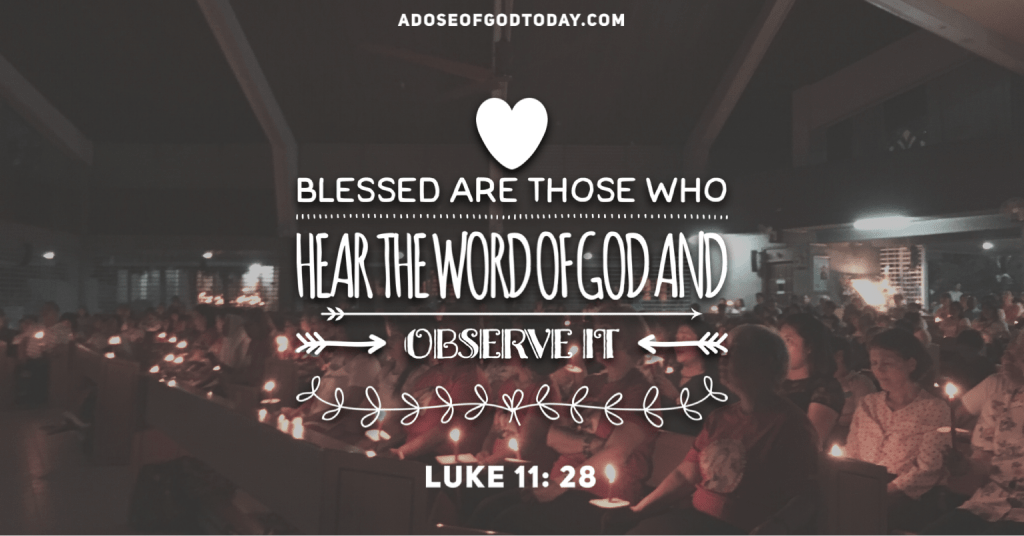
    This tells us that Mary’s devotion to the Word of God did not only stop in mere hearing but the word spoken by God transformed Mary herself. Accordingly, Mary has become our best example of a person who did listen, accept and embrace God’s word. It was in that way that Mary found her joy, her peace and her freedom as a person, as a woman, as a wife and as a mother.

    Today, we, who received the gift of faith and the Word of God, through the Holy Scriptures, through the Sacraments, through our community, are also being invited that our devotion to the Word of God will not just remain a mere obligation or not just a part of our speech but will also transform us. Like Mary, let the Word of God and (faith) our human response of love to God become concrete and life-giving.

    let the Word of God and (faith) our human response of love to God become concrete and life-giving.

    Jesus invites us that as we listen to him, who is speaking to us now, we too will be able to accept and embrace His words. His words may become difficult and challenging, risky and time-consuming but also comforting and inspiring, life-changing and liberating. We will surely then find that as we listen and ponder the Word of God in our heart, our actions, thoughts and speech and our person will also be transformed into what God desires us to be.

    Let our experiences of difficulties, anxieties, confusion and fear in this age of pandemic lead us to listen more and deeper to God’s word and to God’s everyday invitations for us.

    Let us be conscious about to the Word of God revealed in this Eucharist and in the Holy Scriptures so that its inspiration, its warmth and power will give light and life in our relationships with our families and friends, and in the many efforts that we make in our studies and in our work. Hinaut pa.

    Jom Baring, CSsR

  • Giving a space for God

    Giving a space for God

    Advertisements

    September 2, 2020 – Wednesday of the 22nd Week in Ordinary Time

    Click here for the readings (https://bible.usccb.org/bible/readings/090220.cfm)

    Homily

    When we allow a person to occupy a space in our life, this also means that we make ourselves open to the person. The person may know our deepest secrets, as well as our deepest pain in life.

    This is how we find our relationships fulfilling and essential in our personal development. Of course, we assume that the person whom we have given the space in our life has the good intention of giving care and love to us.

    However, if the person whom we have given a space in our heart and in our life, betrays us, gives us more pain and stress, then, our relationship becomes hurtful and even toxic for us. This kind of relationship does not help us and would only bring us into desperation.

    Yet, when it is God who asks for a space in our life and in our heart, will we allow God to occupy a space? Are we willing to give up something for God to be in our life?

    God would surely not bring us harm. God only desires goodness and happiness for us. Nevertheless, giving a space for God also requires something from us. We cannot accommodate the Lord when our heart is full, if our life is occupied with many things. What God actually needs is a small space to bring healing and transformation in us.

    This is what we have heard from the readings today. St. Paul in his first letter to the Corinthians, reminded the people of their childish attitudes which actually made their hearts full and unwelcoming to God’s spirit to work in them. The community in Corinth was filled with jealousy and rivalry. Paul called them “infants,” meaning that the people were still exercising their selfish attitudes and seemed to advance their personal interest rather than the interest of the Lord.

    Paul reminded them to become mature by claiming and welcoming the Lord in their life and not to be limited with the influence given by Apollos or by Paul himself.

    Moreover, the Gospel also tells us how Jesus brought healing and transformation into the house of Simon. As it was in any typical Jewish house at that time, the house of Simon, must had been full of people too. His house was not just occupied by his wife and children but also his in-laws, nephews and nieces.

    However, despite this situation, Simon offered Jesus a space in his house. When Jesus was given a space into the house of Simon, Jesus was able to heal his mother-in-law who was afflicted with a severe fever. The miracle of healing happened here. She, indeed, was healed.

    But what was more interesting was the effect of the healing, and that was the transformation which made her to act, to be generous of herself to the Lord and his friends. When she was healed, she got up and waited on them. This means that when she experienced the healing, she served the Lord in her own capacity. This is faith in action and gratitude being transformed into generosity and kindness.

    This is what the Lord is inviting us also today. We may have experienced hurts and pains in our human relationships because those whom we welcomed in our life have caused us troubles, but we are assured that God would only bring healing and transformation in us. God desires that we will be healed in whatever illness and pain we are experiencing today, may it be physical or emotional.

    Thus, we are called to give a space for God by also getting rid of those that are not actually helpful and not necessary. This applies in our personal life, in our relationships, and in our homes and communities particularly. Allow the Lord today to occupy that space and allow him too to heal and bring transformation in us.

    Hopefully, as we also experience the gift of healing, this may lead us to transformation where we are moved to put in action our faith and to make concrete our gratitude to God by becoming generous and kind towards others. Hinaut pa.

    Jom Baring, CSsR