Tag: Epiphany of the Lord

  • Alternative ROUTE

    Alternative ROUTE

    January 4, 2025 – Epiphany of the Lord

    Click here for the readings (https://bible.usccb.org/bible/readings/010426.cfm)

    “I firmly resolve, with the help of thy grace, to confess my sins, to do penance & amend my life. Amen.”

    We say those words as an act of contrition during confession. In saying these words, we do not only regret our mistakes but we are also making a resolution to change & improve our ways. Meaning, it is not enough just to be sorry of our mistakes, but we have to do something about our mistakes by doing our best because we know that we are and God’s mercy is much better than our sins, faults & shortcomings.

    Making an act of contrition then reminds us that the Sacrament of Reconciliation is not only about being sorry for our sins, but above all giving oneself & God a chance to do things right & do the right things for the better than we usually do. It is useless then to do monthly individual confession if & when we don’t change our ways & resolve to improve, but rather go back to our sinful & corrupt ways. Salvation is all about God’s grace in us rather than about our sins.

    Reconciliation then is allowing God’s mercy & forgiveness work in us, rather than finding & counting our woes, sins, faults, mistakes, shortcoming & of others. It is all about receiving God’s grace than accounting our faults. It is all about changing our ways rather than just being sorry for our sins.

    Today, we celebrate the feast of Epiphany. This is our celebration of our remembrance of God’s loving act of reaching out to us (God making Himself known to us) and our acceptance of Jesus, as God’s self-revelation. We, Christians believe that God has given us His only Son, Jesus Christ, as His first gift to us for our salvation.

    By sharing us His Son, we become related to Him and become also His children, and sharers of His divine life. Jesus, indeed, is God’s greatest gift to us. God’s offer of salvation & our reception of Jesus into our lives give another alternative meaning, directions & ways in our life. Because of Jesus, we are blessed & graced by God.

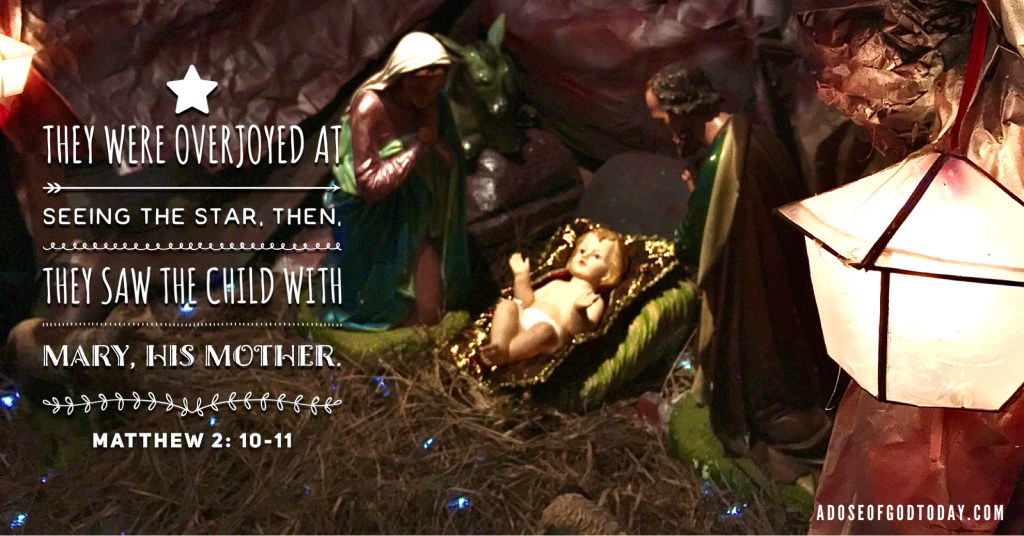
    Here in our gospel today, we are reminded us of what happened when the three kings found the Child Jesus lying in the manger in Bethlehem. Guided by the star, in great joy, they saw the Child Jesus and they did him homage.

    Their encounter of Jesus and the Holy Family in Bethlehem brought the three kings great joy for they have finally found what they are searching for. The birth of Jesus brought new promise & purpose, not only to the local Jews, but also to the migrant magi & to the whole world. With this, like us now, they are grateful, and offered their gifts in homage and thanksgiving to God’s greatest gift to all.

    But let us not forget that after they have witnessed & accepted the Son of God into our lives, they returned by an another alternative route to journey life.

    This is not because they were afraid of Herod, but because of their encounter with Jesus has also changed their lives. After they have recognized God in the child Jesus, the lives of the three kings were never the same again. They did not follow the usual path, but they amend their lives & now tread an alternative way, perspective, and attitude to life. The child Jesus brought them great joy as well as great changes in their way of life.

    The same with our experience of God’s mercy & forgiveness during confession. After celebrating the sacrament of reconciliation, we know deep inside that life now & ahead could & should not be the same again. We have to change our ways & amend our paths. Like the three kings, we have to take an-other, an alternative path of life-journey, much better than our usual lifestyle. The usual King Herod-road to Jesus, our sinful corrupt ways are not anymore safe to tread through again.

    We cannot help but amend our normal ways, or else we find ourselves again with our usual unhealthy drama, blame & excuses – away from God’s grace. Because as we all know & believe, Jesus, God’s salvation for us is more than just about our sins & failures in life, but more about & into God’s love & mercy for us His children.

    As we are beginning a new year, we make an act of contrition. We give ourselves another chance to grow & do better than our life last year. As we receive anew Jesus, God’s greatest gift for us, let us diminish our tendency to account & highlight our mistakes & faults, but be more conscious of God’s grace at work in us.

    And above all, let us amend & improve our lives for the better than our usual normal ways, and seek a new alternative path, roads, & ways for God’s blessing to be always with us today & our near future.

    In other words: “We firmly resolve, with the help of thy grace, to confess our sins, to do penance, & amend our life.”

    Amen.

  • IN SEARCH OF THE TRUE MEANING OF THE FEAST OF THE EPIPHANY

    IN SEARCH OF THE TRUE MEANING OF THE FEAST OF THE EPIPHANY

    The Epiphany of the Lord

    Many decades ago as we were growing up, January 6 was celebrated by the Christian world as the Feast of the Three Kings. The event being celebrated was the arrival of Melchor, Gaspar and Balthazar in Bethlehem to offer gifts of gold, frankincense and myrrh to the newly-born child whom they came to worship.

    Today, liturgically this is known as the Feast of the Epiphany (referred to as Theophany for Eastern Christians). Epiphany means the manifestation of a divine or supernatural being and for us Christians this feast celebrates the revelation of God incarnate in Jesus. Instead of referring to the three visitors as Kings, they are now more popularly known as Magi or Wise Men.  Across the world the celebration can range from January 6 to whatever is the Sunday nearest this date.  Thus in our country, it would be celebrated on January 8.

    Except for Matthew (Mt 2: 1-23), the narrative involving the three Magi does not appear in the accounts of the three other Evangelists. It is a very brief account where the tyrant ruler Herod is also mentioned.  There are very few details that help us know the wise men better except that they were from the East and that their journey to Bethlehem was guided by a star. Otherwise, the narrative ends up as a mythical story shrouded in mystery thus leading to all kinds of conjectures.

    Consequently, many have deconstructed the text and provided a deeper meaning to this narrative. Just this year on the Feast of Epiphany (celebrated at the Vatican with Cardinal Luis Tagle presiding and Pope Francis giving the homily), the Pope provided us his own reflection of the meaning of the Epiphany. Thus, his words:

    “The Magi’s restless questioning and continuous journeying in dialogue with the Lord finds its end in the worship of God… Like the Magi, let us fall down and entrust ourselves to  God in the wonder of worship. Let us worship God, not ourselves; let us worship God and not the false idols that seduce by the allure of prestige and power…  let us love God and not bow down before passing things and evil thoughts, seductive yet hollow and empty.

    The purpose of everything is not to achieve a personal goal or to receive glory for ourselves, but to encounter  God. To let ourselves be enveloped by his love, which is the basis of our hope, which sets us free from evil, opens our hearts to love others, and makes us people capable of building a more just and fraternal world.”

    We can further reflect on how this narrative relates to our contemporary life in our own society and focus our reflection on who were these wise men? The biblical reference indicates they were from the East, which should make it interesting for us Filipinos as we are in this part of the world – the East or the Orient. Some writers theorized that they came from the nearby countries of Israel, namely Persia (now Iran) even as far as India.

    But why were they referred to as wise men? Relying on ethnographic data providing us data  on the Oriental civilizations existing long before the West entered into its Industrial Revolution, there were advanced societies already existing in the Orient from China to India to the Arab countries. They had developed the various fields of philosophy and science, much earlier than the Western world.

    Thus, we can conjecture that Melchor, Gaspar and Balthazar – as they were guided by the star – had knowledge of astronomy if science had developed to that extent during that era. There is, however, one better explanation that anthropologists would posit. Could they be shamans who had developed the gift of communing with the supernatural?

    If they were coming from the East, what faith traditions have evolved in their societies? While there were established religions already during the reign of Herod in other parts of the world and in Israel (Hinduism, Judaism, etc.), Islam and Christianity were still to evolve. But were the magi also shamans who served as ritual officiants of their communities which were ensconced within an indigenous belief system?  We know for a fact that across the world and through the centuries, shamans have developed a keen sense of understanding the mystical realm.  Could this have been the case of the three wise men?

    Perhaps it is futile to have the answer to this question even if there theologians who would like to pursue this question in dialogue with anthropologists. However, we can expand the search of meaning and link it with our attempts to better pursue some of the pastoral challenges in our post-Vatican II Church especially in the discourses of inter-faith dialogue and inculturation.

    A fundamentalist reading of the Matthew text would insinuate that as the magi worshipped the child as God, they had abandoned whatever faith tradition they belong and embraced a new faith. On the other hand, a progressive reading of the text allows for an encounter of faith traditions in dialogue with each other. Thus the Matthew narrative would be very useful for advocates of inter-faith dialogue, as one of the first events in Jesus’ early life pointed to the possibility of faith traditions entering into a dialogue with each other.

    In this day and age, when there are still countries where different groups of believers – Christians, Jews, Hindus, Muslims, Buddhists and others –  are engaged in conflicts leading to the eruption of violence, the encounter of Jesus and the Magi provide the hope that a day will come when all faith traditions would learn to embrace the gift of an encounter that brings peace!

    When that moment arises, all of earth’s people of goodwill can truly celebrate all together a feast of the Epiphany no matter what faith tradition they worship God (in whatever God’s name is invoked!).

  • The Four Movements of the Magi

    The Four Movements of the Magi

    January 3, 2020 – Solemnity of the Epiphany of the Lord

    Click here for the readings (https://bible.usccb.org/bible/readings/010321.cfm)

    What is it that you are hoping for this year? Or what is it that drives you most for this year 2021? Are you looking for somebody who will give meaning to your life? Are you searching for something that will give you contentment in life? Are you expecting something that will fulfill the emptiness in your heart, or of something that will at last dispel your fear and anxiety?

    Each of us must be hoping or expecting something good to happen for ourselves and for our families. That is why, we have dreams and we make plans on how to fulfill what we envision for ourselves. In the recent Pulse Asia Survey conducted from November 23 to December 2, 2020, it revealed that 91% of Filipinos celebrate Christmas and New Year filled with hope amidst the devastating year of 2020. The same percentage also expressed an optimism for this year 2021 and 87% of people in Mindanao particularly, expressed this optimism.[1] The survey indeed revealed a high hopefulness for this year.

    This survey can be an indicator of a high motivation among us to journey forward, to continue searching and making a reality what we hope for ourselves and for our families and communities. This also indicates that as we hope and aspire to fulfill our desires and dreams then we also take risks. The risks here may include investing our time, energy and resources, developing and forming new relationships and venturing into unknown territories.

    Such reality brings me now into what we celebrate this Sunday. Today is the Solemnity of the Epiphany of the Lord or God’s manifestation of Himself to us. This Sunday is popularly known as the Feast of the Three Magi or Wise Men. However, this feast is not actually about them but about that baby boy whom they found after their tiring search of the shining star, the fulfillment of their dreams.

    Though the three Magi are not actually the focus here, but there are lessons that we can learn from them. There are four movements of the Magi here and these are also the invitations that that I would like you to pay attention now. So, allow me to tell their story again and discover how God manifests Himself in us today.

    The first movement of the Magi is searching. These men, who were probably astrologers, had been observing the heavens and they became engrossed so much by this bright shining star. They came from different places yet the star became a common goal for them. The star filled them with dreams and hopes. That is why, they searched for it and followed it. In their search to what will fulfill their hunger for knowledge and wisdom, it required them to go out and look for it. They needed to leave the comforts of their homes and take the risks of unknown territories. In their search too, they realized that it will be demanding because it will require a big amount of their time and energy, resources and presence.

    Along the journey, what they found first was the company of each other. Along the way, they found and built friendship and to journey together. Indeed, it is very important that in our journey, we need also to realize that it is better to journey with others, to have friends to accompany us. The road will be less lonely and life will be filled with laughter when we are with friends.

    More than this, when at last they found the exact location of the star, they found the greatest gift in their life. They found the fulfillment and the joy that they have been looking for. In their search and journey together, the Lord manifested himself to them.

    However, there is something more here too. It was actually the Lord who invited these men. The star that they saw was that glimmer of hope that they were aspiring for. The Lord used the star to lead these men to God who became flesh. That desire and aspiration in their hearts became the entry point of God into their hearts. And because they were open to God’s grace, they were led to Mary and Jesus. They have seen the face of God.

    This leads us now to the second movement of prostrating and paying homage. What filled them with knowledge and wisdom as they looked on the face of God in the arms of Mary, they too realized that their knowledge and wisdom were too little to understand this mystery. God became man and he dwells among us, is beyond understanding. This is something that does not need to be understood and something that does not require a wise man to comprehend. This is the reason why these men prostrated themselves and paid homage to the Baby Jesus. When at last they have witnessed God’s manifestation, they too realized their littleness and insignificance of the greatness of God and of the greatness of his love resting in the arms of Mary.

    To prostrate and to pay homage are expressions of worship and dependence to God. The three magi remind us that as we also fulfill our dreams and realize our hopes, this should lead us to recognize that we are all indebted to God. God manifests himself in the many good things we achieved and in the many blessings we received.

    This recognition of God’s presence leads us to the third movement of the magi and that is the act of offering their gifts. Each of them opened their gifts of gold, frankincense and myrrh. The gold is a symbol that Jesus is king. Frankincense is a symbol that Jesus is a priest. Myrrh is a symbol that Jesus is a prophet. The act of offering their gifts was an expression of their deep gratitude to God who fulfilled the deepest longing in their hearts.

    This tells us that when our heart is truly filled with gratitude because of the many good things that God has done for us, we also respond with generosity. God indeed manifests himself in us when we also learn to open up ourselves and extend ourselves for the goodness of others.

    Thus, a heart that is filled with gratitude begins to see life from a different perspective from before. This leads us now to the last and fourth movement of the magi, which is the returning by a different way. After they beheld the face of God and were warned by the angel of the evil intention of Herod, the magi returned to their homes in a different way. This action is certainly filled with so much meaning. Though this literally means that they took a different way, but, encountering God in their life led them also to a complete change of their heart. Their encounter with God made them new persons, living life never the same as before.

    Truly, when we allow the Lord to reveal himself to us, the Lord will also transform us and change our perspective in life and our way of living life. This change of perspective will be according to how God sees us and how God sees the world. The child Jesus will surely bring great joy in us that it will forever change our life. Hence, in our encounter with God, let us never be afraid of taking a different path or of changing the way we live our life from being complacent to being active, from being indifferent to being kind and caring. God will lead us to many surprises.

    These are the four movements and the four invitations for us. Let me repeat them now for you, so that you may bring these invitations consciously with you today.

    • First, search for that something that will give us the fulfillment of our heart. In our search, be with friends and family. Let them journey with us.
    • Second, in our discovery of God’s presence, allow ourselves to be embraced by the greatness of God’s presence. Pay him homage and worship God. Never forget to come to the Church and express our affection to the Lord through the gift of our sacraments.
    • Third, as we affirm our dependence in God, express also our generosity. Offer our gifts especially to those who are in need of our help. This is a way of expressing our gratitude.
    • Fourth, as we encounter the Lord, allow the Lord to transform us, to change our attitude, our perspective in life and the way we live our life. Let the Lord bring freshness in us. Hinaut pa.

    [1] https://news.abs-cbn.com/news/12/23/20/most-filipinos-hopeful-for-2021-but-many-expect-to-be-poorer-over-holidays-survey

  • Christ: a Life-changing Child

    Christ: a Life-changing Child

    January 3, 2020 – Solemnity of the Epiphany of the Lord

    Click here for the readings (https://bible.usccb.org/bible/readings/010321.cfm)

    The birth of a child within a family is life-changing. Upon child’s birth, life is transformed and became anew not only for the couple as parents but also includes the life of whole family, neighborhood & community. Not only a new life is added & included into the family life, but also each & every members of the family have to take on a new responsibility as grandparents, parents, uncles & aunties, siblings & relatives for the baby. The birth of the child will surely bring about not only great joy but also promises great change within the family for it entails great responsibility.

    Same way as we struggle & mature with life-challenges like illnesses, crises, disasters, pandemic and other life-transitions, the normal birth of a child into our life is indeed life-changing, life-transforming. And it challenges us to live life not again & anymore same as before, but to live life anew in a new normal way with new direction, perspective, responsibility, lifestyle & meaning in life.

    On this first Sunday of the New Year, we celebrate the Solemnity of the Epiphany of the Lord. Known also to us as Three Kings Sunday, we worship & praise the saving act of God in making known Himself to Us All through His Son, Jesus Christ as well as our consent & faith of welcoming, accepting & witnessing God into our lives now. Epiphany is God’s revelation – both made known to us and acknowledged & believed by us. His son Jesus is God’s greatest gift of grace given to us. Jesus is the fulfillment of God’s promise long-awaited by the forefathers of our faith but now we have found in us & with us. By giving us His son Jesus & by our reception of His son Jesus into our lives now, we become & take on the honor of being & becoming ourselves God’s children and now recipient & benefactors of God’s grace of salvation.

    In our gospel today, we are reminded of the events that happened when the three kings found the poor child Jesus lying on the manger in Bethlehem. Guided by the stars, with great joy they have finally found the place where the child Jesus is, & then through the child, they adore & pay homage to God. Their encounter of the child Jesus on a manger with His family in Bethlehem brought about great joy & praise since they have finally found what they have searched & long-waited for. With their offered gifts, they honor and thank God’s saving work in the child Jesus.  Through the child Jesus, the world is now Blessed & forever will be.

    Along with this, we should also credit that after the journey & experiences that the three kings & the Jewish people had to go through to search & find God’s blessing to the world, “warned in a dream, they departed for their country by another way.” Meaning, as they found, acknowledged & accepted God’s grace into their lives, they go back home not on their normal usual way but by another new way of life.

    In other words, with their encounter with the child Jesus, unconsciously through their dreams & not only out of fear for Herod, they have to change their ways, & transform their lives for the child. They will not anymore follow the usual normal path in life again, but now they change their ways, paths, plan, thinking, responsibility & will in life. Same way with the birthing of a child with a family, their meeting with the child Jesus has brought a lot of changes into their lives – Great change in their responsibility, meaning, & outlook in life. Their lives now are not anymore same as before, but their lives now are anew & better than before in a new normal, new identity, attitude, meaning & lifestyle.

    It is then, not only about paying homage & adoration to God who blessed us with His child Jesus but moreso about changing & transforming our lives for the life-changing Christ child Jesus.

    In the same way, as we encounter God, as we recognize God who makes Himself known to us, our lives will never remain the same again. As we welcome & accept God’s gift the child Jesus as Our Lord of our life, we also take on the responsibility to change our lives in accordance with His orientation, ways, meaning, attitude & lifestyle. Same way with the three kings, the family who welcomes a new baby in the family & us now during these pandemic times, we are challenged also to recognize, receive, and allow the child Jesus to be part of our lives now. This would mean that we have to change our normal lives & attune our New normal lives with the life-changing Child Jesus Christ, and be part of His mission of making known & share the fullness of God’s promise of blessing & salvation to all.

    Today, we thank God for His grace of His child Jesus, and we ask Him that we may always be steadfast in our faith & responsibility to parent & share His child Jesus to all, on this new year of our lives. Amen.