Tag: Easter Season

  • I tell myself today, “I am never alone”

    I tell myself today, “I am never alone”

    Advertisements

    May 25, 2020 – Monday 7th  Week of Easter

    Click here for the readings (http://www.usccb.org/bible/readings/052520.cfm)

    You can be in a place where there is nobody present, but filled with confidence and contentment with what you have in life. However, one can also be in the midst of hundreds of people, surrounded by friends and family but feeling alone and lonely. 

    It must be a terrible feeling to feel alone and lonely. The insecurities and the anxieties that we would feel could overwhelm us. People who are severely ill, those who are haunted by their traumatic experiences, and those who suffer chronic depression would mostly agonize these feelings of being alone and lonely.

    These kinds of feelings would make our day to be so dark. Thus, even when there are people around us physically, but these feelings detach us from their presence.

    No wonder, such kinds of feelings disturb our mental state that also affect our whole being – emotionally, physically and spiritually. This anguish would cause people to be so sad and depressed. And how much more when our loved one would leave us alone, physically? When someone we love and so dear to us would just go away and leave us, then, we could face an awful feeling of loneliness and pain.

    The separation from their families of those in the frontlines in fighting Covid-19 must have felt this kind of feeling. Those who have been sick but cannot be with their loved one, must have endured such worries, anxieties and disappointment of being not present during these trying times. 

    People who work away from their family would also feel being alone. They cannot help it but to work a far to give more opportunities for their family and children especially. Yet, as a consequence, they have to endure such loneliness for their sake.

    With this kind of human experience, Jesus has something to remind us today. In today’s Gospel, Jesus reminded us of his conviction of the presence of his Father. Jesus knew that his disciples would abandon him when he will undergo his passion and death. The disciples will retreat and hide because of fear even though that would mean that Jesus will be left alone to suffer and die.

    However, Jesus was filled with confidence that his Father will never abandon him. The Father was there with Jesus even on the cross where Jesus felt being abandoned. In his humanity, Jesus expressed that deep anguish within him as he cried, “My God, my God, why have you abandoned me?”

    Moreover, it was there in that deep sorrow of human suffering where Jesus also found his Father and became more convinced of the presence of his Father. Jesus said with confidence, “Father, into your hands, I commend my spirit.”

    Today, Jesus also wants us to have that same conviction. We are never alone. The Lord is with us, always with us. This is the promise of Jesus to us today.

    His words to his disciples are also his invitation to us today, “I am not alone, because the Father is with me. I have told you this so that you might have peace in me.”

    Advertisements

    Therefore, when we feel alone, let it be known that we are never alone. When a terrible sickness strikes us, when a traumatic experience haunts us, when depression bothers us, when anxiety and uncertainty disturb us, remember, God is with us.

    Those of us who are away from home and away from our families, Jesus comforts us that he is always with us too. Those who feel alone and lonely for whatever reason you may have, those who feel uncertain of what is ahead of us, today, we tell ourselves, “I am never alone.” 

    Jesus promises us too that with him we shall have our peace. When we allow Jesus to come into our life, definitely, we will be at peace. We will never be lonely. We will be at peace because we will be assured, and we will be satisfied with Jesus. Jesus brings peace because he brings us confidence, courage and faith.

    Today also, may I invite you to be more sensitive of people who feel alone who could just be your friend, sibling, or child, or parent or co-worker. Let them feel that Jesus is with them and you too are with them. Hinaut pa.

    Jom Baring, CSsR
    Join 2,850 other subscribers
  • Ask anything and you will receive. Really? Anything?

    Ask anything and you will receive. Really? Anything?

    Advertisements

    May 23, 2020 – Saturday of the 6th Week of Easter

    Click here for the readings (http://www.usccb.org/bible/readings/052320.cfm)

    What do I usually ask and pray? 

    We have realized how Covid-19 brought us so much difficulties these days. During the Enhanced Community Quarantine, the world seemed to stop spinning. Our movements have been halted and so our economic/financial concerns also heightened. As more and more infected cases were confirmed we have become so worried. Perhaps others have come to the point of paranoia for fear of being infected. And for those who have been infected, and succumbed to death, most surely, they have been more embattled by fear and uncertainty.

    Hence, these must have been the concerns that we bring up now to God in our prayers. These are evident in the countless comments and prayer requests we received in our Facebook page (@OMPHRedemptoristDavao).

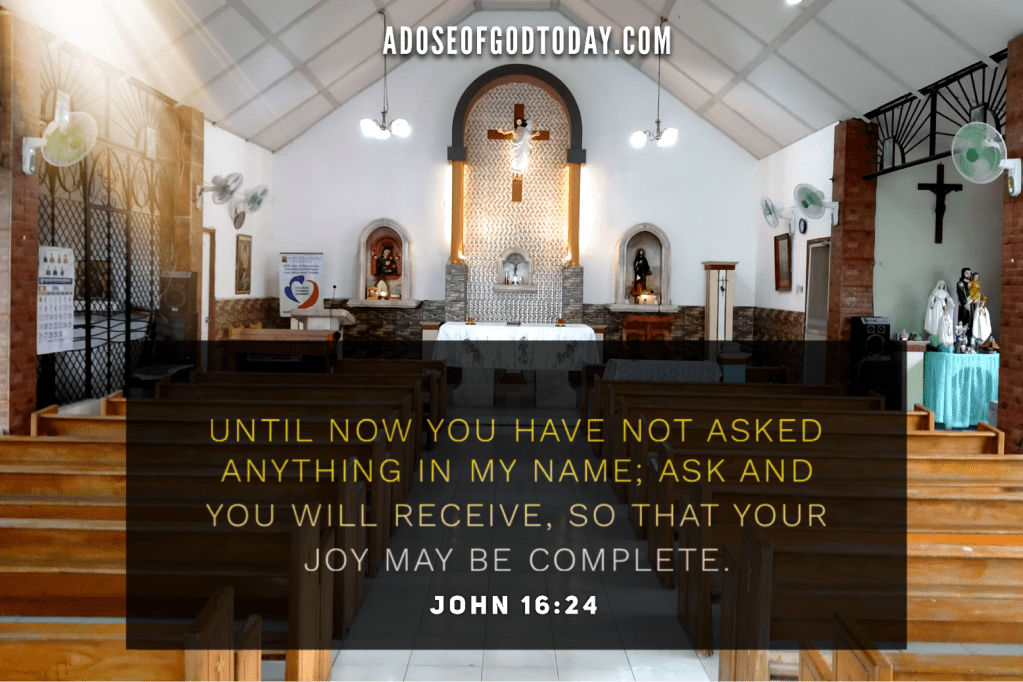
    We believe in the power of prayer and many of us can testify how God pours His blessings and graces to a prayerful heart. Moreover, Jesus told his disciples in today’s Gospel to “ask anything in my name and you will receive.”  Really? Anything? 🙂

    Hmmm, what does it really mean?

    Does Jesus mean that we can just ask anything we want? Does it mean that I can also ask Jesus to give me a lifetime premium subscription on Netflix with an unlimited supply of popcorn and bottomless four-season juice drink? Or can I also ask a top managerial position in a company though I don’t have the qualification?  And then expect that everything will certainly be given to me? Or to make the virus disappear by tomorrow and to bring the world back as it was before the virus came?

    Some of my close friends shared with me that at some point in their life, they felt that God was unfair to them. They have earnestly asked God to grant their prayers and so they visited Churches as many as they could. They would attend the mass faithfully and did novenas to the Saints. They would do these so that God may hear their prayers and their wish will be granted. However, those prayers were unanswered. Consequently, feelings of inadequacy, unworthiness, guilt for the sins committed and even disappointment and being upset may arise. This may lead to a spiritual confusion believing that God is not fair.

    However, we might not be aware also that what we are praying could be filled with selfish reasons. Our prayers might be more focused on ourselves, on what “I shall have and on what I can gain.” Then, our prayer remains self-centered.

    Today, Jesus tells us to ask and to pray “in his name.” The beauty here lies in the prayer that considers the desire of God for us. It means that in our prayer we do not forget Jesus, we do not forget his desire for us and his will for us. 

    Jesus did not say to just ask anything because he, then, would merely be a magician or a genie in a bottle or like an automated money dispenser. Jesus tells us “to ask anything in his name.” 

    Our prayer, then, includes a discernment of God’s will for me and of God’s desire for me. God is not a mere “dispenser” like a machine or a “biometric device” that records our time-in and out to record how much time we spent in our novenas and rosaries. However, God is a person who wants us that he becomes part of our thoughts, of our decisions and actions.

    Advertisements

    Thus, in the Gospel, the disciples had actually already prayed. They asked God many things. However, their prayers were also filled with their own desires and personal wants. This was the reason why Jesus said, “until now you have not asked anything in my name…” The self-centered prayers and requests to God did not make the disciples joyful and contented. They remained insecure and lacking in faith because they did not ask in Jesus’ name.

    Instead of praying – “this is what I want and wish Lord,” ask and pray rather first in this way, “what is your desire for me Lord?” Only then that we will be able to get away from our selfish tendencies and intentions because we shift our focus from ourselves to God – from praying that comes only from personal wants to praying in his name.

    Certainly, God will never say no to a sincere heart that seeks His desire. Jesus will answer our prayers when our hearts and minds are one with him. As we continue to brawl in this time of pandemic, we may also discover more God’s desire for us in our troubles and in our prayers. Hinaut pa.

    Jom Baring, CSsR

    Join 2,850 other subscribers
  • Grace and Freedom in letting go

    Grace and Freedom in letting go

    Advertisements

    May 21, 2020 – Thursday of the 6th Week of Easter

    Click here for the readings (http://cms.usccb.org/bible/readings/052120-day.cfm)

    When a thing or a person becomes important, essential and vital in our life, we also find it hard to let go of it when time calls us to. Moreover, there are also cases when a thing or a person, or an experience, though not so important and vital in our daily existence, that it becomes inseparable from us. Thus, when it becomes so attached to us emotionally/psychologically, we find it then, so difficult to let go.

    When I was already about 6 years old, I would still carry my baby bottle with me and drink any liquid – milk, coffee, water or soda out of that. Once, I brought it with me at school during my Kindergarten and then my older sister found it out. The next day as I searched for my baby bottle in its usual place, I could not find it. The baby bottle was gone. My sister threw it away. So cruel! 🙂

    I was so mad and cried really hard for throwing that away. Perhaps, I thought the world was about to end at that time of losing my “dear baby bottle.” Yet, the day after that and the next day and the following days seemed to be just okay without that baby bottle.

    Advertisements

    Now, I realized, I must have been so attached to that baby bottle that letting go of it was surely difficult. In one way or another, others may find it challenging also those that have become so attached to them. These are not just limited with material things but also our dreams and aspirations in life, relationships and even our memories.

    Thus, when we talk about letting go, we certainly find it  difficult especially with those that we love so much or so attached to our emotions. Our basic tendency is to keep those closer to us because we do not like them to leave from us. That is why, when we are confronted with the reality of loss, then, we experience pain. It breaks our heart. We become anxious and fearful because life may not be the same.

    As a response, we may refuse to let go and in the process become controlling, suffocating and manipulating particularly towards those people we do not want to let go. Moreover, we could become paranoid and obsessed because we continue to linger and attach ourselves with a painful memory, or to a material thing or in a desire.

    What really is the concern here?

    Going into the process of letting go and the letting go itself is what makes our life wonderful. It is in letting go that we actually find more life and express life, to find love and express love. This manifests grace and freedom in us.

    This is what Jesus was asking from his disciples. The disciples who thought that they have lost Jesus when he was crucified rejoiced at his resurrection. However, when Jesus told them that soon, he will no longer be with but will go back to his father, the disciples also became anxious and fearful. They wanted to keep Jesus closer to them. The disciples believed that they were more confident if Jesus was nearby. They were not willing to let him go.

    However, this is not what God wants. Jesus had to go so that he will be able to join and be one with his Father in heaven. It will only be in this way that Jesus will be able to bring us closer to the Father. By returning to the Father, Jesus will open a way for us to the heart of the Father. By this also, Jesus will become ever closer to each one of us, closer than what we can imagine because Jesus will be in our hearts and minds.

    Hence, the words of Jesus to his disciples, “A little while and you will no longer see me, and again a little while later and you will see me,” means that Jesus becomes ever present in each of us.

    In this process of letting go of the Lord, then, the disciples also allowed God to work in them. This was how the early Church found grace and freedom in letting go.

    Today, we are also asked to let go whatever is hindering us to encounter the Lord. We may ask ourselves,What is it that I continue to linger? What is that attachment that I find difficult to let go for me to grow?

    In identifying these, let us also ask the grace to courageously let go of those that hinder us so that we may find the grace for more life, more love and freedom. Hinaut pa.

    Jom Baring, CSsR

    Join 2,850 other subscribers
  • When the Lord opens our heart

    When the Lord opens our heart

    Advertisements

    May 17, 2020 – Monday of the 6th Week of Easter

    Click here for the readings (http://www.usccb.org/bible/readings/051820.cfm)

    “Lydia” is a very popular name among women. Lydia with its Greek origin, actually means “kind.” And among the many Lydias I met, there was one particular Lydia that I could not forget.

    I met “Nanay Lydia,” as what she was commonly called by many, in one of my mission areas when I was still a seminarian. Nanay Lydia was a simple old woman, widowed but surrounded by her children and grandchildren who loved he very much. Despite her poverty, she was the first one to offer her humble home to accommodate us, missionaries.

    It was in her home that I experienced, that joy and contentment in life is very possible even with less material things but filled with love. She was very much cherished by her children and grandchildren. She was highly respected by their neighbors. And as I stayed in her humble house for few days, I received so much kindness from her.

    “Kindness expressed in her grateful response to people around her was her way of life.”

    This attitude from Nanay Lydia is found in her knowledge of the Lord. Her knowledge of the Lord was not out of theological studies but through her experiences of pain and joy, sorrow and comfort, and of death and life. And according to her, she brought all these experiences always into her prayers. This was how she would see things clearly, feel and be comforted of God’s presence in her life. Through her prayers, she listened to God, who also opened her heart.

    This woman reminds me of another Lydia, whom the Acts of the Apostles speaks today. Lydia was one of the women who listened to Paul’s preaching. She was particularly described as a God-fearing woman. However, what was more interesting was her attitude to Paul’s preaching. She listened.

    She welcomed what Paul was saying and by doing that, the Lord opened her heart. It was not her who opened her heart to the Lord. That small inclination from her “in listening” allowed the Lord to come into her heart and opened her heart.

    And when the Lord opened her heart, she began to see clearly how God worked in her life through the preaching of Paul. As a response, she asked for baptism, meaning, she wanted to commit her life to the Lord who opened her heart. Her commitment now was transformed into a generous and grateful action. She welcomed the Apostles, Paul and his companions into her home.

    This is how the Gospel of John is being unfolded to us today also. The Spirit of Truth that Lydia received made her a witness of God’s kindness. Because of the kindness that she experienced from Jesus, reflected in her name, Lydia, she too was inspired to become a witness of that kindness. Her generous and hospitable action to Paul and his companions was a grateful response to God’s kindness.

    Advertisements

    This is the invitation for us today. We are also called to allow the Lord to open our hearts. It is when we listen to God speaking to us through our Sacraments in the Church, through the Bible, through our experiences and daily affairs with the world, that we allow God to challenge us to see God’s surprises in our life.

    Hopefully, as we allow God to open our heart, then, we too will be moved to become a witness of God’s kindness, or goodness or faithfulness to others. Thus, let that be expressed in our actions and words as we struggle today to live in this prolonged community quarantine. This kind of witnessing is very much needed today. This very difficult situation may inspire us then, to become true witnesses of the Resurrected Christ. Hinaut pa.

    Jom Baring, CSsR

    Join 2,850 other subscribers
  • Life amidst and after COVID-19

    Life amidst and after COVID-19

    Advertisements

    May 17, 2020 – Sixth Sunday of Easter

    Click here for the readings (http://www.usccb.org/bible/readings/051720.cfm

    Life under quarantine is without a doubt, difficult. For almost a quarter of the year 2020 now, we find our world on lockdown amid pandemic realities. Definitely these are trying and uncertain times for all of us, humanity as the world we live in is now sick and under serious threat. We find ourselves now limited and deprived – reduced to mere essentials. As we adapt to the challenges of our today’s changing world, we cannot help but be somehow resigned to the possibility that “our life ahead will never be the same again”. And as we also discern with the “new” normal with its required distancing, limited mobility and isolation that would greatly affect our social relations and dealings, we also grapple with basic question: “Is and will there be Life amidst and after COVID-19 2020?”

    Recently a Youtube video-clip called “The Great Realisation” by Probably Tomfoolery about Life in 2020 Pandemic world have circulated around and caught the attention of the social media. Here in a poetic bedtime story manner, and at the hindsight, the father tells the story and describes to his son the causes and effects of COVID-19 virus to humanity. While it projects and promises a much better humane and personal relationships among peoples in our tomorrow’s world,  particularly the following conversion in the video is worth pondering…

    Son: But why did it take a virus to bring the people back together?

    Dad: Sometimes you got to get sick, my boy, before you start feeling better.

    Sometimes you got to get sick, my boy, before you start feeling better.

    Such a profound wisdom. Definitely in changing world during these trying times, our life will never be the same again, …. but our life will be much better and anew than before. And part and parcel of this change for the better life is the virus and sickness that we have to go through and overcome in preparation for our better life-ahead.

    As St. Peter suggests, “better suffer doing good than doing evil”, the bitter herb/taste of medicine, painful injections, the life-threatening surgery, the chemotherapy treatment, dialysis or regiment of blood transfusion – the whole sickness we go through is part of the whole healing process towards our well-being, and better lifestyle.    This is paradox of our life: Our present trials, sufferings, difficulties and uncertainties in life do prepare and brings out the best and  better version in us. In other words, “Sometimes we got to get sick to start to get better.”

    In preparing them for the suffering ahead, Jesus in our gospel challenges his disciples to keep His commandment, which is to love one another as He has loved them. Here Jesus did not only warn his disciples of the coming difficulties His persecution, suffering and death will cause them, but also prepares them the implications and responsibilities of His coming resurrection. And for Jesus, His commandment of “Loving one another” is the key essential attitude and necessary behavior for His disciples, and us now to surpass the difficulties and challenges of His cross and resurrection into our constantly changing  lives.  

    Our love and loving, however, must be “as I have loved you”, which is thus to be done in the same way and as patterned in Jesus’ way of loving us. Unlike our way of loving, Jesus’ way of love also somehow involves patience, distancing and separation, which is usually painful for us. Though His love is personal, intimate and constant, His love is not exclusively for you but to all,  not clingy – too attached “Touch me not” and even provides space and time as we experience it in His seeming absence, separation and distance, as well as in His unpredictable timing. While His love offers us the mystery of  Joy, Light and Glory in life, His love also requires the painful and suffering mystery of our sorrows in loving others. 

    Jesus’ commandment of “Loving one another as He has loved us” would also mean the paradox of resurrection through our cross – meaning “the way to our salvation is the way of the cross”.  Resurrection to new life happens then through the sorrowful mystery of our cross in loving others. In the same manner, reflected here is the life-paradox of sickness before getting better, of pain and suffering towards healing, of rising to the occasion despite difficulties and uncertainties in life. 

    Now as to our musings: “Is there Life during Covid-19? Will there be Life after Covid-19?”

    For those who have faith and trust in Jesus and in God, and who is keeping the Lord’s commandment of “loving others as He has loved us”, along with our faith-life struggle with His cross and resurrection in life, getting better and rising to the occasion of our best and better version of our world despite difficulties and uncertainties, there is and will be life during and after COVID19 2020. However, our life will never be the same again, for without a doubt, our Life then is and will be anew and better than  before. 

    May our love  for one another now, promising though painful it can be, cooperate with the Lord’s healing ways of creating and building our better world in  our life ahead. Amen. 

    (By: Fr. Aphelie Mario Masangcay CSsR, a Filipino Redemptorist  Missionary stationed in Gwangju South Korea, though now still stranded in Cebu until further notice for available flights.)

    Join 2,850 other subscribers