Tag: Corona Virus

  • Ask anything and you will receive. Really? Anything?

    Ask anything and you will receive. Really? Anything?

    Advertisements

    May 23, 2020 – Saturday of the 6th Week of Easter

    Click here for the readings (http://www.usccb.org/bible/readings/052320.cfm)

    What do I usually ask and pray? 

    We have realized how Covid-19 brought us so much difficulties these days. During the Enhanced Community Quarantine, the world seemed to stop spinning. Our movements have been halted and so our economic/financial concerns also heightened. As more and more infected cases were confirmed we have become so worried. Perhaps others have come to the point of paranoia for fear of being infected. And for those who have been infected, and succumbed to death, most surely, they have been more embattled by fear and uncertainty.

    Hence, these must have been the concerns that we bring up now to God in our prayers. These are evident in the countless comments and prayer requests we received in our Facebook page (@OMPHRedemptoristDavao).

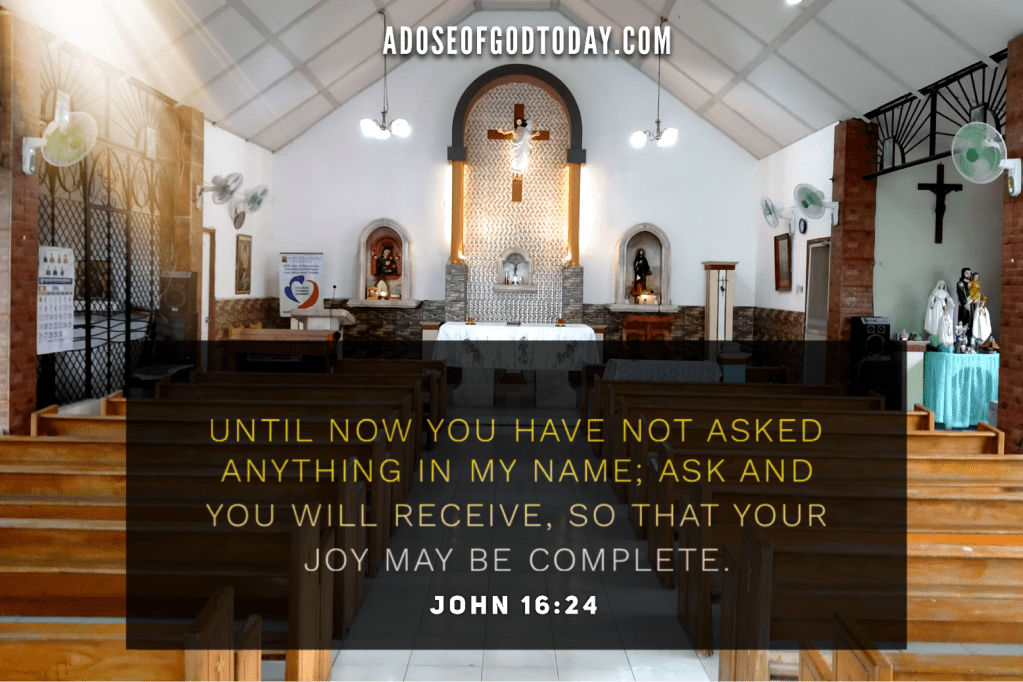
    We believe in the power of prayer and many of us can testify how God pours His blessings and graces to a prayerful heart. Moreover, Jesus told his disciples in today’s Gospel to “ask anything in my name and you will receive.”  Really? Anything? 🙂

    Hmmm, what does it really mean?

    Does Jesus mean that we can just ask anything we want? Does it mean that I can also ask Jesus to give me a lifetime premium subscription on Netflix with an unlimited supply of popcorn and bottomless four-season juice drink? Or can I also ask a top managerial position in a company though I don’t have the qualification?  And then expect that everything will certainly be given to me? Or to make the virus disappear by tomorrow and to bring the world back as it was before the virus came?

    Some of my close friends shared with me that at some point in their life, they felt that God was unfair to them. They have earnestly asked God to grant their prayers and so they visited Churches as many as they could. They would attend the mass faithfully and did novenas to the Saints. They would do these so that God may hear their prayers and their wish will be granted. However, those prayers were unanswered. Consequently, feelings of inadequacy, unworthiness, guilt for the sins committed and even disappointment and being upset may arise. This may lead to a spiritual confusion believing that God is not fair.
    However, we might not be aware also that what we are praying could be filled with selfish reasons. Our prayers might be more focused on ourselves, on what “I shall have and on what I can gain.” Then, our prayer remains self-centered.

    Today, Jesus tells us to ask and to pray “in his name.” The beauty here lies in the prayer that considers the desire of God for us. It means that in our prayer we do not forget Jesus, we do not forget his desire for us and his will for us. 

    Jesus did not say to just ask anything because he, then, would merely be a magician or a genie in a bottle or like an automated money dispenser. Jesus tells us “to ask anything in his name.” 

    Our prayer, then, includes a discernment of God’s will for me and of God’s desire for me. God is not a mere “dispenser” like a machine or a “biometric device” that records our time-in and out to record how much time we spent in our novenas and rosaries. However, God is a person who wants us that he becomes part of our thoughts, of our decisions and actions.

    Advertisements

    Thus, in the Gospel, the disciples had actually already prayed. They asked God many things. However, their prayers were also filled with their own desires and personal wants. This was the reason why Jesus said, “until now you have not asked anything in my name…” The self-centered prayers and requests to God did not make the disciples joyful and contented. They remained insecure and lacking in faith because they did not ask in Jesus’ name.

    Instead of praying – “this is what I want and wish Lord,” ask and pray rather first in this way, “what is your desire for me Lord?” Only then that we will be able to get away from our selfish tendencies and intentions because we shift our focus from ourselves to God – from praying that comes only from personal wants to praying in his name.

    Certainly, God will never say no to a sincere heart that seeks His desire. Jesus will answer our prayers when our hearts and minds are one with him. As we continue to brawl in this time of pandemic, we may also discover more God’s desire for us in our troubles and in our prayers. Hinaut pa.

    Jom Baring, CSsR

    Join 2,868 other subscribers
  • On Idols and Obsessions

    On Idols and Obsessions

    Advertisements

    May 20, 2020 : Wednesday – 6th week of Easter

    Click here for the readings (http://www.usccb.org/bible/readings/052020.cfm)

    The Community Quarantine and Lockdowns caused the closing of malls, shops, small and big businesses. We are all asked to “stay at home” as a preventive and protective measure against the Corona Virus. At the beginning of this “stay at home,” more and more people also found ways to entertain themselves while staying at home. One of the most popular entertainments that one could easily observe now is how people where drawn towards their screens to watch South Korean Drama Series.

    Somehow, the audiences “idolized” South Korean actors and actresses because of their good looks, good acting qualities and the good chemistry that a particular couple show in a movie. With these qualities of South Korean actors and actresses, they captured their audiences internationally. They are truly entertaining that netizens began to post on Facebook mimicking how South Koreans speak, dressing and wearing make-up just like famous South Korean actors and actresses do, posting memes and short clips of the series they have watched. This craze is all over Facebook.

    From https://ramenswag.com/crash-landing-on-you-quotes/5/
    From https://images.app.goo.gl/rSdD1KCATcpoV5Ca9

    This form of idolizing an actor or actress or a culture is a kind of admiration. However, there is another form of having idols that can be pretty serious. This is what St. Paul identified in our first reading today. 

    Paul was in Athens and saw the many idols the Athenians had. The Greeks were known to have many gods and goddesses. Yet, Paul also realized how deeply religious the people were because of that expression. But what touched Paul the most was the shrine dedicated to the “Unknown god.” With this, Paul being a witness and apostle of the Risen Jesus had the responsibility to introduce the Athenians to the one True God.

    Paul preached to them about Jesus, the Son of God, who became like us, and who lived among us. For it is through Jesus that we are saved by dying on the cross and by rising from the dead. However, this is the very reason as well why many of the Athenians did not believe him, only few of them.

    Many could not accept that kind of God who died for us and was being resurrected. This was something beyond their imagination and beyond any human explanation. But what hindered them also to believe was their own absorption of their many idols, of their many gods. This was something, they could not give up.

    This form of “idolizing” was not a mere admiration but rather, obsession.

    Though this happened long time ago, yet, at present this reality is still happening. Idolatry is still creeping in our culture today. We are still somehow captivated by some idols in one way or another that make God a lesser priority, making our Christian life and faith less significant. We may ask, in what way then?

    When a thing or a person is being loved, wanted, desired and even treasured and enjoyed “more” than God to the point that we have become obsessed, then this could be the “idol” that we worship. That could be your boyfriend or girlfriend or even your good looks. It could be the approval of other people, your attractiveness that tend to seek recognition from others. It could also be your successful career or business or work. Or could be your own passion in sports or any hobbies.

    Nonetheless, reflecting on these, they are actually not evil or bad in themselves. These things are good but they become bad when they do not serve the purpose – which is to be closer to God, by knowing him better, by being grateful to him and by being generous to others. 

    In one way or another, these forms of idolatry are also forms of addictions in us. It means that we may tend to be selfish, prioritizing only our own satisfaction – as a result, we will become insecure and not free at all because we are imprisoned by our own obsessions.

    This is not what God wants us to be. God wants us to be free by knowing and loving him more and more. And so, let us remember what Jesus told us in the Gospel. “The spirit of truth will lead us; the spirit will guide us to discover God and know him better.” 

    Advertisements

    What do those words mean to us now? Jesus wants us to pray, to converse with God truly and that is not just to tell God what we “want” but also to ask God what God “wants” for us; not my own “selfish desires”, but to ask what is “God’s desire for me.”

    Today, I would like to ask you to include in your prayers, to ask God to help us identify our actions, attitudes or things that preoccupy us. This may hopefully lead us to recognize our “idols” that hinder us to know God better, to be closer to Him and that continually prevent us to be generous to others.

    Let us ask, then, the guidance and prayers of Our Mother of Perpetual Help, who is a model for all of us. Hinaut pa. 

    Jom Baring, CSsR

    Join 2,868 other subscribers
  • Life amidst and after COVID-19

    Life amidst and after COVID-19

    Advertisements

    May 17, 2020 – Sixth Sunday of Easter

    Click here for the readings (http://www.usccb.org/bible/readings/051720.cfm

    Life under quarantine is without a doubt, difficult. For almost a quarter of the year 2020 now, we find our world on lockdown amid pandemic realities. Definitely these are trying and uncertain times for all of us, humanity as the world we live in is now sick and under serious threat. We find ourselves now limited and deprived – reduced to mere essentials. As we adapt to the challenges of our today’s changing world, we cannot help but be somehow resigned to the possibility that “our life ahead will never be the same again”. And as we also discern with the “new” normal with its required distancing, limited mobility and isolation that would greatly affect our social relations and dealings, we also grapple with basic question: “Is and will there be Life amidst and after COVID-19 2020?”

    Recently a Youtube video-clip called “The Great Realisation” by Probably Tomfoolery about Life in 2020 Pandemic world have circulated around and caught the attention of the social media. Here in a poetic bedtime story manner, and at the hindsight, the father tells the story and describes to his son the causes and effects of COVID-19 virus to humanity. While it projects and promises a much better humane and personal relationships among peoples in our tomorrow’s world,  particularly the following conversion in the video is worth pondering…

    Son: But why did it take a virus to bring the people back together?

    Dad: Sometimes you got to get sick, my boy, before you start feeling better.

    Sometimes you got to get sick, my boy, before you start feeling better.

    Such a profound wisdom. Definitely in changing world during these trying times, our life will never be the same again, …. but our life will be much better and anew than before. And part and parcel of this change for the better life is the virus and sickness that we have to go through and overcome in preparation for our better life-ahead.

    As St. Peter suggests, “better suffer doing good than doing evil”, the bitter herb/taste of medicine, painful injections, the life-threatening surgery, the chemotherapy treatment, dialysis or regiment of blood transfusion – the whole sickness we go through is part of the whole healing process towards our well-being, and better lifestyle.    This is paradox of our life: Our present trials, sufferings, difficulties and uncertainties in life do prepare and brings out the best and  better version in us. In other words, “Sometimes we got to get sick to start to get better.”

    In preparing them for the suffering ahead, Jesus in our gospel challenges his disciples to keep His commandment, which is to love one another as He has loved them. Here Jesus did not only warn his disciples of the coming difficulties His persecution, suffering and death will cause them, but also prepares them the implications and responsibilities of His coming resurrection. And for Jesus, His commandment of “Loving one another” is the key essential attitude and necessary behavior for His disciples, and us now to surpass the difficulties and challenges of His cross and resurrection into our constantly changing  lives.  

    Our love and loving, however, must be “as I have loved you”, which is thus to be done in the same way and as patterned in Jesus’ way of loving us. Unlike our way of loving, Jesus’ way of love also somehow involves patience, distancing and separation, which is usually painful for us. Though His love is personal, intimate and constant, His love is not exclusively for you but to all,  not clingy – too attached “Touch me not” and even provides space and time as we experience it in His seeming absence, separation and distance, as well as in His unpredictable timing. While His love offers us the mystery of  Joy, Light and Glory in life, His love also requires the painful and suffering mystery of our sorrows in loving others. 

    Jesus’ commandment of “Loving one another as He has loved us” would also mean the paradox of resurrection through our cross – meaning “the way to our salvation is the way of the cross”.  Resurrection to new life happens then through the sorrowful mystery of our cross in loving others. In the same manner, reflected here is the life-paradox of sickness before getting better, of pain and suffering towards healing, of rising to the occasion despite difficulties and uncertainties in life. 

    Now as to our musings: “Is there Life during Covid-19? Will there be Life after Covid-19?”

    For those who have faith and trust in Jesus and in God, and who is keeping the Lord’s commandment of “loving others as He has loved us”, along with our faith-life struggle with His cross and resurrection in life, getting better and rising to the occasion of our best and better version of our world despite difficulties and uncertainties, there is and will be life during and after COVID19 2020. However, our life will never be the same again, for without a doubt, our Life then is and will be anew and better than  before. 

    May our love  for one another now, promising though painful it can be, cooperate with the Lord’s healing ways of creating and building our better world in  our life ahead. Amen. 

    (By: Fr. Aphelie Mario Masangcay CSsR, a Filipino Redemptorist  Missionary stationed in Gwangju South Korea, though now still stranded in Cebu until further notice for available flights.)

    Join 2,868 other subscribers