Tag: Corona Virus effect

  • Front-liners at home

    Front-liners at home

    Advertisements

    October 1 , 2020 – Thursday of the 26th Week in Ordinary Time (Memorial: St. Therese of the Child Jesus)

    Click here for the readings (https://bible.usccb.org/bible/readings/100120.cfm)

    Homily

    As the Corona Virus Pandemic continues to bring disorder in our way of life and as we continue to be limited in our movements especially with our religious practices essential to our faith, some parents and grandparents have expressed their worries as to the faith formation of the young generation. The Holy Eucharist and other public celebration of the Sacraments including catechetical gatherings intended for the younger generation, remain to be banned from the vast majority. Though many cities have been allowed to have the public religious gathering by 50% of the building/Church’s capacity, yet, minors and Senior Citizens are still discouraged to be present physically.

    This poses a concern as to how we continue the moral and spiritual formation of the young and the continual spiritual nourishment of the older ones. Consequently, the Church have found ways on how to reach out to those who are excluded particularly now through the use of social media. Yet, this might not be enough since not everyone can access it and the Church’s programs may not be appealing to the young.

    More than ever, the Church is in need of the “active participation” of parents, grandparents and young adults to be at the frontline in terms of moral and spiritual formation of the younger generation.

    Today’s Gospel reminds us of this mission we share from the 72 disciples sent ahead by Jesus to the cities where he intended to visit. They were Jesus’ front-liners at that time. Jesus sent them ahead to announce to them that God’s Kingdom is at hand. They were to prepare the hearts of the people who have been longing to see God and to experience good things from the Lord as what our Psalm proclaims today.

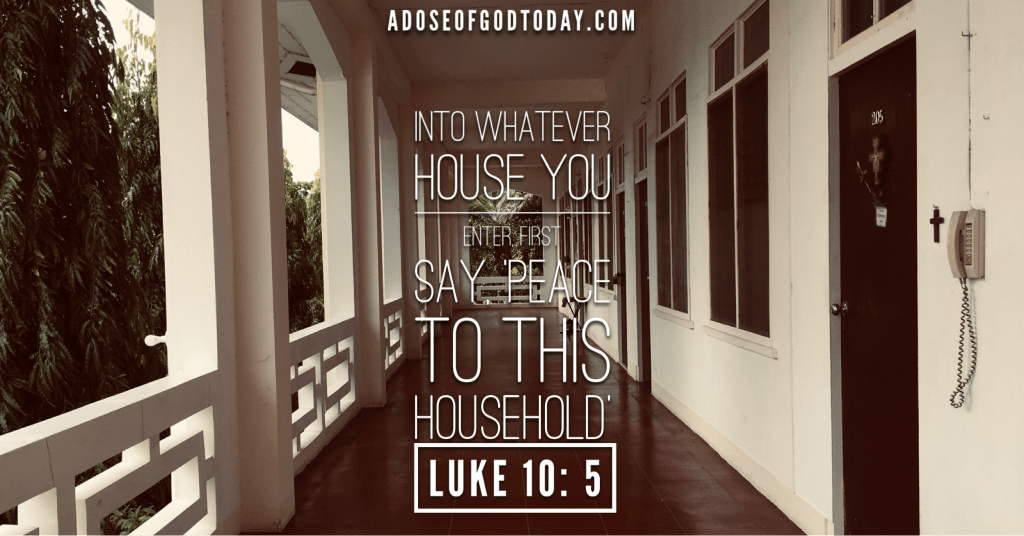
    Thus, the 72 disciples were told to bring peace to every household they visit. Even if there was the possibility of being rejected by those who were not ready, they were still to bring peace. As they were told to stay with those who welcomed them, the disciples were told to accept their hospitality and also to bring healing to those in pain, wounded, and sick.
    These were ways of nurturing those hearts who were longing to see God, to bring hope to those who were in despair and give hope to those who find life difficult and miserable.

    This is also the call to each of us now especially with you parents, grandparents and adults who live among and with the younger generation. Your presence is needed even more now to be those disciples of the Lord in your own context, that is, to be front-liners at home.

    You have this very important role to play to serve as front-liners, to prepare the hearts and mind of the younger ones, to nurture and develop their young faith and relationship with God.

    St. Therese of the Child Jesus, whose feast we celebrate today, reminds us of the mission we share with one another. St Therese is even called as the Patron of Mission even though she herself stayed most of her life inside the convent. Her little ways, her compassion and thoughtfulness to her sisters, her prayers and devotion were her ways of participating in God’s mission.

    Thus, for all of us too, we do our little and humble ways in participating in God’s mission. Parents, grandparents and adults, again, do your little ways in educating and nurturing the younger ones. Be welcoming to their different responses and be accepting to their ways of doing things and in relating with God. Affirm them and appreciate their efforts.

    But remember, to nurture and to develop one’s relationships with God is not done through “imposition” or by “force.” Never impose and never use force in nurturing the young ones. They learn by example. They admire through our sincere words and actions. They see and recognize God through us.

    In this way, we may be able to truly bring peace in our homes and bring healing into the hearts of our own family and friends. Hinaut pa.

    Jom Baring, CSsR
  • Signs and Symptoms not of Covid-19 but of God

    Signs and Symptoms not of Covid-19 but of God

    Advertisements

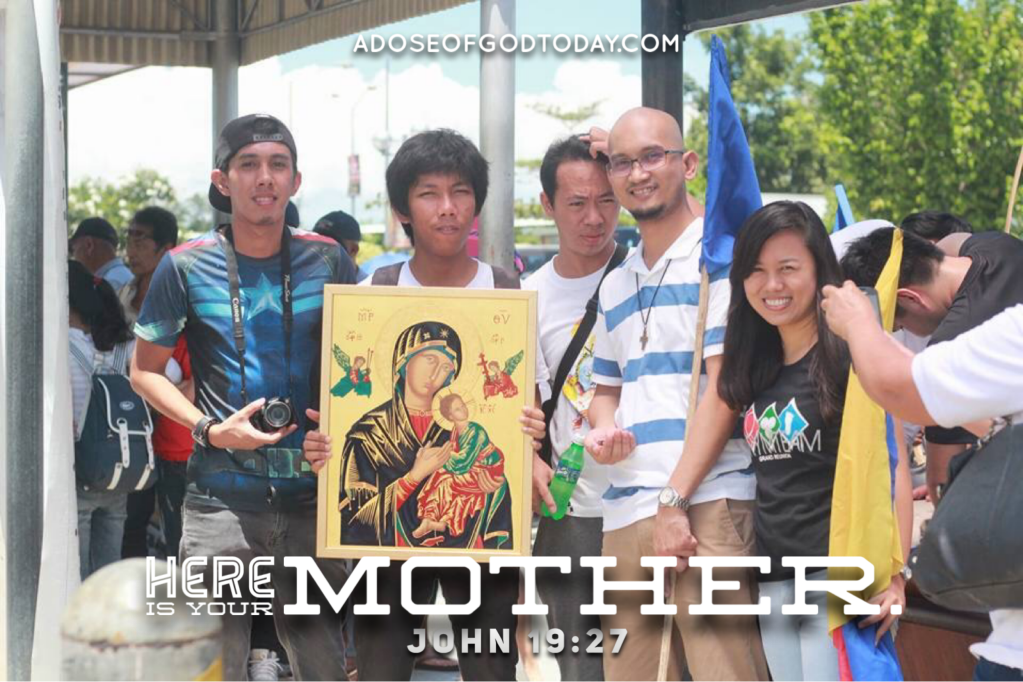
    June 27, 2020 – Feast of Our Mother of Perpetual Help

    Readings: Isaiah 7:10-17; Revelation 12:1-6,10; John 19:25-27

    Homily

    As the Corona Virus 2019 stole the spotlight, the medical experts warned us of the signs and symptoms of the virus. Accordingly, the virus can cause a range of symptoms to a person from mild illness to pneumonia. Its most common symptoms, they said, are fever, tiredness and dry cough. Others may also show aches and pains, nasal congestion, runny nose or sore throat.

    We are made aware of it and thus, when we begin to have these signs and symptoms then we are advised to seek medical help. It is, definitely, important to be aware of these because through this first step then, we can save lives, not just our life but also of those who are dear to us.

    Moreover, looking at it from a distance, this pandemic is in itself a sign that no matter how much we have achieved in life, or no matter how much power and wealth we have accumulated, we are vulnerable. This pandemic also is a sign that tells us how competent or ignorant, sincere or corrupt, and organized or messy our leaders can be. This pandemic also is a sign given to us how individuals and communities have reached out to those in need.

    With all these signs and symptoms that the Corona Virus Pandemic has brought to us, this allows me to dwell deeper into the feast we celebrate today, the Feast of Mary, Our Mother of Perpetual Help.

    Our first reading is very interesting because it tells us about signs. Usually, we would ask signs from God, but, in this story of Ahaz, King of Judah, it was the Lord who asked a man to ask for a sign. Ahaz’s story seemed to be very good because he did not ask a sign from God. He refused to ask a sign. However, his refusal to ask a sign from God was actually a refusal to believe in God.

    What really happened? Ahaz sold himself to another god, to the King of Assyria. He sold himself because he thought that this foreign power, Assyria will only be the one who can grant immediate protection and salvation for him and his kingdom. Instead of asking wisdom from the Lord on how to lead his people, Ahaz went to the Assyrians and pleased them. The kingdom of Judah at that time was under the threat of two other kingdoms, Syria and Israel. Instead of trusting the Lord to protect and save him, he went to another god, to whom he thought was his savior.

    However, history tells us that as Assyria defeated the enemies of Ahaz, he became a puppet of the King of Assyria. Not only that, the Assyrians imposed heavy taxes to the people and blasphemed the Temple of the Lord by introducing the Assyrian gods.

    This is the reason why it was the Lord himself who offered Ahaz to ask for a sign so that he may believe that God will bring salvation. Yet, even though Ahaz refused, God still promised a sign of salvation. This sign is through a virgin who will conceive a son. This son will be called Emmanuel, meaning, God is with us.

    This is the sign that even in the midst of our own disbelief, doubts and even refusal to believe, God remains with us. God remains our God and continues to be for us and with us. This is a sign of God’s faithfulness in us despite our unfaithfulness. This is a sign of God’s generosity despite our ingratitude. And this is what we celebrate today on this feast of Our Mother of Perpetual Help. The Virgin who is carrying the son, the Emmanuel in her arms, is the great sign that God showed to us.

    There again on the cross, as the Gospel of John tells us, the son showed us his greatest sign of love and faithfulness. The son has come to be with us and on the cross he stretched out his hand for the sake of all. The son, indeed, comes to help us perpetually.

    Jesus is in fact the true perpetual help. Mary is instrumental because through her, God’s sign has been brought to us. She allowed herself to be God’s instrument of help and compassion, to be the mother of the Perpetual Help.

    Even when Jesus was about to die, he assured us to have a mother, that we will not be orphaned and alone. Mary’s presence became the sign of God’s presence among us by becoming our mother.

    This is the reason why we, the Church, would always seek guidance and inspiration from Mary because we feel the identity of being a child to her. The intercession of Mary as a mother, becomes a bridge of faith. It is to lead us to her risen Son, Jesus Christ.

    Thus, this feast that we celebrate does not actually point to Mary. This feast points to the greatest sign, the perpetual help, and who is Jesus himself.

    What is it to you and to me now, to us, who are devoted to Our Mother of Perpetual Help? How shall we express our act of thanksgiving for all the graces and blessings received?

    This feast invites us that each of us and that our community becomes a sign of God’s help and love, compassion and faithfulness. This means that we let our devotion transform our life. It means that our devotion should not only remain a mere devotional practice but must also flow into our actions and words, into our decisions and choices in life.

    Our devotion, then, is call to mission. It is mission because we are sent to become signs and symptoms of God’s goodness. I invite you then this time, to discern for yourself on how you could be a sign and symptom of God’s help and compassion to people around you.

    VIVA MARIA! VIVA HESUS!

    Jom Baring, CSsR

  • Mary, Source of Help to the Young

    Mary, Source of Help to the Young

    Advertisements

    June 22, 2020 – Monday 12th Week in Ordinary Time

    5th day of Novena in preparation for the feast of Our Mother of Perpetual Help

    Click here for the readings (http://www.usccb.org/bible/readings/062220.cfm)

    A week ago I met few members of the Redemptorist Youth Ministry here in our Parish to review our youth programs and align them to adapt in this current situation. It was a moment of reconnecting with them as this Corona Virus Disease brought disorder to our lives. Somehow meeting them gave me also an opportunity as a pastor to realize how they have been coping and adjusting themselves in this “new normal.”

    They have learned a lot and made more connections with their families as the quarantine gave more chances to them to be with their families. Sadly, because also of the lockdowns and quarantines some of those who are working among them have lost their jobs, their business and felt uncertain of their employment status.

    However, despite these challenges many of them also found ways on how to go beyond from themselves and be in service of others. This is what I find wonderful because the present difficulties did not prevent them to be for others. Thus, they volunteered in their Barangay to distribute the relief goods and the Social Amelioration Program from the government. Though they received ungrateful responses and offensive reactions and complaints from people, with those whom they served, these did not stop them to volunteer.

    During the Enhanced Community Quarantine also, a friend asked me to pray for a young person who is suffering from depression. She seemed to be so sad that her suicidal thoughts became frequent. People around her became disturbed and anxious of her situation because her posts in Social Media reveal her consciousness of ending her life.

    A week ago also, one of my Redemptorist brothers shared with me how one of his former students ended his life by hanging himself. He remembered his student very well but did not see any hint that this would happen to him.

    Few year ago also, when I was barely a year-old ordained priest, a father brought to me her daughter to help her. His college student daughter according to him was possessed by an evil spirit. She changed voices and seemed to be so angry. She also claimed to see ghosts around that haunted her day and night. However, when I talked to her personally without the presence of her father, everything was revealed. She was in depression. She was bullied at school. She was traumatized by the separation of her parents and was in deep pain for being left behind by her mother.

    These are just my few encounters with my co-young people who are facing with issues and challenges in their life.

    On this fifth day of our Novena to Our Mother of Perpetual Help, we are invited to reflect with the young people today with our theme, “Our Mother of Perpetual Help: Source of Help to the Youth of today confronted with so many issues and challenges.”

    There are countless students who come to the novena on Wednesdays and offer their prayers before the Icon of Our Mother. I witnessed this, not just here in Davao but also in Cebu, in Iloilo and most especially in Baclaran. Students would write their petitions to the Mother to help them find ways to pay for the tuition fees, or their rent, or to pass their board exams. Many also would go to the Mother as they were in trouble with their love life, friends and family or when they experience anxiety at school and at home. Many also would ask petitions to the Mother to help them find a job, for material blessings and courage as they embark into another phase of their life.

    What is it that draws these young people to Our Mother of Perpetual Help?

    Many times the young are misunderstood by those people around them. This misunderstanding must be rooted from the gap between generations where the older ones insist that the young is so much different from their ways when these older generation were ones young. Thus, there is always a tendency among the older generations to impose their ways to the young. Hence, in such situation there will be no room anymore for a young person to be himself or herself. This become a source tension, a source of misunderstanding and a source of judging.

    Moreover, young people who are at the comfort of their families would sometimes find home to be unwelcoming. Home is supposed to be where we can really be, where we feel most secured, loved and cherished. Yet, many of our homes are broken and wounded. Parents who became irresponsible and abusive cause so much pain, anxiety and hopelessness to the young. Family members who have grown to become indifferent to one another could sometimes bring a confused and traumatized young person into desperation. These unwelcoming situations at home do not provide opportunities for a young person to be listened to, to be heard and to be understood.

    Last December during Christmas day, my niece shared to me how a friend of her spent the Christmas Eve at 7/11 because her home was not anymore a home. Despite the presence of others at home, she felt alone. While we were enjoying the company of our loved ones at home in that most joyful night, a young person spent the night alone.

    That is why, Mary’s presence is so captivating because she listens. She does not react out of impulse or emotion. Mary does not judge.  She understands because she discerns. The Gospels would tell us that Mary would keep everything in her heart. The very presence of Mary is a comfort and a source of help indeed.

    Jesus, in our Gospel today, reminds us not to pass quick judgments but rather to be more discerning. To be discerning is to be welcoming because we allow God to be part on how we approach a person or a situation by also looking at ourselves. Jesus warns us when we become self-righteous, an attitude that believes that we are exempted of any fault and failures. Thus, to discern then is a humble way of acknowledging our own shortcomings and failures so that we will be able to relate with others in a loving and compassionate way.

    Advertisements

    Our devotion to Mary, then, calls us also to become more discerning in our relationships. Parents are called especially to be more discerning of their words and actions as they provide opportunities for growth to the young. Relate with them as friends not as superiors who will impose your ways to them. Caress them with your comfort and avoid judging quickly their ways and actions.

    Thus, as a community devoted to Mary, let us be more discerning that we may become more understanding and compassionate to the young who are especially confronted with so many issues and challenges.

    Hopefully, in this way then, we as devotees of Our Mother of Perpetual Help, we too will become a source of help to the young. Hinaut pa. Viva Maria! Viva Hesus!

    Jom Baring, CSsR

  • On Idols and Obsessions

    On Idols and Obsessions

    Advertisements

    May 20, 2020 : Wednesday – 6th week of Easter

    Click here for the readings (http://www.usccb.org/bible/readings/052020.cfm)

    The Community Quarantine and Lockdowns caused the closing of malls, shops, small and big businesses. We are all asked to “stay at home” as a preventive and protective measure against the Corona Virus. At the beginning of this “stay at home,” more and more people also found ways to entertain themselves while staying at home. One of the most popular entertainments that one could easily observe now is how people where drawn towards their screens to watch South Korean Drama Series.

    Somehow, the audiences “idolized” South Korean actors and actresses because of their good looks, good acting qualities and the good chemistry that a particular couple show in a movie. With these qualities of South Korean actors and actresses, they captured their audiences internationally. They are truly entertaining that netizens began to post on Facebook mimicking how South Koreans speak, dressing and wearing make-up just like famous South Korean actors and actresses do, posting memes and short clips of the series they have watched. This craze is all over Facebook.

    From https://ramenswag.com/crash-landing-on-you-quotes/5/
    From https://images.app.goo.gl/rSdD1KCATcpoV5Ca9

    This form of idolizing an actor or actress or a culture is a kind of admiration. However, there is another form of having idols that can be pretty serious. This is what St. Paul identified in our first reading today. 

    Paul was in Athens and saw the many idols the Athenians had. The Greeks were known to have many gods and goddesses. Yet, Paul also realized how deeply religious the people were because of that expression. But what touched Paul the most was the shrine dedicated to the “Unknown god.” With this, Paul being a witness and apostle of the Risen Jesus had the responsibility to introduce the Athenians to the one True God.

    Paul preached to them about Jesus, the Son of God, who became like us, and who lived among us. For it is through Jesus that we are saved by dying on the cross and by rising from the dead. However, this is the very reason as well why many of the Athenians did not believe him, only few of them.

    Many could not accept that kind of God who died for us and was being resurrected. This was something beyond their imagination and beyond any human explanation. But what hindered them also to believe was their own absorption of their many idols, of their many gods. This was something, they could not give up.

    This form of “idolizing” was not a mere admiration but rather, obsession.

    Though this happened long time ago, yet, at present this reality is still happening. Idolatry is still creeping in our culture today. We are still somehow captivated by some idols in one way or another that make God a lesser priority, making our Christian life and faith less significant. We may ask, in what way then?

    When a thing or a person is being loved, wanted, desired and even treasured and enjoyed “more” than God to the point that we have become obsessed, then this could be the “idol” that we worship. That could be your boyfriend or girlfriend or even your good looks. It could be the approval of other people, your attractiveness that tend to seek recognition from others. It could also be your successful career or business or work. Or could be your own passion in sports or any hobbies.

    Nonetheless, reflecting on these, they are actually not evil or bad in themselves. These things are good but they become bad when they do not serve the purpose – which is to be closer to God, by knowing him better, by being grateful to him and by being generous to others. 

    In one way or another, these forms of idolatry are also forms of addictions in us. It means that we may tend to be selfish, prioritizing only our own satisfaction – as a result, we will become insecure and not free at all because we are imprisoned by our own obsessions.

    This is not what God wants us to be. God wants us to be free by knowing and loving him more and more. And so, let us remember what Jesus told us in the Gospel. “The spirit of truth will lead us; the spirit will guide us to discover God and know him better.” 

    Advertisements

    What do those words mean to us now? Jesus wants us to pray, to converse with God truly and that is not just to tell God what we “want” but also to ask God what God “wants” for us; not my own “selfish desires”, but to ask what is “God’s desire for me.”

    Today, I would like to ask you to include in your prayers, to ask God to help us identify our actions, attitudes or things that preoccupy us. This may hopefully lead us to recognize our “idols” that hinder us to know God better, to be closer to Him and that continually prevent us to be generous to others.

    Let us ask, then, the guidance and prayers of Our Mother of Perpetual Help, who is a model for all of us. Hinaut pa. 

    Jom Baring, CSsR

    Join 2,850 other subscribers