Tag: Christmas

  • Maturing in faith through time

    Maturing in faith through time

    December 30, 2025 – Tuesday, 6th Day in the Octave of Christmas

    Click here for the readings (https://bible.usccb.org/bible/readings/123025.cfm)

    As the days of Christmas pass, the noise slowly fades. The lights remain, but the excitement becomes quieter as most of you might have observed. Yet, it invites us to notice something important that Christmas is not meant to rush us, but to deepen us.

    The Church, on this 6th Day of the Octave of Christmas, gently reminds us to slow down. We should ask ourselves what kind of people we are becoming. This reflection calls for our growth not only in age, but in faith, wisdom, and love. As Christ was born for us, Christmas calls us now how our hearts should be formed over time to recognize what truly lasts.

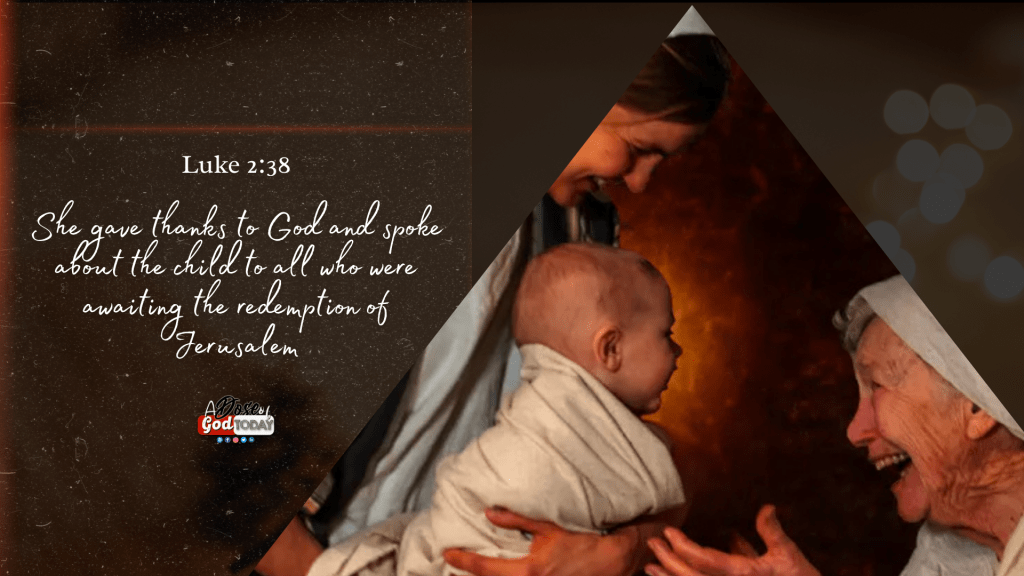
    This is why the Gospel today brings us to Anna, the prophetess, a woman whose life had been quietly shaped by years of faithfulness. She did not rush through life, and she did not allow loss or loneliness to harden her heart. Her many years in the temple were not empty waiting but faithful presence before God. And so, when the child Jesus was brought to the temple, Anna immediately recognized Him. While others may have seen only an ordinary child, she saw hope being fulfilled. Her long journey of trust had trained her heart to see what truly mattered.

    Anna showed us that faith deepens when we stay rooted, grounded. She waited long, but her waiting did not turn into bitterness. Her years did not make her cynical. Instead, they sharpened her vision and her spirit more attuned to God’s coming presence. Thus, she could see hope because she had learned how to trust God through many seasons of loss and silence.

    Moreover, the first reading from the First Letter of John speaks to different stages of life. John addresses children, young people, and fathers. He recognizes that faith looks different at each stage of our life. Children know forgiveness. Young people are strong and have overcome evil. Elders know God deeply because they have walked with Him for a long time.

    However, John also gives us a serious warning. He said, “Do not love the world or the things of the world.” He is not saying that the world is bad. John, rather, reminds us not to build our lives on what does not last such as power, pleasure, possessions, and pride. Though these things promise satisfaction, but they fade quickly and leave hearts empty.

    Hence, this message is very relevant today. We live in a time when many are pressured to prove their worth through success, appearance, or status. Even during Christmas, many could have felt that pressure to have the best food, the nicest gifts, or the happiest photos we can post of our social media platforms. Yet Anna’s life quietly tells us another truth that certainly, a meaningful life is not measured by what we accumulate or show of to others, but by who we become.

    Hence, true maturity in faith is learning to long and desire what lasts. Anna desired God above all else. That is why, when salvation stood before her, she recognized it.

    For us today, this is an invitation to examine our hearts. We ask ourselves. What are we holding on to? What consumes our energy and attention? Are we forming our children only to succeed, or also to love and serve? Are we using our strength as young adults only for ourselves, or also for what is good and just? Are we allowing our elders to be teachers of wisdom, or have we forgotten to listen to them?

    Remember, Anna did not keep the good news to herself. She spoke about the child to others. Faith that matures always becomes generous. It shares hope.

    As Christmas continues, we are reminded that Christ is still growing among us. And like Anna, we are called not only to see Him, but to point Him out to others through our lives shaped by patience, simplicity, and trust.

    May this Christmas season teach us not just to celebrate, but to mature in love, so that when Christ passes by our lives, we will recognize Him and rejoice. Hinaut pa.
  • Learning to See the Light

    Learning to See the Light

    December 29, 2025 – Monday, 5th Day in the Octave of Christmas

    Click here for the readings (https://bible.usccb.org/bible/readings/122925.cfm)

    After the joy of Christmas Day, after the lights and songs, the Church gently asks us today an important question. Do we still know how to see the light, and are we willing to live by it?

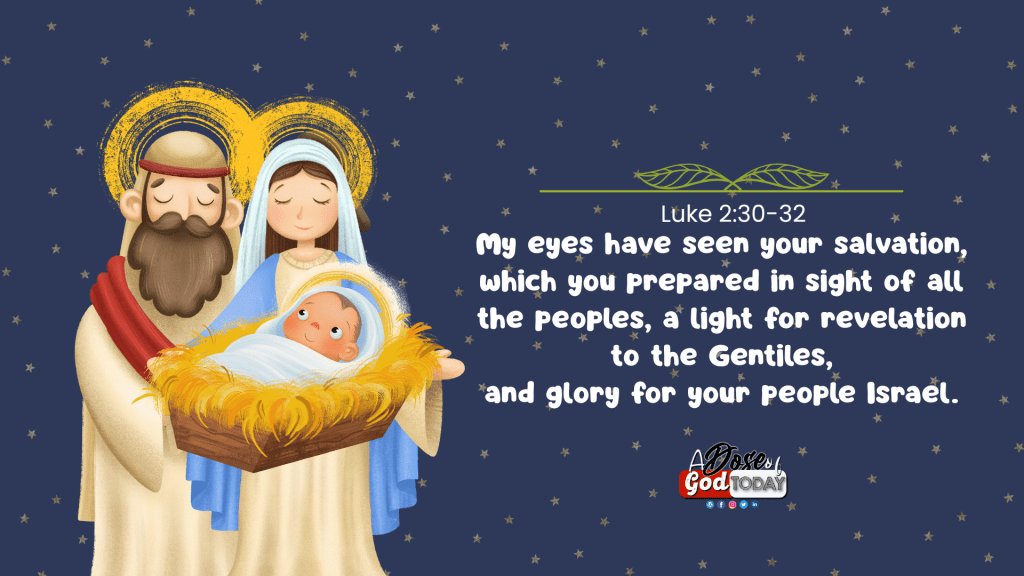
    In the Gospel, we met Simeon, an old man who had waited his whole life for this moment. He carried no title, no power and no influence. What he had was patience, faith, and a heart trained to recognize God’s presence. When Mary and Joseph brought the child Jesus to the temple, Simeon saw what many others did not. He saw salvation and the light. And holding the child, he said, “My eyes have seen your salvation, a light for revelation.”

    Simeon teaches us something important. Seeing the light is not about having sharp eyes, but about having a faithful heart. Many people were in the temple that day. Only Simeon recognized the Messiah. Why? Because he waited, listened, and remained open to God even when the years were long, boring and quiet.

    However, Simeon also spoke words that were hard to hear. He told Mary that this child will be a sign of contradiction, and that a sword will pierce her heart. Indeed, Christmas joy is real, but it is not shallow. The light that comes into the world will reveal what is true in every heart. Hence, as light brings comfort to us, but it also exposes. As light gives warmth, but it also demands a response from us.

    This is where the first reading from the First Letter of John speaks clearly to us. John told us that knowing God is not just about words or feelings. “Whoever says, ‘I know him,’ but does not keep his commandments, is a liar.” These are strong words, but they are honest. Thus, faith that remains only in speech is incomplete. And love that is not lived becomes empty.

    Now, John even went further. He said that those who walk in the light do not hate their brother or sister. It is when we linger to hatred, resentment, jealousy, and indifference that we belong to darkness. Because they blind us and make us stumble without even realizing it. This is very close to our daily lives. We may celebrate Christmas, attend Mass, and speak about love, yet still carry anger, silent grudges, or coldness toward others.

    Hence, the message of today is simple but challenging. We are reminded that to see the light of Christ is to choose to walk in love. This tells us that light is not just something we admire from a distance. It is something we follow.

    Like Simeon, we know what it means to wait. Waiting can make us tired. Sometimes it can harden our hearts. But Simeon showed us that waiting with faith sharpens our vision. It teaches us to recognize God even in small and ordinary moments.

    Today, Jesus is still presented to us not only in the temple or in our Churches, but in people. Jesus comes to us in those who are difficult to love, in those who test our patience, in those who need forgiveness. How we respond to them reveals whether we are walking in light or still choosing darkness to linger in our hearts.

    As we continue the Octave of Christmas, let us ask ourselves honestly, “Do my actions reflect the light I claim to see? Do my relationships show that I am walking in love?”

    May Simeon teach us patience. May John teach us integrity. And may Christ teach us how to live as children of the light not just in season, but every day in our ordinary lives. Hinaut pa.

  • Called to Stay, Called to Love

    Called to Stay, Called to Love

    December 28, 2025 – Feast of the Holy Family of Jesus, Mary and Joseph

    Click here for the readings (https://bible.usccb.org/bible/readings/122825.cfm)

    In this Christmas Season, we always long to be with our family. We try our very best to spend a quality time that includes good food shared together and family vacations. Indeed, in our culture, family matters. When we gather we tease, we argue, we make each other wait, but at the end of the day, we show up. And Christmas, above all, is a season when our presence matters most.

    Today’s celebration of the Feast of the Holy Family invites us to reflect on that same truth that God wants to dwell with us, and family is where love stays alive. But before we dig into the readings, let us be honest and see the challenges our families face today.

    First, according to the recent survey of SWS as of September of 2025, it shows that half of Filipino families describe themselves as poor.[1] This is a reality that affects how homes function and how dreams are lived out. Many feel the pressure of financial insecurity in providing not just food on the table, but education, health, and a future for their children. Families worry about making ends meet, and that daily strain can create stress, misunderstandings, and fatigue that hurt family relationships.

    Second, many Filipino families experience conflicts that remain unresolved, sometimes staying silent because of pride, fear, or the belief that they should handle everything on their own. Because of this, the inability to seek healthy closure when relationships become harmful can trap families in cycles of pain and even violence.[2] These realities challenge the very heart of what a home should be.

    Into this context of our families that we also find God speaking to us through the Word.

    In the first reading from the Book of Sirach, we are reminded that honoring our parents, being steadfast in family relationships, and caring for one another brings healing and blessing. “Those who honor their father atone for sins,” the text says. Indeed, family life with its joys, tensions, wounds, and reconciliations, is not something accidental. It is central to how God chooses to teach us about love. When we value one another, we not only strengthen each other’s lives; we participate in God’s work of healing.

    The Psalm echoes this blessing for those who walk in love and obedience. The image of a fruitful vine, a household thriving and secure, is not simply about comfort. It is God’s promise that when a family commits to love through respect, patience, and perseverance, they reflect God’s own faithful care.

    In the Letter to the Colossians, Paul speaks directly into the life of the Christian household. He speaks not only about virtues like compassion, kindness, and forgiveness, but about allowing Christ to rule in our hearts. Families are called to welcome one another, not just in physical presence during Christmas gatherings, but in the everyday choices that shape a home manifested in our listening, understanding, affirming, and forgiving. Paul’s words remind us that family becomes a school of love when Christ is at the center.

    Finally, the Gospel presents the Holy Family fleeing to Egypt. This may sound far from our Christmas parties and bright lights, but it is deeply human. Joseph, Mary, and Jesus were strangers in a foreign land, living with uncertainty and loss. Yet, they stayed faithful to God’s call. They did not abandon one another. In the midst of fear and displacement, they lived out trust and care. This shows us that family is not defined by comfort or security, but by commitment and love in difficult times.

    Today, we celebrate the Holy Family because their journey resembles ours not in perfection but in our struggles. Joseph, Mary and Jesus knew fear, uncertainty, and sacrifice. They knew the heaviness of responsibility and the challenge of staying together. And yet, they trusted God fully because God is indeed with them.

    Thus, this Feast of the Holy Family invites us to take a hard, honest look at our own families. In a country where economic hardship often burdens homes, where communication sometimes breaks down, and where love is tested by struggles we did not choose, God calls us to grow in deeper fidelity, presence, and care. The Holy Family teaches us that love is not a feeling that waits for perfect conditions. Rather, it is a choice that stands firm amid difficulties.

    We are reminded today that family is a gift and a mission. It is where God calls us to stay, to love, and to build life together with courage.

    And so, how do we live this out this Christmas season, not just as a fleeting celebration, but as real transformation? With this question, I also leave you now two simple, concrete invitations:

    First. Choose intentional presence. Go beyond being physically at the table. Turn off the phone to be able to listen deeply. Share not only food, but concerns, dreams, and fears. Let your home become a place where hearts are heard and valued.

    Second. Rebuild trust and communication. When there is hurt, take the first step and say, “I am sorry.” Ask, “How are you really?” and mean it. Commit to one regular family ritual even just a weekly conversation time where everyone can speak and be heard without judgment.

    Remember, our families are the first school of love in our society. If love thrives in our homes, it will shape our communities, our nation, and our future.

    May the Holy Family intercede for us, especially in this Christmas season, that our homes may become places of peace, endurance, personal growth and love, where we are truly present to one another, and where God continues to dwell. Hinaut pa.


    [1] https://www.gmanetwork.com/news/money/economy/964345/50-of-filipino-families-consider-themselves-poor-sws-survey/story/

    [2] https://igg-geo.org/en/2023/06/27/divorce-prohibition-in-the-philippines-a-system-serving-the-patriarchy/

  • When A Child, A Love becomes more present

    When A Child, A Love becomes more present

    December 24, 2025 – The Nativity of the Lord (Christmas), Mass during the Night

    Click here for the readings (https://bible.usccb.org/bible/readings/122525-Night.cfm)

    Several years ago, after a strong typhoon hit a coastal town in Samar, a reporter interviewed a family whose house had been completely destroyed by Yolanda. The roof was gone, the walls had collapsed, and almost everything they owned was washed away. When asked where they would celebrate Christmas, the father smiled gently and said, “Dito pa rin. Magkakasama naman kami.” That night, with only a small candle, a few cups of rice, and neighbors gathered around, they shared a simple meal and prayed. There were no Christmas lights, no gifts, and no loud music but certainly, there was warmth, laughter, and gratitude. In that very fragile home, Christmas still happened, because love was present.

    That story captures something deeply close to us Filipinos and deeply Christian. Christmas, for us, is not about having everything complete or perfect. It is about being together. Meaning, it is about presence. And tonight, as we celebrate the Nativity of the Lord, the Church proclaims a truth that speaks directly to our hearts that God chose to be present with us, especially in our darkness. And so, let us explore our readings how love becomes more present into our realities.

    The first reading from Isaiah, it speaks to a people who knew what darkness felt like. They were burdened by fear, oppression, and uncertainty about the future. Life was heavy, and hope seemed far away. Yet, God speaks words of promise to them. God tells them that a great light will shine upon those who walk in darkness, and that this light will come not as an idea or a feeling, but as a child. A son will be born, and through him peace, justice, and hope will take root again. This makes love ever more present.

    This promise is not only for the people of long ago. Many us, Filipinos, today also walk in darkness of different kinds. Darkness comes in the form of rising prices of commodities, unstable work, broken relationships, systemic corruption that wounds our nation, and personal struggles we quietly carry. Some families celebrate Christmas tonight with heavy hearts, worried about tomorrow or missing loved ones who are far away, sick, or gone. And into this reality, the Word of God speaks clearly to us by not waiting for darkness to disappear before He comes. Rather, the Lord enters the darkness and brings light from within. This makes love ever more present.

    In fact, the Gospel of Luke shows us how this light arrived. God did not choose Rome or a palace, but Bethlehem. He did not announce the birth to kings or the powerful, but to shepherds. They were ordinary people who worked at night and lived on the margins. The angel’s words to them are tender and direct, “Do not be afraid. I bring you good news of great joy for all the people.” This joy is not selective. It is offered to everyone, especially to those who feel small, tired, and forgotten. And this makes love ever more present.

    Indeed, the child is born in simplicity, wrapped in swaddling clothes and laid in a manger. This tells us something important about God’s heart. God does not come to overpower us. He comes close enough to be welcomed, trusted, and loved. In the vulnerability of the child Jesus, we see a God who chooses closeness over control, compassion over display, and gentleness over power. This makes love ever more present.

    Saint Paul, in his letter to Titus, helps us understand what this means for our daily life. He tells us that the grace of God has appeared, bringing salvation to all, and that this grace teaches us how to live. Christmas grace is not passive. It invites us to turn away from what destroys life and to choose what builds and nourishes life. The birth of Christ is not only something we remember now. Christmas should rather shape how we live and decide as Christians.

    This leads us to the heart of tonight’s message that Christmas is the moment when God’s light enters our ordinary lives so that we may live differently and fully. God’s light enters homes where patience is tested, relationships are strained, and forgiveness feels difficult. God’s light enters communities where honesty and integrity are challenged and where doing what is right often costs something. God’s light enters a nation longing for healing, justice, and peace. And when that light enters this makes love ever more present.

    Moreover, the shepherds showed us how to respond to this light. They did not delay or made excuses. They went, they saw, and they believed. After encountering the child, they returned to their work, but they returned being changed by that encounter. They carried joy, wonder, and praise back into their ordinary lives. Christmas did not remove them from reality, it rather, transformed how they lived within it. This makes love ever more present in them.

    This is also our challenge tonight. After this Mass, we will return to our homes, into our routines, and our responsibilities. The question is not whether Christmas will end, but whether its light will continue in us. And so, Will the child born in the manger be seen in our words, our choices, our priorities, and our relationships?

    In a society where anger spreads quickly and truth is often compromised, Christmas calls us to be a people of light. In families where silence and resentment have grown, Christmas calls us to be bridges of reconciliation. In a country where many feel powerless, Christmas reminds us that God often begins renewal through small but faithful acts done with love so that it becomes more present in us.

    Remember what the angels proclaimed, “Glory to God in the highest, and on earth peace.” That peace grows when hearts choose humility, compassion, and courage. Tonight, God has come home to us not to demand perfection, but to walk with us and transform us from within.

    And so, let us welcome Jesus not only with songs and decorations, or with our Noche Buena and parties, but with lives willing to carry His light beyond this night so that love becomes ever more present and concrete in our lives.

    And so, I invite you to pray with me this prayer as I end this reflection. Together…

    Lord Jesus, Light of the world, come into our homes this Christmas. Stay with us in our joys and in our struggles. Heal what is broken among us, soften our hearts, and teach us to love as You love. May our family become a place where Your light is seen, Your peace is felt, and Your presence is shared with others. Amen.

    Merry Christmas everyone!

  • God is Home with Us 

    God is Home with Us 

    December 24, 2025 – Vigil Mass of the Nativity of the Lord

    Click here for the readings (https://bible.usccb.org/bible/readings/122525-Vigil.cfm)

    Every Filipino knows that Christmas is not complete without family. Even those who live far away will try their best to come home. Some travel for hours, others for days. We brave traffic, long lines, delayed trips, and empty wallets, just to sit again at the same table. And when we finally arrive, there is always that familiar scene: food that overflows but for some it may seem never enough but somehow feeds everyone, relatives teasing each other, stories repeated every year, and laughter that makes the house feel alive again. Sometimes it is chaotic, sometimes noisy, sometimes even tiring but we still say, “Lahi ra gyud ang Pasko kung kumpleto atong pamilya.”

    Tonight, as we celebrate the Vigil Mass of the Nativity of the Lord, the Church tells us something very simple and very deep that Christmas is God coming home to us. Not as a guest who stays for a while, but as family who chooses to stay, who chooses to be with us.

    The first reading from Isaiah speaks of joy and restoration. The people had suffered exile, loss, and shame. They felt abandoned. But God speaks to them with tenderness. He tells them that they will no longer be called forsaken, no longer desolate. God delights in them. God rejoices over them like a bridegroom rejoices over his bride. This is not the language of a distant God. This is the language of love. God does not just fix things from afar. He commits Himself. He binds His joy to the joy of His people.

    The Psalm continues this promise. God speaks of a covenant that will last forever. His kindness will not be taken back. His faithfulness will remain. For a people who experienced broken promises from leaders, from systems, even from family, this assurance mattered deeply. God is saying, “I am not leaving. I am staying with you. I am here for you.”

    Moreover, in the second reading from the Acts of the Apostles, Paul retells the long story of God’s faithfulness. As God chose the people, God also raised leaders. God guided them patiently, even when they failed. And from this long history, God brings forth a Savior, Jesus. This reminds us that Christmas did not happen suddenly. It was prepared through generations of ordinary people. Some of those were faithful, some weak, some confused but all held by God’s mercy.

    This brings us to the Gospel of Matthew. Instead of beginning with angels and shepherds, Matthew starts with a long list of names which we have already heard on the Second Day of Misa de Aguinaldo. At first glance, it may sound boring. But if we listen carefully, this genealogy tells us something powerful. God chose to enter a family line that is imperfect. There are saints and sinners, kings and outsiders, faithful men and broken ones. This is not a clean story but a very human story.

    In this lineage we have Joseph, a man of silence and gentleness. He does not speak a single word in the Gospel. But his actions speak loudly. When he learns that Mary is pregnant, his world collapses. He is hurt, confused, and afraid. He plans to walk away quietly. But God meets him in a dream and asks him to do something difficult. He was called to trust, to stay, to take Mary into his home, and to name the child, Jesus.

    And Joseph obeys. He chooses love over pride. He chooses responsibility over comfort. He chooses faith over fear. And because of that choice, God enters the world not in a palace, but in a home with him and in with Mary.

    Here is the heart of Christmas: God does not save us from a distance. God enters our story and becomes part of our family. Thus, Emmanuel, the God-with-us, is not an idea. It is a reality lived in the middle of human weakness, confusion, and our ordinary life.

    This is why Christmas speaks so deeply to us Filipinos. We know what it means to hold families together despite poverty, distance, and wounds. We know what it means to forgive, to adjust, to endure, just so the family remains whole. And tonight, through the birth of Jesus our Lord, God tells us, “That is exactly how I love you.”

    But Christmas is not only meant to touch our hearts. It is meant to change how we live. It is meant to transform us.

    In our country today, many families are struggling. In fact, in the recent SWS Survey as of September 2025, the study found 50% of Filipino Families considered themselves poor.[1] In addition to that, there are also some tables are missing loved ones because of migration, sickness, conflict, or recent deaths. Many homes carry unspoken wounds like misunderstandings, resentment, and long silence. There are families divided by politics, money, and pride. There are also homes where joy has been replaced by survival.

    Into all of this, God still comes. Not to judge, but to heal us. Not to condemn, but to stay with us. But God also invites us to respond. We are not meant to stay passive.

    And Joseph teaches us that welcoming Jesus means making space, even when it is inconvenient. Isaiah reminds us that God delights in restoring what is broken. The genealogy reminds us that God works through imperfect families. And Jesus’ birth tells us that love becomes real when it chooses to commit and stay.

    So tonight, Christmas asks us one honest question, Is there room for God to be born in our family, not just in our decorations, but in our relationships?

    God comes home to us so that our homes may become places of mercy, patience, and hope. When we forgive, God is born. When we choose to stay instead of walk away, God is born. When we protect life, dignity, and truth, God is born. When we choose honesty and uphold what is just, God is born.

    Indeed, Christmas is God choosing to stay with us, so that we may learn to stay with one another.

    As we celebrate tonight , exchange our joyful Christmas greetings and gifts, and gather around our tables, may we remember that the greatest gift is already here. God is home with us.

    And so, I leave you one invitation. This Christmas, choose one relationship in your family where you will take the first step toward healing through forgiveness, listening, or simply by being present. Let that be your way of welcoming Christ into your home. Hinaut pa.


    [1] https://newsinfo.inquirer.net/2132072/half-of-filipinos-consider-themselves-poor-sws-survey-shows