To exercise authority gives us the opportunity and capacity to serve others. This is how we understand “authority” in Christian perspective. This means that when we have authority over other people, this does not give us the right to belittle or put people down just because we have power over them. Having authority is not even about overpowering others where it is easy for us to manipulate and control others for our own benefit.
In any community, organization or even in our workplaces, when we are given authority, it is rather meant to give us the ability to empower others and to facilitate the community for productivity, growth and maturity.
Jesus in today’s Gospel also “gave authority” to his twelve disciples. And the authority he has given to them has two functions.
First, to drive out unclean spirits that terrifies and imprisons people. Second, to cure every disease and every illness of the people to whom they were sent. Through the authority given by Jesus to the Twelve disciples, the Lord gave them the opportunity and capacity to serve others by setting people free and bringing healing to the sick.
The Gospel tells us now that authority is a gift. It is given to us as an opportunity and giving us the capacity to serve others and not to serve ourselves or to serve those who are only close to us.
Thus, exercising authority is a form of loving-service. And we will know that it is a loving-service when in exercising authority it sets people free, inspires freedom, brings healing and creates a space for growth and maturity to people around us.
Yet, let us also remember, when authority is used as a means to serve oneself by manipulating, controlling and overpowering others, then, authority discourages and oppresses people just like unclean spirits or demons would do.
Moreover, in this case, authority becomes cause of divisions, wounds and toxicity in our community or organization just like a disease or illness would bring suffering to a person.
Thus, Jesus calls us today that as we exercise authority in our own context and life-situations whether at home, at work or in our communities and organizations, we may always be able to inspire freedom, to allow others to be free and become agents of healing and growth. Hinaut pa.
Once a friend of mine shared with me his family problem. Particularly, it was about his sister who decided to change her religion. My friend and the whole family were very sad and hurt about his sister’s decision to change her religion from Catholic to Born-Again Christian. He still cannot understand why her sister, raised in a Catholic family, was educated in a Catholic school and an active youth leader of their parish, could bear herself to change her religion, totally different from their family’s Catholic faith.
What really happens to my friend’s life only reflects the present crisis in our Christian faith. Though most of us, Filipinos are Catholic, we cannot deny that in our community and our church today, quite a number of our brothers and sisters have been influenced by other religious sects, already changed their beliefs, and even lost their faith in the Church. It is true, not only our nation is going through a political and economic crisis, but it is also alarming that our Catholic Church today is also facing a crisis in faith.
However, if we reflect on our Gospel today, we realize that this crisis in faith we faced is a direct challenge for us to bear witness to our own Christian Catholic faith. We see that in the midst of this crisis in faith, our Lord Jesus Christ here in our gospel today calls us to make and strengthen our own faith-commitment, accepting Him as the coming Messiah and our Redeemer.
Yes, it is true that like the apostles, our faith in Jesus was influenced by how our parents witness and our family practices our faith in Christ. But, as the faith of our family influenced and guides our own faith, eventually, one has to deepen and strengthen his own personal faith relationship with Christ, based on one’s recognition and acceptance of the person of Jesus, as our Lord Savior, Christ today, and of his Church.
Just as Jesus in our Gospel challenged His disciples’ faith, “Stand erect for your liberation is near at hand,” he calls all of us today to a much deeper personal faith in His person and his salvation, and to hold on & remain steadfast in our Christian faith, with his Church today. Though we sustain our faith with our own family, each and everyone of us need to make our own personal faith-commitment, as one’s own response to the challenge of faith and hope to God’s salvation, in the midst of this crisis of faith. In other words, “Pagmatinud-anon ug barugi ang imong gituohan, ayaw’g pagpalingpaling kay ang Gingharian sa Dios haduol na.”
Our gospel then is Jesus’ announcement, not of the coming disaster and crisis but of God’s promise of salvation with our faith. Challenging realities of faith crises in our midst is also our very chance to give testimony to what believe & to God whom we believe, thus, our very own faith-bearing witness.
Remember, as the saying goes, “Darkness gives the light of faith a chance to glow brightly.” True enough, in our darkness and life-crises, we start to rely in our faith in the Lord, to begin to believe, to have faith not in what we can see, but in what our hearts see, trying to see things in our eyes of faith. Life seems to be dark, hopeless and discouraging, but our persevering faith in the Lord, in the midst of these darkness can lead us to our complete healing and salvation.
As we stand erect & raise our heads by our commitment and witnessing of our common & personal faith in Jesus as Christ of our lives, we are worthy to receive the dignity in being called as sons and daughters of God, in his Kingdom. Through God’s grace and our faith-response, we become worthy to receive and nurture our Christian dignity and God’s grace of salvation in our own lives at hand.
As we celebrate today, the first Sunday of Advent, in the midst of crisis in Catholic faith we faced, the Lord Jesus Christ challenges us today, then to deepen our acceptance and recognition of his person and mission in the Church; and to strengthen our commitment and witnessing of our faith, trust and hope in His saving power in our lives.
And so… Lord, take away everything that distance us from You. Grant us everything that bring us closer to you. Detach us from ourselves to give our all to you.Amen.
Corrie Ten Boom, a Nazi concentration camp Christian survivor, now a well-known inspirational writer, once said: “If you look at the world, you will be distressed. If you look within yourself, you will be depressed. If you look at God, you will be at rest.” These words of wisdom are learned from her life-experience of the cruelty of war and racism, not only before her captivity in Amsterdam while her family were helping in hiding escaping Jews, and during her captivity in the concentration camp of Germany, and after her release and liberation, but also based from her experience of life struggles and faith journey in general, as Christian.
If and whenever we reflect on these words, we somehow can relate with her on how we also experience our life-struggles and faith-journey as Christian in general. Though we may not share the same experience of life with her, but her words offer us a realistic but still hopeful view of our Christian life:
“If you look at the world, you will be distressed. If you look within yourself, you will be depressed. If you look at God, you will be at rest.”
True indeed, distressing it is to look at world today. With a lot of things going on – war, racism, discrimination, alienation, poverty, moral decadence, corruption, crisis, natural and human disaster, migration, pandemic and other, we cannot help but be distressed, upset, worried and be bothered with life nowadays and in near future. And while looking at our world today with distress, we cannot also help but be depressed, helpless, and hopeless within ourselves as we try to adjust, adopt, and respond to our troubling world. Addiction, crimes, sex, violence, drugs, suicide, abortions, marital breakdowns are just mere manifestations of how depressed & depressing we are and we can be within ourselves, due to the reality of our world outside and our life within. These are the common pains we are experiencing life as it is.
Worse, Jesus in our gospel today even warns us of these on-going and coming distressing and depressing realities of life in the world to happen. We cannot help but be bothered of Jesus’ cosmic depiction of the end-time, “Sun will be darkened, moon will give not its light, and the stars will be falling from the sky, and the powers in the heavens will be shaken.” We may not have yet experienced end-time as Jesus described it, but with our experience of our life’s common pains nowadays of increasing fatality & sickness, easy for us to see that at most we are already on our way towards destruction and end-game of life (even to a point we say, nahugno na ang kalibutan)
We might have been experiencing life at its worse these times, however, Jesus promises us a life, not as how we look and experience it, but Eternal Life with God. Jesus proclaims and promises us: “Heaven and earth will pass away, but my words will not pass away.” (Lilipas man ang Langit at Lupa, ngunit ang aking mga salita ay hindi lilipas: Mahanaw man and langit ug yuta, apan akong pulong dili gayud mahanaw).
Here Jesus is teaching us that eternal life is not about life without end, or endless life, or our life/world now not passing away. For Jesus, eternal life with God is not the extension and expansion of our life as we look and experience it. Surely, we desire not the extension and expansion of our common pains & struggles in life. But what Jesus promises us is eternal life with God that gives us meaning and purpose as we experience life’s common pains & sufferings.
In & with our experience of life’s common pains, Jesus is thus offering us eternal life of common purpose. He is offering us Himself as our Way, Truth and Life that would give us meaning, direction and purpose as we struggle with life and journey in faith amidst our common pains of life. Jesus wants us to live our Life In & With Christ. In other words, Jesus offers us common purpose and meaning amidst common pains of life. Pains & sufferings thus take place and will happen in our life here on earth, but rest assured, Jesus -God’s word and love for us remains for us and with us forever, as promised. Ika nga: (Matupok man lahat ang buong daigdig, hindi magmamaliw ang aking pag-ibig. And so, Jesus is calling & directing us to focus & center our life on Him, to prioritize Him, Our Lord & Savior, the Son of God in our daily lives than our world & selves.
True enough, though Corrie’s experience happened few decades ago, but still we can also say, based on our experience & what is going on in our life today…. Distressing it is to look at our world… Depressing is our helplessness to look into ourselves…. But promising, assuring & hopeful it is to focus our gaze & look to God for meaning & sense in life.
So, whenever we find our life distressing and depressing, and as we long for rest and peace in life, just be reminded of and learn from the wisdom-shared to us by Corrie ten Boom: “If you look at the world, you will be distressed. If you look within yourself, you will be depressed. If you look at God, you will be at rest.”
What motivates me most these days? What drives me to do my best? What is it that I desire for myself? What is it really that I am looking for? – these few questions bring us into more awareness of where we are at the moment and how our actions and decisions are molded by what we nurture in our heart and mind.
It is basic and natural to each of us to seek what would give us security and assurance in life. In every stage of our life, since our infancy until towards our older adulthood, having a sense of security and assurance is a must. This is the very reason why we do things and aspire to make our life comfortable, easier, and independent. We want and we need security in terms of material things in life and also security in our relationships. We seek security in our studies and jobs as well as in our friendship, family and marriage. We want a secured future for ourselves and for people whom we love.
People, because of this nature in us, would also risk to invest their time, talent, treasure and whole person in order to achieve and gain a return of investment. In fact, just this month, political aspirants have just filed their certificate of candidacy. And as early as the first quarter of this year, there were already hundreds or even thousands of big tarpaulins with the over-sized photos of politicians along the streets and highways, in every corner and post. Such move is a way of securing themselves a seat in the political arena. And what drives and motivates our political aspirants? Public service? Political manipulation? Self-giving to the people? Or selfish political agenda?
These are just few examples of our need and reality of wanting security in life. This reality is what this 29th Sunday in Ordinary Time has also reminded us. And so, allow me to reflect with you how the Lord calls and challenges us to become better Christians.
James and John, who were close relative of Jesus, cousins actually, dared to ask favor from Jesus. They said, “Teacher, we want you to do for us whatever we ask of you.” What they actually wanted was to have a secured seat when Jesus reigns in his kingdom. Each of them asked that each one will be able to sit one at his left and one at his right.
The two actually imagined that Jesus’ kingship is like of this world filled with political power and manipulation, wealth and influence. Having a seat at his side will make them superior above other disciples. Why not? They were close relatives of Jesus. These two used this closeness with Jesus to secure their future and to advance such a selfish desire of being comfortable and staying in power.
In our culture today, we call this “Padrino System.” This is value system in our Filipino Culture that gains favor, promotion, or political appointment because of family affiliation (called as nepotism) or through friendship (called us cronyism).[1] And this happens even if the person has no qualifications or not deserving at all.
Nevertheless, this is motivated by selfishness. That is why, Jesus confronted the two that such selfish desire cannot be possible in the kingdom of God. To be entitled to it is futile because only God knows and only God grants.
This irked the other disciples of Jesus because of the selfish intentions of the two. They wanted security in their life by securing a seat of power, thus, leaving the others behind. Indeed, it was expected that they must have compared each other as to who was better, brighter and closer to Jesus because each one also wanted security and assurance of what was to come.
However, this became an opportunity for Jesus to teach the disciples of the value of the kingdom of God. What matters most is not what one can gain, or what we will be able to achieve, not even the influence, power or wealth that we gather and possess. In the Kingdom of God, to be great is to be able to give oneself for others. Greatness then is not measured as to how much people adore or praise us, but with our capacity to serve and to love. It is by being able to give oneself for the sake of others.
Our security then is found not with the comforts and riches we have in this world, but with our relationship with the Son of Man, with Jesus. The Lord himself is our true security and assurance that above all else, the Lord gives us true comfort and contentment in life who first gave himself to brings to the fullness of life.
This is what Prophet Isaiah told us in the first reading that through the life of the Suffering Servant (Jesus), we shall see the fullness of light and life. The letter to the Hebrews also reminds us of such security with Jesus as our High Priest for with him and in him we are given “confidence to approach the throne of grace to receive mercy and find grace.”
Hence, as we celebrate World Mission Sunday today, let Jesus himself be our true security and assurance and our contentment through our capacity to serve and love others without any selfish intentions to seek praises and favor.
Let our Christian faith then be a true expression of that capacity in us to serve and love others even when we called to make a sacrifice, for giving and in loving that we are already secured and assured in the kingdom of God. Hinaut pa.
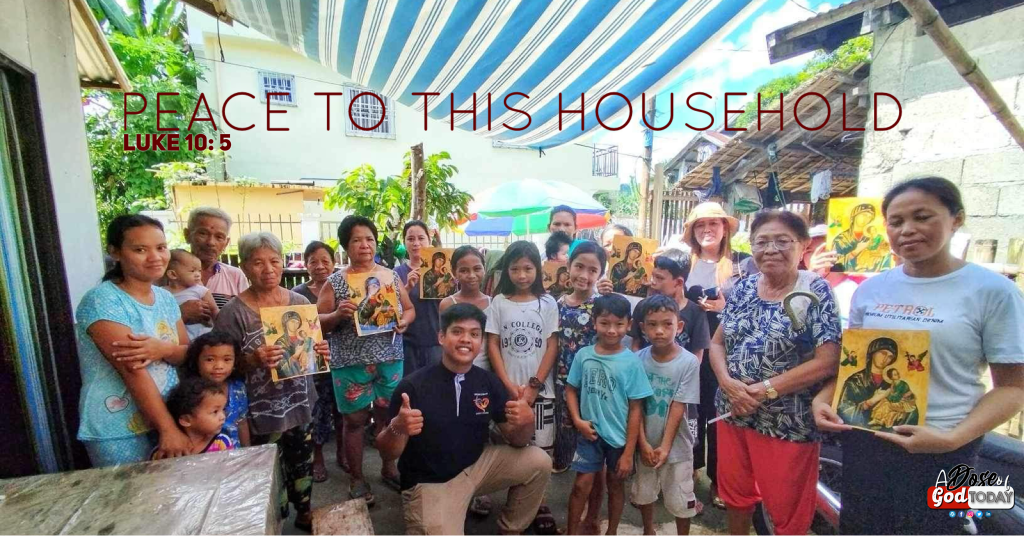
For the past days, our sub-mission team in Barangay Opong, in the Municipality of Catubig, Northern Samar (Diocese of Catarman), has been visiting houses and conducting house blessings. Since Monday, the Sacraments of Anointing of the Sick to several old and sick persons, Reconciliation/Confession to countless residents, Baptism to 4 children, Confirmation to 2 couples and their Marriage and the First Communion of elementary pupils and several high school students were celebrated this week. The participation in the Holy Eucharist celebrated daily since Sunday increased day by day as well.
Despite the short days spent in this Christian Community, the many encounters I had with the people, allowed me as well to develop rapport and some kind of friendship among them and not just with the team. This is the wonder and the beauty as we bring and share the Gospel and encounter Christ who is already there in the hearts of the people. As one of the Mission Volunteers, Rizza Mae Malalay, has shared, we are “meeting God in between.”
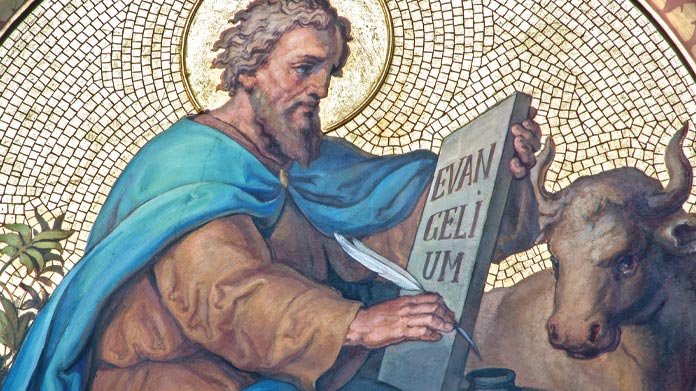
This very encounter, indeed, allowed me to meet God in the “in between” where the Lord brings healing, friendship and blessings. I am certain that this is also the very ground experience of St. Luke, an evangelist, whose feast the whole Church celebrates today.
St. Luke who is known as Patron of Physicians and Surgeons, was himself a healer, a doctor. Though it was believed that Luke was actually a slave, but it was common at that time in the antiquity that even slaves were educated in the service of their masters. Hence, Luke as a healer met God in his ministry of healing. This must be the very reason why Luke recorded many healing stories in his Gospel. Luke realized that healing not just in our physical bodies but also our spiritual and emotional healing bring us to the fullness of life. Salvation and the promise of freedom is certainly integral and whole.
St. Paul in his Second Letter to Timothy expressed the many difficulties and struggles he went through. Many had left him and persecuted him because of the Gospel, yet, only one remained to support and help him. It was Luke who became a faithful friend and companion of Paul. Through Paul, Luke also met Christ. Even though Luke was a Gentile, a Greek from Antioch, Syria, yet despite the cultural and religious differences between them, Christ became the bond of that friendship. Indeed, this very friendship formed between these two great men made them more convinced of their friendship and closeness with Jesus, whose Gospel they preached with joy.
St. Luke was also well-educated in classical Greek. He himself was a writer, no wonder, why the Gospel was written and the Acts of the Apostles. Thanks to him we have another angle of the life and ministry of Jesus. This was how Luke brought blessings to many until today. In fact, the very Gospel on his feast tells us of the 72 disciples sent by Jesus two by two in order to bring peace and blessing. The visitations of the disciples were to prepare the people of the coming of Jesus. This is meeting God.
Celebrating now the feast of St. Luke also calls us to these three points. First, we too are called to bring healing. Let our words, our actions and presence become channels of healing especially to a friend, family member, co-worker or anybody who need healing. May we not be a source of pain and hurts in homes and communities and so we ask the Lord himself also to heal any wounds in us so that we can bring that grace to others.
Second, we are called to develop and nurture friendship. Our presence may also become a source of comfort and assurance to those who feel alone and lonely. Let us also develop our friendship with Jesus through the sacraments and Holy Scriptures. May we not be a source of division and tension then.
Third, we are called to bring blessing. Let our presence also be a blessing and not curse. May our encounter and visits to people then, will also become God’s visitation to others. We do this as we also allow the Lord to work wonders through us.
Indeed, may we be channels of healing, friendship and blessing. Hinaut pa.






 A DOSE OF GOD TODAY