Tag: Childlike

  • Hapag

    Hapag

    July 14, 2021 – Wednesday 15h Week in Ordinary Time

    Click here for the readings (https://bible.usccb.org/bible/readings/071421.cfm)

    Surely we are all now familiar of the painting called “Hapag ng Pag-asa” painted by Joey Velasco. Surely you have seen it. How could you have missed it? Like the Last Supper painting, Hapag is a painting of Jesus having meal (breaking bread) with street-children, instead of his disciples. As it grew into popularity, Joey Velasco made a documentary-video “Kanbas ng Lipunan” to revisit those street-children on the painting, listen to their stories & their reaction about the painting.

    One of them,  “Emong”, as he saw himself on the painting, somehow  said: “while nangangariton on a very hot day, We saw Jesus walking along our dirty & noisy street. Seems tired, alone weary & hungry. So, niyaya namin sya kumain. We invited Him to eat into our corner. Shared our pagpag (left-overs) with Him as He also shared us His little bread. Then we talked & shared about our stories, journey & struggles. Then, menasahe namin sya. We also laid down to rest & sleep for a while. That day was our salu-salu & we have Jesus with us.”

    Easy for us to see the painting of Jesus having salu-salo with street-children AS the Lord lovingly reaching out to us poor & needy people. Emong’s take on the painting however provides a much wider perspective. It is not only God reaching out to us, but it  also we, like the poor street-children is reaching out & responding to God, who needs also our acceptance, welcome, care & hospitality. The street-kid Emong reminds us that God’s blessings & grace of salvation work with our response & participation. God has everything to offer us always for our salvation & He do need our child-like response & participation. Great indeed to be helped by the Lord. But it is much greater when we help the Lord in His work of salvation. There is Pag-asa/HOPE whenever God & people/the Lord & us collaborate with one another.

    And In our Gospel today, Jesus particularly  praises innocence & challenges us to have an innocent childlike attitude & view about life now & here after.  Why? Because, common sense tells us that mature people tends to deduce, judge & conclude positions, while innocents tend to induce, imagine & propose possibilities. Mature people tend to critically denounce, while innocents tend to pronounce & proclaim with wander. Even in our mature & old age, we should never lose & forget our ability to be childlike – open to live & view life not only from our own perspective, but also  wandering about God’s better work, will & plans for us.

    Like Moses before the burning bush, we can only experience God’s presence in our midst, if & we start again & anew to be curious & wondering about what is going on & happening with us now along with what God is doing & offering us now. Somehow we do need at time to be palaboy, wandering aimlessly in like Moses & Emong, so that we may see, respond & contribute in the mission of Jesus Christ.

    The Lord Jesus is always reaching out to us. He has a message to tell us.  He has God’s grace to offer us now. All we need now is like Emong, the streetchildren, & Moses, to reach-out, share & do our part – taking care, responding & helping our Lord Jesus to do his mighty works & renew the face of the earth.

    Lord, like the little ones, make us see what you see in us, what you are offering us, what we can offer & help you to do you will, especially during these pandemic times. Amen.

  • Have the Courage and Faith to be Childlike

    Have the Courage and Faith to be Childlike

    December 11, 2020 – Friday of the Second Week of Advent

    Click here for the readings (https://bible.usccb.org/bible/readings/121120.cfm)

    Homily

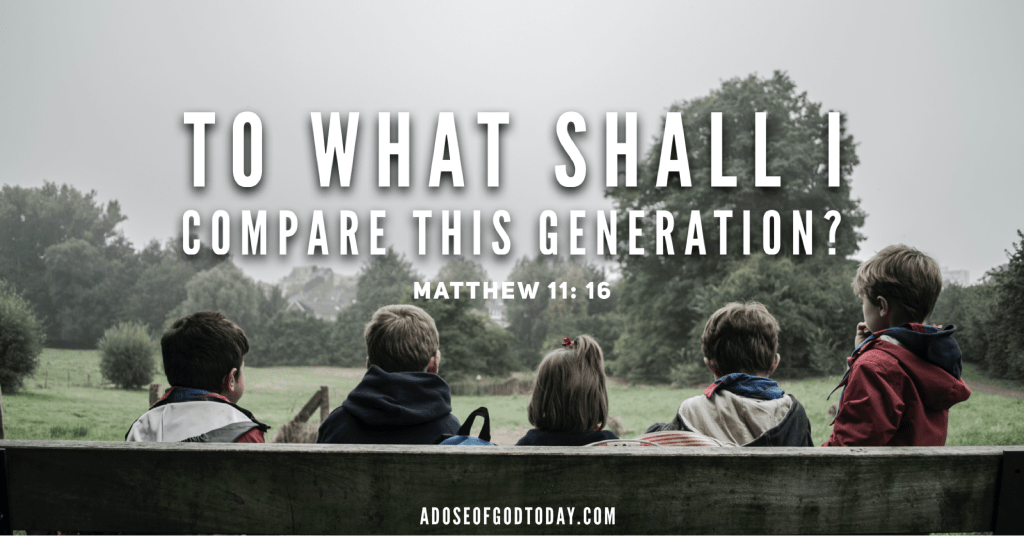
    Children are particularly special to Jesus because the Kingdom of God belongs to them. This is because of the characteristics associated to the children. Children express their dependence to adults and tend to be trusting, welcoming and open to surprises. Their simplicity makes them sensitive to God.

    Jesus used the image of children in the Gospel, however, this mirrors the attitude of unbelieving people.  Children have both strengths and weaknesses. In the parable of the kingdom of God, Jesus pointed to us the strength of being “childlike.” And in today’s Gospel, Jesus emphasized the dark side of becoming “childish.”

    Being “childish” reveals our negative and selfish attitudes. A child can throw up tantrums when displeased and does not get what he/she wanted. This attitude of a child is an unconscious form of control and manipulation to get what he/she desired.

    Being childish is being selfish to get what we want no matter how unfair that would be to others. Being childish focuses on what “satisfies me” and on what “I can gain.”  To be childish prevents us to “listen” to what is more important. It also prevents us to believe and to accept other ideas because we are already convinced of our own judgments and beliefs. Thus, being childish is also characterized by being indifferent.

    This was the attitude of those people who rejected Jesus as well as John the Baptist. So, what was Jesus really doing? Jesus was very unconventional because he ate and drank with sinners. He touched and mingled with the sick and the unclean people. Jesus preached a loving and forgiving God the Father. He was from Galilee, from an insignificant town called Nazareth. He was not a well-known intellectual and did not come from a rich and influential family. And all that Jesus did was a threat to the status quo.

    The Chief Priests of the Temple and the Pharisees were already contented with the comfort that they had, with the power and influence that they were enjoying. They were privileged people and the ordinary ones would almost worship them. They preferred a strict and unforgiving God because it was through that belief that they could advance their self-interest. They used their position in the society to enrich themselves at the expense of the poor.

    That is why; they were against Jesus because he was changing their ways. Their hearts were filled with bitterness, hate, anger and the desire to have more; in other words, they were filled with themselves, worshipping their very selves. This is idolatry.

    These were the reasons why they could not accept Jesus or even recognize the presence of God in Jesus. They rejected John the Baptist by accusing him of being possessed by a demon for being different and radical. They rejected and despised Jesus, accusing him for being a glutton and drunkard because Jesus ate and drank with sinners and the poor.

    Being childish makes us blind to what God shows us now. This attitude makes us “blind” to what is happening around us today. We refuse to see the suffering of others because we tend to only see ourselves. This attitude would also make us deaf to what God is telling us now. It makes us deaf to the many cries of those who are suffering.

    The Lord invites us not to be childish anymore and to turn away from that attitude and become childlike. This is the invitation today, as we continue our journey in this Season of Advent. Let us pray that we may have the courage and the faith to become childlike who can see and hear God in the lives of those who are suffering and among our loved ones. Hinaut pa.

  • In our Capacity to receive and embrace

    In our Capacity to receive and embrace

    Advertisements

    September 28, 2020 – Monday of the 26th Week in Ordinary Time (Feast of San Lorenzo Ruiz)

    Click here for the readings (https://bible.usccb.org/bible/readings/092820.cfm)

    Homily

    Look at how the disciples behaved themselves. This passage of the Gospel of Luke tells us how the disciples argued among themselves on who was the greatest among them. They must have been boasting one another about their closeness with Jesus, their great qualities, their faithfulness, on who was the first to be called and who was the favored one among them. Their argument must have been fierce because it reached the ears of Jesus. Jesus heard not just their words but even realized the intention of their hearts.

    At this point, the disciples thought that Jesus’ kingdom will be like those of kings sitting on a golden throne in the palace with a great army, a political king. They believed that Jesus will inherit political power and vast riches and material wealth. Thus, obtaining a position and having a closer relationship with Jesus will give them the security and assurance of a higher and influential position when Jesus reigns.

    Consequently, the argument of the disciples was based on how they could benefit from their friendship with the Lord. As Jesus heard them, he too realized that this was in the heart of the disciples. Jesus had to teach them and to mold their hearts according to God’s desire.

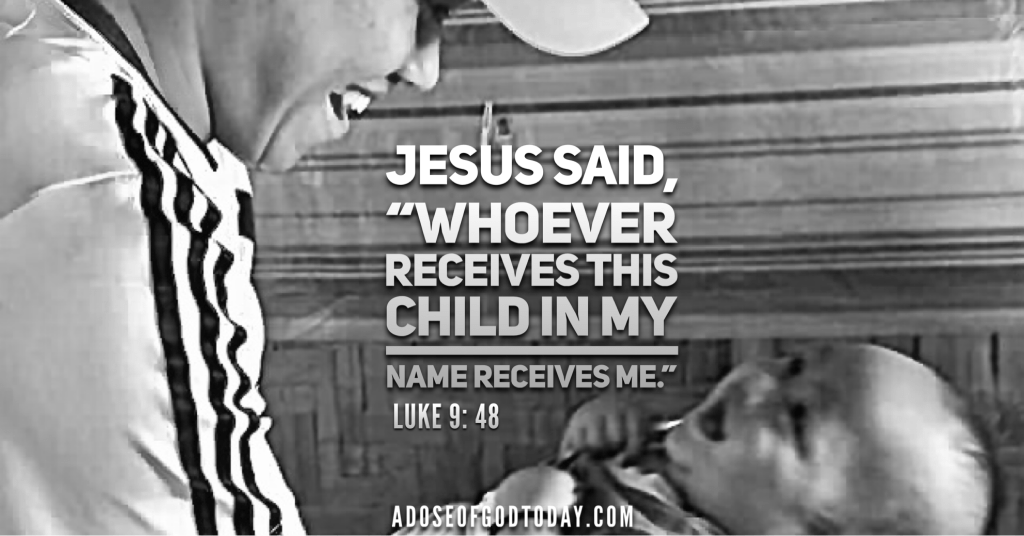
    That’s why Jesus taught the disciples an important lesson through a child. Jesus took and placed the child by his side and said, “Whoever receives this child in my name receives me, and whoever receives me receives the one who sent me. For the one who is least among all of you is the one who is the greatest.”

    Children, at the time of Jesus were considered not important because they were dependent, they have no rights and thus cannot be called as fully man at all. Jesus teaches that in the Kingdom of God, greatness is measured in the capacity to receive God. To receive God is best expressed in welcoming, in embracing and in receiving the least in our community.

    We are called to receive God in the person of those who are the least in our church and society. We are called to aspire to be great but neither in the way that we will be above others, nor to seek a higher position at the expense of others, but in the way of embracing others.

    This capacity to embrace others and embrace God fully was what San Lorenzo Ruiz showed to us. In offering his life, even to the point of death, San Lorenzo was always confident that Jesus was with him. He said, “If I have thousands of lives, all of them, I will offer to God.” This shows us that San Lorenzo had found himself, the kingdom.

    Thus, we shall surely see that when we make ourselves open to receive others, we too shall receive Jesus and Jesus will live in us. This is the reward, Jesus himself. The kingdom of God will be present in us because when we have Jesus, we will be at peace, secured and loved even if we are in the midst of trials and turmoil in life. Hinaut pa.

    Jom Baring, CSsR