Tag: Body and Blood of Christ

  • GIVE THEM SOME FOOD YOURSELVES

    GIVE THEM SOME FOOD YOURSELVES

    June 19, 2022 – Solemnity of the Most Holy Body and Blood of Christ

    Click here for the readings (https://bible.usccb.org/bible/readings/061922.cfm)

    How often do you go hungry, physically? With people who have easy access to food supply, to feel hungry is a choice, perhaps because of workload, so the meal is being delayed. Others, perhaps because of dieting, in order to lose weight. Yet, to many who do not have an easy access to food supply, being hungry is not a choice, but a struggle they cannot avoid.

    According to World Bank, hunger levels remain alarmingly high, globally, with a number close to 193 million people acutely food insecure.[1]  UNICEF also said that there are 95 Filipino children dying every day because of malnutrition.[2] While the recent SWS result said that there is a total of about 12.2% of Filipinos or an estimated number of 3.1 million Filipino Families who experienced hunger in the first quarter of 2022.[3] Out of this 3.1 million, 2.4 million families have experienced moderate hunger while 744,000 families have to survive as they were having severe hunger.

    Hunger, indeed, is everywhere. Despite the advancement of our technology, food security remains a problem. There is a need for us that we too shall become aware of the hunger that many of our brothers and sisters around us are suffering. We cannot just be blind and indifferent to this need. Our readings this Sunday, on this Solemnity of the Most Holy Body and Blood of Christ would actually help us to be more conscious of such hunger and other forms of hunger around us. The Lord through this sacrament of the Holy Eucharist nourished us, yet, this also calls us to be able to respond, as individuals and as a church.

    The Gospel reading we have today captures on how we are called to respond. So let us see how we are being called today.

    The disciples upon seeing the crowd of people wanted to dismiss them so that they can look for food. At this moment, the disciples could not see their responsibility to provide food for the crowd since they did not have the resources. This was the reason why the twelve asked Jesus to dismiss the people. Naturally, they were worried because they did not have enough food for themselves.

    However, what was surprising was the response of Jesus. “Give them some food yourselves,” Jesus told them. Such a response was perhaps ridiculous to the minds of the disciple. They were conscious that what they have were only five loaves and two fish. Hence, the anxiety of the disciples came from that scarcity. If they would give the little that they have, what would be left? In the minds of the disciples, there will be nothing for them. They will go hungry. And they were not ready to do such a thing.

    Such attitude and belief of the disciples tell us something about ourselves. Our natural tendency is to keep things for ourselves. We think first of ourselves. We first take care of our needs. Yet, when it becomes our anxiety, this can blind us, not being able to recognize the needs of others and separates us from the difficulties of people around us. This explains why the disciples wanted to dismiss the people. They did not want to take care of their needs. Hence, they too became dismissive and indifferent.

    However, this has become an opportunity for Jesus the teach the disciples and to open their eyes to the needs of others. “Give them some food yourselves,” was Jesus’ invitation for the disciples to look beyond themselves and beyond their anxieties of losing and giving. Certainly, losing something from us and giving out something for others can become an anxiety and insecurity in us especially when we believe that we do not have enough.

    But then, this was how Jesus revealed to the disciples and now to us that it is in generously giving oneself that we find satisfaction and true fulfillment in life. This is the reason why we celebrate the Eucharist and this Solemnity of the Most Holy Body and Blood of Christ, for Jesus himself offered and generously gave his own body and blood, his whole life for our sake.

    The multiplication of bread and fish was the very image of a life being shared to others in which those who have received were also inspired to give and make the sacrifice for others. This will remain powerful in us when the memory of giving oneself is preserved and done out of gratitude.

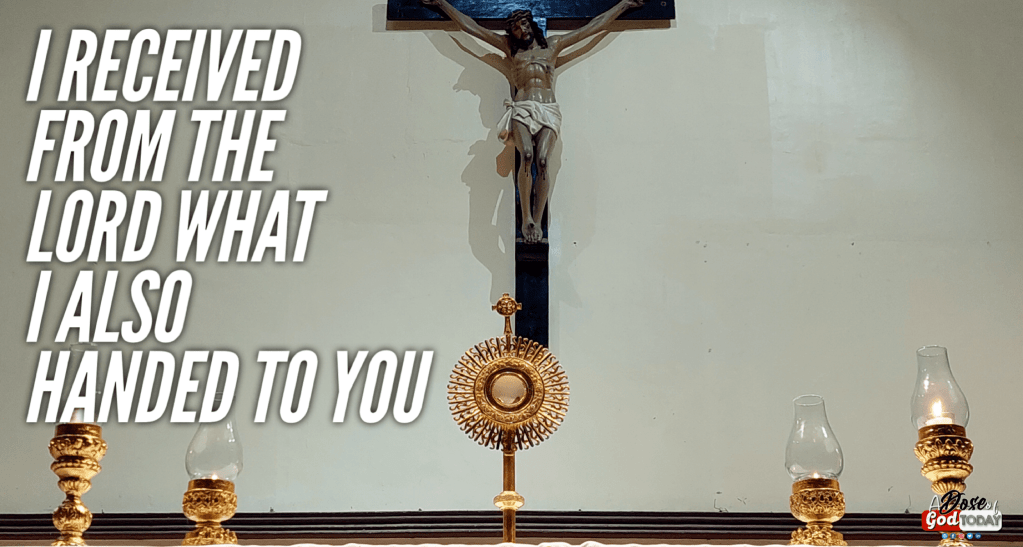
    This is how Paul reminded us in the second reading. Paul shared his gratitude as he said, “I received from the Lord what I also handed to you.” Paul himself who received Christ in his life, was motivated and inspired to also give his own life for others as his concrete expression of making the memory of Jesus alive. And as he expressed that gratitude, he also reminded the people at Corinth of the command of Jesus, “Do this in memory of me!” The sharing of the meal is meant to be shared to all and should come from a heart that is grateful. Once this is done out of the context of the community and without gratitude, then, it ceases to be a powerful memory of Jesus.

    That is why Paul wrote this letter to remind them of the errors they did.  The people became neglectful of the true meaning of the Lord’s Supper. For the people, it was just an occasion of eating and drinking. But, the Lord’s Supper is more than that but doing it in the memory of Jesus, making the bread and wine into true body and blood of Christ that gives life to others.

    Now, on this solemnity, there are at least three invitations for us in order to make the memory of Jesus more alive and powerful in us.

    First, give without grumbling and give out of generosity. This will only be possible when we also remain grateful no matter how little we have in life.

    Second, as we truly receive Christ in this Eucharist, be always life-giving, as Christ gives us his life. We can only be life-giving when we think less of ourselves and less of our comfort.

    Third, share a meal with the hungry. When you have an opportunity to feed a person who is hungry, please do not close your eyes, do not dismiss or send them away without nothing.

    As we allow these invitations be made concrete in our actions, may our way of life will also truly become a powerful memory of Jesus today. Kabay pa.


    [1] https://www.worldbank.org/en/topic/agriculture/brief/food-security-update#:~:text=Globally%2C%20hunger%20levels%20remain%20alarmingly,previous%20high%20reached%20in%202020.

    [2] https://www.unicef.org/philippines/child-survival#:~:text=Every%20day%2C%2095%20children%20in,permanent%2C%20irreversible%20and%20even%20fatal.

    [3] https://newsinfo.inquirer.net/1607293/3-1m-filipinos-experienced-hunger-in-q1-of-2022-sws-survey-shows

  • Bonded by the Lord’s meal

    Bonded by the Lord’s meal

    June 6, 2021 – Solemnity of the Most Holy Body and Blood of Christ

    Click here for the readings (https://bible.usccb.org/bible/readings/060621.cfm)

    In almost every Filipino homes there is a picture of Last Supper near the dining table. Have you ever wondered why in all places such picture of the Lord’s last supper is hanged near the dining table?

    This is because we, Filipinos love celebrations. We like to be part of big party or fiesta. Basically, we are meal-oriented people. We like to eat, and mealtimes are important and meaningful activity for us. Yes, we like to eat, but we like to eat together. We eat not only for nourishment but for companionship as well. For us, eating is not only a usual routine of nourishing our own physical body, but also a common activity of strengthening relationship and bonding. That is why we eat together not for the food, but for the companionship and covenant it brings. Mealtime for us is not only the time to eat, but also the opportunity to encounter – to experience one another.  This is why we don’t like to eat alone. We like to eat with companion, because for us, meals, eating, tables would mean celebrations, table-fellowship, sharing, bonding, rituals, and communion.

    The word ‘companion’ is an interesting word. It comes from two Latin words: cum which means “with”, and panis which means bread. So a ‘companion’ literally means someone whom I share bread with. And it is only a few (not all) you enjoy having meal with. There has to a bonding – a relationship first, which is deepened by the sharing of food and drink. Usually, by inviting a person to a meal, we seal our contracts, we show acceptance and approval. We know that once you are invited to take part in their table – to eat with them, it would mean that you are already accepted.  You become one of them. You belong to them.

    This is why we like the picture of the Last Supper hanging on near our dinner table because we want to be part of Lord’s celebration of life.  Taking our meals in front of the picture of the Last Supper, whatever the food is, whether lechon or bulad or ginamos, would mean we want to be a companion of Jesus and his disciples in their party celebration. This is why it is also particularly difficult for us to not able to attend Holy Mass during these pandemic times, & how insufficient it is, just to take part of the Holy Mass through the live-streaming. In other words, we do like to renew and strength our faith-relationship with Him. We want to be accepted and belong to His community. We like to be part of His family-banquet, His party. And All of these are greatly done and signified until now in our table-fellowship in the Lord’s Eucharist, in our celebration of the Holy Mass. 

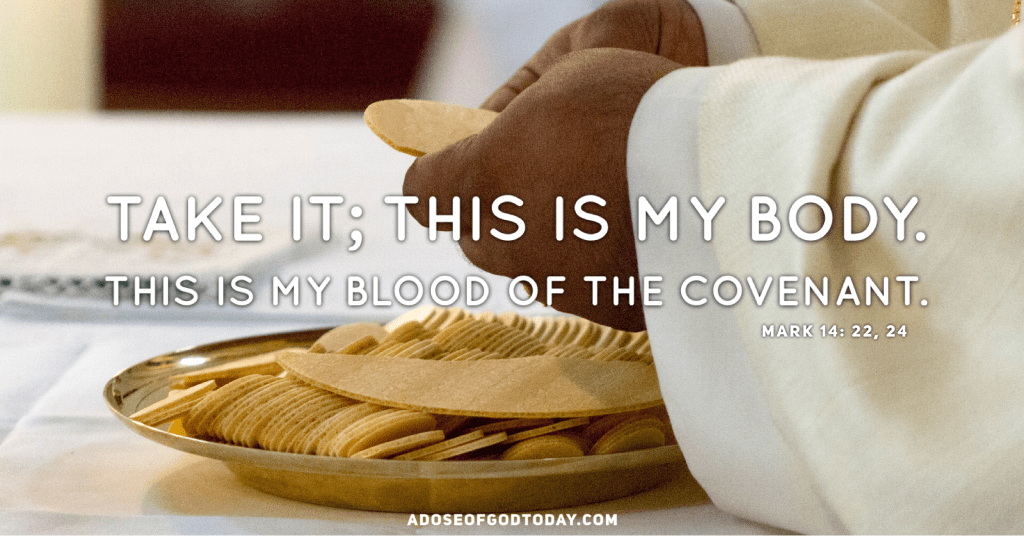
    Today, we celebrate the feast of Corpus Christi, the Body and Blood of Christ. Today, we recognize and celebrate Christ’s continuing Presence and His binding promise of love and redemption to us, through His gift of Himself in a form of bread and wine. Our readings today remind us that as in life we feed ourselves with food, the Lord also feed us with His food, not only to nourish us but also to strengthen our covenant relationship with Him. Jesus in our gospel today specially has offered us His body and blood, as our inheritance of God’s manna in the Holy Eucharist. By sharing us Himself in body and blood, Jesus sealed us new covenant-relationship with God. And because of this, we are continually nourished by God’s graces and we are in communion with Christ’s eternal life. In other words, through His body and blood, Jesus is offering us not only God’s food for our faith-life journey but also a meal-time party (or a food trip) with God. That is why every time we celebrate the Holy Eucharist, we are in covenant or in companionship with God, with Jesus, and with one another. Thus, through our table-fellowship as family and community in our celebrations of the Lord’s Eucharist every Sunday and also as Filipino in front of the picture of the Lord’s Supper, we are united with the Lord and we take part with His glory and work of redemption. 

    Perhaps if we say nowadays, “We are what we eat and who we eat with” (Tayo ay ang Anong kinain at sino ang kasama), in attending Eucharist, we as Christian proclaim that through the body and blood of Jesus we are having party-meal (food trip/ breaking bread) with God now and always.

    For those who are not able to receive communion during live-stream Masses, nowadays they pray Act of Spiritual Communion of St. Alphonsus, saying “I desire to receive you into my soul. Since I cannot now receive you sacramentally, come at least spiritually into my heart… Never permit me to be separated from You. Amen.” Such words express our deep desire to be in communion with Jesus, to be part and companion of His eucharistic sacred life.

    During these pandemic times, we pray that we may always be in communion & in companion with our risen Lord, be nourished by His body & blood, and be always united & bonded, not separated from His love & mercy.

    So Help Us God, So May it be. Amen.

  • Body and Blood of Christ

    Body and Blood of Christ

    Advertisements

    June 14, 2020 – Solemnity of the Body and Blood of Christ

    Click here for the readings (http://www.usccb.org/bible/readings/061420.cfm)

    If you wish to experience and appreciate the unique culture of other people, try their local cuisine. Aside from their usual cultural sights and sounds, literatures, routine & rituals, exploring the local common & exotic food offers us a taste of the local people’s culture. Local food industry & food tourism have been thriving businesses nowadays because we would like to have a taste and sense of local culture. We do know that there is more to food than just as a source and nourishment. Food mirrors the peculiar resources, quality, and meanings of the culture and lifestyle of the local families and community. For instance, the famous Korean Kimchi “pickled cabbage” has been a common substitute food in Korea to augment during scarce, difficult, icy-cold winter season. We only need to hear the stories behind those local exotic food and delicacies to understand the meaning behind the special taste those food can offer. In the same manner, we get to know people by the food they eat and the people they eat with. We might even say nowadays: “You are what you eat, and who you eat with” or “The food you eat reflects who you are and the company you keep.” Like, a vegetarian eats vegetables with vegetarians. Meat-eater parties with meat-eaters. Drinkers hangs-out with drunkards. We somehow tend to identify ourselves with our intakes and diet, and with those who share with our health lifestyle.

    Food has also been a unique faith expression and extension of our Catholic faith and culture. By our celebration of Eucharist, we come to articulate and others come to experience the value and meaning of the Consecrated Host we worship, share and partake. Since for us Catholic, the bread we partake in the Eucharist provides us not only spiritual sustenance and nourishment, but also the reason, meaning & mission to live, and the promise and hope for a better life with God.

    Our first reading today reminds us how God has taken care of us His people in our life-journey by providing and feeding us bread from heaven. This manna, the bread from heaven, is not our usual cuisine, but God’s special exotic food for us – “which neither you and your ancestors are acquainted”.  This food is not only for sustenance and nourishment but also as medicine “to humble you, to test you – to know what is in your heart & in the end to do you good.” God’s manna then is God’s health intervention and medication for our spiritual healing and well-being. It is God’s dietary food supplement to detoxify us and to boost our spiritual immune system that “let you afflicted with hunger, fed you with food unknown, in order to know that not by bread alone does on live, but in every word that comes forth from the mouth of the Lord”. And in our gospel today, Jesus proclaims that He is the manna, the bread of life from heaven. He is God’s food given to us to live our live now purposely and to the fullness. Our daily bread, food-consumptions is not enough and cannot sustain us in life apart from Jesus who is God’s word, God’s bread/food of life from heaven.

    This is how significant the Body and Blood of Christ in the Eucharist for our Catholic culture and lifestyle. Jesus is God’s way of forming, nourishing, protecting, making us grow and healthy in our faith and life with God in the world. As Jesus wants us to “do this in memory of me”, following, celebrating, taking on God’s diet and Jesus’ lifestyle are somehow the way forward we can opt to live and we can share with others in life. We are Christians because we take on Christ. He is our food in our life journey. People come to see and “taste” our Catholic Christian faith by and in our communion of the Body and Blood in the Eucharistic celebration.

    The past few months of CoVID-19 pandemic has been particularly difficult for us Catholic. As our life has been abruptly interrupted and our world has ben partly changed (and still changing unpredictably), our physical, mental and spiritual health have been in distress and crisis. For quite sometime now, we are deprived of public celebration of Holy Eucharist due to social distancing, quarantine and lockdown. It has infected and affected also our spiritual nourishment. As we worry for our daily food and consumption, we do need also to take care of and nourish our spiritual hygiene, immune system and well-being.

    Advertisements

    As we celebrate today Corpus Christi Sunday, the Solemnity of the Body and Blood of Christ, let our present spiritual malnourishment and deprivation to commune with Jesus our bread of life from heaven during the every Eucharistic celebration, make us hunger and long more for Him, and properly dispose us to receive Him once again & taste God’s food for our life, soon enough as allowed.

    Deprived of, set apart from and hungry now for the Body of Christ, with St. Aphonsus de Liguori, let this be our prayer of Spiritual Communion:

    “My, Jesus, I believe you are really present in the Blessed Sacrament. I love you more than anything in the world, and I hunger to feed on your flesh. But since I cannot receive Communion now, feed my soul at least spiritually. I unite myself to you now as I do when I actually receive you. Never let me be drift away and separated from you. Amen.”

    (By: Fr. Aphelie Mario Masangcay CSsR, a Filipino Redemptorist  Missionary stationed in Gwangju South Korea, though now still stranded in Cebu until further notice for available flights.)