Tag: Baptism of the Lord

  • Baptized to Become the Compassion of Christ

    Baptized to Become the Compassion of Christ

    January 11, 2025 – Feast of the Baptism of the Lord

    Click here for here for the readings (https://bible.usccb.org/bible/readings/011126.cfm)

    On this Feast of the Baptism of the Lord, we are invited not simply to recall a moment in the life of Jesus, but to look deeply and honestly at our own lives as baptized Filipinos. This feast quietly yet firmly asks us: What has our baptism truly done to us, and what is it asking of us today?

    The Philippines remains one of the most religious countries in the world. According to data from the Philippine Statistics Authority, nearly 79 percent of Filipinos still identify as Roman Catholic.[1] Prayer, devotion to saints, novenas, and religious fiestas continue to shape our culture. At the same time, recent surveys reveal a growing tension beneath the surface. A Social Weather Stations survey reported that while about seven out of ten Filipinos[2] say they pray daily, far fewer attend Mass regularly, especially among the younger generation. Many still believe, but many also struggle to connect faith with daily decisions, social issues, and moral responsibility. Faith is present, but often fragile, routine, or confined to our rituals.

    Thus, this reality invites us to examine ourselves. Have we really grown in our faith? Have we deepened our relationship with God and with one another? But, let us remember, our faith cannot be reduced to kneeling and standing, holding a rosary, or faithfully reciting novenas though these are also important practices.

    As sociologist Dr. Jayeel Cornelio has observed, many Filipinos today are searching for something “more” from their faith.[3] This “more” is not about abandoning Catholic tradition, but about longing for a faith that transforms life, confronts injustice, heals wounds, and gives direction amid uncertainty. This “more” is precisely what the Feast of the Baptism of the Lord places before us.

    To discern this “more,” let us allow the Word of God proclaimed to us on this Sunday to guide us.

    In the first reading from the Prophet Isaiah, we hear about the Servant of the Lord. This Servant is chosen, beloved, and pleasing to God. God’s Spirit rests upon him. But what defines this Servant most clearly is not power or dominance, but compassion. He brings justice not through violence or force, but through gentleness. Isaiah tells us that a bruised reed he shall not break, and a smoldering wick he shall not quench. This Servant does not crush the weak; instead, he protects what is fragile, restores hope to the weary, and lifts those bowed down by suffering. He opens blind eyes and frees prisoners living in darkness. God’s justice, as Isaiah presents it, heals and restores before it confronts and corrects.

    The Psalm continues this vision in a quiet but powerful way: “The Lord will bless his people with peace.” This peace is not simply the absence of conflict. It is the peace that flows from living in God’s presence, from recognizing that God is active in creation and present in every human life. When we truly acknowledge God’s presence in everything and everyone, respect and reverence naturally follow. Peace then becomes something we embody and share, not just something we pray for.

    This promise finds its fulfillment in the Acts of the Apostles. Peter proclaims that the Servant spoken of by Isaiah is Jesus of Nazareth. He is anointed with the Holy Spirit and power, and His life is marked by a simple yet profound description: He went about doing good and healing those oppressed by the devil. These words summarize the entire mission of Jesus. He restores dignity, heals brokenness, and brings hope to those crushed by sin, fear, and injustice. This is how God chooses to be revealed and not through domination, but through mercy.

    All of this reaches its deepest meaning in today’s Gospel, the Baptism of the Lord. Jesus enters the waters of the Jordan, not because He needs repentance, but because He chooses full solidarity with humanity. His immersion in the water is an act of complete trust in the Father. As the Psalm proclaims, the voice of the Lord is over the waters, and Jesus allows Himself to be embraced by the Father’s will.

    As He rises from the water, the Spirit descends like a dove. This moment reveals that God is not distant or unreachable. God’s Spirit rests upon Jesus and remains with Him. Then comes the voice from heaven: “You are my beloved Son, with you I am well pleased.” These words echo Isaiah’s prophecy and confirm Jesus as the beloved Servant. He is sent to bring healing, justice, and peace.

    This feast today speaks directly to our own baptism as well. In baptism, we too are claimed as beloved. We too have received the Spirit. We too are sent. This is where we discover the “more” that many Filipinos are longing for in their faith. Baptism does not make us passive believers. Rather, it calls us to become active disciples of Jesus.

    We are reminded first that we are deeply loved. This truth alone has the power to heal many wounds, fears, and insecurities. In a society facing economic pressures, environmental threats, and growing inequality, our identity as beloved children of God becomes our deepest strength. We are also reminded that God’s presence is not far away. The Spirit of God dwells among us, in our families, workplaces, classrooms, and communities. We do not need to search only in the clouds to find God. We too are invited to recognize the Lord here and now.

    Our baptism also carries a clear responsibility. We are called to bring justice and peace, not through anger or force, but through compassion and gentleness. Isaiah reminds us that true justice protects the weak and restores hope.

    To live our baptism is to participate in the ministry of Jesus and that is to open our eyes blinded by greed, pride, and indifference, and to free hearts imprisoned by hatred, guilt, and sin.

    As we look ahead to 2026, Filipinos face serious challenges. We have economic uncertainty, the worsening effects of climate change on vulnerable communities, and a growing temptation to reduce faith to mere ritual. The Feast of the Baptism of the Lord calls us back to the heart of discipleship. The “more” in our faith is “to make Jesus more present in our actions, more present in our words, and more present in our homes and communities.

    Let me leave you with two simple reminders to carry with you now:

    First. Live your baptism daily. Let love, honesty, and compassion shape your choices.

    Second. Be Christ where you are. In your family, your work, and your community, allow others to encounter Jesus through you.

    May the grace of our baptism continue to renew us, strengthen us, and send us forth as bearers of God’s peace. Hinaut pa.


    [1] https://www.bworldonline.com/the-nation/2023/02/22/506351/catholics-make-up-nearly-79-of-philippine-population/

    [2] https://www.pna.gov.ph/articles/1195717

    [3] See https://www.ucanews.com/news/young-filipinos-keep-the-faith-but-shun-conventional-piety/97562
  • BELOVED CHILD

    BELOVED CHILD

    January 11, 2026 – Feast of the Baptism of the Lord

    Click here for the readings (https://bible.usccb.org/bible/readings/011126.cfm)

    As we all know nowadays, there is an updated way of praying the rosary. Instead of the usual joyful – sorrowful – glorious mysteries, there is an added mystery called the Luminous mystery or the Mystery of the Light to be prayed every Thursdays. This is to emphasize that the life of Jesus is not only Joyful, Sorrowful, & Glorious, but also Luminous.

    Meaning, our salvation thru Jesus does not happen only by means of his birth, suffering & death, and resurrection, but above through his public ministry & mission. Luminous Mystery of the rosary highlights then the evangelization & ministerial work of Jesus proclaiming & bringing above the Good News of God’s salvation to all. 

    Thus, it emphasizes that the mission and public ministry of Jesus wherein his life where not only joyful, sorrowful and glorious but also luminous, radiating God’s love to the all humanity and that Jesus have proclaimed, preached, and shared the Gospel of God’s love to all.

    And the first mystery of the Light – the first highlight of Jesus’ public ministry is his baptism, the Baptism of the Lord. Our gospel today, the Baptism of Jesus by the river Jordan marks the beginning of His public ministry. After thirty years of local ordinary life, Jesus now exposed & revealed himself to the world publicly that He is the long-awaited & anointed Messiah. In his baptism, Jesus knows Himself as God beloved Son, whom the world should listen.

    Meaning, the child Jesus did not remain a child, but grew up as a mature adult responsible person who is on mission, on-the-go & has a message to share for all of us in this life. He offers us not only joy, sorrow & glory but also Light, meaning, direction, guidance & illumination for our earthly & eternal life given to us by God through His Son. Here, Jesus is affirmed as God’s beloved and marked the beginning of his ministry, evangelization and mission.

    Consider then that when he was baptized in the river Jordan by John the Baptist, he needs to hear the words and confirmation from the Father, himself saying, “This is my beloved Son, with whom I am well please”. Such words emphasize his very spiritual identity before God and the vision of God’s kingdom.

    Here, he is reminded in a deep, deep way of who he is, of his very being before God and people – that among anything else, He is God’s beloved Son. This is the very affirmation and confirmation of his being before God.

    In the same way, when he carried out his mission and public ministry, Jesus wants us also to hear the same message from the Father that “You are my Beloved on whom my favor rests”. Jesus wants us to be aware and hear of the very reality that before God, it is not only Jesus but we, you and I who believe in Jesus are also essentially God’s beloved sons & daughters.

    In God’s heart and eyes, we are His beloved children. And by virtue of our baptism, we are consecrated to be God’s children. We are His beloved, not because of our merits – not because we did anything, not because we proved ourselves or not because of what we did and have achieved in life. God still loves us whatever we do or whatever happens in our life, and He would even love us more when while still in this world we also proclaim to Him and all that, “Yes, Lord, I love you, too”.

    Once in a dream a lady found herself at the heaven’s door. She confidently knocks at the door and demands “Let me in”.  But instead she heard God’s loud voice asking, “who are you?” She then replied, “You don’t know me. I am the mother of our town’s mayor. I have been known for my generosity, an elder of the church’s lay organization and have sponsored the education of your seminarians and ordination of your priests. I even spearheaded the renovation of your cathedral in our town”. “Sorry, I don’t know you”, God replied. Angry and disgusted with God, she just stayed outside, grumbling at the doorsteps, while seeing others being admitted inside. Coming to her senses, she once again knocks at the door and requests for admittance. She said, “Lord, actually, my life has been a failure. I am separated from my husband. My children have been involved with a lot of questionable & corrupt activities. I have been oppressive landlord, abusive lady and known gambler. I am a sinner and have caused other’s to sin. I am sorry, Lord”. God replied, “is that so? But still, who are you?” Confused and ashamed of herself, she again stayed outside and pondered who she really is before God. Then something dawned in her that made her stand, knocks at the door and humbly admits “Now I know who I am, Lord. Despite what happened to me in life, I am still your beloved child.” The door then opened widely and God’s voice joyfully proclaimed “Welcome back, my daughter. Come on in.”

    As Christmas is about to end and we are just starting the year, same way as Jesus grew up maturely in life & mission, let us not treat Him to remain as a child, but we allow Him to grow mature in our lives & let Him do his mission & ministry work for us now, so that we can fully benefit from the promise of Salvation he offers us, as God’s beloved children.

    Today we celebrate the feast of Lord’s Baptism for us to once anew hear from Him that we are God’s beloved and proclaim to other that God is also our Beloved. Let us now renew our baptismal consecration, as we profess our faith….

  • Christians are made, not born

    Christians are made, not born

    January 10, 2021 – Feast of the Baptism of the Lord

    by Fr. Manoling Thomas, CSsR

    Click here for the readings (https://bible.usccb.org/bible/readings/011021.cfm)

    The Christmas Season began with the 1stepiphany”, the announcement by the angel to the shepherds about the birth of the Saviour [Lk. 2:8-20]. He is the Messiah and the Lord whom Israel had been waiting for. This we celebrated on Christmas Day. The 2ndepiphany” we celebrated was last Sunday, when the Magi who travelled from the East found the “king of the Jews” through the guidance of “the star” [Mt. 2: 1-12]. This was the revelation by God to the Gentiles, represented by the Magi.

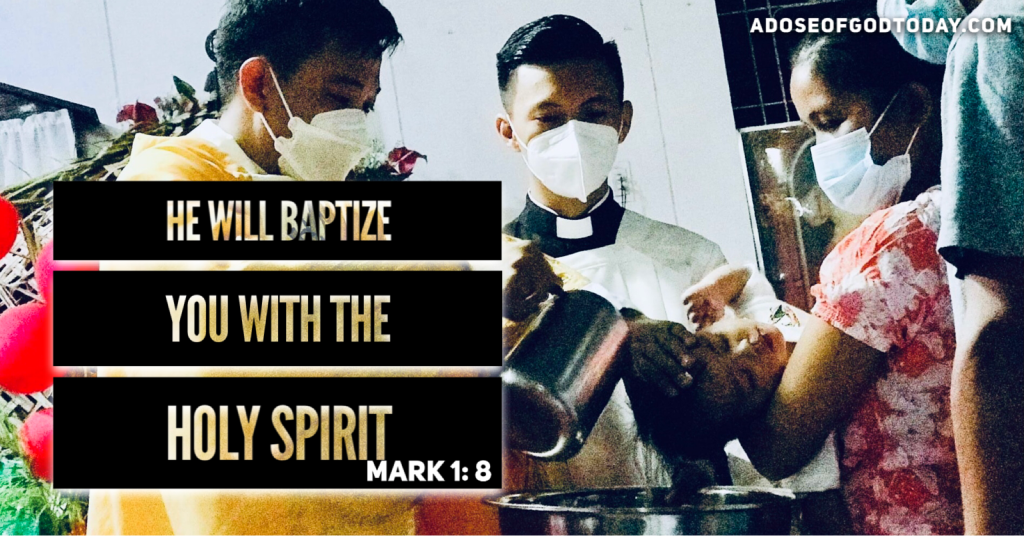
    And today, the feast of the Baptism of the Lord is the 3rd and last of the three “epiphanies” or “revelations” within the Christmas Season. Today, at Jesus’ baptism, God the Father revealed Jesus to us as the Messiah, the one anointed “with the Holy Spirit and with power” [Acts 10:38]. Jesus was sent by the Father to baptize us “with the Holy Spirit” [Mk. 1:8].

    At his baptism, Jesus made a deliberate decision to reach out to humankind. The 1st Reading from the Book of the Prophet Isaiah is applied to Jesus to emphasize this point. According to the Prophet Isaiah, this “servant of God” being empowered by the Spirit of God, will faithfully implement God’s plan. Because of the very close relationship between God and this “servant”, he becomes the “bridge” between God and the people. He becomes the “light” to God’s people and inspires hope in them.

    The four Gospels show us how Jesus exactly fulfilled all these! Empowered by the Holy Spirit after his baptism, Jesus went about to do his mission here on earth. Jesus brought the people and God closer to each other. By his teaching and deeds, Jesus became the source of inspiration, courage, and hope especially among the poor and those abandoned and ignored by society!

    At baptism Jesus was empowered by the Holy Spirit, to enable him to accomplish his specific mission on earth. The same thing happened at our own baptism. The power of the Holy Spirit is there to help us fulfill our specific mission on this world!

    At Jesus’ baptism, the Father confirmed that Jesus is God’s beloved Son, in whom God is well pleased! The same confirmation has been made by God on the day of our baptism! This is how important and significant our baptism is!

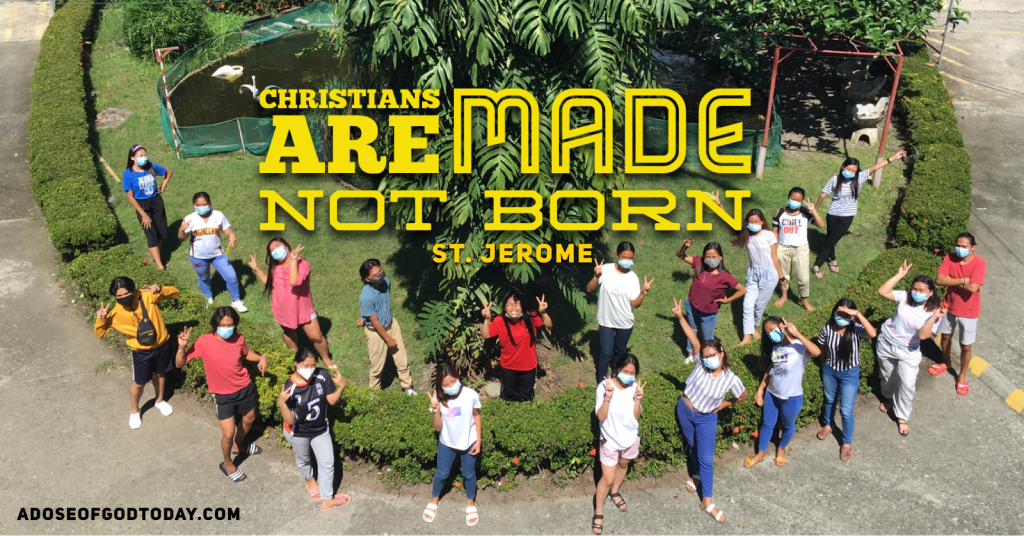
    But our baptism, we did not make of us “an instant and a finished product Christian”! St. Jerome, the one who translated the Bible into Latin, once said: “Christians are made, not born.” From the day of our baptism, we have to continue to grow, to develop, and to mature as a Christian! This growth and development in us, must be seen in the way we live, act, and think; and in our attitudes in life! This ongoing process of growth and development is the process of our Christian maturity! “Christians are made, not born.”

    On the day of his baptism, Jesus made a free and deliberate decision to be God’s “faithful servant” who was to implement God’s plan for humankind and the rest of creation! Becoming and growing as a Christian then is a free decision each one of us must make!

    Most of us, if not all, were baptized when we were still infants. We were not in the position to make that free choice, so our own parents and godparents, made that decision on our behalf. They were supposed to tell us, and to explain to us about the meaning and significance of that decision! As we grow older and mature, at a certain point in our life, we have to freely decide whether we will accept or reject that decision made for us! That is one of the reasons, why during the Easter Vigil Mass and at the Masses on Easter Sunday; we are invited to renew our baptismal vows and promises. This gives us the opportunity to freely choose whether we want to continue on being the “beloved adopted sons and daughters of God” and disciples of Jesus Christ!

    Although this gift is freely offered by God to all, yet it is never forced on anyone! Jesus never forces anyone to continue their discipleship! Our free choice and decision will be respected and honored by God and by Jesus Christ!

    As you continue to mature as a Christian, is your mission here on earth becoming clearer? Do you experience the power of the Holy Spirit helping you accomplish your mission? Are you continuing to grow and mature as a disciple of Jesus? If your baptism is that significant and important, do you know the date of your baptism as you well know your own birthday?

  • God’s Beloved: I am & we are

    God’s Beloved: I am & we are

    January 10, 2021 – Feast of the Baptism of the Lord

    Click here for the readings (https://bible.usccb.org/bible/readings/011021.cfm)

    Who are you? How do people define yourself? How do you define yourself?

    Henri Nouwen, a known pastoral theologian and spiritual teacher once said: “We are not what we do. We are not what we have. We are not what others think of us. Coming home is claiming the truth that… I am the beloved Child of the Creator.”

    True indeed, we do tend to define our life by what we do, what we have & what others say about us. In defining ourselves, we do tend to claim & know ourselves & others by our talents, abilities, successes as well as our failures & mistakes. We do tend to see ourselves & others by our backgrounds, possessions, privileges, properties, friends, influences, power, as well as limitations, poverty, and misfortunes. We do tend to characterize ourselves & others by the praises, awards, titles, honor, as well as by the insults, gossips, & comments people say about us. We do tend to name our identity, dignity, reputations, & life-purpose by what we do & not do, what we have & we have not, and what other say & not say about us.

    Though much effort & time we have spent in life to identify ourselves & others by our actions, possessions & feedbacks, we do know deep inside that these standards are limited & limiting. These self-classifications are degrading (ka-menos) to our very person & not who we really are. Eventually we have to claim that we are more than and better than what we do, what we have, & what people say about us. Eventually we need to believe & come home to the reality that we (you & I) are God’s beloved. We need to claim & name ourselves as essentially God’s beloved Child.   

    The chance of claiming & naming ourselves as God’s beloved Child is perhaps the most profound realization & blessing we can give to God & ourselves in life. Even Jesus Himself also have to experience and went through the process of claiming & naming Himself as God’s beloved Child.

    Before launching to His mission of evangelization in sharing to the world the Gospel of Salvation, Jesus must have first gone through a lot of soul-searching as to what is His very identity, dignity, reputation & purpose. Human like us, Jesus also grappled with the basic human question: “Who am I?” and reflected with our tendency to define ourselves by our actions, possessions & feedback.

    And on His baptism by the river Jordan, Jesus came to realize & experience who He really is – God’s beloved Child. Jesus needs to hear the words of confirmation from the Father, himself saying, “You are my beloved on whom my favor rests”. Such words emphasize His very spiritual identity before God and the vision of God’s kingdom.  Here, He is reminded in a very deep way of who he really is, of his very being before God and people – that among anything else, He is God’s beloved Son. This is the very affirmation and confirmation of His being before God.  That beyond what he can do, what he can have, & what people would say about him, Jesus has to listen & honor, and claim & name for Himself that He is God’s beloved son, whom God is well pleased.

    Claiming & naming His being God’s beloved child did not only empower Jesus to now & always proclaim God’s grace of salvation to all in our world, but also serve as the content, process & spirit of His mission. As He claimed & named His very identity before God, Jesus also preached, taught & guided us the Good News that beyond what we do, what we have, & what others say about us in life, we are also essentially God’s beloved children – and that is how valuable & significant we are before God.  And same way with Jesus, we only realize & come to term with this reality by our soul-searching, claiming & naming, affirming & confirming, and until be at home & at rest with our True identity as God’s beloved Children. And only then, we can find more meaning & purpose in life when we regard ourselves & others as ultimately God’s children.

    Today on the Feast Day of the Lord’s baptism, we are reminded of who we are & how significant we really are before God & others, as God’s beloved Children. And we are also reminded on the very day of our baptism when we ourselves are consecrated, affirmed & confirmed to be always God’s beloved Child.

    This year 2021 is also a very important year for the Philippine Church. It marks not only 500 years of Magellan’s discovery of the Philippine Islands in March 16, 1521 but moreso of the first baptism happened in our land and the 500 years – five decades of Filipino Catholic faith. Although for more than three decades we have been colonized by Spanish rules, upon our independence, we did not abandon our Catholic faith but rather remain faithful to our Filipino faith that provides us the cultural values and principles that made us Filipinos as one nation and heritage, and as the only Christian nation in Asia with 86 % Catholic among more than 100 million Filipino people all over the world. In other words, as Filipino nation & society, since then & until now, we identify, define & claim ourselves as baptized Christians, beloved Children of God.

    Perhaps as we begin this New Year amidst pandemic times, the best Message you may hear today is to proclaim to yourself & other that :

    I am God’s beloved – a valued, valuing, & valuable person whom God’s favor rest & God loves now & forever.

    And as Filipino Christians, we proclaim to ourselves & others that:

    We are God’s beloved – a valued, valuing, & valuable people whom God’s favor rest & God loves now & forever. For that is who we are, who you are, & who I am. Amen.

  • There is more in our Faith

    There is more in our Faith

    January 10, 2021 – Feast of the Baptism of the Lord

    Click here for the readings (https://bible.usccb.org/bible/readings/011021.cfm)

    Are Filipinos more religious because of Covid-19? This is the title of the analysis of Jayeel Cornelio, PhD, a sociologist of religion.[1] This article was published in October 25 at rappler.com. The article discussed significant subjects particularly on the survey done by Pulse Asia last September 2020.

    The survey revealed that 51.8% of Filipinos have become more religious during this pandemic. According to Dr. Cornelio, this is not surprising because of two reasons.

    First, we are known to be one of the most religious societies in the world. And according to Pew Research Center, 96% percent of Filipinos find it “necessary to believe in God in order to be moral and have good values.”

    Second, Dr. Cornelio said, “faith is our immediate resource in times of crisis.” Citing another survey by the Veritas Truth Survey, it revealed that 89% percent of the responders of the survey said that faith is “very important” in the fight against Covid-19.

    From here, the sociologist also concluded that because of the “vulnerable social and economic context,” that is, being a third world country, the pandemic promotes a higher religiosity in us. In his words he said, people in poor social conditions such as having “inadequate health care, high incidence of conflict, and unreliable state agencies”  – people feel that they can turn to nothing else but faith in God.

    Indeed, it is when we become vulnerable and poor that we become more conscious of God’s presence. When we become more aware that we have actually nothing and are nothing in this world, that we also begin to realize of that great presence of God.

    A very comfortable life, a rich and powerful lifestyle can easily bring us into the attitude of indifference. It is indifference that prevents us to recognize that God is with us and continues to be present in the world.

    Moreover, at the end of his article, Dr. Cornelio also wrote that “there is so much more to COVID-19 than simply challenging the core of people’s religious convictions. In the end, it’s not just that Filipinos have become more religious because of this crisis. They are also beginning to seek something ‘more’ from their faith.”

    This sociological analysis brings me now to our very identity as baptized Christians. More than this survey of our religiosity, there is also a need to examine ourselves whether we have grown really in our faith, in our relationship with God and with one another. Our faith is not just about kneeling and standing, holding a rosary and saying our novenas. As Dr. Cornelio said, there is something “more” that we begin to seek from our faith. This “more” is something that I invite you now to pay attention as we celebrate this Sunday the Feast of the Baptism of our Lord Jesus.

    To be able to discern this “more” from our faith, allow me to journey with you through the readings and to see how God reveals His invitations for us today.

    In the first reading, Prophet Isaiah proclaimed the presence of the Servant of the Lord. The servant’s identity were described in three points. First, the Lord said,  “he is my chosen one with whom I am pleased.” This servant is loved very much by the Lord God, thus, God’s presence rests upon him. Second, the servant is to bring justice through compassion and gentleness of his presence and not through violence and force. Isaiah described and said, “a bruised reed he shall not break, a smoldering wick he shall not quench.” This servant is hope for those who are hopeless and are suffering. Third, the servant is to open the eyes of the blind and free prisoners and those who live in darkness. The servant who brings hope also brings peace, freedom and new life.

    The Psalm also stated this, “The Lord will bless his people with peace.” Peace here is living in the presence of God who is present in all creation. And the recognition of God’s presence in everything and in everyone brings us to show respect and love.

    This very promise of God is fulfilled and revealed in the Acts of the Apostles and in today’s Gospel. In the Acts of the Apostles, Peter proclaimed that this servant whom God chose is Jesus of Nazareth. He is anointed with the Holy Spirit and power. This is shown in the ministry of Jesus “in doing good” and in “healing the oppressed by the devil.”

    This is what we also find in the Gospel of Mark. The baptism of Jesus was a revelation to us that Jesus is the servant spoken by Isaiah. The scenarios in the Gospel are also very important told to us in three actions.

    First is the “immersion of Jesus in the water” was an expression of complete confidence in the Father. The Psalm proclaimed to us that “the voice of the Lord is over the waters, the Lord, over the vast waters.”  Here, Jesus allowed the power of His Father to embrace him.

    The second action is the “Spirit descending like a dove.” This is the very presence of God allowing our eyes to behold where it rests. The Spirit of God is in Jesus, the Lord who is among us. This tells us of the presence of God not just above us, but here among us.

    The third action is the voice heard coming from heaven saying, “You are my beloved Son, with you I am well pleased.” This has been proclaimed also by Isaiah.

    Indeed, this feast of the Baptism of the Lord tells us something important about our own baptism which we share in Jesus. This is where we also find the “more” in our faith. The “more” in our faith asks us not to be passive-believers but to be active-believers. The “more” in our faith tells us now of four points. These are invitations that you can bring with you today.

    • First, we are all loved. Never forget that.
    • Second, God’s presence is among us. We do not have to look above and seek God’s presence in the clouds. Look around also. God’s Spirit rests here among us.
    • Third, our baptism compels us to bring justice and peace. Isaiah reminds  us that this will be realized not through violence and force but through compassion and gentleness of our presence.
    • Fourth, to bring justice and peace is to also participate in the ministry of Jesus. This ministry is to open the eyes including our eyes blinded by greed, anger and indifference. And to free our hearts imprisoned by hatred, sin and guilt.

    Thus, the “more” in our faith is to make Jesus more present in our actions and words, and more present in our hearts, homes and communities. Hinaut pa.


    [1] See his article in https://www.rappler.com/voices/thought-leaders/analysis-are-filipinos-more-religious-because-covid-19