An encounter with the Lord leads to discipleship and to be on mission. This is message for us today. But for us to grasp better the message, let us make a step by step discovery.
First, the call or the invitation is God’s initiative. It means that it is God who calls us and God chooses us to be His servant, to be his disciple. God’s way of choosing is not through the wealth we gathered, or how much power and influence we possessed. God calls us when we are open to him regardless of our profession, status and state in life. This is how Jesus summoned the ordinary 12 disciples and then sent them to proclaim the kingdom and free people from the slavery of sin and evil.
Second, we need the help of our family, friends, and community to lead us to God. An encounter with God, though that can be very personal but it is essentially always in the context of the community. Thus, seek the help of others. It will be easier for us to recognize God when we have a friend who will help us to see God.
Third, our God-experience or personal encounter with God is the most wonderful experience we will ever have. Because it is so wonderful that we cannot just keep it by ourselves. Our encounter with God leads us to action – it leads us to follow the Lord and leads us to tell others about what we have seen, heard, felt, and experienced with God. The 12 apostles’ personal encounter with Jesus led them to this point where that encounter moved them to action to become healers, witnesses and preachers.
Each of us today, whoever we are and wherever we are, as Christians we are called to preach Christ, to preach the Gospel by our life that we may become agents of healing and reconciliation, and bring other people closer to God. This is what it means to become an apostle.
May we always remember this and become true Christians in the way we live our life, in the way we perform our work and in the way we relate with others and with one another so that we who have experienced God’s goodness will also become instruments in bringing other people closer to God. Hinaut pa.
We celebrate today the Feast of St. Andrew, one of the original 12 apostles. We know very little of him. According to our tradition, Andrew became the first bishop in the community of Constantinople until he was martyred through crucifixion on an X-shape cross. The gospels tell us also that he was the brother of Peter. They were from Bethsaida, a town near the Sea of Galilee. In John’s Gospel, we were told that Andrew was a disciple of John the Baptist at first. In the same gospel, we found that Andrew had actually brought Peter to Jesus, telling his brother, “We have found the Messiah!” (Jn 1:35-42). It was also Andrew who called the attention of Jesus about the boy with 5 loaves and 2 fish (Jn 6:8-9). Again, it was Andrew with Philip who told Jesus that there were some Greeks who wanted to see Jesus (Jn 12:20-22).
From here, we can sense that Andrew was actually an apostle with a typical role. Unlike Peter, he was not able to witness the transfiguration of Jesus at Mt. Tabor. Andrew was not part of Jesus’ inner circle composed of Peter and the 2 brothers, James and John. He was in fact an ordinary guy, an ordinary apostle of Jesus. However, Andrew had a remarkable faith in Jesus. Remember, his brother Peter doubted and even denied Jesus three times. But for Andrew, he was the first one to realize that Jesus was truly the Messiah. In his conviction, he joyfully shared what he found to his brother. He himself became an evangelist, a preacher of the good news to his own brother. Also, he brought others to Jesus like the boy and those Greeks. He became a bridge between Jesus and other people. He actually bridged the gap between those people and Jesus.
This is what St. Paul has told us in the first reading. There is a need and beauty in sharing one’s faith in Jesus to others. Paul writes, “Their voice has gone forth to all the earth, and their words to the ends of the world.” His letter to the Romans helps us ponder our own call to be a kind of apostle or bearer of the good news to others like St. Andrew.
Moreover, the Gospel tells us how we are being called individually. To each of us, Jesus says, “COME, FOLLOW ME, AND I WILL MAKE YOU FISH FOR PEOPLE! I WILL MAKE YOU MY OWN APOSTLE!” This can surely be materialized when we preach with joy by our own example.
So, as students, when we believe in what we are studying; as workers, when we are happy with what we are doing and honest in our business and with our co-workers; and when we are sensitive to others and volunteer to help whenever someone needs a helping hand; when we become joyful givers to those who have less; when we are more understanding and compassionate with those who are experiencing more difficulty in their life; and when people feel that we believe what we pray in the church, in our homes or with others…THEN PEOPLE WILL SEE ALL THESE THINGS AND WILL RECOGNIZE THAT WE ARE CHRISTIANS.
Like St. Andrew, we will be able to bridge the gap by bringing others closer to Jesus. Hinaut pa.
Have you ever come to a point where you felt so unworthy, useless and even felt disgusted with yourself because of something wrong that you have done before? This happens when we have a deep consciousness of our own sinfulness, imperfections and weaknesses. Yet, when we also tend to focus to what is only wrong and ugly in us, we also begin to lose self-confidence, self-worth and self-value. We also begin to underestimate our capacities and ourselves.
In relation to this, the way we relate with God is also affected because we would tend to relate with Him as someone who would judge us and punish us for what we have done. Then, we relate with God in fear and guilt rather than in love.
This kind of attitude was very strong during the time of Jesus. Sinners had no place in the Jewish society. When a person is poor and sickly, they believed that God punished him/her for the sins the person committed or committed by his/her parents in the past. People believed that sinners must be driven away from the community.
This is the reason why lepers were untouchables, or the paralytics, the lame and the blind were despised by the “normal people,” because they were sinners and were punished by God. The seemingly normal people who were identified as the Pharisees and Scribes maintained a status quo that separated them from the sinners. These people would not touch any known or public sinners. They would not join them in any celebration. They forbid those sinners from entering the synagogue and the Temple. They disowned the sinners, treated them as less-humans, despised them and condemned them.
Thus, every sinner felt unloved, unwanted and condemned. However, this is not the case with Jesus. Jesus turned the condemning culture upside down. Jesus went away from the rigid, judgmental and unforgiving Pharisees and Scribes. He surprised them with forgiveness, mercy and love.
This is what has been proclaimed in today’s Gospel as Jesus called Matthew, a tax-collector to follow him. Matthew, since he worked with the Roman rulers and collected tax among his fellow Jews, was considered a public sinner. His fellow Jews despised and prohibited him to enter the synagogue and the temple and even to mingle with his fellow Jews. Matthew, like any other sinner, was condemned and excommunicated by the Jewish society.
For the Jews, no righteous Jew shall talk to him or touch him. Yet, Jesus did all these things. Jesus talked to Matthew, touched him and even dined with him, made him a friend and called Matthew to be one of the disciples. This tells us how Jesus calls and brings many wonders in the life of a person who responds.
Jesus proclaimed his message to everyone as he said, “I did not come to call the righteous but sinners.” This tells us that God is a God of forgiveness, of many chances, of healing and freedom. Jesus understands the struggle of a sinner though he was not a sinner himself.
The letter of Paul to the Ephesians tells us that each of us has been given the grace according to the measure of Christ’s gift. As Matthew, the sinner was given the grace of forgiveness and acceptance, and so we are. The presence of God is the grace that liberates us from whatever burden, shame and guilt that we are suffering from.
Hence, we should be careful then, when we feel the temptation to appear righteous and superior. Jesus said that he did not come for the righteous but for the sinners because righteous people do not need God. In fact, when we feel too righteous, we become arrogant. Arrogance keeps us away from God and would make us deny God’s mercy.
This is the invitation for us today. We are called to humble ourselves by acknowledging our sinfulness. This moves us then, to recognise our need for God, need for forgiveness and healing. And when we recognise God in our life, then, we also allow God to transform us, to change our lives, to call us and to touch us like what happened to the public sinner, Matthew. As he allowed Jesus to call him, Matthew’s life was changed forever who became an apostles and an evangelist. Matthew, through his past life, brought many people to know Jesus until today.
Hopefully, this kind of attitude towards ourselves and towards God, our attitude and treatment to those who failed, committed mistakes and have wronged us, may also become more like Jesus – that we may become welcoming of other sinners like us, by forgiving those offenders like us, and by promoting healing and reconciliation and not condemnation and destruction of sinners and offenders like us. Hinaut pa.
People who encourage others would always bring support and growth because encouragement nurtures confidence and hope. Parents who would give generous encouragements to their growing children would find children to be happier and lively. Teachers who would also express words of encouragements to their students would find them animated to perform well in their studies.
This is also true among employers or corporate heads. A supervisor or manager who is generous in expressing encouragement to his/her workmates or colleagues or employees would surely find people around him or her to work confidently and competitively in a healthy way. Thus, a person who is being looked up by many as a leader and expresses words and actions that unite people, that heal division and reconcile differences, creates a space that bring people to work together. However, when a leader or any authority figure becomes vicious in his or her speech or acts unfaithfully from his or her duties, promises and words, then, he or she promotes unwarranted conflicts and stress to people.
Moreover, when words of encouragements are expressed whether at home, at school or at work, they lessen unnecessary stress, avoid unnecessary conflicts and rather promote self-confidence, trust and hope.
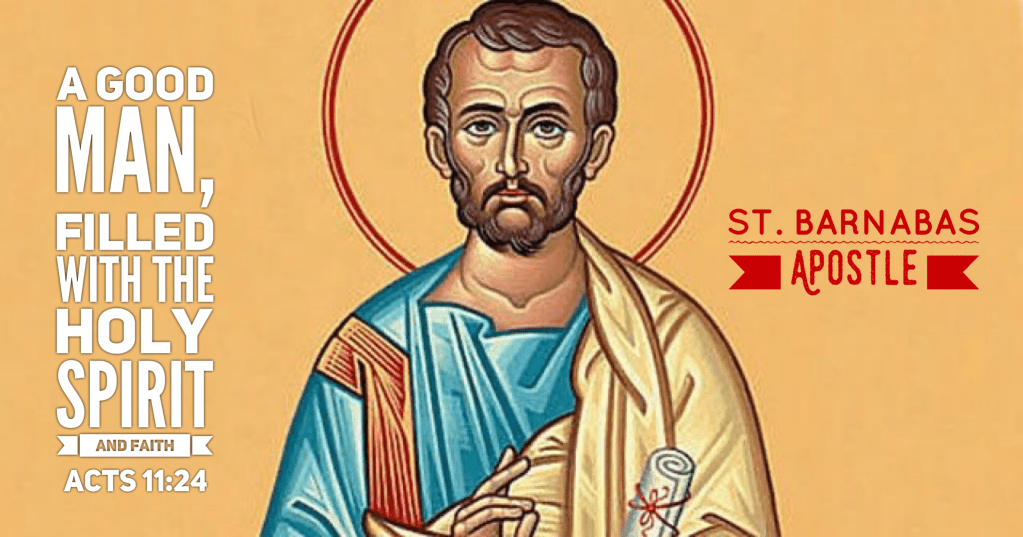
This attitude of encouraging others had been shown to us through the person whose feast we celebrate today. St. Barnabas, an apostle, was a man of encouragement. During his lifetime, in his ministry, he never forgot to encourage people around him. In fact, it was through his encouragements, together with St. Paul, that they helped and nurtured the early Church to grow and to mature. It was in the Church of Antioch, through Barnabas too, that the Church realized that indeed, it is Catholic or universal in its nature. In Antioch, Jews and Gentiles lived together. Despite the differences in culture, language, and history, the Church became one in faith but so dynamic and vibrant in living together as Christians.
It was in Antioch also, that we, believers of Jesus, were first known as “Christians.” Thanks to that attitude of Barnabas because his encouragements to the first Christians made them confident in living together and become reconciled with one another. In fact, the name Barnabas means, “the son of encouragement.”
The Acts of the Apostles reminds us of the attitude of Barnabas that he was “a good man, filled with the Holy Spirit and faith (Acts 11:24).” This tells us that when we welcome and allow the Holy Spirit to satisfy us, then, we also become discerning on how the Holy Spirit works in the life of those people around us. Certainly, we become familiar to the movements of the Spirit and become welcoming to God’s invitations for us.
This calls us now to become welcoming of others. We shall surely see more opportunities of growth and rooms for developments for ourselves and for those people around us. Accordingly, we see more value in expressing encouragement rather than in blurting out destructive criticisms that may only damage one’s self-confidence and the hope to redeem oneself after a failure. We also see more value in expressing encouragement rather than in making threats that would incite violence and indifference toward others.
Thus, on this feast of Barnabas, each of us is being reminded and called to be more welcoming of the Holy Spirit in our life so that our hearts and minds will be filled with wisdom, understanding and compassion particularly in these trying times where this pandemic has caused so much stress and anxiety in our life.
We may become then, persons of encouragements that promote growth, confidence, trust and hope in our own context; whether at home, at work, or wherever we are called to be. Hinaut pa.
A friend of mine once shared to me why she became confused and distressed. She was restless and depressed because of a deep-seated emptiness within her. She felt unloved, rejected and worthless. Her parents separated when she was young, her father was so strict that she could not even express what she needed, her siblings treated her as if she’s not existing, at school she was bullied. She’s aware that she has a house to live, but she has no home where she feels being loved, supported and affirmed. This emptiness in her heart haunted her when she’s asleep even when she’s awake. Her life became so dry and meaningless. She does not know where to go.
To feel being loved and affirmed is everyone’s need. Love gives brightness and meaning to our life even in the midst of suffering and much difficulty. That is why, when love seems absent, life becomes a horror.
This reality reveals the imperfection of our human relationships. Though our relationships are the source of our fulfillment and joy, yet, it is through our human relationships also that we find the deepest pain and frustrations because of rejection and at times betrayal. But, that is not the end of everything because even out of a messy relationship, something can grow.
This is where we can find the presence of God. As God joined us in flesh in our history, God also dwells in our human relationships. Jesus was born into a family and gathered people and made them his friends. Within this context, Jesus experienced rejection as well as betrayal from people closest to him. Yet, despite this painful experiences, we also find redemption, we find forgiveness and find life.
TODAY ON THIS FEAST OF ST. MATTHIAS, AN APOSTLE, OUR READINGS GIVE US THE COMFORT THAT WE ALL NEED WHEN ALL OUR HUMAN RELATIONSHIPS FAIL. WITH IT, WE RECOGNIZE THE NEED FOR REDEMPTION AND FORGIVENESS.
In the Gospel, Jesus says to you and to me, “I love you!” John, who is believed to be the author of this Gospel and traditionally, as the beloved disciple, truly felt the weight of this love. It was because of this love that made him to stand strong even in the midst of confusion at the arrest of Jesus. He followed Jesus on his way to be crucified. John was also present at the foot of the cross of Jesus with Mary and witnessed the death of his Lord. John was also the first to believe in Jesus’ resurrection upon seeing the empty tomb despite his confusion and fears.
However, aside from him, the rest of the disciples of Jesus were nowhere to be found. Judas betrayed his Lord and Master and killed himself. Peter denied Jesus three times. And the rest? They all fled and him themselves because of fear. However, the Lord never abandoned them. The Lord never gave up on them. The Lord will never give up on us.
This is how we find the Gospel truly life-giving. Jesus says, “There is no greater love than this, to give one’s life for one’s friends; and you are my friends.” Jesus calls us his friends and nobody can take that away from Jesus. Hence, even with rejection, denial and betrayal, these will not make Jesus to withdraw from us. “You are my friends,” says the Lord.
This is the same love shown by Jesus in the most concrete way, that the disciples were converted. They began to see their imperfection that though they were all unworthy, but Jesus remained faithful till the end. This is the love that made the disciples to become confident and daring. The love that they truly believed is life in itself for them. Thus, as a community, we believed that God first loved us and because God is faithful, God will always love us even if everyone and everything goes wrong.
This love then, empowers the disciples. This is how we find the story of Matthias being chosen to be part of the 12 Apostles who were sent to continue what Jesus has started. Matthias became part of this apostolic ministry that proclaims the life of Jesus and the power of his resurrection.
It is the same love that God tells us today. When rejections, betrayals and fears haunt us, when our relationships fail, and begin to feel unloved, then, Jesus tells each of us, “I LOVE YOU AND YOU ARE MY FRIEND.” God is totally in love with you and with me. Be assured and be confident in that love because His love is constant and faithful.
It should be this same love that would hopefully lead us to see the light and joy even in the midst of suffering and pain in life, even in the midst of rejection and betrayal of people who are close to us, and even in the midst of worries and anxieties in times of pandemic.
Advertisements
This love should also inspire us to respond in love, to express our love to God, to ourselves, and to others even to those who have hurt us and people we do not like. This is the commandment of Jesus, “love one another as I have loved you.” St. Matthias is a witness to this. This is the reason that he also committed himself to Christ that he may be able to give life to the Church even in the midst of persecution.
Indeed, God’s love is liberating and empowering. This is how Easter becomes glorious because God’s love empowers and liberates. As we are being loved, we are also moved to love.
Loving and being loved certainly make our life worth living. Love gives us purpose and meaning in life and this becomes concrete as we continually reach out to others to express our love and show our kindness. Thus, hopefully, we may not become reasons for others in making their lives miserable and horrible because of our indifferent, childish and selfish desires and intentions.
May I invite you then today, show your kindness to people around you in the most concrete way. Make that person feel being loved as God lets you feel being loved today. Hinaut pa.







 A DOSE OF GOD TODAY