
Tag: A Dose of God Today

  • Body and Blood of Christ

    Body and Blood of Christ

    Advertisements

    June 14, 2020 – Solemnity of the Body and Blood of Christ

    Click here for the readings (http://www.usccb.org/bible/readings/061420.cfm)

    If you wish to experience and appreciate the unique culture of other people, try their local cuisine. Aside from their usual cultural sights and sounds, literatures, routine & rituals, exploring the local common & exotic food offers us a taste of the local people’s culture. Local food industry & food tourism have been thriving businesses nowadays because we would like to have a taste and sense of local culture. We do know that there is more to food than just as a source and nourishment. Food mirrors the peculiar resources, quality, and meanings of the culture and lifestyle of the local families and community. For instance, the famous Korean Kimchi “pickled cabbage” has been a common substitute food in Korea to augment during scarce, difficult, icy-cold winter season. We only need to hear the stories behind those local exotic food and delicacies to understand the meaning behind the special taste those food can offer. In the same manner, we get to know people by the food they eat and the people they eat with. We might even say nowadays: “You are what you eat, and who you eat with” or “The food you eat reflects who you are and the company you keep.” Like, a vegetarian eats vegetables with vegetarians. Meat-eater parties with meat-eaters. Drinkers hangs-out with drunkards. We somehow tend to identify ourselves with our intakes and diet, and with those who share with our health lifestyle.

    Food has also been a unique faith expression and extension of our Catholic faith and culture. By our celebration of Eucharist, we come to articulate and others come to experience the value and meaning of the Consecrated Host we worship, share and partake. Since for us Catholic, the bread we partake in the Eucharist provides us not only spiritual sustenance and nourishment, but also the reason, meaning & mission to live, and the promise and hope for a better life with God.

    Our first reading today reminds us how God has taken care of us His people in our life-journey by providing and feeding us bread from heaven. This manna, the bread from heaven, is not our usual cuisine, but God’s special exotic food for us – “which neither you and your ancestors are acquainted”.  This food is not only for sustenance and nourishment but also as medicine “to humble you, to test you – to know what is in your heart & in the end to do you good.” God’s manna then is God’s health intervention and medication for our spiritual healing and well-being. It is God’s dietary food supplement to detoxify us and to boost our spiritual immune system that “let you afflicted with hunger, fed you with food unknown, in order to know that not by bread alone does on live, but in every word that comes forth from the mouth of the Lord”. And in our gospel today, Jesus proclaims that He is the manna, the bread of life from heaven. He is God’s food given to us to live our live now purposely and to the fullness. Our daily bread, food-consumptions is not enough and cannot sustain us in life apart from Jesus who is God’s word, God’s bread/food of life from heaven.

    This is how significant the Body and Blood of Christ in the Eucharist for our Catholic culture and lifestyle. Jesus is God’s way of forming, nourishing, protecting, making us grow and healthy in our faith and life with God in the world. As Jesus wants us to “do this in memory of me”, following, celebrating, taking on God’s diet and Jesus’ lifestyle are somehow the way forward we can opt to live and we can share with others in life. We are Christians because we take on Christ. He is our food in our life journey. People come to see and “taste” our Catholic Christian faith by and in our communion of the Body and Blood in the Eucharistic celebration.

    The past few months of CoVID-19 pandemic has been particularly difficult for us Catholic. As our life has been abruptly interrupted and our world has ben partly changed (and still changing unpredictably), our physical, mental and spiritual health have been in distress and crisis. For quite sometime now, we are deprived of public celebration of Holy Eucharist due to social distancing, quarantine and lockdown. It has infected and affected also our spiritual nourishment. As we worry for our daily food and consumption, we do need also to take care of and nourish our spiritual hygiene, immune system and well-being.

    Advertisements

    As we celebrate today Corpus Christi Sunday, the Solemnity of the Body and Blood of Christ, let our present spiritual malnourishment and deprivation to commune with Jesus our bread of life from heaven during the every Eucharistic celebration, make us hunger and long more for Him, and properly dispose us to receive Him once again & taste God’s food for our life, soon enough as allowed.

    Deprived of, set apart from and hungry now for the Body of Christ, with St. Aphonsus de Liguori, let this be our prayer of Spiritual Communion:

    “My, Jesus, I believe you are really present in the Blessed Sacrament. I love you more than anything in the world, and I hunger to feed on your flesh. But since I cannot receive Communion now, feed my soul at least spiritually. I unite myself to you now as I do when I actually receive you. Never let me be drift away and separated from you. Amen.”

    (By: Fr. Aphelie Mario Masangcay CSsR, a Filipino Redemptorist  Missionary stationed in Gwangju South Korea, though now still stranded in Cebu until further notice for available flights.)
  • To Become Persons of Encouragement

    To Become Persons of Encouragement

    Advertisements

    June 11, 2020 – Feast of St. Barnabas, Apostle

    Click here for the readings (http://www.usccb.org/bible/readings/061120.cfm)

    People who encourage others would always bring support and growth because encouragement nurtures confidence and hope. Parents who would give generous encouragements to their growing children would find children to be happier and lively. Teachers who would also express words of encouragements to their students would find them animated to perform well in their studies. 

    This is also true among employers or corporate heads. A supervisor or manager who is generous in expressing encouragement to his/her workmates or colleagues or employees would surely find people around him or her to work confidently and competitively in a healthy way. Thus, a person who is being looked up by many as a leader and expresses words and actions that unite people, that heal division and reconcile differences, creates a space that bring people to work together. However, when a leader or any authority figure becomes vicious in his or her speech or acts unfaithfully from his or her duties, promises and words, then, he or she promotes unwarranted conflicts and stress to people.

    Moreover, when words of encouragements are expressed whether at home, at school or at work, they lessen unnecessary stress, avoid unnecessary conflicts and rather promote self-confidence, trust and hope. 

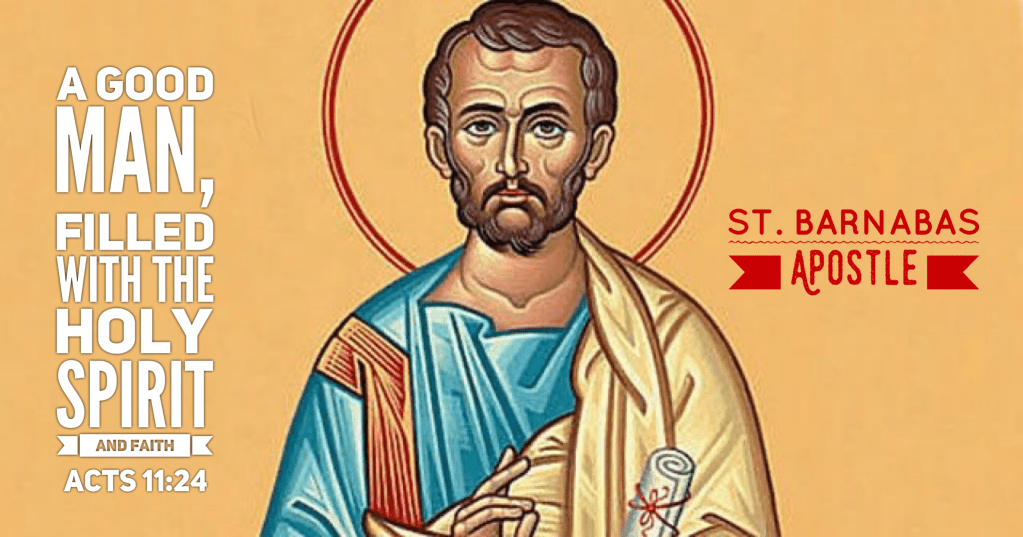
    This attitude of encouraging others had been shown to us through the person whose feast we celebrate today. St. Barnabas, an apostle, was a man of encouragement. During his lifetime, in his ministry, he never forgot to encourage people around him. In fact, it was through his encouragements, together with St. Paul, that they helped and nurtured the early Church to grow and to mature. It was in the Church of Antioch, through Barnabas too, that the Church realized that indeed, it is Catholic or universal in its nature. In Antioch, Jews and Gentiles lived together. Despite the differences in culture, language, and history, the Church became one in faith but so dynamic and vibrant in living together as Christians. 

    It was in Antioch also, that we, believers of Jesus, were first known as “Christians.” Thanks to that attitude of Barnabas because his encouragements to the first Christians made them confident in living together and become reconciled with one another. In fact, the name Barnabas means, “the son of encouragement.”

    The Acts of the Apostles reminds us of the attitude of Barnabas that he was “a good man, filled with the Holy Spirit and faith (Acts 11:24).” This tells us that when we welcome and allow the Holy Spirit to satisfy us, then, we also become discerning on how the Holy Spirit works in the life of those people around us. Certainly, we become familiar to the movements of the Spirit and become welcoming to God’s invitations for us.

    This calls us now to become welcoming of others. We shall surely see more opportunities of growth and rooms for developments for ourselves and for those people around us. Accordingly, we see more value in expressing encouragement rather than in blurting out destructive criticisms that may only damage one’s self-confidence and the hope to redeem oneself after a failure. We also see more value in expressing encouragement rather than in making threats that would incite violence and indifference toward others.

    Thus, on this feast of Barnabas, each of us is being reminded and called to be more welcoming of the Holy Spirit in our life so that our hearts and minds will be filled with wisdom, understanding and compassion particularly in these trying times where this pandemic has caused so much stress and anxiety in our life. 

    We may  become then, persons of encouragements that promote growth, confidence, trust and hope in our own context; whether at home, at work, or wherever we are called to be. Hinaut pa.

    Jom Baring, CSsR

  • WHICH VALUE SYSTEM DO WE FOLLOW?

    WHICH VALUE SYSTEM DO WE FOLLOW?

    Advertisements

    June 8, 2020 – Monday of the 10th Week in Ordinary Time

    Click here for the readings (http://www.usccb.org/bible/readings/060820.cfm)

    (This article is not a usual weekday homily as one may find this too long. This was first used as a recollection material given to a group Redemptorist Seminarians.)

    As we live our Christian vocation and commit ourselves to Jesus, the Redeemer, we encounter both joys and sorrows in our life. We also encounter temptations and challenges as disciples of Jesus. The world that we live in, the environment that we are situated with both provides challenges and opportunities for growth in our commitment to God and to our Christian Faith. 

    It would be very good then to make ourselves aware of the dynamics present in our world and in particular, in our small environment. It would be advantage to examine and be made aware of the “value systems of the modern world” that offers easy and comfortable alternative for us in living our Religious and missionary vocation and Christian Vocation in general.

    But then, we should also ask honestly ourselves, will these value systems bring me closer to myself, to my neighbors and to God? Or will they only lead me farther?

    These are the Value Systems of the Modern World.

    1. Happy are the rich and powerful, those who possess plenty because they can have whatever they want and do things instantly.
    2. Happy are the popular and pompous because they all have the praises and attention of everyone now.
    3. Happy are those who do not care of other people’s suffering for they will not be affected by such trouble.
    4. Happy are those who only stay in their own comfort zones and do not dare to give them up for they feel secured there.
    5. Happy are the aggressive; for they will get anything they want, no matter what.
    6. Happy are the proud and the arrogant because inferior people will bow on them.
    7. Happy are the bullies and haters because they will have a lot of fun over other people’s pain and weaknesses.
    8. Happy are those who do not speak up and stand up for justice, who choose not to see and hear oppression and injustice for their lives will be out of trouble and there will be no persecution from the powerful.

    These value systems are, indeed, attractive and tempting because they promise security but false security. They seemingly promise comfort and happiness for a moment but nothing for tomorrow. These values keep us away from becoming true disciples of Jesus. These are rather values of an UNBELIEVER, a secular person who rejects God’s goodness and the beauty and wonder of his/her neighbor.

    Advertisements

    Let me share with you THIS REFLECTION ON the Sermon on the Mount by Sharla Guenther

    We use the word bless a lot but perhaps we don’t know what it really means.

    If someone sneezes we usually hear someone say, “bless you!”  It is not completely clear why we say that but the word ‘bless’ is a positive word.

    Jesus had been walking with his disciples always teaching and talking with them.  More and more people would see Jesus and follow him because they could sense there was something special about him.  The way he spoke and what he spoke about captured everyone’s attention.

    This was one of those days when people had been following and Jesus decided to stop on a hillside with his disciples and taught those who wanted to listen.

    Jesus made ten points in the first part of his sermon known as the beatitudes.  All except one of these points start with the word blessed.  So we should probably figure out what the word means before we continue.

    To be blessed is to be more than happy.  

    Life does not always go our way, or the way we plan and expect it to be. Because of this, it does not make us happy. However, being blessed is being full of joy on the inside even if things are not perfect. Being blessed is to be grateful in life even if there are also things or aspect in our life that may seem to be lacking. 

    Thus, to be blessed is a deeper joy because we know, as believers, that the spirit of God lives in us.

    Now let us see each one the Beatitudes and the invitations for us.

    1. Blessed are those who are poor in spirit for theirs is the kingdom of heaven.  Being poor in spirit means that we are not attached to all the stuff that we have.  That you understand that God has given you all the great things or blessings and we should be very thankful and even willing to give them up or share them with others.  All our things on earth do not matter because we cannot take them with us to heaven, which will be more amazing than we can imagine.
      • To be poor in spirit also means to become confident in the providence of God, in his grace upon us. It invites us then to grow in that confidence but at the same time also to embrace the feeling of our insecurity. Hence, it is okay to feel inadequate, to feel our poverty, to feel our emptiness and lacking in something. Remember, it is when we are empty that God can also fill us. God will not be able to fill us up when we are already full of many things.
      • Chairman Cha in a K-Drama entitled Clean with Passion For Now, said, “To fill up, you must be empty and in order to grab, you must let go.”
    2. Blessed are those who mourn, for they shall be comforted.  Mourning is when we are really sad. Perhaps you have cried because you got hurt or someone you knew died, but this is different from that.  This is being very upset about those people who have not heard about God or being upset about the sin in our life.  We might not think about these things very much yet but as we get closer to God this will bother us and that’s okay.  God promises to comfort us when we need it.
      • To mourn and be sorrowful of our personal sins is not about ‘being guilty.’ Guilt only leads us away from the mercy of God and from the chance of renewing our life. Guilt makes us imprisoned of our own failures and sins. To mourn is to be truly sorry of our sins with the intention to be transformed by God. To mourn accepts God’s forgiveness and allowing ourselves to be led and transformed by God in the way God want’s us to be.
    3. Blessed are the meek for they shall inherit the earth.  Being meek is being patient and gentle, not easily angered and not thinking of ourselves too highly.  A bad example of this in the Bible was the Pharisees.  They would make sure people knew that they were fasting and praying and seemed proud about what they were doing for God.  Except God is looking for us to do these things without putting on a show for others but doing it just for God, not for approval from others.
      • This is an invitation for us to grow in humility, to seek God’s favor and not our own favor, to seek God’s glory and not our personal glory. Our person, our talents, intelligence and many gifts are not instruments to merely boast oneself but ways for us to recognize better our God, the giver of gifts. Thus, be mindful when we will tend to draw attention and recognition from others, when we become conscious of our self-image that we also become arrogant and worst will refuse to be corrected or criticized by our friends. 
    4. Blessed are they who hunger and thirst for righteousness: for they shall be filled.  Being righteous is impossible on our own.  Can we always do the right for God?  No, and God knows that.  We can do our best to do the right thing and if we don’t, we can always ask forgiveness and be renewed.  The verse not only asks us to try to be righteous but to hunger and thirst for it.  Have you ever been really hungry and thirsty?  To be truly hungry and thirsty you might have to go without food or water for more than a day or two. God wants us to need and feel like we’re starving for righteousness and He will fill us up with it.
      • This invites not to remain passive in our baptismal vows but to live our vows pro-actively. It means that we are called to exercise righteousness with full consciousness. Yet, let us also remember that at times we may fall asleep, but then, be always aware of your attitudes so that you will also be able to wake up again. In other words, make it your heart’s desire to live your Christian life with honesty, sincerity and gratitude.
    5. Blessed are the merciful: for they shall obtain mercy.  To have mercy is to be loving and kind to others.  This does not mean just being loving and kind to your family and friends but also to those whom you might not know and even those you don’t like. Those who are ready to forgive the offense of others, shall be forgiven. The merciful tastes the forgiveness of sins and innumerable blessings of this life.
      • This invites us to always exercise mercy as the hallmark of our Christian vocation in the way we relate with ourselves, with our family and friends and enemies. This calls us more when we are ask to show mercy to those who have offended us or who have sinned against us.
    6. Blessed are the pure in heart: for they shall see God.  Being pure is like having a clean heart.  Like the heart inside of us, it pumps blood and keeps us alive and if something is wrong with our heart, we won’t work right.  Jesus is talking about the place where we think and make decisions, why we do things, and our thoughts.  If we keep our mind, thoughts and decisions full of good, God says we’ll understand Him more as we see Him better in all things and in every people we meet. This is a call for sincerity in our words, deeds and piety.
      • This invites us now to examine our intentions and motivations. What is really in my heart now? What is it that keeps me going? Or what is it that prevents me from accepting myself fully and welcoming God in my life? Or what is it that keeps me bothering now, which disturbs me a lot? Hopefully, in treating those questions, they too will lead us in purifying our intentions so that we too shall see God clearly, ever working in our lives.
    7. Blessed are the peacemakers: for they shall be called the children of God.  The simplest way to explain this is someone who makes peace.  Helping others to get along would be a big part of it.  The second part of this beatitude says: then you will be called the children of God.  Being God’s child would mean that you truly are a part of God’s family and that you’re starting to be more like Him; just like when we are with our parents. This is an assurance that God is indeed our Father for God is a God of peace.
      • This invites us too to seek peace in our hearts and minds, peace in ourselves. If we do not have peace, then, how can we become peacemakers? What we can only give is that something we have at present. Thus, seek peace, let God give you that peace so that in return then, you too will be able to make peace with others and inspire others for peace.
    8. Blessed are they who are persecuted for righteousness’ sake: for theirs is the kingdom of heaven.  God knows that being who He wants us to be is not the way the world acts.  By doing the opposite of the world we will be made fun of or worst, because people don’t understand why we don’t do things only for ourselves.  By living a life that does things for others confuses the way the world thinks.  A lot of people in the world want beauty, money, fame and attention and don’t care about others as long as they get what they want.  This is opposite to the life God wants us to lead.  Doing the right thing isn’t easy but God wants us to know that the kingdom of heaven is waiting for us if we can get through the tough times in this life.
      • It invites us now to always seek God’s desire for us, God’s desire for me. God’s desire may not be popular. God’s desire for us may be different from what others desire for us or from our own desire. Always seek that and be ready to let go of other desires because it is in following God’s desire that we shall also find the fulfillment. But remember this, in seeking and following God’s desire, others may not like it or we may not like it too, we might be facing oppositions from our friends and family and even our very selves. 

    God calls us to be different than the rest of the world.

    The beatitudes end by saying that we should rejoice and be glad because by following these we will receive great treasures in heaven.

    God promises that we will be blessed when we follow these teachings but it won’t be easy.  We all are still figuring out how to do these things, but don’t be discouraged.  God calls us to be different than the rest of the world.

    Keep in mind that the beatitudes are impossible to do without God’s help.  He wants to help us and to become a big part of decisions you make and in all that you do. Give to God, then, that opportunity to work in you and through you.

    Advertisements

    Remember, Jesus didn’t give us these beatitudes and then wants us to fail.  He wants to give us something to aim for.  He wants us to do our best and give us a life full of blessings not just for tomorrow in heaven but even today.

    For a deeper reflection, let this contemporary interpretation on the Beatitudes challenge and lead us closer to the Lord.

    Jesus’ Beatitudes Today

    1. Blessed are you who recognize your need of God because you will give yourself to the providence of God’s love to direct your life.
    2. Blessed are you who feels sorrow for your sins against God and your brothers and sisters and to repent, because you will find true comfort from God’s loving forgiveness.
    3. Blessed are you who choose not to live by your selfish tendencies but will give yourself to God because you will find and have the important things in your life.
    4. Blessed are you when you truly desire to please God and not others or yourself alone because that deepest desire of yours will be fulfilled.
    5. Blessed are you who love, care, serve others, heal the wounded and comfort the sorrowful because you too will surely be shown mercy.
    6. Blessed are you as you dedicate your life sincerely in doing the will of God because in that pursuit you will have a deeper understanding of being God’s beloved.
    7. Blessed are you who strive to promote peace and reconciliation because you yourself will become a witness and instrument of God.
    8. Blessed are you when you stand for what is right, just and true even in the midst of accusations, insults and persecutions because you will have an everlasting joy with God.

    Jom Baring, CSsR

  • Relationship Status Update…

    Relationship Status Update…

    Advertisements

    June 7, 2020 – Solemnity of the Most Holy Trinity

    Click here for the readings (http://www.usccb.org/bible/readings/060720.cfm)

    What is your relationship status? The state of your relationships – your being with others? 

    Social media netizens nowadays have the option to post in public their own relationship status in their profile. This is more than just about their usual civil status of being single, married or separated, but more so about the description of the present state and quality of their relationship with an-other special person: be it in-love, complicated, available, committed and others. (perhaps same way as MU: mutual understanding and SS/DU: Sikit-Sikit/Dili Uyab, as we used to describe before).

    As others may concern about their relationship status, we might as well consider our relationship status at the time of social distancing in today’s pandemic world. Quarantine and social distancing have rendered us nowadays isolated and distance from others and with one another. And surely this has affected the quality of our relationships with others: be it too/less close or far; too/less deep or hollow, too/less presence or absence. Social distancing during pandemic has deeply and uniquely affected our social relationships. While it may have shaken and threatened our family, community and love life to possible break-up, dryness and dying, we could not deny also that our distance from and/or being “stuck” at-home with them may have also re-ignited, rekindled, renewed, and deepen our relationships with another. So also as we consider our relationship status during these times, healthy for us to consider our faith status – our relationship with our God: on how social distancing have affected the state and quality of our relationship with God.

    Today, first Sunday after Easter Season, is Solemnity of Most Holy Trinity or simply called Trinity Sunday. More than just a reminder of our Christian faith in the Triune (the three in one) nature of our God, our celebration today invites us to reconsider our relationship status with God. 

    In our gospel, (as the key text and core message of St. John’s gospel), Jesus gives us the description of the status and quality of God’s  relationship status with us. God is so in-love with us that He gives us His Son to believe and follow, for us not to be condemned in life but to have eternal life with Him. With these words, we can highlight here two points to describe the quality of God’s relationship status with us: God is in covenant with us and God is in collaboration with us

    The word covenant roughly  means “coming together”. To describe God’s relationship status with us as “in-covenant” would mean that God “comes together” with us – God is one, in community, in loving marital relationship with us, because He is so in love with us. Moreover, the word collaboration would also roughly mean “working together”.

    To describe then His relationship with us as “in-collaboration” would mean that God “works together” with us – God is in sync, tandem, partnership with us  by offering us to adopt and be co-responsible for His Son in our life and faith. By His Love for us, God is in relationship with us, and by giving us His Son, God is responsible for us and with us. This is how blessed we are and should be, for God is in covenant relationship and in collaborative commitment with us. 

    Now, what is and should be our relationship status with God? 

    Moses wished that though we may stiff-necked and wicked, God may “come along in our company” and “receive us as (His) own”. Paul prays that “the grace of the Lord Jesus Christ, and the love of God, and the fellowship of the Holy Spirit, BE with all of Us.” It is thus the hope and prayer of the forefathers of our faith, and still now, that we also may be “in covenant” and “in collaboration” with God – that our faith, our relationship status with God is in sync also with God’s status with us – however righteous, limited or stubborn we might be.

    Advertisements

    A wise man once said, “Each one of us are but angels with one wing. We can only fly by embracing one another.” True enough, this saying not only affirms our limited human nature of being one-winged, but more so highlights our spiritual nature of being angels. Our present life then is and should be in relation, in sync & in tandem with God and one another, so that we can sore and rise above to the occasion of living our lives to its fullness as we journey back to our heavenly home, and share in God’s offer of eternal life with Christ. 

    Ironically to protect and keep us safe, our pandemic world rendered us now limited, restricted, set apart and distanced from one another. However, our natural longing to be social – to be one and together with one another and God offers us breath, life, hope and support in the during these trying and difficult times. And putting value anew, upgrading and working out to improve the quality of our relationships status (our being with God and others) could somehow alleviate and bring more purpose and meaning to our present predicament.Though limited angels with one wing may be and due to pandemic realities now set apart from one another, may we always keep the faith, and come and work in one – together with our Triune God, as He is forever in covenant and collaboration with us. Amen. 

    (By: Fr. Aphelie Mario Masangcay CSsR, a Filipino Redemptorist  Missionary stationed in Gwangju South Korea, though now still stranded in Cebu until further notice for available flights.)

  • The Word of God nourishes and challenges us at the same time

    The Word of God nourishes and challenges us at the same time

    Advertisements

    June 5, 2020 – Friday 9th Week in Ordinary Time; Memorial of St. Boniface

    Click here for the readings (http://www.usccb.org/bible/readings/060520.cfm)

    The Holy Scriptures or the Bible is of great importance and gift to our Christian faith. The Second Letter of Paul to Timothy tells us that the scriptures will give us wisdom that leads to salvation, through faith is Christ Jesus. This means that by knowing and developing a relationship with Jesus brings us to freedom being experienced as individuals and as a community, as a church.

    Paul reminds us too that “all scripture is inspired by God.” As this is inspired by God, the Bible teaches us how God reveals the Divine Plan of Salvation. Hence, God in his great love for us has become man like us to feel what we feel, that God may be in solidarity with us.

    Moreover, the scriptures also refute error and corrects us. It means that the bible is not merely a passive literary work of some people, but it confronts us of what is wrong with us, of what is unjust and oppressive, of what is sinful. The scriptures then, bring us to be closer to God’s presence and to understand better the wisdom of God working in our life.

    Consequently, the scriptures serve as our guide to follow closely the Lord in our life. This is what Paul shared with Timothy. Following the Lord gives us peace and confidence in what we do yet this will also bring us challenges and difficulties as Paul experienced persecution from people who rejected Jesus.

    Paul was inspired by the Lord and committed his life to God. This was how Paul’s heart was captured by God. Paul’s heart gladdened at the revelation of Jesus to him which made Paul to be converted. This is what we have heard from the Gospel today, “many people came to Jesus and listened to him gladly.”

    That gladness came from that revelation of God, of God speaking to us. As Jesus spoke to Paul, Paul could not keep silent then. This was how Paul turned from being a brutal persecutor to a life-giving apostle of the Lord.

    Today, the Lord invites us that as we celebrate the Liturgy of the Word, let us also listen gladly to the Lord.

    Thus, let us allow the Lord to speak to us, to nourish us and at the same time to teach, correct and challenge us. Let the Lord confront us of our passivity and indifference towards others, of our sin and guilt, to confront us when we only settle to what is only comfortable and beneficial for us and to confront our hearts and conscience when we choose to keep our eyes blind from an unjust system.

    In this way, we may become Christians who like St Paul and St Boniface who were martyred because of what they preached, to also become a light and inspiration in this time of pandemic where our religious freedom is also being tested. Hinaut pa.         

    Jom Baring, CSsR