Tag: A Dose of God Today

  • “What are your plans? What’s next?”

    “What are your plans? What’s next?”

    June 21, 2020 – 12th Sunday in Ordinary Time

    Click here for the readings (http://www.usccb.org/bible/readings/062120.cfm)

    “What are your plans? What’s next?”

    Perhaps nowadays we find ourselves confronted quite frequently with these questions about our near future, as raised to us by others and/or even we ask personally ourselves. However, unlike before when it was easy to see opportunities ahead, today’s quarantined and lockdown world during pandemic times renders our foreseeable future bleak and unpredictable. Wherever, whatever, whenever and however we find ourselves now, to plan ahead for what we want to happen next is quite difficult and challenging. This is not only because possible opportunities for our future can be impossible to discern and predict, but also the normal lives we used to live with have to adjust and adapt to the new and unfamiliar realities of the pandemic world and times we now live in. Whether we like it or not, our life is changing. Our world is changing, We are changing. Challenging it is to deal with and manage our present realities, how much more difficult than it is to foresee and make  plans for the near future.

    And it is and would be difficult and challenging for everybody. Making plans would surely be difficult for people who know what they want, for they also see how limited and constricted they can now be, considering available resources, mobility, programs, systems and schedules. It would also be much challenging for people who does not know readily what they want because they have to tend first to the immediate needs of others. We think here of people who are in helping professions, those who are in the frontlines of public services, medical-mental-spiritual health, education, and above all our parents who have to postpone, numb and even forego their own personal plans just to accommodate and address other people’s needs while also worrying about available resources and possibilities. We could understand then that raising the question now about future plans can be difficult and challenging, if not, already distressing and depressing. How game-changing indeed our world  now we live in.
    Somehow however, we may also wander what would Jesus say about our plans. What would Jesus say about our difficult and challenging realities now and ahead?

    Like a teacher giving pointers to students before an exam or a coach giving advices to players during the game, we hear Jesus in our gospel today telling His disciples and us now words like: “Fear no one… do not be afraid… worry not… you are worthy… acknowledge me… have faith.” As we struggle with our present life and worry about our future, Jesus is saying us here words of assurance, encouragement, affirmation, faith and confidence on us, as His on-going guidance and directives for us. Moreover, Jeremiah & our Psalm today also reminded us how God protects and answers those who remain faithful and loyal to Him in the midst of life-adversities, same way as Paul wants us to recognize the promise of God’s grace and Christ’s gift that “overflow for the many”. What is very important here is that God has a plan in Jesus; and we are to acknowledge, believe and trust in it. Somehow in our game of life – stable or changing it might be, we need to believe and trust that “God got our backs for He has a plan for us”.

    Advertisements

    It is once said: “When we get what we want, that is God’s Direction. When we don’t get what we want, that is God’s Protection.” True indeed, when our wants and plans are in sync with God’s plan, we are being directed on the right track.  But when our plans and wants are not in sync with God’s plan, we are being protected for we are off the tracks. This is not about us  surrendering to fate or have an irresponsible “do or die, que sera sera” attitude towards life, but is all about doing our part, involving with and being responsible not only for our own actions and plans but moreso, in God’s grand plans and ways of being in life. Not getting what we want while also not knowing and unsure of what our next plans then is perhaps God’s way of protecting us from possible failure and death, and His constant invitation to believe in Him and trust in His plans for us.

    So, what’s the next plan?

    Since God got and has a plan for us in Christ, we abide and trust in His plans, His directions, and His protection…. That’s the Plan. In other words, Be part of God’s plan.

    And may this be our prayer to Him: “As we abide in Your plans during these trying times, Thanks you, Lord for protecting us from what we thought we wanted, and for blessing us with what we don’t know we needed.” Siya nawa. Hinaut pa unta. Kabay pa. Amen.

    (By: Fr. Aphelie Mario Masangcay CSsR, a Filipino Redemptorist  Missionary stationed in Gwangju South Korea, though now still stranded in Cebu until further notice for available flights.)
  • Keeping God in our Heart

    Keeping God in our Heart

    Advertisements

    June 20, 2020 – Saturday, Immaculate Heart of the Blessed Virgin Mary

    Click here for the readings (http://www.usccb.org/bible/readings/060820.cfm)

    What is it that you consider as the dearest for you? Or who is it that you consider as the closest to your heart?

    Yesterday, we celebrate the Solemnity of the Sacred Heart of Jesus and today, the feast of the Immaculate Heart of Mary, his mother. The Sacred Heart of Jesus reminds us that God is indeed loving and forging, compassionate and merciful. And in that heart, we are the closest to God. We are God’s dearest people.

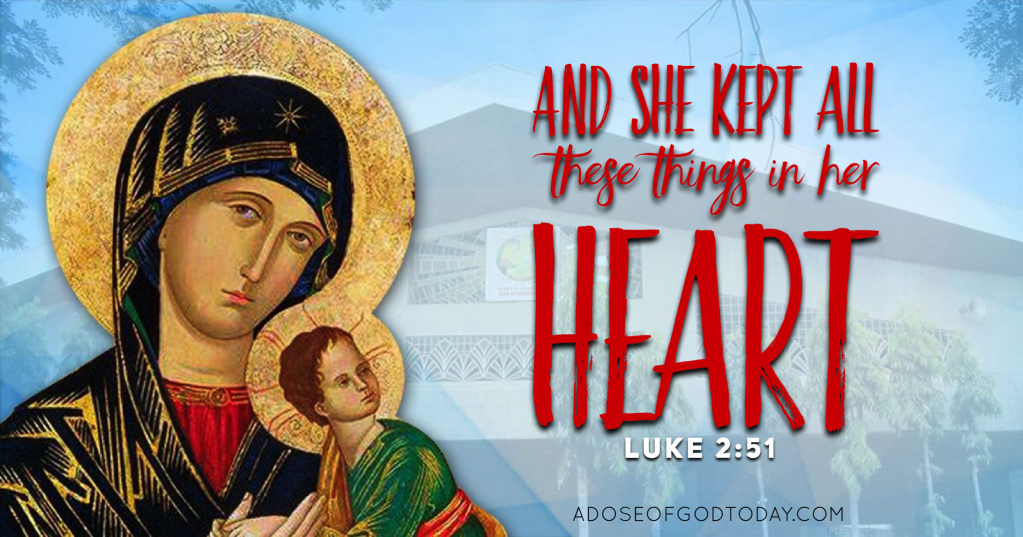
    In this feast, the Gospel of Luke tells us who is the dearest and closest in the heart of Mary. This is where we could also find the strength of Mary. Just look at the image of Our Mother of Perpetual Help. Her son Jesus carried by her left arm also rests on her chest where her heart is.

    Mary had been confused and afraid at the annunciation of the Angel. At that moment she too must have felt overwhelmed at God’s unfolding in her life. The events surrounding the birth of her son must have made her more confused at the amazement and joy she experienced. There were many events there that must be beyond her expectation.

    In today’s Gospel, we were told how the young boy Jesus spent his days in the temple sitting among the teachers. But the words of the young boy Jesus, “Why were you looking for me? Did you not know that I must be in my Father’s house?” has left Mary and Joseph baffled. They must have felt the pain of the seemingly indifferent words of Jesus after their days of anxious finding of him. Those words were difficult to understand at that time.

    However, just like at the annunciation, at the visitation of the Shepherds in the manger and now here, she kept all these things in her heart.

    With all the complexities, strangeness and difficulty to understand the situation, Mary has kept the Lord close to her heart. She kept all those revelations from the Lord close to her heart that she may be able to understand them in the way God desires them to be understood.

    This was how Mary would always find wisdom and strength because with the many events that happened in her life, she might not be able to bear them all. Mary will surely remained confused, afraid and unable to decide and do anything if she chose to distance herself from the Lord by reacting out of impulse or mere emotions.

    Keeping all those things in her heart” really means that she tried to understand how God was uncovering and revealing to her the plan of salvation. Mary realized that God reveals Himself every day. Mary did not want to miss all of them. Consequently, she sought the best way of understanding them by not reacting to every event through mere emotion or just out of compulsion.

    Hence, Mary did not react out of anger or even disappointment in front of the young Jesus. Though she did not understand his words, but she must have felt that there was something deeper in there. God must be behind it. Thus, in her confusion, she kept all those things in her heart, to ponder them, to seek wisdom and understanding in the way God wants her to understand them.

    But most of all, Mary was able to do that because within her heart, God is there already. She has welcomed the Lord and allowed the Lord to be always in her heart. This led her into that kind of understanding from God’s perspective and so she responded to every invitation of God for her, willingly and lovingly.

    This is how we find Mary’s presence captivating in our Christian faith because her very life is an example of a perfect communion with God. This how we also find comfort in her, as a mother, because her human heart is touched by God’s heart.

    Advertisements

    Today’s feast, God’s invitation for us also is to grow in that area, that like Mary, our heart too will be more welcoming to the Lord and to allow the Lord to be in our heart. This is an invitation to make God as the closest and dearest in our heart. It is in this way that we shall also find understating, wisdom and strength in the many infoldings of events that happen to us everyday.

    In particular, these days of the pandemic has made us feel uncertain of the coming days and anxious of the present. Many of us felt insecure materially, emotionally and perhaps also spiritually by now. However, do not waiver, do not remain stunned by these difficult days, remain vigilant instead by pondering and keeping all the things in our hearts.

    May I invite you then, as we find our ways on how to live and adjust ourselves with the “New Normal” set aside a time to ponder, to listen deeper and carefully to the many events and circumstances happening in our life now. As we allow God to be closer to our heart and seek the Divine wisdom, we may also become more welcoming of the presence of others, more connected with people around us as Mary is to us. Hinaut pa.

    Jomil Baring, CSsR

  • How do I pray?

    How do I pray?

    June 18, 2020 – Thursday 11th Week in OT – First day of Novena

    Click here for the readings (http://www.usccb.org/bible/readings/061820.cfm)

    How do I pray? What are those that I usually ask from the Lord?

    Others usually pray spontaneously asking what they want and desire for themselves and for their loved ones. Others also are more comfortable of using the memorized prayers as forms of meditation and deeper reflection of the mystery of God. We usually ask many things from the Lord. Others would even have a litany of requests and petitions. And as a form of asking God’s favor others would even observe number of days of prayer, like observing 9 days novena, or the 9 days Misa de Gallo during December, believing that God would grant ones desires and prayers.

    Well, today we are starting the first day of our novena in preparation for the feast of our mother. I am sure all of us, devotees of our mother have countless petitions these days especially as we are now experiencing a very difficult time. People get sick of corona virus that has no vaccine yet. As a result, our movement has been limited to stay at home. People are having so much difficulty with the status of their jobs and businesses. Others get paranoid of getting sick and some have become anxious of what lies ahead and on what the coming months are offering us. We might have friends and family members too who have become desperate while waiting for their turn to come home as thousands of OFWs and migrant workers were left at the mercy of their Local Government. Thus, the environment itself that we have now has become gloomy and stressful.

    Our theme for today’s novena really speaks of this recent experiences we have now, “OMPH: Source of Help for Families Fragmented for Various Reasons.” Even before this lockdowns and quarantines, we come and ask the help of Mary for our families suffering and being tried from various reasons. Hence, our own family might be wounded by broken relationships, by unfaithfulness and betrayal, poverty, sickness and death. Moreover, covid-19 joined and added to these current concerns we have and has made more difficulties in our families.

    Advertisements

    Thus, we, as devotees would always find comfort and recourse to Mary, Our Mother of Perpetual Help. I have witnessed it myself recently also. The gate of our parish is left open at some certain time of the day to welcome people to pray in the Church. One afternoon as I was walking in the Church grounds, a woman caught my attention as she prayed before the Icon of Our Mother displayed at the entrance. She stayed there gazing at the icon long enough for me to notice her. Perhaps, she too has been carrying so many burdens and has ran to Mary to ask for help. For many of us, that has been our experience too.

    As many concerns are brought into our prayers it would be good also to take a look in the way we do our prayer, of the intentions we make in our prayer and of the consciousness that we have in our prayer. This is something very important too because this will help us to evaluate our personal relationship with God and with others.

    Now, in today’s Gospel Jesus reminds his disciples of the importance of prayer and also of the importance of the kind of consciousness in their prayer.

    Jesus mentions about the way the pagans pray. These pagans love to use many words in their prayers because they believed that it was in that way that they would be able to get the attention of their gods and goddesses. They believed that these gods and goddesses were unforgiving, impulsive and frightening. These pagans babbled in their prayers in order to get the favor from these difficult and terrifying deities.

    However, Jesus reminds his disciples that our God is not like that. God is not vengeful, not inconsistent or terrifying but rather God is loving and forgiving. Hence, to use many words would not be necessary because God knows the desires of our heart.

    Moreover, as Jesus reminds his disciples, he also tells us now that our prayers are not meant to appease an angry and hateful god or to gain favor from a terrifying God. This also means that the content of our prayers should not be self-centered. To pray is not just to ask something for ourselves but also for others. That is why Jesus taught us his own prayer.

    This prayer starts with these two words, OUR FATHER. It did not say My Father and not even Their Father. This tells us that when we pray we always remember others. We are always together as people. Our relationship with God though can be personal but it is also founded in our community. That is why it starts with “OUR” because this includes you and me and everyone else.

    This prayer (Our Father/Lord’s Prayer) tells us that God is a Father. This means that God relates to us personally. God is not somewhere out there who is so far away from us but God is here with us. This means also that we are invited to seek God’s will and God’s desire not just our desire. Most of the time, when we pray we only think of what we want and desire but we forget to ask, what is it that you desire for me Lord?

    It invites us also to become dependent to God because God is generous and faithful to us. To pray, give us this day our daily bread, means to be more focused of today, this day not tomorrow because tomorrow has not yet come. Indeed, we can be too anxious of what will happen tomorrow that it will prevent us to see what is more important today. Thus, Jesus invites us to be more contented of today and to ask sustenance enough for today also.

    Notice also that in this prayer, it recognizes our sinfulness and need to be forgiven. It is necessary that we become humble and ask God’s mercy because this is the way that we make ourselves open to God’s grace. When we remain arrogant and unrepentant of our sins, then we prevent God to transform us and prevent others to come into our life.

    Advertisements

    And finally, we make ourselves aware that there is also the presence of the evil one around us. The evil one constantly tempts us to move away from God and to cut our relationship from the Lord. The evil will always try to allure us to think that it is better not to pray and that we do not need God. The evil will seduce us to think that we can do everything in our power without the help of God and that we do no need to think of others but ourselves alone.

    In this seemingly hopeless situations, the evil one may tempt us also to believe that we are beyond hope, beyond salvation and beyond the grace of God. Thus, the evil one may bring us into a hopeless scenario to bury ourselves into self-doubt and guilt, into depression and death. Be careful then of these temptations.

    So hopefully, being made aware of the consciousness behind the Lord’s Prayer, we too shall grow in our relationship with God and with one another, that we may become less self-centered and self-serving but to become self-sacrificing and life-giving as God desires us to be.

    May our devotion then to Mary, Our Mother of Perpetual Help, bring us closer to the real source of our hope and help, to Jesus. Hinaut pa.

    Jom Baring, CSsR

  • Looking At Ourselves Closer for the Father Sees

    Looking At Ourselves Closer for the Father Sees

    Advertisements

    June 17, 2020 – Wednesday of the 11th Week in Ordinary Time

    Click here for the readings (http://www.usccb.org/bible/readings/061720.cfm)

    Jesus warns us about our narcissistic tendencies. We might not be aware of our tendency to draw other people’s attention to us. Indeed, there is a need for us to purify our every motivation and action so that we will live free and become true Christians.

    Jesus takes this seriously as he reminded his disciples in today’s Gospel. To follow Christ is not to seek the attention of others, or to seek praise and approval of those people around. A disciple of the Lord does not need to put up a billboard and announce to the people what he/she has done and accomplished.

    The Lord is more concerned with our heart so that we don’t have to pretend to be someone else we are not. This happened with those who were called hypocrites in the synagogues that Jesus was talking about. These people pretended to be the best person in their community. They proclaimed and told people how good they were. They did all these to seek recognition from the people. Indeed, they craved for people’s attention and approval because they too were hungry for power and control.

    People who constantly seek the attention of others and their recognition ultimately manipulate others so that they will be in control and will become powerful. Yet, it is also a revelation how these people are so insecure of what they have and of what they don’t have.

    As people who seek God, we are rather called to be more confident with Him, and with our relationship with God. Our generous actions, good deeds, our prayer and religious practices must flow from that relationship. Deepening one’s relationship with God should be our primary motivation and not in boasting oneself.

    This relationship with God should also lead us to recognize God’s generosity and faithfulness in us despite our failures and sins. This will hopefully inspire us to respond with gratitude to God. To become a grateful person certainly makes us a generous person both in our words and actions. This will make us true to ourselves, closer to people around us and to God.

    Remember, God sees us. God is very aware of what we do. God is not blind. The Gospel today reminds us of this that God sees us in secret and repays us with His faithfulness. Though God does not do policing but God watches us only with delight. Therefore, as God sees us, we may truly be a delight in God’s eyes through our generous actions and words.

    With this, Jesus invites us today to look closely at our behaviors and attitudes, practices and devotions if these are helping us to be closer and to be more like Jesus or if these are moving us away from God and from others.

    Advertisements

    To remind ourselves about this, let us ask ourselves with these questions, “Who is being honored and served by my good deeds, generous actions and religious devotions? Is it myself or is it God? Do they lead me closer to God and others or do they rather make me more indifferent towards God and others?

    In our hope to grow daily in our consciousness of God’s presence in our life in these difficult times, we may always seek the Lord and find strength and confidence in Him. May our actions and words become expressions of our gratitude to God who has never ever left us for God finds delight in us. Hinaut pa.

    Jom Baring, CSsR

  • To offer no resistance to one who is evil?

    To offer no resistance to one who is evil?

    Advertisements

    June 15, 2020 – Monday of the 11th Week in Ordinary Time

    Click here for the readings (http://www.usccb.org/bible/readings/061520.cfm)

    Violent, cruel, brutal and merciless are some of the words we could describe on what happened with Naboth the Jezreelite. A man who refused to give up his ancestral heritage was falsely accused, treated with so much brutality, viciously framed for a crime he did not commit and murdered in daylight by the minions of Jezebel.

    No one stood for Naboth. Nobody dared to speak on his behalf. The minions just followed the order from above perhaps they too were more excited of what they can gain from participating in such crime.

    Ahab, on the other hand though did not commit the crime directly but played passively. He was passive because he did not want to be involved himself. Yet, he did not also choose to stop Jezebel because he knew he would be able to benefit from such corrupt and murderous act of her wife.

    This tells us really that no matter how much possessions we may have or no matter how secured we can be materially, or no matter how much power and influence we may possess, it does not mean that we will be satisfied. This has been shown already by Ahab even before the murder. Ahab was disturbed and angry because he did not get what he wanted though he did not need it. Thus, in that greed of Ahab through the cunning and vicious plans and actions of Jezebel, the little possession of Naboth was taken away from him including his life.

    Is God then, blind to this kind of crime committed against the weak and powerless? Our Psalm proclaims to us today the prayer of a man like Naboth, Lord, listen to my groaning.” This is an appeal to the Lord to listen to that groan filled with pain. It is a cry for help from a person who find life too much to bear because of the exploitation and abuse from others.

    The author of the Psalm also recognized that indeed, the Lord is not blind or deaf to that painful groan for the Lord abhors the bloodthirsty and the deceitful. This is the very image that Jezebel gained after that murderous act, bloodthirsty and deceitful.

    However, what is more puzzling in today’s God’s invitation for us is what Jesus tells us in the Gospel,offer no resistance to one who is evil.”

    Does it mean that we become passive to the abuses committed against us, against the weak and the powerless? In the case of Naboth, it was perhaps even impossible to resist because the evil scheme against him was just too overwhelming. He was alone.

    However, to offer no resistance to one who is evil has a deeper meaning. Not to resist to one who is evil, is not allowing evil to control us. Meaning, once we resist to one who is evil, this may bring us into the same position of the one who is evil. We shall tend to resort to the same violence, then. Hence, responding evil with evil or responding to violence with violence will only bring us into an endless cycle of evil and violence.

    Hence, responding evil with evil or responding to violence with violence will only bring us into an endless cycle of evil and violence.

    The wisdom of Jesus lies in the offer of peace. To offer the other cheek when someone strikes us on the right cheek, though this sounds ridiculous for many of us, is an opportunity for the one who hurt us to embrace peace and reconciliation. Peace and reconciliation is truly a difficult path. A very unpopular one. However, this is the only way to end the cycle violence and evil.

    Advertisements

    Moreover, this is not an excuse to just remain passive to the abuses and other forms of oppression. It does not mean that when your spouse physically abuse you, or a family member is sexually abusing you, or a friend or colleague is exploiting your goodness and generosity, that you remain passive and indifferent. The teaching of Jesus is meant to keep violence at the minimum and not to escalate more violence towards others and ourselves. In such situations, we are called to get out from the abusive relationship and to demand justice and show mercy.

    To demand justice then is to make the perpetrator take the responsibility and consequences. To show mercy is to get rid of hatred and anger within our hearts for us to live free by offering peace and reconciliation towards those who have wronged us.

    Therefore, God invites us today to live freely by not allowing evil to control us or to have an access to our hearts by holding on to grudges, hatred, anger and selfishness. God calls us to be more satisfied with what we have and to be grateful of the blessing God gave to us so that unlike Ahab, our hearts won’t grow ungrateful and corrupt. God calls us too that in the event when an evil act is committed against us, do not give a chance to evil to have a control over us by resorting to evil also. Jesus calls us to offer peace, not violence, not anger, not hatred, but also not for a passive peace or an indifferent one. Offer peace that gives and promotes life. Hinaut pa.

    Jom Baring, CSsR