In the popular Netflix Series, The Sandman, an episode portrays how the Lord of Endless Dreams (Morpheus) went to Hell to retrieve his tools. In Hell, Morpheus faced Lucifer in the duel through the “Oldest Game” where each one has a turn to use a concept from their imagination to defeat the other. As each one used a concept, Lucifer at the end, used Anti-Life. In this, Morpheus was down and weak. He was asked by Lucifer, “What can survive the anti-life?” Yet, slowly, Morpheus tried to speak, until he was able to utter, “I AM HOPE.” With hope, Lucifer was defeated for nothing kills hope.
On this Easter Sunday of the Resurrection of Jesus, we are reminded of HOPE. However, we as Christians now, do we really believe in the resurrection?
Well, on that Sunday morning, as the Gospel of John told us, when the women wanted to visit the tomb of the dead Jesus, his body was nowhere to be found. They believed that the body was stolen. However, the other disciples whom Jesus loved, when he saw the cloth that covered the head of Jesus was rolled up in a separate place, HE SAW AND BELIEVED! The Lord indeed, rose from the dead!
Jesus’ resurrection sums up everything in the Sacred Scriptures. The resurrection of Jesus is the very essence why the Church continues to live until today. If not because of the resurrection, there is nothing to believe, nothing to hope for. Hence, the resurrection of Jesus is the “DEFIANT HOPE, a hope, hoping against hope.”
With all those suffering and gruesome death of Jesus, the disciples ran away, hid and believed that that was the end, and there was nothing more. However, the Lord is more powerful than death, more powerful than our frustration and disappointments, or of our failures, more powerful than human sin, more powerful than human violence and greed.
God’s commitment to us and his love for you and me is so great that it makes the dead back to life, to the glory of resurrection, to new life, to a blessed and joyful life.
Thus, friends, remember too, if you find yourself at the brink of giving up, or at the edge of losing your desire to live and to dream, or when you are at the end of hopelessness and despair, God will never let go of us. God will never surrender on us. Remember that! Believe in that!
Jesus went through all those suffering and even the loneliness on the cross, because Jesus believed that there is more in you and in me, in each of us, and that there is more in our broken and wounded world caused by human sin of greed and indifference. We may also consider ourselves as terrible sinners, or others may condemn and think that we are hopeless and worthless, but the Lord will always see hope in us. God sees a joyful and blessed life in each of us, in all of us, as a community.
Thus, the power of the resurrection tells us now of the Church’s mission and commitment to life and to freedom. The Church, and that is US, is a believing community who is being moved, touched and taught by the Lord.
As the Lord dwells in each of us and in our community, we are now called to become EASTER PEOPLE or PEOPLE OF THE RESURRECTION. This means that what we preach and what we live is the joy and hope that the resurrection brings. But, remember too, that to be become a people of the resurrection, we also become a contradiction to those who want to act like God and become like God and those who are anti-life, like Lucifer. Just as Jesus was a threat to them, we too shall be. Yet, the glory of the resurrection will bring us into hope and joy which can be experienced not just after our death but can be tasted, felt and lived even today.
How would that be possible? By becoming the presence of Jesus today to people around us through our very life that gives and expresses hope for others. Kabay pa.
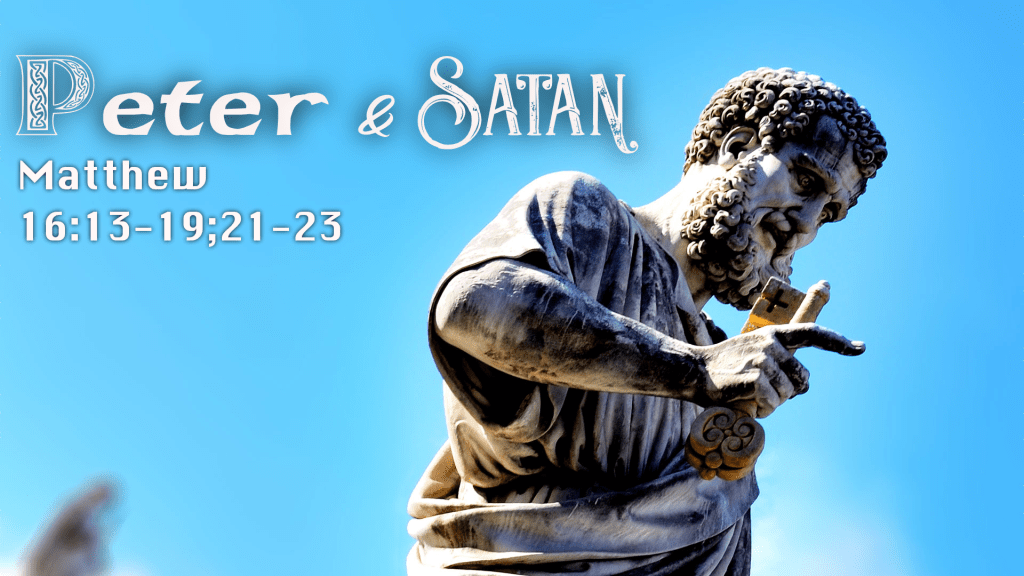
Peter was a man who have many inconsistencies. If you remember, it was him who first realized that Jesus was the Messiah, the Son of the Living God. Because of the close friendship with Jesus, Peter knew in his heart that this man Jesus is someone bigger. Yet, it was Peter also who was scolded by Jesus and was told, “Get behind me Satan!”
After confessing that Jesus is Lord and the Messiah, Peter also wanted to prevent Jesus from doing the will of the Father by not undergoing pain and suffering. Peter wanted Jesus to escape from pain and suffering. This was how he was named Satan at that time because Satan will always tempt us to take a short-cut, to prevent us to go through pain and suffering. Yet, at the end, Satan will only bring us to destruction and death.
With this particular attitude of Peter, let me ask these questions to you.
Who wants a life without suffering, without sacrifices and difficulties? That would be nice, right?
We dream of a life that knows only comfort, that is easy, and that we’ll always feel good. Today, we are actually being offered with different ways to make our life comfortable, fast, easy and smooth.
There is actually nothing wrong of dreaming a life filled with comfort and without sacrifices and difficulties, to always feel blessed and good. This is a desire from us to feel secured. Nevertheless, the danger lies within the heart that denies sacrifice and suffering as part of our life, and as part of our Christian way of living.
I remember a story being told to me when I was in college. There was a boy who went out into their garden and found a cocoon. It was so timely that he saw how the cocoon moved. The butterfly was about to come out from its cocoon. However, the butterfly was struggling. The boy felt pity for the butterfly. And so, the boy immediately, ran back to his room, got a pair of scissors. He wanted to help the butterfly and so, with scissors in his hand, he cut the cocoon carefully in order not to wound the butterfly. He was so successful that the butterfly was in her perfect shape and out of her cocoon.
But then, something was wrong with the butterfly. She did not fly. Why? She couldn’t fly because her wings were too weak. When the boy cut the cocoon, the butterfly lost the opportunity to make her wings strong. She was supposed to go through in that struggle, in that difficulty of coming out from her cocoon. Because of the easy way out, her wings were not made strong to enjoy the wind as she was supposed to fly.
You know, Jesus scolded Peter when he denied that Jesus should suffer and die. Even though, Peter confessed that Jesus is indeed the Messiah, the Christ sent by the Father, but then, Peter did not understand the commitment of being sent by the Father.
Peter only knew of the victorious image of the Christ who will bring salvation and glory. Peter held on to his belief that in Jesus, there will be only blessings, power, and praises. This means that to follow Christ is not just about feeling good, feeling blessed, with abundance and material prosperity.
This was the mistake of Peter. He couldn’t accept that Jesus will undergo suffering, persecution and death. He couldn’t accept of a vulnerable and weak God. This caused Peter to be scolded by Jesus and even called Satan because Peter only wanted an easy one, an easy life. Peter only considered what he wanted, not what God desired.
This is also the consequence when we encounter Jesus. Before Peter was being rebuked by Jesus, the Lord actually asked the disciples, “Who do you say that I am?”
This question of Jesus was a question of commitment. And Peter responded this question with conviction. Peter said, “You are the Christ, the Son of the Living God.” Like Peter, if we confess that Jesus is the Christ, our Lord and Savior, then, this confession implies commitment and risk.
After all, when we commit ourselves to somebody we love, risks and sacrifices are implied. We are reminded neither to fear nor deny the reality of making a sacrifice, of experiencing pain and difficulty in our life. Life is found when we go through the process of struggling. Never cut the cocoon or else there will be no life. When we experience pain, struggles, and difficulties never lose those opportunities because those are ways where we too shall find life, meaning and purpose.
When we are called to make a sacrifice for others, never fear, because life is brought forth there. Take the example of parents and to mothers especially, giving birth is painful and excruciating, but the beauty of life is found when the baby finally comes out.
Hence, do something concrete this Holy Week that would best express your faith and knowledge of Jesus. Hopefully, having this consciousness, this will further help us in knowing Jesus all the more because it is in knowing him that we also grow in our faith, in our commitment and relationship with God and with one another.
Peter and His Denials
When Jesus was arrested, Peter was confronted by the people and recognized him as a disciple of the Lord. However, Peter denied Jesus three times which can be found in all four Gospels (Mt. 26:33-35; Mk 14:29-31; Lk 22:33-34; Jn 18:15-27).
He denied the Lord because he was afraid of going through the same pain and suffering of Jesus. But then, Jesus never condemned Peter. Jesus only looked at Peter in the eyes.
In the same way, Jesus also looks at us lovingly. Individually, he looks at our eyes, calling us by our name. The gaze of Jesus is an assurance to us that we are not judged and we are not condemned.
Even though we might consider ourselves as unworthy and useless, yet, Jesus would never point his finger on us condemning us for being sinful and unfaithful. Rather, Jesus looks at us with affection and love, wanting us to be with him.
With that look of Jesus, Peter realized what he had done. He denied the Lord because he was afraid and did not have the courage to stand and be true to his faith. Peter was filled with shame and guilt. But then, Peter also realized that he was sorry.
With that look of Jesus, he found not condemnation nor judgment from the Lord. Peter only saw forgiveness from Jesus. This moved Peter to come out from his fear and accept God’s forgiveness. That is why, Peter was given the gift of Jesus after the resurrection to lead the Church because Peter acknowledge his failure and sins, but also he accepted God’s forgiveness. With this, it transformed Peter into a better person.
[1]Matthew 16:13-19;21-23 (He said to them, “But who do you say that I am?” Simon Peter said in reply, “You are the Messiah, the Son of the living God.” Jesus said to him in reply, “Blessed are you, Simon son of Jonah. For flesh and blood has not revealed this to you, but my heavenly Father. And so I say to you, you are Peter, and upon this rock I will build my church, and the gates of the netherworld shall not prevail against it. I will give you the keys to the kingdom of heaven. Whatever you bind on earth shall be bound in heaven; and whatever you loose on earth shall be loosed in heaven.” n From that time on, Jesus began to show his disciples that he* must go to Jerusalem and suffer greatly from the elders, the chief priests, and the scribes, and be killed and on the third day be raised. Then Peter took him aside and began to rebuke him, “God forbid, Lord! No such thing shall ever happen to you.” He turned and said to Peter, “Get behind me, Satan! You are an obstacle to me. You are thinking not as God does, but as human beings do.”)
Judas was most probably the most practical and at the same time the brightest among the disciples of Jesus. Why? Judas was assigned to be the treasurer of the group. He held the money bag. Jesus had confidence in him because of the qualities he saw in the person of Judas. Judas must have shown dedication in his work.
Yet, in the Gospel of John[1], it was mentioned how the heart of Judas also was corrupted by jealousy and insecurity. When Mary the sister of Lazarus poured an expensive perfume on the feet of Jesus, Judas complained about it. For him, it was better to sell the perfume and given to the poor. However, it was not really his intention. Judas intended to use the money for himself and not for the poor. He was jealous of the action of Mary to Jesus because Judas did not experience such kindness from that lady. He also did not benefit anything from that expensive perfume.
Judas turned bitter and corrupt even though he was with Jesus for at least the past 3 years of public life of Jesus. He was there with the other disciples to witness the many miracles of Jesus, in healing the sick, forgiving sinners and raising the dead. He was there in the preaching sessions of Jesus. He heard about the coming of the Kingdom of God and that it belongs to the humble like the children. He too was there in the Last Supper of Jesus, he shared the meal with Jesus and with his co-disciples.
However, deep within, Judas failed to see that there was more in the person of Jesus. Perhaps, Judas found Jesus to be just an interesting charismatic leader. it was fun to be with him and to be with the other co-disciples. Yet, Judas also was able to benefit from those times of being with Jesus. He held the money bag. He kept the resources given to Jesus and for the group for the ministry. Nevertheless, it was also an opportunity for him to become dishonest.
This was the reason why, it was so easy for him to sell Jesus to the chief priests of the Temple. For him, betraying Jesus and selling his whereabouts to the chief priests was an opportunity to gain something, materially. Judas believed that the thirty pieces of silver will give him satisfaction and contentment. But he was wrong.
We can also ask why. Why would Judas do that to the person who has only shown kindness and generosity to him and to the people around?
Judas though was chosen to be one of the close friends of Jesus and disciples had these two attitudes that motivated him to betray the Lord and to sell him for thirty pieces of silver.
First, Judas never believed that Jesus is the Lord and the Messiah, the Son of God who is sent into the world to redeem the world and save the people from their sins and evil ways. Judas never believed in Jesus but only thought that Jesus was a mere teacher. Thus, Judas never called Jesus as Lord but only Rabbi, which means teacher.
Second, Judas did not have a close, personal and intimate relationship with Jesus. Because Judas never believed in Jesus as Lord, it also followed that Judas had never developed that close relationship with the Lord. Thus, Judas actually failed to build true friendship with Jesus and so failed to recognize God in Jesus.
These attitudes of Judas may also be present in us. When we do not believe or refuse to believe in Jesus as our Savior and Lord, who has come to love and forgive us, then, we too shall have the difficulty of not being able to build a personal relationship with God. Failure to recognize God in our life leads us to an estrange relationship with God.
This is also true with our human relationships. Failure to believe in the person, to a friend, to your husband, or wife, or child will lead us to a distanced relationship. This failure of knowing the person and building personal and intimate relationship with others will lead us to easily discard those people around us, to easily hurt them, to easily leave and abandon them, abuse them – because we are never committed in that relationship.
Thus, we are called rather now to know better the person that we are in relationship with, our friends and those people around us because it is in knowing them that we also come to recognize their importance and believe in them. And again, this shall also move us to commit ourselves in that relationship by developing a close and intimate relationship with others and with God.
Judas and the Influence of Satan
The Gospel of Luke recounted how Satan entered into Judas (Luke 22:3). In the Gospel of John, it was said, that the devil had already induced Judas (John 13:2). In the same Gospel, it was also described that as soon as Judas took the morsel, Satan entered him (John 13:27). The intentions of the heart and actions of Judas were already leaning towards the evil spirit, hence, it was easy for Satan to get hold of Judas and brought him deeper into darkness and sin. This was how the devil influenced the mind, decisions and actions of Judas.
This was symbolically recounted also in John’s Gospel, “So he took the morsel and left at once. And it was night.” (John 13:30) This was an action, a decision being made to go into darkness. A very dangerous thing. Judas must have thought that his desires and longings will be fulfilled through these decisions and actions of him. Yet, he was wrong. He was controlled and manipulated. He was not himself anymore. His mind and heart were clouded by the darkness of human greed and insecurity.
However, the moment he realized what he had done, he deeply regretted it. Though he realized that Jesus was entirely innocent and he had sinned, yet, Satan who got hold of his heart and mind led him deeper into despair and hopelessness. Judas could not see himself anymore. He could not see God and even believe that God can still forgive him. The Gospel of Matthew told us that Judas, after returning the 30 pieces of silver to the chief priests and elders of the people, he left and hanged himself (Matthew 27:5).
Judas was in total darkness. Satan was controlling him, perhaps, even without realizing that the evil spirit was already manipulating and dictating him further away from the grace and light of Jesus and closer to darkness and death. This led him to that pitiful death.
The Eucharist and Betrayer
Even though this was what happened to Judas, it cannot be denied that at the Last Supper of Jesus, his Body and Blood were given also to a disciple, a friend and a companion who betrayed him on that night. In fact, the Eucharistic Prayer II says, “At the time he was betrayed…” and similarly, Eucharistic Prayer III also says, “For on the night he was betrayed…” – both prayers recognize that important point in our salvation history in which Jesus offered his whole life for Judas and for all the potential Judases (in the words of Bishop Ambo David in his Facebook Post – In Defense of Judas) that we might be. As Bishop David wrote in his post, “the Eucharist is Jesus’ option to transform that night of betrayal into a night of forgiveness.”
This is how we realize that unconditional love of the Lord and his fundamental mission to continuously offer and grant mercy, forgiveness, freedom and new life. Kabay pa.
[1]John 12:1-11 (Six days before Passover Jesus came to Bethany, where Lazarus was, whom Jesus had raised from the dead. They gave a dinner for him there, and Martha served, while Lazarus was one of those reclining at table with him. Mary took a liter of costly perfumed oil made from genuine aromatic nard and anointed the feet of Jesus and dried them with her hair; the house was filled with the fragrance of the oil. Then Judas the Iscariot, one of his disciples, and the one who would betray him, said, “Why was this oil not sold for three hundred days’ wages and given to the poor?” He said this not because he cared about the poor but because he was a thief and held the money bag and used to steal the contributions. So Jesus said, “Leave her alone. Let her keep this for the day of my burial. You always have the poor with you, but you do not always have me.”)
“It is finished.” These were the last words of Jesus as he bowed down and completely handed over his spirit to the Father. The scenes of betrayal, denials, tortures, insults, humiliations and indifference towards him were overwhelming. Yet, Jesus remained silent in many instances to allow humanity to look at the growing hatred in the hearts of many and to recognize as well how God patiently gazed at each of us, calling us to that kind of loving and self-giving that is of complete madness.
Yet, in this madness, we are spared from eternal death through the life, suffering and death of Jesus. This is what makes this horrible day turned into Good, because evil and death is to be overcome by love and life. Hence, we call this Good Friday.
Indeed, Jesus suffered and Died. Jesus knew that he will suffer and die but at the beginning he did not know how he will it be. This was something that Jesus had a control but he let go of his power to have full control of his life. Jesus rather submitted himself to the will of his Father. He emptied himself, did not cling to his power and divinity, for us to be given life.
God’s commitment to us and in our covenant with him, is so deep and great. God is most willing not just to become like us but also to suffer and to die like us and for us. But what is really sad, is that Jesus was a victim of an unjust political system, a victim of manipulation of the powerful in the society. He suffered because of the greed of the powerful. He died because of the corrupted heart of those in power.
The Lord embraced suffering and death because that was his ultimate expression of “solidarity with the suffering.” His suffering and death was an insult to those who wanted to stay in power. The all-powerful God embraced human suffering and death to tell us that everything in this world will also end. No matter how much wealth and power we will have, those will come to an end.
However, let us also remember that Jesus’ death was a REDEEMER’S PAYMENT. The punishment of human sin is eternal death and misery. But because of the death of Jesus, God paid our debt, so that we won’t have that eternal death and misery.
Photo by Agree Portraits
Remember again, the sin of Adam and Eve to become like God, was the image of the whole humanity’s sin to act like God and to be like God. Thus, Jesus’ death on a shameful cross broke also that separated us from the grace of God. Jesus brought us back again into God’s presence. Nevertheless, death is never the end. Suffering and death is not everything in this finite world. There is more, even beyond death.
From here, we are called to silently gaze upon the cross, to look at Jesus and see ourselves. Yet, let us also look beyond, let us also see our families on that cross, our friends, our communities, our nation and world that is suffering and in need of redemption.
Let our silence and God’s silence on the cross, bring us more into the heart of God that constantly calls us into life and freedom. Kabay pa.
A month before those lockdowns and enhanced community quarantines were imposed, in March of 2020, I was in Mactan-Cebu Airport waiting for my flight back to Davao. While I was sitting and scanning my Facebook wall, in front of me was a baby girl in the arms of her mother. After a while the baby started crying. It was quite annoying because the baby was too loud. But babies cry like that anyhow.
However, what moved me so much was the response of the older brother who was about 5 or 6 years old. When his baby sister cried, he stopped playing the phone and moved closer to his mother. And then, he started caressing the face of his baby sister and hummed a song I cannot recognize. That caress must have brought comfort to his baby sister because few minutes later, she stopped crying and slept again.
It moved me so much because that small gesture created an impact of gentleness and affection. To be able to touch in a form of a caress truly expresses gentleness and affection. It brings comfort, peace, restoration, healing, and also reconciliation to a heart that is wounded by failures, trauma, anger, hatred, and sin.
Indeed, we are invited to allow the Lord to caress us with his mercy.
Allow me now to read to you a story in the Gospel of Luke chapter 7 verses 12 to 15.
As he drew near to the gate of the city, a man who had died was being carried out, the only son of his mother, and she was a widow. A large crowd from the city was with her. When the Lord saw her, he was moved with pity for her and said to her, “Do not weep.” He stepped forward and touched the coffin; at this the bearers halted, and he said, “Young man, I tell you, arise!” The dead man sat up and began to speak, and Jesus gave him to his mother.
When you get a sprain on your ankle or any part of the body, what usually do you do with it? Is it not that you seek a massage/hilot for healing? When a child stumbles and gets hurt, a parent would console the child by caressing the painful part of the body, isn’t it? When lovers meet together, is it not that they automatically caress one another to show their affection? Among farmers, it is just natural and part of being a farmer to caress many times their livestock and plants. It is in touching them that a farmer makes a connection with his plants and animals. When we visit churches and pray before holy images, is it not that we also touch those sacred statues and images, hoping that our prayers will be granted?
Moreover, there is certainly power of healing in touching. Yet, touching can also be a form of destruction especially when our touch involves malice and greed.
Just like for example, when stalactites and stalagmites and other cave formations are being touched by human hands, there is a danger that their growth will be prevented or will be damaged in a split of a second by a simple touch. When touched by many, the oil and dirt in our hands could also turn these white deposits of calcium carbonate into black and destroy their process and formation which were formed for thousands or millions of years.
When forests are also touched by greedy human hands, our natural resources are depleted and destroyed and could even bring destruction to us and even to unimaginable destruction. This is also true when our government projects, local and national budgets are under the hands of greedy and corrupt officials, then, we get poor infrastructures, poor services, swelling government debts that tax payers will pay, and troubling inflation of basic commodities.
Additionally, when a husband becomes manipulative and controlling over his wife and children, his touch also becomes destructive and abusive. His caress becomes punches and hurtful words towards the people around him. Or when a wife and mother turned to be self-centered, her caress will also become indifferent, her actions become brutal and words become damaging to the self-image of growing children.
Certainly, a touch can bring healing and life or it could also bring destruction, pain and death. As Christians, what we are called is to touch others with the intention to bring healing, freedom and life. And we can only do that when our touch is in a form of a caress as God our friend caresses us with mercy. Yet, we can also only caress with mercy when we allow God our friend to caress us and “caress the wounds of our sins[1]” with mercy.
In fact, the Gospel story that we have read from Luke, tells us of Jesus who witnessed a funeral procession of a young man. This event is actually pregnant with invitations where we shall see how the Lord has come to meet us in order to touch us with mercy and his liberating friendship.
So, allow me once again to bring you step by step, deeper into this story.
First, Jesus was coming in to the city while the funeral was going out of the city. This tells us that at the city gate Jesus met this funeral procession. And it was an encounter, a meeting between life and death, of Jesus, the mother and her dead son in a coffin carried by people.
This tells us too that the Lord, certainly, meets us in a surprising way even when we think and believed there was no hope for us anymore for healing, for freedom and for being happy.
When suffering and death overwhelm us, in an amazing way, the Lord would surely come to us to give us hope. Even when other people around us would think and believe that we are beyond healing and beyond hope, but the Lord always sees hope in each of us. This was the reason why, Jesus stopped this procession, then he dared and cared to interrupt the people carrying the coffin to its resting place.
Yes, Jesus dared and cared to interrupt in order to meet us. Believe in that! This is what Jesus is telling us in this first part of this story.
Second, Jesus saw her! The Lord saw the mother. The mother was inconsolable. She was grieving for her only son. Losing him meant an end of her life too. At that time, a woman had no value in a male-dominated society. A woman cannot live alone by herself. She was already a widow. For that woman to survive she needed her son. Yet, her only protector, strength, and hope was taken away from her.
With this situation, Jesus was moved with pity. In other Bible translations, it says, “And Jesus had compassion for her.” Jesus felt the helplessness of the mother. He felt her pain of losing a son and of losing her life. For Jesus it was just so unfair. Jesus felt pity also of the young boy for being deprived from the many opportunities that his youth can offer, and that is, to grow, to enjoy life, to meet people, to give life to others, to fulfill his dreams and hopes. And so, in compassion, Jesus told her, “Do not weep.” And this was a promise of joy. It is God’s commitment to life, in order to bring joy.
Third, the encounter of Jesus with this difficult situation moved him to touch them, to touch their lives. The Gospel tells us that Jesus stepped forward, without hesitation and touched the coffin of the boy and told him, “Young man, I say to you, arise!”
The young man woke up and rose up to the astonishment of the people. Jesus brought the boy back to life and also brought back life to the mother. The touch of Jesus was very symbolic here. Touching the coffin of the dead boy, made Jesus ever connected with the suffering of the people and at the same time he brought hope and life to them. The touch of Jesus surely brought hope and restored the life of that boy and of her mother. His touch was a caress that turned the bitter and painful day into joy and comfort.
What is more interesting here was how Jesus touched. The Lord actually only touched the coffin and not the body of the boy. The coffin is the image of what limits, prevents and suppresses life. The coffin is after all, a box that hides what is inside. And Jesus touched that coffin, he gave freedom, joy and new life.
To each of us too, Jesus feels the pain when we are in pain. When we are losing our desire to live, losing our dreams and hopes, losing our optimism and enthusiasm, losing our desire to love and to forgive, to be kind and generous, then, we are certainly trapped in a coffin.
Yes, we might not be fully aware this time or we might be pretending as if nothing is wrong with us but we too might be already in a coffin because people around us have put us in a box, or we could have put and limit ourselves too in a box.
Thus, this box or coffin could be our own addictions and unhealthy compulsions and coping. We could be confined within the coffin of anger and hatred, of depression and loneliness, of guilt and shame, of pretensions and self-righteousness. We could also be imprisoned within a coffin of scrupulosity, of corruption and manipulation, of dishonesty and oppression. We could also be in a coffin of pride and arrogance or lying within the coffin of our emotional pain and trauma from abuse, fear and anxiety.
My friends, the Lord desires our freedom, our joy and peace and the fullness of life for us, thus, Jesus invites us to allow him to touch us, to caress us with his mercy and friendship.
Again Pope Francis says, the Mercy of God is great, the mercy of Jesus is great; they forgive us by caressing us.[2]
In this way, hopefully we too will be able to welcome the invitations of Jesus, to ARISE and to GO IN PEACE!
PRAYER
God of Mercy and Friendship, you never cease to bring your loving and tender caress into the world. I ask you now, Lord God, to caress my heart and soul once again, that I may also be filled with life, healing and freedom. Grant me also the faith and courage to caress and touch others with mercy and friendship so that I too may bring life and healing to my brothers and sisters. Amen.








 A DOSE OF GOD TODAY