Tag: A Dose of God Today

  • When movement to love gives life

    When movement to love gives life

    Advertisements

    July 7, 2020 – Tuesday of the 14th Week in Ordinary Time

    Click here for the readings (http://www.usccb.org/bible/readings/070720.cfm)

    Homily

    The Book Hosea speaks to us of Israel’s continuing guilt and of God’s boundless love and mercy. What Israel had done reflected through Gomer, the wife of Hosea, who broke the covenant with God. Israel deliberately became unfaithful to God because Israel believed that there will be more power and wealth with other gods. She was seduced by the promises of others. Yet, she was being blinded by her desire to have more and did not realize the fullness of life with God.

    Israel was led to believe that with those other gods, Israel will have life at its abundance and security. However, this was not the case, Israel in fact experienced her downfall and destruction. What Israel always wanted was immediate satisfaction of desires as to the hunger for power, for wealth and security.

    Thus, as Gomer fell again and again and lost her way every time, Hosea would always come to bring her back to his side. Gomer might have been blinded by the glamour of others and fell into sin against her husband, yet, Hosea never failed to be faithful to her. Hosea never gave up on Gomer. Hosea would always assure her of his love and faithfulness. This is love indeed that brought freedom and assurance to the troubled Gomer.

    Moreover, our Gospel today speaks of a  man possessed by a demon and could not speak but when Jesus freed the man, he began to speak. The man was prevented to speak by the demon in order to hide what was wrong with him. Thus, the demon’s work here is also in silencing us, keeping us quiet so that the demon will continue to torment us and others around us.

    Yet, as the demon was driven out, the man also spoke because he found again his freedom. The man found himself again as Jesus found him.

    This was how the heart of Jesus was also moved as he saw the multitude of people who were suffering. Jesus’ encounter with those people made him more connected to them and to the struggle they had to endure.

    This tells us of a God who is being moved upon seeing us just as Jesus’ heart was moved with pity because he felt their pain and troubles in life.

    In a way, this is the very picture we have in the first readings. Hosea, most of all, understood his wife Gomer. Hosea was always moved with pity and so would come to her rescue. Hosea’s action was not just limited with his pity but it was ultimately a movement from his heart, a movement of love.
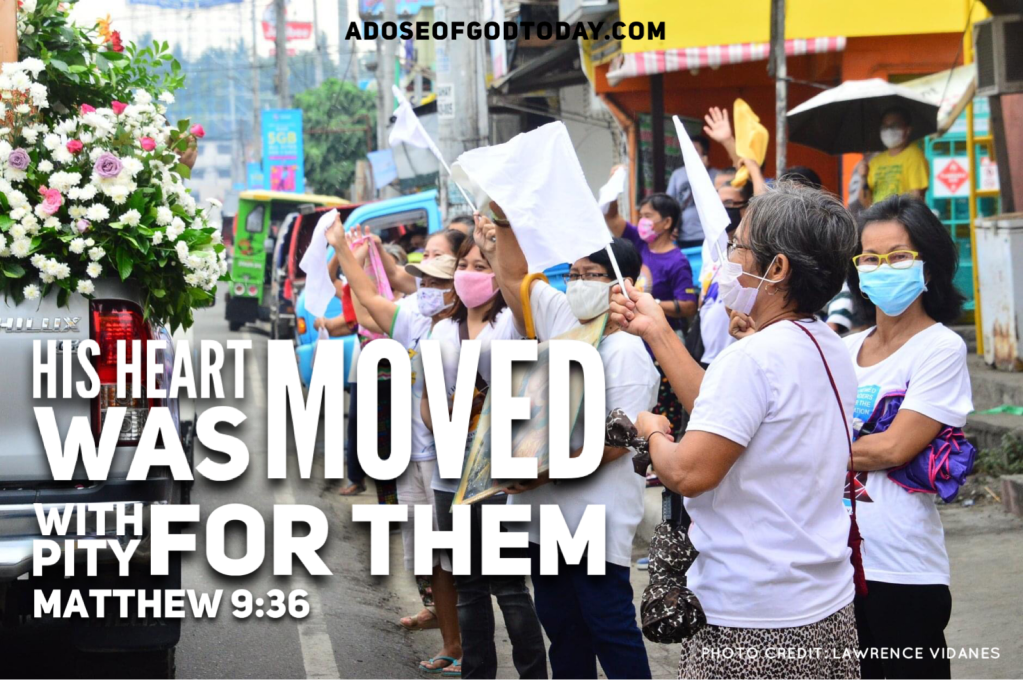
    Jesus too upon seeing the man possessed by the demon and the many people who were troubled and abandoned was moved with pity because of his love for the people. Jesus’ action to respond was a movement of love, a movement from the heart.

    This movement of love is truly liberating and saving. Gomer who represented the people of Israel and the man possessed by the demon and those many people had experienced that liberating and saving movement of God’s love.

    This is the invitation for us today. We may be moved also with pity that comes from our love and not just of pity itself. Indeed, the Lord invites us that like him we too our heart will be moved to respond to the needs of our brothers and sisters around us. Hopefully, this will also move us to respond with love to the different needs in our own capacity and gifts. Thus, be moved with pity and love today so that we may also give life, comfort and assurance and Jesus has shown us. Hinaut pa.

    Jom Baring, CSsR

  • Let God speak in your heart today

    Let God speak in your heart today

    Advertisements

    July 6, 2020 – Monday 14th Week in Ordinary Time

    Click here for the readings (http://www.usccb.org/bible/readings/070620.cfm)

    Homily

    “I will lead her into the desert and speak to her heart.” Prophet Hosea reminds us today of this.

    Indeed, the Lord leads us into emptiness, into situations of our life where we become vulnerable, unpretentious, without our facades and masks. It is in those situations where we can hear God the most because of our emptiness like the desert. God then speaks to us in our heart as Yahweh spoke to Israel in her downfall.

    There are two concrete situations where God speaks in the experience of emptiness of a person as told to us in the Gospel of Matthew.

    First, a synagogue official who was most probably had many doubts in Jesus but was able to hear God speaking through his desperate experience. His love for his daughter and his desperate plea to heal her led him to Jesus. In that experience, God spoke to his heart and believed.

    How? The grief and sorrow of that Synagogue official were situations where God made himself present in a very surprising way. God’s presence was revealed in Jesus as he willingly journeyed with the official towards the place of his sorrow and grief, towards her dead daughter. This was his desert, his place of emptiness where he was most helpless. And Jesus got up and followed the man. It was in that experience that the Synagogue official felt closer to God.

    Second, a woman who was suffering for many years ended her bitterness as she encountered Jesus. That very suffering in her life led her not into a hopeless scenario by committing suicide, and ending her life to end her suffering. However, the very encounter with Jesus gave her hope that there was something beyond her suffering, beyond her bitterness, beyond her sickness. This was hope for healing, hope for a better life. In this way, God also spoke to her, there in the desert of her suffering that there was indeed hope for healing and life for her.

    Moreover, the woman with hemorrhages was surprised at the power of God. Certainly, Jesus had somehow allowed this woman to touch him. And when Jesus saw her, Jesus also treated her warmly and affirmed her faith.

    From here, there are two invitations for us today.

    First. Seek help. God also intervenes through our participation. Remember, the woman touched the cloak of Jesus. This means that God also does not want us to be just a passive receiver of graces and blessings. On our part, we do something. So take the initiative and realize what we need. Reach out to people who can help us. Certainly, this does not mean that if we are greatly suffering then we can do nothing for ourselves. With our participation and willingness, God gives us the grace.

    Second. Allow the Lord to touch us by allowing Jesus also to walk with us in our own desert, in our own emptiness. Jesus took the hand of the dead girl because the official allowed Jesus to journey with him into his own desert. This means that God also touches us through the help of other people. God walks with us when we allow him to by allowing others to be with us. By allowing God to be with us, then, we shall surely find assurance and confidence. Thus, through the love, support and care of our family, friends and community we too will experience healing and a fulfilling life. Hinaut pa.

    Jom Baring, CSsR

  • How welcoming am I?

    How welcoming am I?

    Advertisements

    June 28, 2020 – 13th Sunday in Ordinary Time

    Click here for the readings (http://www.usccb.org/bible/readings/062820.cfm)

    Homily

    When I was younger, I used to play, eat and even sleep at my playmates’ house or them in our house. I grew up in this environment being assured that I was welcomed. I also witnessed how the adults at that time would do the same where they also felt welcomed. Indeed, that culture made me realize how a community becomes more compassionate and generous as every house and every person welcomes others.

    This brings me to what our readings this Sunday is reminding us, that is, the call of hospitality or the invitation to be welcoming.

    Our first reading tells us of the story of Prophet Elisha who was welcomed by a rich woman but childless and whose husband was old. Elisha, though a stranger, was welcomed into their home. In their culture at that time, a childless couple would surely suffer shame for having no child. Elisha who was very aware of this feeling of the couple particularly of the woman, prophesied something that would made them truly happy. Elisha promised the couple that by the following year she will certainly have a child.

    Thus, though it seemed that it was only Elisha who was welcomed by them but in fact, Elisha on his part also welcomed the desire and the longing of this couple.

    This tells us now that welcoming others into our homes or into our lives, brings grace. Making ourselves open for others allows the grace of God to also work in our lives. This is what Paul wrote in his letter to the Romans.

    Paul reminds us that baptism is a way of welcoming God into our lives. Moreover, it is also God’s way of welcoming us into God’s divine presence. That is why, Paul told us that as we were baptized we also join in the death of Christ. But how? Christ died for our sins. And in baptism, our sin dies because we are being forgiven. Through that forgiveness then we also rise into a new person just as Christ rose from the dead.

    The grace of baptism lies here because as we welcome God into our life and God welcoming us, this becomes a “mutual welcoming.” When welcoming becomes mutual then true relationship begins to form and develop. Consequently, God is our Father, and we are God’s children.

    This is the same also when we take the risk in welcoming others into our life. True friendship only develops and strengthens when there is a mutual welcoming of each other. This mutual welcoming involves sharing of stories, sharing of pains, sharing of joys as well as sharing of hopes and dreams.

    Recently, a dear friend visited me after months of lockdowns. Since our movements now have been eased for a bit, compared to the situation during the Enhanced Community Quarantine, we had an opportunity to catch up with each other personally even for a short period of time. Such simple encounter was indeed a form of mutual welcoming.

    However, we also know that in welcoming others we may get hurt. This happens when there is no mutual welcoming in our relationship. A relationship that is colored with manipulation or abuse or betrayal or pretensions is such a toxic relationship. This kind of relationship gives us pain and trauma which could lead us to sadness and misery in life.

    Advertisements

    This happened to a friend who welcomed a person in her life. Yet, unknowingly she was not welcomed at all in the life of that person whom she loved. She was just used and abused for the sake of personal pleasure of the other.

    But then, the Gospel of Matthew tells us and assures us the kind of relationship Jesus is offering to us. Jesus offers us a relationship that gives and promotes life and joy. Although the Gospel sounds a bit harsh for it suggests to hate our parents, but it actually means to place our relationship with God as the first or the beginning.

     Making God as the first priority in our every relationship gives us a good foundation to our other human relationships. The more we become in touched with our relationships with the Lord, the more we also become in touched with our human relationships.

    Consequently, Jesus calls us today to be welcoming, to allow ourselves to open up even though that would mean that we become vulnerable. Jesus said, “Whoever welcomes you, welcomes me, and whoever welcomes me, welcomes him who sent me.” Meaning, welcoming others with the intention of loving is welcoming God.

     Making ourselves vulnerable to welcome others is a way of losing our life, yet, in welcoming others, we also realize the beauty of loving and finding our life. Therefore, today, Jesus calls us to be welcoming as we are being welcomed, to be loving as we are also being loved.

    Today also, let us seek forgiveness and reconciliation with those whom we have hurt because of our selfishness, dishonesty and indifference. May we truly welcome others in our life too in the way of loving truly and not as a form of manipulating or using others for our own advantage and pleasure. Hinaut pa.

    Jom Baring, CSsR

  • Of Being Social-Distanced

    Of Being Social-Distanced

    June 28, 2020 – 13th Sunday in Ordinary Time

    Click here for the readings (http://www.usccb.org/bible/readings/062820.cfm)

    Homily

    Not until the first quarter of this year that we come to experience and be familiar with the term: “social distancing”. To protect ourselves from Corona Virus infection, nowadays we normally resort to social distancing. To avoid being infected by others or possibly infect others as well, we now set apart and maintain a safe distance from others as we assume that the world around us is getting sick, and we can easily get sick.

    Safe and practical it is and would be, social distancing is never been that easy as observed and practiced. Simply because social distancing is particularly painful to us  for it requires of us not only the physical bodily distance but also the  experience of being and feeling isolated, lonely and cast-out/cast-off from one another. Being physically quarantined, isolated, set apart, distanced, marginalized, suspected, and monitored could make us also personally feel marginalized, segregated, ostracized, stigmatized, outcasted, feared, unwelcome, abandoned, lost and forgotten. With or without viral pandemic, physical and social distancing has always been painful and difficult (even traumatic) experience for all of us for it deprives us of our need for personal intimacy, closeness and relationships. In other words, social distancing hurts because it is not only physical but also personal.

    It is but natural and life-giving for us to connect, relate and interact as persons. More just being social animals, social inter-actions and interpersonal relationships are very important dimension of our lives. And a song would insist, “No man is an island.. No one stands alone.” We are not just being with others but we are human PERSONS with others. We grow, live and thrive in life as community of persons: Persons related and relating with others personally. That is why to live life alone, distance, and isolated is difficult, painful and discouraging indeed.

    Our readings today reminds of the great value of our interpersonal relationships both in life and faith. Jesus in our gospel today appeals for us to “receive me”, “love me”, “follow me”. He invites us to have a personal intimate relationship with Him. Like any of us, he wants us to be close to Him as much as He wants to be close with us personally.

    Being Christian, as Paul emphasized, we are WITH Christ: personally related with Jesus in death, life and resurrection. And like in the first reading, to be personally welcoming  and hospitable host to our guests would blessed and graced us with the gifts of their person, to receive and love the person Jesus in our lives personally is to personally be with and share with His divine life with our Father.

    Personal intimacy, closeness and connected with Jesus and with one another as community is indeed promising and life-giving. While social distancing and isolation is sickening and life-threatening indeed.

    While we suffer physically and personally with social distancing  for safety and protection from infection nowadays, we may take this trying times as opportunity for us to review, reflect and renew the quality of our personal relationships with God, with our family and friends and our community. Just because we are physically constrained and apart, it does not mean we are not and cannot anymore be connected with one another personally. Distancing thus could also be a chance to improve the quality of our faith, personal life and inter-personal relationships.

    For instance, social distancing may have deprived of us to celebrate Sunday Eucharist and worship as community of faith, but it could also make us improve the quality of our Spiritual Communion with Jesus and our participation as we hope and look forward to the coming opportune time for celebration. We also may find more quantity and quality time and improved lifestyle with our own selves and with our loved ones now, and thus be in touch with most essential and important in ones life.

    In other words, since social distancing is personal, so let us make it more personal, let us get more and Better Personal…. And improve the Quality of our personal, social and spiritual life during this time.

    On my fifty-ish age and nearing my silver years as Redemptorist missionary priest, perhaps my five-year old musings below could be of assistance in reflecting about our experience of social distancing nowadays:

    “Paradox of being with others”

    Along the way, we suffer two things being with others: too much & too little – of closeness and distance. Too much and too little Closeness & too much and too little Distance. Coping with these both blocks our growth in relationships as well as forms and sharpens us to be better person for and with others. Ultimately it moves us to be intimately independent as well as independently intimate with one another.

    As we are personally in faith with the Lord, may we communally not be separated from Him and one another,  and  may we not lose life but rather find Life meaningfully. Amen.

    (By: Fr. Aphelie Mario Masangcay CSsR, a Filipino Redemptorist  Missionary stationed in Gwangju South Korea, though now still stranded in Cebu until further notice for available flights.)

  • Signs and Symptoms not of Covid-19 but of God

    Signs and Symptoms not of Covid-19 but of God

    Advertisements

    June 27, 2020 – Feast of Our Mother of Perpetual Help

    Readings: Isaiah 7:10-17; Revelation 12:1-6,10; John 19:25-27

    Homily

    As the Corona Virus 2019 stole the spotlight, the medical experts warned us of the signs and symptoms of the virus. Accordingly, the virus can cause a range of symptoms to a person from mild illness to pneumonia. Its most common symptoms, they said, are fever, tiredness and dry cough. Others may also show aches and pains, nasal congestion, runny nose or sore throat.

    We are made aware of it and thus, when we begin to have these signs and symptoms then we are advised to seek medical help. It is, definitely, important to be aware of these because through this first step then, we can save lives, not just our life but also of those who are dear to us.

    Moreover, looking at it from a distance, this pandemic is in itself a sign that no matter how much we have achieved in life, or no matter how much power and wealth we have accumulated, we are vulnerable. This pandemic also is a sign that tells us how competent or ignorant, sincere or corrupt, and organized or messy our leaders can be. This pandemic also is a sign given to us how individuals and communities have reached out to those in need.

    With all these signs and symptoms that the Corona Virus Pandemic has brought to us, this allows me to dwell deeper into the feast we celebrate today, the Feast of Mary, Our Mother of Perpetual Help.

    Our first reading is very interesting because it tells us about signs. Usually, we would ask signs from God, but, in this story of Ahaz, King of Judah, it was the Lord who asked a man to ask for a sign. Ahaz’s story seemed to be very good because he did not ask a sign from God. He refused to ask a sign. However, his refusal to ask a sign from God was actually a refusal to believe in God.

    What really happened? Ahaz sold himself to another god, to the King of Assyria. He sold himself because he thought that this foreign power, Assyria will only be the one who can grant immediate protection and salvation for him and his kingdom. Instead of asking wisdom from the Lord on how to lead his people, Ahaz went to the Assyrians and pleased them. The kingdom of Judah at that time was under the threat of two other kingdoms, Syria and Israel. Instead of trusting the Lord to protect and save him, he went to another god, to whom he thought was his savior.

    However, history tells us that as Assyria defeated the enemies of Ahaz, he became a puppet of the King of Assyria. Not only that, the Assyrians imposed heavy taxes to the people and blasphemed the Temple of the Lord by introducing the Assyrian gods.

    This is the reason why it was the Lord himself who offered Ahaz to ask for a sign so that he may believe that God will bring salvation. Yet, even though Ahaz refused, God still promised a sign of salvation. This sign is through a virgin who will conceive a son. This son will be called Emmanuel, meaning, God is with us.

    This is the sign that even in the midst of our own disbelief, doubts and even refusal to believe, God remains with us. God remains our God and continues to be for us and with us. This is a sign of God’s faithfulness in us despite our unfaithfulness. This is a sign of God’s generosity despite our ingratitude. And this is what we celebrate today on this feast of Our Mother of Perpetual Help. The Virgin who is carrying the son, the Emmanuel in her arms, is the great sign that God showed to us.

    There again on the cross, as the Gospel of John tells us, the son showed us his greatest sign of love and faithfulness. The son has come to be with us and on the cross he stretched out his hand for the sake of all. The son, indeed, comes to help us perpetually.

    Jesus is in fact the true perpetual help. Mary is instrumental because through her, God’s sign has been brought to us. She allowed herself to be God’s instrument of help and compassion, to be the mother of the Perpetual Help.

    Even when Jesus was about to die, he assured us to have a mother, that we will not be orphaned and alone. Mary’s presence became the sign of God’s presence among us by becoming our mother.

    This is the reason why we, the Church, would always seek guidance and inspiration from Mary because we feel the identity of being a child to her. The intercession of Mary as a mother, becomes a bridge of faith. It is to lead us to her risen Son, Jesus Christ.

    Thus, this feast that we celebrate does not actually point to Mary. This feast points to the greatest sign, the perpetual help, and who is Jesus himself.

    What is it to you and to me now, to us, who are devoted to Our Mother of Perpetual Help? How shall we express our act of thanksgiving for all the graces and blessings received?

    This feast invites us that each of us and that our community becomes a sign of God’s help and love, compassion and faithfulness. This means that we let our devotion transform our life. It means that our devotion should not only remain a mere devotional practice but must also flow into our actions and words, into our decisions and choices in life.

    Our devotion, then, is call to mission. It is mission because we are sent to become signs and symptoms of God’s goodness. I invite you then this time, to discern for yourself on how you could be a sign and symptom of God’s help and compassion to people around you.

    VIVA MARIA! VIVA HESUS!

    Jom Baring, CSsR