Tag: A Dose of God Today

  • When Jesus got into the boat of failures and frustrations

    When Jesus got into the boat of failures and frustrations

    Advertisements

    September 3, 2020 – Thursday of the 22nd Week in Ordinary Time; Memorial St Gregory, the Great, Pope and Doctor of the Church

    Click here for the readings (https://bible.usccb.org/bible/readings/090320.cfm)

    Homily

    It must have been disappointing and at the same time tiring. Simon and his group caught nothing despite working all night to catch fish. Yet, there was nothing Simon can do. He and his group had to go back to the shore and wash their nets.

    Have you ever been so disappointed with life? You felt tired and exhausted and there were many failures around your life. In spite of your efforts, the enthusiasm and the passion you have shown, yet, life seemed to be so unfair. It was just too overwhelming and you felt surrendering.

    This must have been the feeling of Simon too as he led a group of fishermen. There was nothing, not even a single catch of fish. It was not just a failure but a disaster for a fisherman like him.

    However, it was in this low moment of Simon that someone got into his boat. Jesus got into his boat and began teaching the people. Through that very boat of failure and disappointment of Simon, the Lord transformed it into something wonderful and beyond Simon’s expectation.

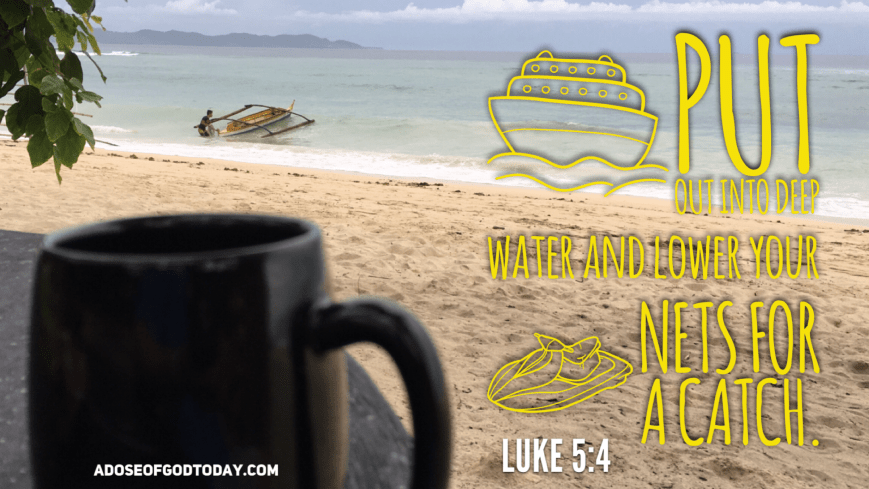
    After teaching, Jesus told Simon something, that could have made Simon to wonder, “Put out into the deep water and lower your nets for a catch.” In Simon’s mind, it was completely absurd as human wisdom and knowledge would tell him that. They had been working all night but caught nothing. However, because it was the Lord who said, Simon trusted the words of Jesus.
    This is what St. Paul said in the first reading, “if anyone among you considers himself wise in this age, let him become a fool, so as to become wise. For the wisdom of this world is foolishness in the eyes of God…” Indeed, by trusting the wise words of Jesus, Simon found something wonderful and life-changing.

    This all started when Simon let Jesus be in the boat of his failures and frustrations. The very presence of God became an assurance to Simon in the midst of the troubles in his life and in the midst of his search of something big in his life. The invitation of Jesus to him was call of faith. To go into the deep water and to lower down the nets was an invitation to dwell deeper into the most essentials in Simon’s life, to lower down his comforts and even pretentions, and to leave behind at the shore his uncertainties, fears, failures, guilt and sins.

    When Simon did all these, what he found was God’s tremendous goodness, deep love and generosity to him symbolized by the great catch of fish. This moved Simon to beg Jesus to depart from him because Simon had become aware of his sins, failures, fears and insecurities. However, this realization became the entry point of Jesus to make more wonderful things in the life Simon.

    Simon was called for a bigger purpose, to a mission where his participation became an important part in the ministry of Jesus. All of these happened because Simon let the Lord to be in his boat, allowed Jesus to challenge him and to change his life.

    This story of encounter with God led to chance and to a mission. Indeed, a real encounter with God or to allow God to be with us in our boats of frustrations and guilt, strips us from our pretentions and masks. Such encounter makes us bare to see how sinful and unworthy we are before God.

    Yet, it is in this moment of humility and honesty that we find God more merciful, loving and forgiving to us.  Once we lay down our guards that God comes to us to make miracles in us – to free and to give a true fulfilling life.

    It is when we own and claim our weaknesses, sinfulness and failures to God that we are also being strengthened, forgiven and empowered by the Lord.

    Thus, these are the invitations for us today.

    • First, allow the Lord to be with us even in our frustrations and failures in life, in our guilt and shame. Never be ashamed to allow Jesus to be in our boats. Let him teach us, to reminds us how much we are being loved.
    • Second, allow the Lord to challenge us and to shake our pretensions for us to discover more ourselves before the presence of God.
    • Third, allow God to bring changes in our life and to make wonderful things even out of our messy and troubled life story.

    May this encounter with Jesus empower us to go on mission by becoming His own instruments of mercy, love, peace and forgiveness. Hinaut pa.

    Jom Baring, CSsR
  • Giving a space for God

    Giving a space for God

    Advertisements

    September 2, 2020 – Wednesday of the 22nd Week in Ordinary Time

    Click here for the readings (https://bible.usccb.org/bible/readings/090220.cfm)

    Homily

    When we allow a person to occupy a space in our life, this also means that we make ourselves open to the person. The person may know our deepest secrets, as well as our deepest pain in life.

    This is how we find our relationships fulfilling and essential in our personal development. Of course, we assume that the person whom we have given the space in our life has the good intention of giving care and love to us.

    However, if the person whom we have given a space in our heart and in our life, betrays us, gives us more pain and stress, then, our relationship becomes hurtful and even toxic for us. This kind of relationship does not help us and would only bring us into desperation.

    Yet, when it is God who asks for a space in our life and in our heart, will we allow God to occupy a space? Are we willing to give up something for God to be in our life?

    God would surely not bring us harm. God only desires goodness and happiness for us. Nevertheless, giving a space for God also requires something from us. We cannot accommodate the Lord when our heart is full, if our life is occupied with many things. What God actually needs is a small space to bring healing and transformation in us.

    This is what we have heard from the readings today. St. Paul in his first letter to the Corinthians, reminded the people of their childish attitudes which actually made their hearts full and unwelcoming to God’s spirit to work in them. The community in Corinth was filled with jealousy and rivalry. Paul called them “infants,” meaning that the people were still exercising their selfish attitudes and seemed to advance their personal interest rather than the interest of the Lord.

    Paul reminded them to become mature by claiming and welcoming the Lord in their life and not to be limited with the influence given by Apollos or by Paul himself.

    Moreover, the Gospel also tells us how Jesus brought healing and transformation into the house of Simon. As it was in any typical Jewish house at that time, the house of Simon, must had been full of people too. His house was not just occupied by his wife and children but also his in-laws, nephews and nieces.

    However, despite this situation, Simon offered Jesus a space in his house. When Jesus was given a space into the house of Simon, Jesus was able to heal his mother-in-law who was afflicted with a severe fever. The miracle of healing happened here. She, indeed, was healed.

    But what was more interesting was the effect of the healing, and that was the transformation which made her to act, to be generous of herself to the Lord and his friends. When she was healed, she got up and waited on them. This means that when she experienced the healing, she served the Lord in her own capacity. This is faith in action and gratitude being transformed into generosity and kindness.

    This is what the Lord is inviting us also today. We may have experienced hurts and pains in our human relationships because those whom we welcomed in our life have caused us troubles, but we are assured that God would only bring healing and transformation in us. God desires that we will be healed in whatever illness and pain we are experiencing today, may it be physical or emotional.

    Thus, we are called to give a space for God by also getting rid of those that are not actually helpful and not necessary. This applies in our personal life, in our relationships, and in our homes and communities particularly. Allow the Lord today to occupy that space and allow him too to heal and bring transformation in us.

    Hopefully, as we also experience the gift of healing, this may lead us to transformation where we are moved to put in action our faith and to make concrete our gratitude to God by becoming generous and kind towards others. Hinaut pa.

    Jom Baring, CSsR

  • When our words give life and freedom

    When our words give life and freedom

    Advertisements

    September 1, 2020 – Tuesday of the 22nd Week in Ordinary Time

    Click here for the readings (https://bible.usccb.org/bible/readings/090120.cfm)

    Homily

    Our words to another person can become destructive or can become uplifting and life-giving. Those who silently suffer from verbal abuse at home, at school or at work would look at herself or himself terribly. The emotional stress and psychological trauma could affect the entire perspective of a person about himself or herself and about others. Such negativity makes a person to have a low self-esteem, to be depressive, angry and hateful towards himself/herself or/and towards others.

    However, a person who receives enough affirmations, constructive corrections, good counsel and advises from credible and people of good example would tend to become more hopeful and positive in life.

    This tells us how our words play an important part in our development in emotional or psychological and spiritual aspect of our life. Thus, the readings today convey to us how our words can transform the lives of others and of our community.

    The first letter of Paul to the Corinthians tells us how the Spirit of God inspires us to understand the Word of God, “to understand the things freely given us by God.” As a community of faith, we speak on the mysteries of God revealed to us not with words taught by human wisdom, which is limited and can be self-centered, but with words taught by the Spirit which is life-giving and liberating.

    This is how we find the words in the Bible to be always uplifting and inspiring because they are filled with the Spirit of God. In the same way, a parent who lovingly corrects a child for the wrongdoing the child does and without condemnation and insult, builds the character of the child to become a good and better person.

    Such powerful and life-giving words are also heard in our Gospel today. The Gospel of Luke tells us of the experience of the people from Capernaum, a town in Galilee. Jesus who taught the people in the synagogue found him different from the Scribes and Pharisees. Jesus spoke with authority not just with knowledge and familiarity of his teachings. Jesus spoke from the heart, from the wisdom of God that intends to give life to the people.

    Hence, the people found life in his teachings, in his words. This was more manifested when Jesus encountered a man with the spirit of an unclean demon. Through the words of Jesus, that demon was made quiet and was commanded to come out of the man. That demon was surely oppressive to the man by taking out the voice of the person. The person was made a slave by that demon. Yet, through his encounter with Jesus the man was given a chance to be freed and to be healed. Indeed, this is the effect when words give life and freedom.

    Thus, at the words of Jesus, the demon came out of the man without doing any harm to the person. This tells us again how those words of Jesus truly brought life, freedom and healing because Jesus’ intention was of kindness and his words were out of generosity.

    Today, Jesus also calls us to find healing, life, and freedom in his words and presence in the scriptures and in our Sacraments. Hopefully, what we find and receive will also be transmitted into our life that we ourselves will become life-giving and instruments of freedom.

    It would be good then to examine our words and our encounters with people today.

    Let this be the object of our discernment today. Are my words and presence life-giving or condemning? Am I giving freedom or condemnations? Are my words filled with hatred and anger or peace and kindness?

    If we find that our words and presence express more of condemnation, and judgments, of hate and bitterness, allow Jesus to transform us. Allow Jesus to cast out the demon in us that oppresses us and oppresses other. Allow Jesus’ words to make free and at peace so that we too shall learn in giving words to others that are filled with love, life and freedom. Hinaut pa.

    Jom Baring, CSsR

  • Life Again OR Anew? Normal Life OR New Life?

    Life Again OR Anew? Normal Life OR New Life?

    Advertisements

    August 30, 2020 – 22nd Sunday in Ordinary Time

    Click here for the readings (https://bible.usccb.org/bible/readings/083020.cfm)

    Homily

    How are you coping lately with the New normal life pandemic times has put us up? Whether we like it or not, pandemic reality has changed, is changing, and will change our lives. For better for worse, our life ahead will never be normal back again. Rather than hoping to regain back the normal good old times, we cannot help but accept that we are now at the dawn of the New life ahead and cope with its demands.

    Challenging at this early stage is our grieving over our losses – be it relationships, work opportunities, privileges, lifestyle and above all our usual normal life back then. Many have resorted to anger and blame-game (blaming government, civic and church leaders, & even God and themselves) while others succumbed to bargaining (selling themselves short) and denial & depression – a great danger to mental health. That is why at the dawn of a new life before us now it is important for us nowadays to check and be aware of how we are grieving over our losses and coping with its demands, and above all discern our proper attitude and approach towards the dawn of  new normal life ahead.

    And perhaps we could ask the question: WWJS? “What Would Jesus Say” about our experience of New Normal? How should we approach and what should be our attitude to this New life with Him being offered before us now?

    We remember that for deciding and professing Jesus as his Christ, and as confirmed by Jesus, Peter gained a new identity, role and faith in life as the “Rock”. Because of his inspired new faith in Jesus as the Messiah, Peter plays now an important mission as the foundation stone in the New life Jesus is offering all. However, the same Peter in our gospel today is called by Jesus as stumbling block because he hinders Jesus from the coming suffering and persecution New life entails. For Jesus, the way to redemption is not through our normal way but through the suffering of the way of the cross that requires “deny oneself, take up your cross & follow me.” Meaning, newness also brings along death of our normal lives and loosening of our usual ways. Peter here becomes  an obstacle – a stumbling block to the New  because though he chooses the New but not at the cost of his usual old Normal but corrupted life and ways. Peter do believe in the promise of the New life with Christ but not at the expense of his usual but limited  normal life. Meaning, for listening and being inspired by God, Peter becomes the foundation stone to the promise of a New Life; but for clinging on to his usual Normal human ways, Peter becomes its stumbling block.  

    Thus amidst the New Life being offered us now during this pandemic times, as Jesus directs us through Peter, we may choose now whether to be a foundation stone OR a stumbling block to the New life with Christ. We may open and be inspired to welcome and adapt with the New ways OR we may remain with our usual limited normal life.

    And we also know that for the inspired New to come and grow in our lives now, we have to loose and give up our corrupted normal life. New wine requires new (not normal old) wineskin. New (not the usual) vine for new branches. New updated (not old outdated) system version for new programs. Updates are and should not be same but much better than the usual. And all these new lifestyle requires rebooting, reformatting, and reprogramming, i.e. in religious lingo, the way of the cross towards resurrection and the sorrowful mystery towards the glorious mystery. As Albert Einstein would say: “We cannot solve our problem with the same thinking we used when we created them”, we do need something new and above us (difficult it may be), and cannot remain with the same usual normal thinking, approach or attitude to deal and live with the new offer of life before us now. Same with Peter, we cannot BE Fishers of men by simply just doing our usual normal way of fishing fishes.

    Perhaps we ponder on these questions: “When given another chance now, would you do it Again OR Anew? Would you do it same as before OR better than before? Would you live now as usual as before OR as New as it can & will be?” And now we are given another Chance, so what’s it’s gonna be? Lord, as we, your followers cope with the challenges of our pandemic reality,  guide us to be a foundation stone, rather than a stumbling block to Your promise and offer of New Life with us now and always. Amen.  

    By  Fr. Aphelie Mario Masangcay, CSsR (a former Filipino Redemptorist Missionary for Filipino Migrants in South Korea who, due to immune compromised diabetic condition, stationed back home  in the Philippines for now).

  • Unlocking our hearts for God

    Unlocking our hearts for God

    Advertisements

    August 23, 2020 – 21st Sunday in Ordinary Time

    Click here for the readings (https://bible.usccb.org/bible/readings/082320.cfm)

    Homily

    Do you use passwords or codes for your smartphones? I am sure most of us have done this. Others might have used a simple code to easily unlock their phone. Others must have used a complicated combination of numbers. Others could have also used the “touch ID” using the finger prints. There are also other systems that use face recognition where one has just to face the camera to unlock.

    Having passwords or codes are true not just with our smartphones. We also have passwords, key cards or just the traditional keys for our cars, doors of our rooms and offices. Every day we use them and they have become part of our way of life.

    Keys and passwords are indeed very important because aside from having access to most personal and confidential things, we have the assurance of security and at the same time a reminder of our responsibilities.

    Aside from these, however, there are also aspects in our life that we choose to close and lock perhaps as our way of protecting ourselves or from distancing from others.

    For instance, a person who had a painful memory in the past may choose to lock that painful past because it was too much to bear. We suppress the memory in forgetfulness yet it comes up when we are triggered. However, what actually happens when we do this to ourselves, is that, we become prisoners of our painful past.

    Moreover, our heart is the entry point of all our relationships. When we experience pain, the more we close our hearts and restrictive in opening up for others to come. Like for example, a person who experienced the pain of betrayal from a loved one may become suspicious and untrusting the next time the person develops another relationship. This is a kind of defense mechanism to people who have been hurt and so made the heart closed and restrictive.

    The key to a memory overwhelmed trauma and to a bruised heart because of betrayal is healing from the pain through forgiveness and reconciliation.

    Having this in mind, allow me to bring you deeper that we may discover together how God invites us this Sunday by reminding us of the simple things that we have, the keys to lock and unlock things.

    In today’s Gospel, we have heard Jesus telling Simon, son of Jonah, that he has been given the keys to the Kingdom of Heaven. Simon has been given the role to lock and unlock the gates of the kingdom.

    As Jesus entrusted to Simon the keys, let us first see a bit deeper the event and the very circumstance that led us to the keys of the Kingdom of Heaven.

    The gospel of Matthew told us that Jesus asked his disciples personal questions. The first question was on the perceptions of the people about him, the Son of Man. The disciples told Jesus that the people believed that he was the resurrected John the Baptist, or Elijah, or Jeremiah or just one of the prophets. These answers revealed that despite the miracles done by Jesus, the people perceived him as a different person. The people in many ways did not understand yet the very identity of Jesus.

    Thus, Jesus reformulated the question and directed it to his disciples. It was Simon, speaking in behalf of the group, who answered Jesus. Simon here is the image of all other disciples, including us today.

    As the Gospels tell us, the person of Simon was characterized by being hesitant, doubtful, fearful and sometimes inconsistent. In the scriptures, we find him having doubts as he was invited by Jesus to walk on water. He was also called by Jesus to get behind him because he refused to believe that Jesus should undergo suffering. He ran and hid himself when Jesus was arrested and even denied him three times when he was questioned by the people.

    However, what was redeeming for Simon was his “openness” to the invitations of God. This explains to us why he immediately followed the Lord when his brother Andrew brought him to Jesus. This openness of Simon allowed him also to intimately recognize and know Jesus in the most profound way. That is why, when Jesus asked his disciples about their perception of him, Simon boldly professed that Jesus is the “Christ, the Son of the Living God.”

    Simon did not depend on the perception of others about Jesus, who thought that Jesus was merely a teacher or some sort of a magician or a resurrected old prophet. No! Simon, like the rest of the disciples, had a personal encounter with Jesus and thus, he recognized the Lord.

    Though Simon was an imperfect disciple but God revealed himself to him because Simon was open to God. This tells us that knowing Jesus does not rely on human reason but through divine revelation. But remember also, this divine revelation unfolds through our human experience and personal encounter with Jesus.

    And thus, Jesus called Simon to follow and to serve in the best way Simon could serve God. This call from Jesus has two important points.

    First, through the openness of Simon, Jesus gave him another name, Kephas or Rock or Peter. This means a responsibility has been given by the Lord to Simon Peter to lead the Church.

    Second, through the personal encounter of Simon Peter with Jesus and that deep relationship with God, Simon Peter was entrusted with the keys of the Kingdom of Heaven. This tells us of the authority given to Simon Peter who is considered as our first Pope, to unlock and lock, to grant access and prohibit the doors of heaven.

    This tells us too that Peter holds not just the key of God’s house, but of God’s heart. Jesus is telling us today that through the person of Simon Peter, we are also called to see ourselves in him and find God’s invitation of us today.

    Advertisements

    Thus, many times, we will find ourselves hesitant, doubtful, fearful and inconsistent. These attitudes would surely make our hearts locked and disallowing God to come and to transform us.

    Like Peter, we are called today to go beyond from these restricting attitudes of our hearts and begin to open up for God and for others. We can only do this when we also acknowledge that we are weak, inadequate and sinful. Then, we too acknowledge that we need help and we need God to transform and renew us.

    Like Peter too, we shall be transformed and renewed as we develop a deeper relationship with God through personal encounters with Him in the scriptures, through our sacraments, and through the people around us.

    In this way, we may courageously unlocked our closed hearts for others to come and bring more joy in us and for God to transform and renew and bring more life to us. Hinaut pa.

    Jom Baring, CSsR