Tag: A Dose of God Today

  • Attachments and Conditions in Commitments

    Attachments and Conditions in Commitments

    September 30, 2020 – Wednesday of the 26th Week in Ordinary Time

    Memorial of St. Jerome, Priest and Doctor of the Church

    Click here for the readings (https://bible.usccb.org/bible/readings/093020.cfm)

    Homily

    What prevents us to fully commit ourselves to a relationship? Why are we being prevented and what makes it difficult to fully commit?

    A couple who was about to be married shared to me their thoughts and plans. They were surely in loved with each other and wanted to live as husband and wife. Yet, they too shared to me that as a couple they planned not to have a child. They just wanted to live as husband and wife. I asked them why. The two of them confirmed that, to have a child is difficult for them. Both of them were at the peak of their careers and their individual profession was so important that losing them was not a choice. Thus, if they will have a child then their careers will be affected.

    Christian marriage is not just limited between the union of husband and wife. This love and union should also overflow towards their children. Completely closing the doors to the possibility of having children, rearing, loving and nurturing them is after all, a non-commitment to Christian marriage.

    Thus, our many attachments can actually prevent us from fully committing to a relationship. It is indeed difficult when we are called to let go of our many attachments. These attachments could be our careers and jobs, positions and influence, power and wealth, or unfulfilled dreams and desires, our traumatic experiences or past broken relationships. These can also be our various addictions and compulsive behaviors, or just our family and circle of friends.

    These attachments prevent us to fully commit to a relationship because we are being held back and we allow ourselves to be caught up. This happened to those whom Jesus invited to follow him.

    Jesus said “follow me.” The person certainly wanted to follow Jesus, BUT, in following Jesus, there were conditions attached. Jesus emphasized the urgency of following him but then the person was being held by his attachments. These attachments prevented him to follow the Lord by making conditions.

    This is something Job realized also in the first reading. The story of Job tells us about the human suffering of those who find themselves righteous and good. Yet, life is not under our control. God remains the author of life and decides about our life. Job here slowly realized that he was not the master of his life. All the things that he possessed are not his, including the life of his family and his very life. His suffering was a proof that attachments in life do not give security and contentment and that he can just set conditions in his relationships with God, the almighty.

    Today, Jesus also calls us to follow him freely and without conditions. Each of us is being invited, wherever we are and whoever we are. Whether you are working and married or single, unemployed or a simple vendor, a professional or a laborer, well and healthy or sick, a religious or a government official, young or old – the Lord calls us to commit ourselves to Him. When we commit ourselves, then, we too are challenged to let go of our attachments that may prevent us from fully following Jesus.

    Let us ask Mary, Our Mother of Perpetual Help, t to guide us in recognizing our unhealthy attachments so that we will be able to let go of them and realize the freedom and peace of choosing Jesus. Hopefully, in choosing to follow Jesus we may also discover the joy and the beauty of allowing God to be the center of our commitment in our relationships. Hinaut pa.

    Jom Baring, CSsR

  • HOW TO BE YOU, PO?: ON THE FEAST OF ARCHANGELS

    HOW TO BE YOU, PO?: ON THE FEAST OF ARCHANGELS

    Advertisements

    September 29, 2020 – Feast of Archangels Michael, Raphael and Gabriel

    Click here for the readings (https://bible.usccb.org/bible/readings/092920.cfm)

    Homily

    How to be you, po? This is a youthful expression of admiration to a person and desire to become the person being admired. The admired person may have shown great talents, goodness and kindness that touched and inspired others or some other good qualities.

    The feast that we celebrate today, though they are not human beings like us, but spirits, Archangels, have something to teach us, as these angels reveal qualities that we can develop as we relate with one another and with God.

    Let us discover a bit who these archangels are and what they reveal to us and about God.

    The three are particularly called “Archangels” and not just “angels” because of the great importance behind their ministry. Their ministries are also revealed through their names.

    In particular, the name “Michael” means “the one who is like God.” The Book of Revelation mentions Michael and his angels fighting against the dragon identified as the Devil and Satan. Michael, the angel who fights against the Devil and protects the people shows the might and power of God. Thus, the ministry of Michael tells us how goodness will always defeat evil, and how God overpowers the Devil.

    Gabriel will always be remembered because of the role he played in the birth of Jesus. The name “Gabriel” means “the strength of God.” At the annunciation to Mary, Gabriel revealed how the strength of God was manifested in the ordinary life of Mary and in the smallness of the birth of a child. Gabriel also announced the birth of John that revealed how God showed power through the childless old couple, Zechariah and Elizabeth. This child will prepare the way of the Prince of peace. The ministry of Gabriel reminds us that the strength of God is found even with the small, even with those that the world thought to be insignificant.

    Raphael brings healing to people. Hence, the name “Raphael” means “God’s remedy.” In the Book of Tobit (see chapter 12), Raphael healed Tobit from his blindness and freed Sarah from a demon that tormented her. The ministry of this archangel tells us how God touches us to bring healing to us, to our wounded hearts, to our tired bodies and tormented spirits.

    Celebrating this feast today, this calls us too that as we seek the intercession of these Archangels, we should also learn from them and develop those characters that these Archangels possess.

    Thus, like Michael who is called the one who is like God, we are called to also protect others, to defend others especially the weak and the least in our community, and not to let darkness and evil to win. As individuals and as a community, we do our best with the help of God’s grace to counter our evil desires and the evil intentions of those who are corrupt and abusive.

    Like Gabriel, who is the strength of God by announcing the coming of the Lord, we are also called to announce Jesus to all but first we are called to always welcome and embrace Jesus in our life. Jesus, as he was born as an infant, his presence may also appear in ways we do not expect. Be mindful then, of God’s ordinary and everyday revelations.

    Like Raphael, who is God’s remedy, we are also called to be instruments of healing to the wounded, to those who are in pain, to the suffering by being able to touch them. Touch others with your kindness and concern, with your friendship and love as God touches us with his presence. Hinaut pa.

    Jom Baring, CSsR

  • In our Capacity to receive and embrace

    In our Capacity to receive and embrace

    Advertisements

    September 28, 2020 – Monday of the 26th Week in Ordinary Time (Feast of San Lorenzo Ruiz)

    Click here for the readings (https://bible.usccb.org/bible/readings/092820.cfm)

    Homily

    Look at how the disciples behaved themselves. This passage of the Gospel of Luke tells us how the disciples argued among themselves on who was the greatest among them. They must have been boasting one another about their closeness with Jesus, their great qualities, their faithfulness, on who was the first to be called and who was the favored one among them. Their argument must have been fierce because it reached the ears of Jesus. Jesus heard not just their words but even realized the intention of their hearts.

    At this point, the disciples thought that Jesus’ kingdom will be like those of kings sitting on a golden throne in the palace with a great army, a political king. They believed that Jesus will inherit political power and vast riches and material wealth. Thus, obtaining a position and having a closer relationship with Jesus will give them the security and assurance of a higher and influential position when Jesus reigns.

    Consequently, the argument of the disciples was based on how they could benefit from their friendship with the Lord. As Jesus heard them, he too realized that this was in the heart of the disciples. Jesus had to teach them and to mold their hearts according to God’s desire.

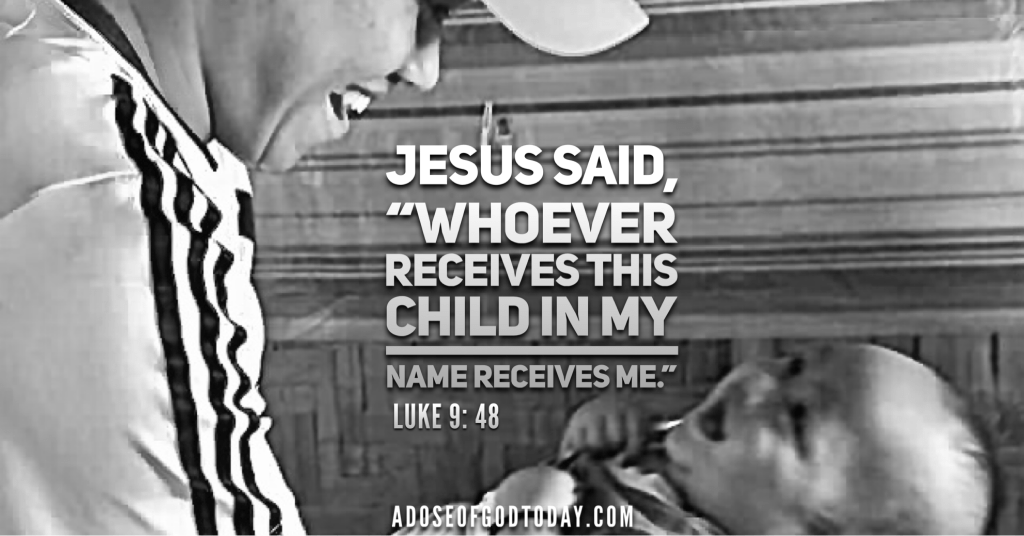
    That’s why Jesus taught the disciples an important lesson through a child. Jesus took and placed the child by his side and said, “Whoever receives this child in my name receives me, and whoever receives me receives the one who sent me. For the one who is least among all of you is the one who is the greatest.”

    Children, at the time of Jesus were considered not important because they were dependent, they have no rights and thus cannot be called as fully man at all. Jesus teaches that in the Kingdom of God, greatness is measured in the capacity to receive God. To receive God is best expressed in welcoming, in embracing and in receiving the least in our community.

    We are called to receive God in the person of those who are the least in our church and society. We are called to aspire to be great but neither in the way that we will be above others, nor to seek a higher position at the expense of others, but in the way of embracing others.

    This capacity to embrace others and embrace God fully was what San Lorenzo Ruiz showed to us. In offering his life, even to the point of death, San Lorenzo was always confident that Jesus was with him. He said, “If I have thousands of lives, all of them, I will offer to God.” This shows us that San Lorenzo had found himself, the kingdom.

    Thus, we shall surely see that when we make ourselves open to receive others, we too shall receive Jesus and Jesus will live in us. This is the reward, Jesus himself. The kingdom of God will be present in us because when we have Jesus, we will be at peace, secured and loved even if we are in the midst of trials and turmoil in life. Hinaut pa.

    Jom Baring, CSsR

  • Afterwards

    Afterwards

    Advertisements

    September 27, 2020 – 26th Sunday in Ordinary Time

    Click here for the readings (https://bible.usccb.org/bible/readings/092720.cfm)

    Homily

    Jesus told this parable of the two sons to make a point to his listeners that they may be able to see themselves in the story. The parable is a common situation at home that those who were listening could relate well. The father who asked his sons to be in the vineyard depicts an image of the everyday struggle of parents in motivating their children to follow them. And this kind of domestic situation was being used by Jesus to  make his message known and let people know God’s invitation.

    Thus, for us this Sunday, let us go deeper into this parable. Let us see the attitudes of the two sons and discover God’s invitation for us today.

    The father asked the first son to go and work in the vineyard. However, this son refused and said he will not. This son must be very busy with some other things in his life. He did not want any disturbance from his father. And so the father received an immediate “no” from his son. However, the Gospel told us that “afterwards,” the son changed his mind and went and worked in the vineyard.

    The word “afterwards” is very important here. Certainly, the son did not want to be disturbed. He did not want to be challenged by his father. He did not want to participate or to follow what his father said. At that time, what his father told him was insignificant for him. Yet, “afterwards,” he realized something and changed his mind. He changed his attitude and changed the direction of his life.

    This “afterwards” of the son was that process of realization on the importance of life. This son who initially refused his father had thought very well the implications of his actions. Not to go and work in the vineyard will not only not be his failure but will affect the entire family. This means that the “afterwards” of the first son became a moment for him to think not just for himself but also for people around him.

    This is what St Paul said in his letter to the Philippians, “do nothing out of selfishness or out of vainglory; rather, humbly regard others as more important than yourselves.” Certainly, this “afterwards” made the son to consider others and move from his own comforts in order to respond to a greater need. Thus, from changing his mind, this allowed him to change his perspective in life and his approach towards life. Moreover, this inspired him too to change his actions that led to transformation. Prophet Ezekiel tells us something about this, “since he has turned away from all the sins which he committed, he shall surely live.”

    This first son is the image of those sinners like the tax collectors and prostitutes at the time of Jesus who at their encounter with John the Baptist were touched and thought of their life. Indeed, the presence of Jesus made a great impact on their life and moved them to change and transform their life according to God’s desire for them.

    However, the second son in the story who was also asked by the father to go and work in the vineyard and said his big “Yes,” did something that must have surprised the father. This second son, though his words must have been a comfort and assurance to the father, revealed later on that he was only filled with pretensions. This son was only concerned in being affirmed. His words were empty. His words were merely a sugar-coating. Yet, his actions revealed different.

    This means that this son responded in words but he never listened and never believed. Afterall, what he was after was himself. He was merely concerned of his own interests. He did not consider others.

    Indeed, the second son is the image of the religious leaders and elders of the community at that time of Jesus. These were the people who memorized the scriptures, strict in observing rituals yet never changed their minds and attitudes towards others. They never believed in Jesus because believing in Jesus meant moving away from their privileges, moving away from their comforts, challenging the status quo and making themselves less important.

    The call of Jesus was too much for them, not good for their self-righteous image, bad for their business.  That’s why Jesus criticized their attitudes because they were only full of themselves, full of pretensions. When we become people like these, then, we are only depriving ourselves with true life, with freedom and depriving ourselves with the joy of being with God.

    God invites us today to identify ourselves not with the second son but with the first son who like him have said “NO” to the Lord many times. The mistakes, failures and sins we have committed in life were those moments of saying “no” to the Lord. Those were the moments of depriving ourselves with true life, with freedom and joy of being with God. Yet, time and again, God surprises us with His presence and appears before us through people and events to call us once again and to invite us to come closer to him.

    God only desires what is good and best for us. God desires that we enjoy a life where we are free and joyful. Hence, never deprive ourselves from these by becoming full of pretensions, full of selfishness. A person who is always pretentious, selfish, always seeking approval and affirmation, advancing his or her personal interest is a very sad and insecure person.

    Let us embrace our “afterwards,” those moments of realizations to dwell deeper on the importance of our life, of our relationships , of God, and on how our actions can affect others. By becoming less and less selfish and self-conscious then the more we become loving, life-giving and happy. Hinaut pa.

    Jom Baring, CSsR

  • DO What You Mean

    DO What You Mean

    Advertisements

    September 27, 2020 – 26th Sunday in Ordinary Time

    Click here for the readings (https://bible.usccb.org/bible/readings/092720.cfm)

    Homily

    Recently, a Q&A post was logged in Facebook. It asked the question: Is mortal sin forgiven only through sacramental confession? In other words, is it enough just to confess your sin to be forgiven of your mortal sin? The answer was, sacramental confession is normatively but not absolutely required of mortal sin. Meaning, confession can forgive mortal sin but it is not the only one way of forgiving and being forgiven of mortal sins. Saying sorry then is not enough for you have to do something about being sorry to renew faith & trust with others.

    Yes, forgiving mortal sin through sacramental confession is all about reconciliation with God and others, but it is also and moreso about repentance – the whole process of turning from sin and dedicating oneself to amend one’s life & relationships for the better.

    Our readings today have a lot to teach us about repentance. First of all, repentance is more than just changing one’s mind, but it is about making a choice – a stand for ones life. In our gospel, both sons changed their minds, the second did not fulfill what he promised while the first did what was requested which he had initially refused. The virtuous as well as the wicked may also change their mind as our first reading suggests. Although it involves much changing one’s mind, repentance thus requires our choice – to turn away from virtuous or wicked life, as well as to fulfill or neglect our promise.

    Second, repentance is giving oneself and the others another chance. In our gospel today, because he chose to neglect his promise, the second son did not give himself and his father a chance to make things right. The first son however gives himself and his father another chance to make things right again by doing what was requested, even though he did not initially commit at first. In the same way, for the wicked to change his mind and turn away from his wickedness, he gives himself another chance for God to forgive and be merciful to Him, and for himself to lead a virtuous life.

    Third, repentance is about saying what you mean and meaning what you say. It is not only about confessing you sin – just saying you’re sorry, but it is all about Being sorry. Confessing one’s sin is also not only about resolving to change your ways but it is all committing/ dedicating oneself in changing one’s life. Jesus asks about whom among the sons who Did the will of Father. He is not concern with who says Yes or No, but who does the Father’s will. Meaning, God needs doers who mean what they say, live and witness what they preach and believe, rather than preachers who do not do, live, witness what they say and preach.

    Although less appreciated compared to other sacraments, repentance of sin through the sacrament of reconciliation or confession is actually a Gospel – a good news of God’s salvation because it involves the resolve and commitment of the sinner to change one’s life, to give oneself and God another chance, as well as to live his life and dedicate his faith as witness to Christ’s good news to all.     

    St. Francis of Assisi who once said: Preach the Good news at all times, and use words when necessary. This reminds us that everything in our life as Christian – our struggles, hopes, dreams, aspirations, commitments, as well as our repentance of sin is a Life of Witness to the Good News of Christ. Whatever we do and however we live our Christian lives is a testimony to God’s work of salvation. It is ours now to share and preach such gospel to all at all times, not only by our words but also by our actions.

    Remember our God is a God of surprises and another chances who we will come to know if and when we give Him and ourselves another chance of better than usual life through our reconciliation and repentance. Somehow Jesus is saying to us today that it is never too late for us to change our minds, our ways and our lives…. just believe in Him, and be His witness by doing what we mean. This would be the Lord’s  challenge for us now.

    Advertisements

    Today’s pandemic times has indeed been a significant crisis experience for all of us that also requires our important life-adjusting decisions. Difficult as it may be, these times could also be our choosing to give ourselves and God another chance now for a better meaningful than our usual directionless life,  by our living our lives in witness of our faith. Transform, O Lord, our initial refusal, reluctance and neglect to follow you so that we may taste and see the better chance you are offering us now even amidst and through this pandemic crisis in our life. Amen.

    By  Fr. Aphelie Mario Masangcay, CSsR (a former Filipino Redemptorist Missionary for Filipino Migrants in South Korea who, due to immune compromised diabetic condition, stationed back home  in the Philippines for now).