Tag: A Dose of God Today

  • Ready? Handa ka naba?

    Ready? Handa ka naba?

    Advertisements

    November 8, 2020 – 32nd Sunday in Ordinary Time

    Click here for the readings (https://bible.usccb.org/bible/readings/110820.cfm)

    Homily

    “Last two minutes”. Usually in a basketball game, the last two minutes is scheduled as “Time-out” for both teams. At that moment, the game is paused for a minute break to allow both teams to assess their situation in view of the coming end-game. This is the chance for both teams to have a wider look on where they are and how they fair at that period of the game. It is an opportunity for teams to have a reality-check in terms of their strengths and weaknesses as well as of the possible opportunities and threats at this stage of the game, in view of plotting a game-plan strategy for the end-game. The “last two-minutes time-out” of the basketball game is thus an occasion for each team to consider at the last two minutes of the game their resources and limitations in relation to their aspired goal and end-game and their remaining game-plan. 

    Just recently early this month of November, our observance and celebration of All Saints Day and All Souls Day respectively may have been also “a last two-minutes time out” occasion for us, Christians. As we prayed for the eternal repose of our saintly and beloved dead brothers and sisters, we may have also slowed down, have a pause and break from our busy schedules in order to consider not only the death and lives of those who have gone before us, but also our own lives so-far now as we are still in this life. Yes, as we considered the lives of those who have gone before us these days, we are also confronted with the reality of the mortality of our very lives now as we are still alive living here. Like the last two minutes time-out in a basketball game, the last two months of the year can be a chance for us to consider where and how we are in our lives in relation to our game in life – our dreams and aspirations as well as what we are to do to improve our lives now for the better, and above all in relation to our salvation.    

    Behind the story of the five wise and five foolish virgins in our gospel today is the call for us to be vigilant and ready. Jesus wants us to be Wise enough to be prepared and awake, and not to be foolish enough to be not ready and unaware. When we hear this challenge, many people think that they have to be ready for death so as not to be caught unaware. Rightly so, because when we came into the world, death has become natural to us. We know that no man lives forever in this world. Death is our lot, and reminds us of how limited our life is. We have only one life, lived in a given time. And it is wise enough to be prepared for our coming death.

    However, much more than our coming death are meant in our gospel today. Our gospel today is all about how ready and prepared are we to meet and experience the Lord IN our lives here and now, and not in our coming death later. In other words, the challenge of Jesus for us to be wise enough to be vigilant and ready is for Here and Now while we are still living, and not for There and Later on our death.  Thus, the readiness and vigilance we are to be is not in view of our end – our death, but as to how we have lived and spent our life so-far here and now as we meet and encounter the Lord in our daily lives.

    Ralph Waldo Emerson once said, “When you were born you were crying and everyone else was smiling. Live your life so at the end, you are the one who is smiling and everyone else is crying”. True enough, in our death, we wish to be remembered not how we died, but how we live our lives to the fullness with the Lord. It is not the end-game itself – the Winning or Losing but about the GAME itself – How we lived our lives and play our game with the Lord in life, that matters most. 

    As we are still living in this world now – most especially during this pandemic times, we have yet to learn how to be wise & street-smart enough to be aware and ready to meet the Lord now in the many ways he comes to us. He is the “Word of God made flesh”, the God with Us, our companion in the journey of life, who lives with Us. Blessed then are those who are ready and alert to Welcome the Lord in our lives, not in our death. So, Are you ready now? Handa ka na ba?

    On our “last two-minutes time-out” moment, we pray that we may be wisely awake and cleverly prepared enough to welcome Him in our lives now as we meet Him in our church, our brothers & sisters, our fellowmen and others, in our day to day lives. Amen.

  • Desiring God Always

    Desiring God Always

    Advertisements

    November 8, 2020 – 32nd Sunday in Ordinary Time

    Click here for the readings (https://bible.usccb.org/bible/readings/110820.cfm)

    Homily

    The first reading was very interesting. We have heard that Wisdom was personified by a “she,” by a woman who hastens to make herself known to us in anticipation of our desire to have her. Wisdom even makes her rounds, “seeking those worthy of her, and graciously appears to us with great attention and care.” This is a sign of intimacy from God being shown to us. This image actually makes me remember of my own experience with my mother, surely with your own mothers too. Usually, if not most of the time, a mother always knows what her son or daughter needs and wants. As soon as I pronounce the word, “Ma,” my mother knows what I need.

    This is wisdom described to us in the first reading. Now, wisdom is innate in each of us as we are created in God’s image and likeness, who is the source of wisdom. Our Psalm reveals what is innate in each of us. Our Psalm says, “My soul is thirsting for you, O Lord my God.” Yes, our human heart is designed to long for God, to be with God. Acknowledging our “thirst for God” is in fact the beginning of Wisdom which makes us become conscious of the importance of God in our life. Wisdom is also faith because it leads us to believe in God who has been “seeking to find us.”

    Let us remember this, that God seeks to find us as wisdom has been seeking for us in anticipation of our desire to find her. This is a hint for us that though God seeks to find us first, yet God wants something from us also – and that is to have “the desire to long for him.” It means acknowledging our desire for God. It is in recognizing our desire for God that our heart will keep burning. Our desire to be with God makes us hopeful, generous and joyful as we wait to welcome the Lord in our life.

    This is basically what our Gospel is teaching us today. The Parable of the 10 virgins gives us the image of people who lose hope and forget their desire for God and people who hope against adversities and difficulties and still remember their desire to welcome God in their life.

    Thus, the Gospel actually assures as that in our Christian life we may fail, we may fall asleep in the middle of the night because we have become so tired from waiting for the Lord, because our prayers remain unanswered, because you have failed several times in your exams despite your reviews and daily devotion, or your partner or family member is still problematic despite the prayer intentions you have offered, or until now you are not yet healed from your illness which gives you suffering despite the many “pamisa” you’ve made, or your loved one was taken away from you because of a sudden death even though you have been a good catholic, or because this pandemic is taking too long to disappear and your job or business is losing and you have grown tired from this quarantine and in following the protocols while powerful political people in our country enjoy the comforts of life yet people are growing hungry, homeless and sick, etc.

    These experiences are truly disappointing. They discourage us and so we feel that our faith is weakened. This happens when we lose our desire for God and tend to focus more on our personal wants, personal assurance of comfort and security.

    This was the situation of the five foolish virgins. It was not just about running out of oil in their lamps but losing their desire for God. They were losing the light and oil of their lamps and so was their enthusiasm to meet the bridegroom. They felt tired from waiting and waiting for the bridegroom to come.

    This situation was also the condition of the Christian Community under St. Matthew’s. His people had grown tired, felt hopeless because Jesus seemed not to come back anymore as he promised. At this time, the belief of the immediate “parousia” or the second coming of Jesus was so strong that anytime during their lifetime – Jesus will come to welcome them all in his kingdom. Yet, the first disciples were already being martyred by the Romans and as if nothing was happening. Therefore, Matthew addressed them here and challenged them to be like the other five wise virgins and that is “to be always vigilant” – “to be always ready to welcome God” despite the difficulties and discouragements that they were experiencing.

    This is the invitation for us this Sunday and that is to be wise enough, to seek wisdom from God, to desire Him even in the midst of trials, of discouragements, of boring and dry moments, and even in the most ordinary days of our life.

    Remember, God reveals his abiding and loving presence to us in any moment of our life. Let us keep our hearts then to always desire God through our constant and intimate communication with God through our personal prayer and through this Eucharist.

    Let us hope that as we are able to meet the Lord in our ordinary life may it become a moment of joy for us and a life-changing experience for us and for our community. Hinaut pa.

    Jom Baring, CSsR

  • Friendship brings comfort in our distress

    Friendship brings comfort in our distress

    Advertisements

    November 7, 2020 – Saturday of the 31st Week in Ordinary Time

    Click here for the readings (https://bible.usccb.org/bible/readings/110720.cfm)

    Homily

    When we are in distress, in pain and in great confusion because of some difficult situation in our life, the people who come to share our troubles will surely bring comfort in us. Even when our friends cannot be present with us physically, but, their expression of being with us spiritually also brings confidence in our distressed hearts.

    While Paul was in prison, the people who became his friends never left him. The Philippians who were converts of Paul’s mission travels, remembered him. They had been Paul’s supporters in joys and sorrows. And when Paul was captured by those who were hostile against the Christians, the Philippians made sure to bring aid to Paul in whatever way they can. Paul was being persecuted. His prison cell must had been a terrible place to stay. However, to be alone in there could have been more lonesome and grim.

    That is why, Paul expressed in his letter to his friends, the Philippians, his gratitude to them. Indeed, his friendship with them brought comfort in his distress. Paul said, “It was kind of you to share in my distress.” To be remembered by friends and to have friends who are ready to empathize with us certainly brings confidence in us. Thus, more than the material gifts he received, Paul rejoiced for the gift of friendship with them.

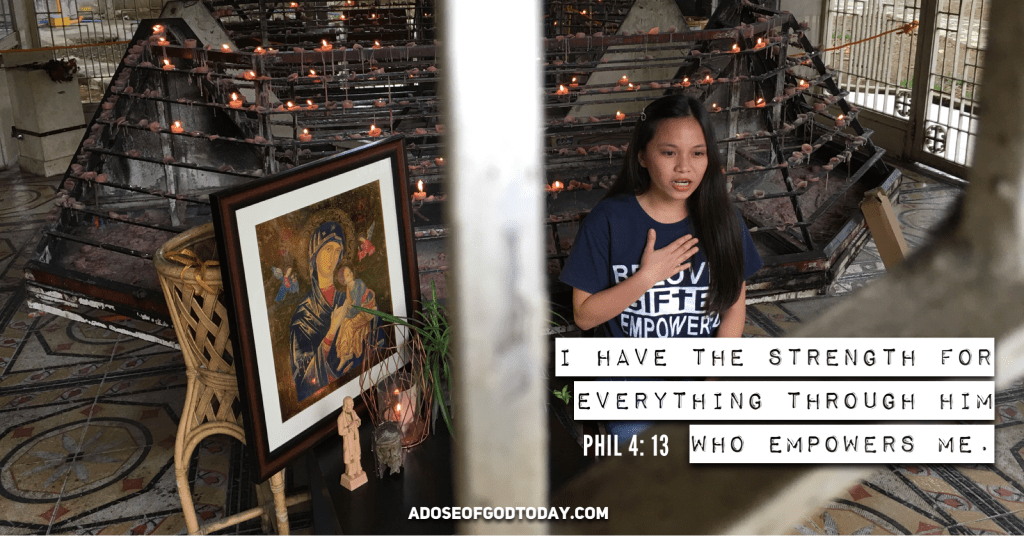
    Moreover, Paul also recognized that what gave him more strength was his friendship with the Lord. Paul expressed with confidence, “I have the strength for everything through him who empowers me.” This is also Paul’s invitation to the Philippians, that they too will grow more in their friendship with the Lord Jesus who shall give them the strength for everything.

    The Lord, indeed, gives us the strength for everything. Paul learned how to adjust in every situation in his life and how to make every difficult situation bearable because of his faith and confidence in Jesus, the Lord.

    This is the invitation for us today, that we become generous givers and gracious receivers of gifts. The Philippians became generous givers to Paul because they had been gracious receivers from Paul’s teaching and preaching. Paul, as well, became a gracious receiver of friendship from them because he had been a generous giver to them.

    This is the very value that Jesus reminds us in today’s Gospel, that we may not be possessed by our resources but become charitable. To become truly charitable is to become trustworthy even in small matters because we do not allow our hearts to be corrupted by the desire to have more and to keep more for ourselves alone.

    Hopefully, we may grow in our consciousness of becoming aware of the needs of others and to be more generous in giving our ourselves to those friends who need help. We may also grow to have a welcoming and humble heart to receive the help from our friends and become grateful more of our friendship. Hinaut pa.

    Jom Baring, CSsR

  • The Prudence of the Dishonest Steward

    The Prudence of the Dishonest Steward

    November 6, 2020 – Friday of the 31st Week in Ordinary Time

    Click here for the readings (https://bible.usccb.org/bible/readings/110620.cfm)

    Homily

    We have a puzzling gospel reading today. The master in the story praised the dishonest steward. But does it mean that Jesus also praises those who are dishonest? Certainly, no! It was not the dishonesty of the steward that was praised neither by the master in the story nor by Jesus but rather the ‘prudence’ of the steward.

    Let us look again how the steward acted prudently. The steward faced with a crisis, he was about to lose his job for being dishonest to his master. In his mind he couldn’t go on by becoming a labourer by digging or by begging. What he did, then, was to take away the commission that he would usually get from the debtors of his master. That is why he asked one debtor to make 50 for the one who owed 100 measures of oil and 80 for the other who owed 100 bushels of wheat. Surely, those debtors would be very happy of being unburdened of such debt. The steward had just thought about his future so that when he will be fired, there will be people who would hire him for a job out of gratitude to him.

    This is what Jesus tells us today, that as Christians, we are challenged to be prudent enough. We are challenged particularly in using and spending our material possessions in the hope of making our relationship with other people to be better. For this reason, we are called to be careful that we may not be ‘possessed’ by our own possessions which will only bring us into the danger of indifference and oppression towards the lowly and the poor.

    Consequently, we are also called to be fair and to be generous enough as we deal with those who are economically struggling. Thus, it would be a big help to support local vendors and local businesses, to buy products from local peddlers and show fairness with our own business too. Our material possessions can be best employed also in reaching out to others by feeding the hungry and clothing the naked especially those who are being affected recently by the super typhoon Rolly.

    Indeed, these are ways of recognizing God as the generous giver of graces. By being grateful to the Lord, may it move us then to be generous also to the needy. This is a way of building relationship with one another, building friendship and helping one another as a community of believers. Hinaut pa.

    Jom Baring, CSsR

  • God is Loving and Forgiving

    God is Loving and Forgiving

    November 5, 2020 – Thursday of the 31st Week in Ordinary Time

    Click here for the readings (https://bible.usccb.org/bible/readings/110520.cfm)

    Homily

    I find it disturbing that while Jesus was trying to bring people to conversion, to freedom and closer to God, there was a group of people also who grumbled and complained because of Jesus’ actions. The parable of the lost sheep and of the lost coin are images of God searching for those who along the path of life have lost their way, distanced from the community and from God. Yet, God longs and desires the presence of those who lost their way. Thus, these two parables tell us really how dear each of us in God’s heart. God will not rest and will not surrender until God wins us back and finds us again.

    However, such image and nature of God, was received with hatred by those who wanted to control God. The Pharisees and scribes complained and grumbled because Jesus was eating with sinners and being friendly with them. They did not want a God who forgives and redeems sinners and the lost. They wanted a God who condemns.

    This was the reason of their grumbling because they wanted a condemning God. Having this kind of God, then, they can easily incite fear among the people and control people according to their agenda and selfish intentions.

    That is why, Jesus’ presence was indeed a threat against these people, because Jesus was turning the table against them. Jesus revealed the true face of God, a loving and forgiving God.

    Hence, while Jesus tells us of God’s embrace and God’s longing for us, we too are reminded of our tendency to reject God. The Pharisees and the scribes represent that tendency in us to reject whatever is of God’s. However, just as the shepherd never stopped until he found the lost sheep and just as the woman searched carefully until she found the lost coin, God also continues to call and invite us, to search and to find us until we allow God to embrace us.

    This is something that Paul also realized. His letter to the Philippians recounted his past where he thought that he was already in the right path. Yet, Paul was a lost soul believing that righteousness based on the law was enough. However, when Jesus found him, Paul also found himself and gained everything in Christ.

    May these parables always remind us of this God who longs and desires for our presence, for our conversion and for our freedom. Moreover, may it move us too to be more embracing, accepting and welcoming of our brothers and sisters who need a lot of understanding and loving because of unfortunate circumstances in their life. Hinaut pa.

    Jom Baring, CSsR

    Please take more doses of God today. The only side-effect is for you to become holier.

    BELOVED CHILD

    January 11, 2026 – Feast of the Baptism of the Lord Click here for the readings (https://bible.usccb.org/bible/readings/011126.cfm) As we all know nowadays, there is an updated way of praying the rosary. Instead of the usual joyful – sorrowful – glorious mysteries, there is an added mystery called the Luminous mystery or the Mystery of the…