Category: Year 2

  • Be merciful to us, Lord

    Be merciful to us, Lord

    March 21, 2020 – Saturday 3rd Week of Lent

    Click here for the readings (http://www.usccb.org/bible/readings/032120.cfm)

    Homily

    Being judged because of what you have done before, or of a mistake, or failure or sin that you have committed is a devastating experience. This becomes  overwhelming too especially when we are “put in a box,” that, as if there is nothing more in us except our sins and failures.

    Aside from being judged by others, each of us too can be the one who judged others because of their mistakes and failures in life. We could have played to be the righteous individuals who scrutinize people searching for their faults. We could be that mean person whose main intention is to bring other people down by shaming and gossiping their weaknesses in order to hide our own sins. This happens among our families, circle of friends and even in our workplaces.

    The Gospel story that we have heard today conveys this message to us. To become self-righteous only blinds us. Thinking highly too much of ourselves will even prevent us from asking God to show his mercy upon us because we already think that we do not need God’s mercy. The righteous person actually thought of himself so highly that God is as if obliged to be good to him. In his thoughts, God has to pay him for being good and righteous. 

    What happens here is a reversal of relationship. God is as if the servant of this righteous person. Although he might be after of rewards in his life for being righteous, yet, he was actually seeking to control God through his righteousness. Thus, this attitude leads us to build invisible walls that separate us from others.

    We might still have that idea of condemning our brothers and sisters who were considered terrible sinners. We too might have that attitude of separating those people whom we consider as unclean for fear of being contaminated and be associated with them.

    Thus, Jesus invites us now to rather look closely at ourselves and to examine better our intentions, our thoughts and actions so that it may also lead us to that recognition of our failures and sins. This realization will hopefully lead us to also join the tax collector in praying, “O God, be merciful to me, a sinner.” 

    We are invited to be more understanding of those who failed but not in the sense of condoning such failures and sins. We are invited to be merciful rather than to be condemning.

    Let us remind ourselves that to both the righteous and the sinners, God does not condemn but God rather desires healing, reconciliation and fullness of life for all.

    This calls us, then, to see more in the person of our brothers and sisters, to stop our harsh judgments and condemnations, to stop our gossiping and image shaming that only destroy the image of our brother or sister.

    What is its invitation now for us as we face such difficult situation amidst this deadly Covid-19. Even during this challenging times, we are called to show compassion and generosity to our brothers and sisters, particularly those who are most in need. And since we are called to “stay home” as a form of prevention of the spread of the virus, let us also not spread malicious gossips about our neighbors or friends. To stay at home is also an invitation for us to pray for each other and to show our true concern for one another. Hinaut pa.

    Jom Baring, CSsR

  • Responding in gratitude

    Responding in gratitude

    March 20, 2020 – Friday 3rd Week of Lent

    Click here for the readings (http://www.usccb.org/bible/readings/032020.cfm)

    Homily

    Policies, regulations or laws are essential elements in our society. They govern and guide us as we live our life and relate with one another. Our lawmakers in this country are expected to make laws that will promote life, protect life and develop the life of every Filipino. That is how a law is very important.  As good citizens, we strive to follow the law of the land.

    Because of the pandemic Covid-19 our lawmakers and key government leaders are now giving directives and executive orders to us citizens in order to protect the population and prevent the spread of the virus.

    Talking about laws, our religion has also laws of which we are expected to follow. We have the Ten Commandments from the Old Testament and the Code of Canon Law that guide our Roman Catholic Church. In fact, there are plenty of laws being conceived and promulgated year after year. 

    The image of many laws reminds us of the Jews especially of the Pharisees and other teachers of the Jewish law at that time of Jesus. In Jesus’ time, there were about 613 laws that a good and faithful Jew must know and observe. Laws are designed to guide a person but since laws are man-made they too are prone to imperfection. Laws are designed to give and preserve justice, fairness and make direction and guidelines as people relate with one another . However, many laws can also be a burden. And there were many laws of the Jews that were quite burdensome.

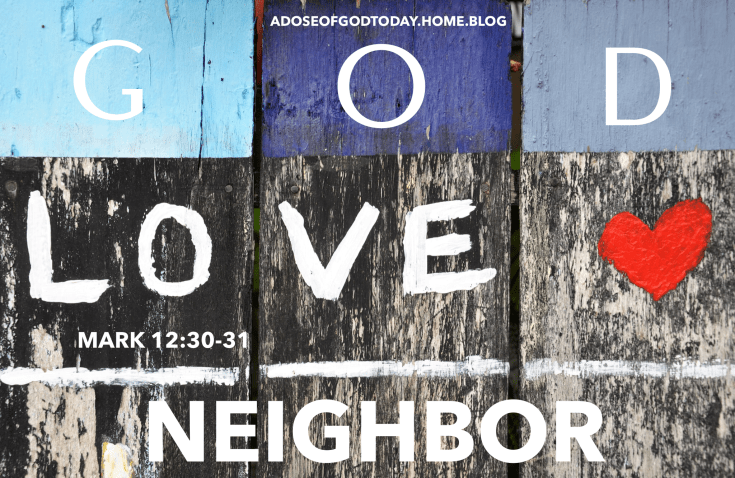
    We have heard a scholar of the Jewish law asking Jesus on what was the greatest law? Jesus responded with two that are inter-related. The first is, “to love God, with all your heart, with all your soul and with all your mind.” And second, “to love your neighbor as yourself.”

    Our Christian faith must be rooted in these two commandments. However, following these two greatest commandments we need the right attitude. And what is that right attitude? 

    The failure of many of us in practicing our faith is when we limit our faith within church laws. Limiting ourselves within these laws or commandments will only bring us into a legalistic attitude. This attitude believes that Christianity is about fulfilling laws. When we break a law or a rule we feel guilty. This attitude is not what God wants. God does not want us to feel guilty of the wrong we did in breaking God’s law. Rather, God wants us to feel sorry because our response to Him is lacking and ungrateful.

    We may have laws but God wants us to look what is behind these many laws. This is what Jesus said to the teachers of the law. Jesus revealed to them what was behind these laws, and that was love – to love God and to love our neighbor as ourselves.

    How shall we do this? We are only able to respond to God with love when we ourselves are conscious of God’s love for us, his goodness and generosity in us. This is what we find in  the Book of Hosea. The first reading tells us how God shows mercy and compassion to the erring people. God has promised, “I will heal their disloyalty and love them with all my heart.” God as if speaking in human language, shows God’s faithfulness to us despite our unfaithfulness.

    This experience of forgiveness, mercy, love and faithfulness from God moves us now to respond to God, to respond in “gratitude.” This is the right attitude that we are called to develop.

    This is how Jesus is inviting us today – that as we live our lives as Christians, our response to God should be out of “gratefulness” not out of fear or mere obligation. Thus, faith is beyond obligation, it is a human response of love to the God who first loved us, as Pope-Emeritus Benedict XVI said.

    Our love for God will then be shown in our words as well as in our actions. We shall be generous to those who are in need because we are grateful to God who is generous to us. We shall show our concern and affection to our friends because God shows his love to us in many ways. We shall forgive those who hurt us because God has forgiven us first. 

    Today, we are also called to follow the directives set by our civil and church leaders as our act of gratitude in protecting and serving us and also as our act of charity to people who are now at the frontlines in fighting against the Covid-19. Hopefully, by our collective effort in following the guidelines for our community, God may also deliver us from this disease. Hinaut pa.

    Jom Baring, CSsR

  • God is in our midst

    God is in our midst

    March 19, 2020 – Solemnity of St. Joseph, Husband of Mary

    Click here for the readings (http://www.usccb.org/bible/readings/031920.cfm)

    Homily

    When life becomes confusing, messy and overwhelming, how do I react? When a relationship is intrigued by anger or hatred or contempt over a misunderstood situation, am I easily driven by my feelings or do I withdraw from the situation and hide? 

    Today, on this Solemnity of St. Joseph, Husband of Mary, the Gospel presents to us an attitude that portrays wisdom and compassion and above all an attitude that seeks guidance from God. Joseph’s relationship with Mary was intrigued with a suspicion of scandalous betrayal and unfaithfulness.  Within the period of engagement between them, Mary got pregnant. The people in their village knew that Joseph was not the father. Joseph himself was confident that Mary’s child in her womb was not his. Joseph knew that the Jewish law would find Mary guilty of adultery.  This is an act punishable by shame and death. Their law mandated Joseph to divorce Mary.

    In a small village like Nazareth, gossip seemed to be faster than lightning. Surely, every person in their village knew that Mary was pregnant. If we would imagine Joseph, certainly, he too was hurt. He might have felt being betrayed. Joseph was most likely in darkness at that moment, confused and overwhelmed by the situation.

    But then, Joseph showed a non-reactive attitude. Instead of condemning Mary immediately, he showed compassion by divorcing her silently and avoiding to put Mary into disgrace and bullying from others. This particularly, pleased God. Joseph was a good man, righteous and thoughtful. We expect Joseph to have been really hurt by this scandal yet what Joseph showed towards Mary was mercy rather than revenge and love rather than hate and not withdrawal in the midst of his own disappointment, confusion and fear. 

    This has become the way for God to reveal the divine plan. That is why, God revealed to Joseph in the night of dreaming and pondering. Through that revelation, Joseph’s view of Mary and her pregnancy and even of himself became larger and brighter. Joseph began to see the overwhelming and scandalous situation of Mary’s pregnancy through the eyes of faith rather than his fear and disappointment; through God’s love rather than anger and hate.

    Joseph saw and felt that what has been revealed to him was truly scandalous because God revealed Himself to him, because God has become man there in the womb of Mary. It was scandalous because we thought that God is up there or out there in the heavens only, a place that no person can reach. But then, Mary got pregnant. 

    This is what blows our mind now, because through that unexpected pregnancy, God tells us the He is intimately present with us; he tells us that humanity can become pregnant with God.

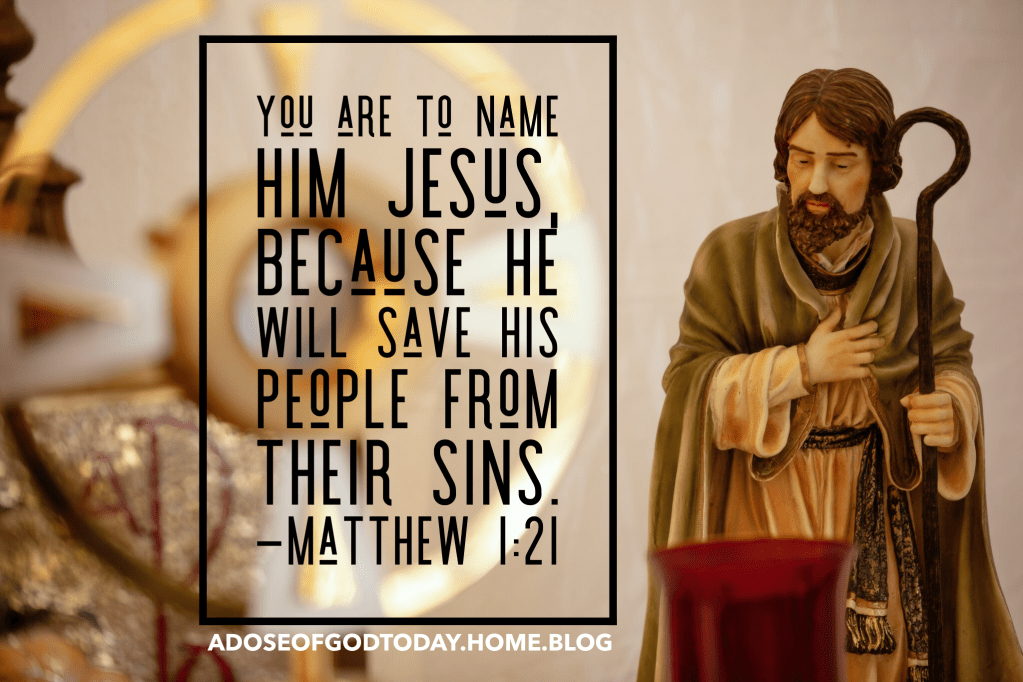
    After the revelation to Joseph, he understood that Mary’s pregnancy was a statement of God’s faithfulness and commitment to us. God commits himself to be our God; He commits himself to choose us as His people. For this reason, Joseph was told to name the baby, “Jesus, because he will save his people from their sins.

    This is God’s assurance to us now that he is present and he lives in the midst of our lives, in the midst of our pain, of our failures, of our disappointments, hurts and fears and even in the midst of an overwhelming situation as we are experiencing it today amidst the Covid-19 that brought panic and fears in our global community. Jesus is in our midst in order to bring us His mercy, his love and his friendship, and the assurance of his presence and of his healing power. Hinaut pa. 

    May, Joseph, the Husband of Mary, pray for us.

    Jom Baring, CSsR

  • To respond in love is confidence in God

    To respond in love is confidence in God

    March 18, 2020 – Wednesday 3rd Week of Lent

    Click here for the readings (http://www.usccb.org/bible/readings/031820.cfm)

    Homily

    When someone presents to you laws or rules and regulations? How would you feel? Isn’t it restricting and limiting? 

    This kind of feeling might have been more present these days as “community quarantine” has been imposed and gatherings of people have been suspended and discouraged by the Civil and Church authorities as precautionary measures against the virus covid-19.

    When I was also younger (in high school and college), I would also always look at rules and regulations as something that put limitations to what I can do. Most of these are stated like, “you shall not,” or “don’t.” These rules and regulations were reinforced by strict parents and teachers at schools. Thus, I was taught indirectly to be fearful because if ever I will disobey any of those, then, there will be a consequence, a corresponding punishment. 

    This made me an obedient yet fearful boy. I followed every rule, and so was never been late in school and had only one absent in my entire high school and that was when I got sick seriously. I was obedient to the rules and regulations, to teachers and other persons of authority because of fear. Only later that I realized that I was relating in a very unhealthy way. I felt so unfree because of my fear of breaking laws and to the authorities who will execute punishments.

    Yet, this is not the right attitude. Rules and regulations, or even Church laws are originally designed to make us freer as we relate with one another, they protect us rather than harm us. We only feel them restrictive to our freedom and self-expression when we also do not have the right attitude in responding to laws or rules and regulations.

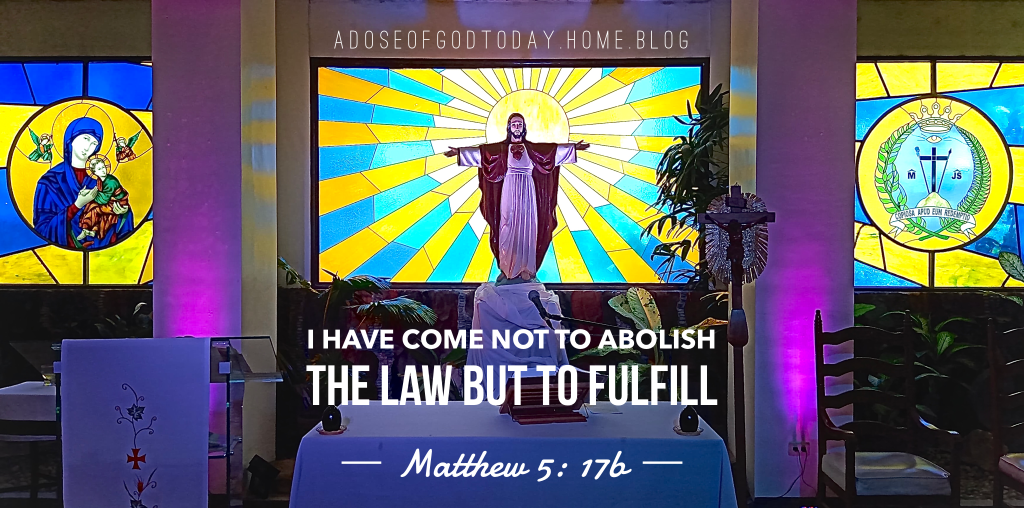
    Our Gospel today has reminded us of that right attitude towards laws. Jesus himself has told us that he has come not to abolish the Jewish law and the teachings of the prophets but rather to fulfill them. Hence, it is in fulfilling the law or commandment of God that we will find joy and peace, security and life. 

    So how, what kind of attitude then? We will find it in Jesus’ relationship with his Father in heaven. Jesus has a complete trust to the Father. He never doubted his intimacy with the Father and the Father’s love for him. He is indeed secured in the Father’s love. This has been manifested and was evident when Jesus was on the cross, in pain and was about to die. Despite his confusions and questions in his own suffering, he trusted the Father as he offered his life.

    This is the invitation for us now. We are reminded by Jesus to take confidence in God’s tremendous love and affection for us. It is only by being confident that we also learn to follow God’s commands because we know that we respond in love and not in fear.

    Hopefully, this will make us become Christians who are free and who live not in the fear of being punished or being limited by many restrictions and “don’ts” but in the confidence of being loved and cherished by God. Hinaut pa.

    Jom Baring, CSsR

  • Forgiving without a limit

    Forgiving without a limit

    March 17, 2020 – Tuesday 3rd Week of Lent

    Click here for the readings (http://www.usccb.org/bible/readings/031720.cfm)

    Homily

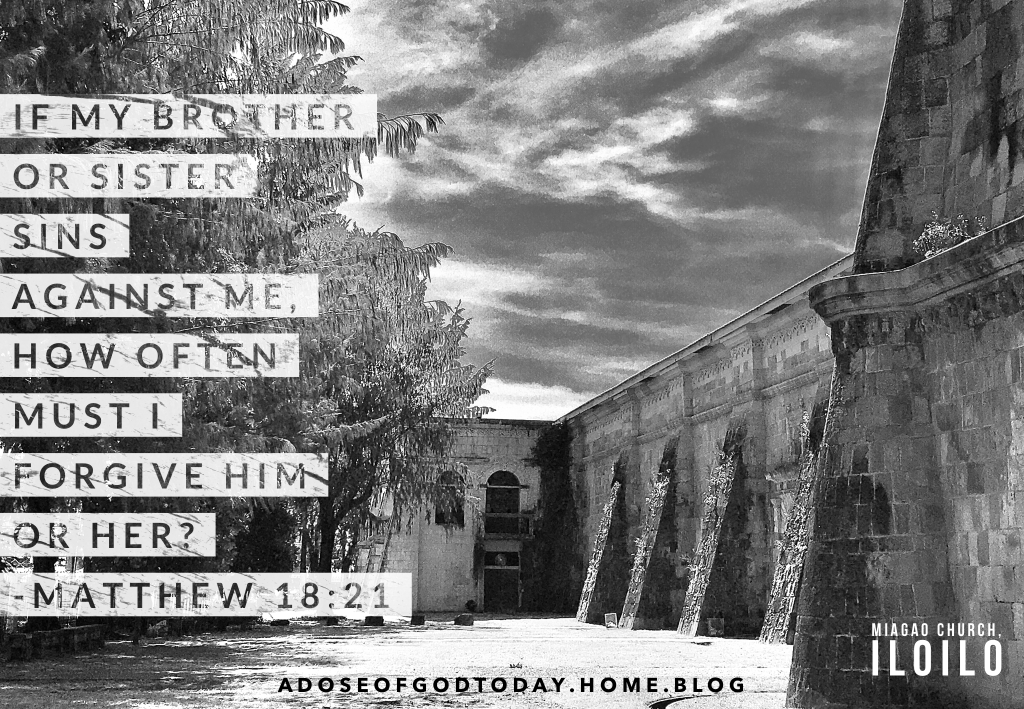
    Peter asked Jesus about how many times he should forgive. For the Jews a righteous man should forgive those who have hurt them for 4 times. But then Peter exceeded that and made it to seven. He thought he has more than enough. However, Jesus responded to him that not just seven times but seventy seven times. The number actually does not matter. What Jesus is saying is that, forgiveness has no limit.

    Why is that? Why forgive without limit?

    It is even so difficult to forgive even once especially when the person who have hurt us is someone we love and someone we trust. Most of our painful experiences are sometimes rooted from our relationships especially when we are betrayed or abused or deceived by our own friends or family members. 

    The pain and suffering that come from those broken relationships create deep wounds in us. And will forgiveness be possible then? Yes, forgiveness will always be a call for all of us. 

    Forgiveness is not really for the person who have hurt us but rather it is all about us. The pain that we endure will lead us to feelings of anger, hatred and bitterness.  When we linger to these they will lead us to a heart that seeks only revenge. This will become our tendency from our belief that by hurting the person back, our anger and hatred will be satisfied. But then we are all wrong because anger and hatred will never be satisfied by violence. Violence will only make us angrier, hateful and bitter person. The more we linger to our pain, anger and hate; they become a cycle that will never end. 

    We will only create our own cycle of violence, revenge, anger and hatred. We will become prisoner of our own pain. All of these will only control our lives, our thoughts and actions towards others. We will never be free because we will try to avoid those who have hurt us and avoid occasions of meeting them. We will begin to become suspicious to our other relationships. We will be afraid of trusting others, of loving others again and even ourselves. We are afraid because we linger to that pain thinking that other people might do it again to us. And so, the cycle never ends.

    Unless, we find forgiveness in our hearts that begins with accepting and embracing those painful experiences and go on with life, then, we will not be free. 

    Remember, forgiveness will make us free. It will not erase the scar of betrayal or of abuse or of deceit in our life but we will be able to stand up, to wipe our tears and go on with life.

    Forgiveness then is not about telling the person, that what he/she did was okay and pretend as if nothing happens. No! Forgiveness is to heal our wounded heart that will make us say to the person, “I forgive you not because of who you are but because of who I am” as the Dalai Lama said. It means that I choose to be free and at peace. I choose love and not anger and hatred. 

    This is what Jesus is saying to us now and he wants us to forgive many times because a single unforgiveness will only make us prisoner of our own pain and hatred. Jesus wants us to be free and not prisoners of anger, hatred, and bitterness or of violence.

    In this way, we may always find reconciliation with God and with those who have hurt us so that in return, we too shall also be forgiven by those we have hurt in one way or in many ways. Hinaut pa.

    Jom Baring, CSsR