Category: Year 2

  • To see and hear God everyday

    To see and hear God everyday

    October 12, 2020 – Monday of the 28th Week in Ordinary Time

    Click here for the readings (https://bible.usccb.org/bible/readings/101220.cfm)

    Homily

    Will it be possible to see and hear God every day? God’s manifestation in the world and in our life is constant. God may not appear before us, as Jesus did walk among the people before, but God’s presence continues to abide with us.

    St. Ignatius of Loyola believed that we could find God in all things. God in His great and profound love reflects His divine presence in all things, even in events and in our experiences both in sad and joyful moments. Life, then, despite its everyday challenges, is brighter and more wonderful when one finds God in the simple and ordinary.

    Indeed, when we become more conscious of God every single day and in every moment of our life, we become friendlier and gentle. This makes our activities, our daily struggles and demands less stressful because we find delight in small and simple things.

    However, the more we also become anxious, find life stressful and disappointing, when we tend to focus on big and extraordinary things to happen. To become indifferent to what is simple and ordinary, makes us dismissive of God’s every action.

    This is something that Jesus criticized among the people in today’s Gospel. This particular passage in Luke, recounts how Jesus frankly told the people of their indifferent and dismissive attitude towards God’s presence. The people were looking and only after of spectacular signs that Jesus would do. They were more focused on extra-ordinary things to appear and to happen. They actually wanted Jesus to become like a magician.

    Nevertheless, such attitude missed the very presence of God. The people did not recognize the greatest sign who was standing in front of them. Hence, curse to these people because God has already lived among them, yet, did not see and hear the greatest sign.

    The Ninevites whom Jonah hated because they were enemies, believed in him and recognized the many signs, he brought to them. Thus, the people repented and believed in God. The same with another non-believer, the queen of the south also recognized God’s wisdom through Solomon and believed in God.

    These people recognized God though they were non-believers of God. They were, certainly, more inclined to God’s presence than those who claimed were believers.

    Jesus called the people to really “see and hear him” for through him, God walks and teaches them. In the same way, Jesus also calls us today, to see and hear him clearly in our life.

    Our demands coming from school, work, home, and in our relationships should not keep us from recognizing the Lord who constantly work through us. God has many wonderful things prepared for us. Life will be more wonderful too when we learn how to see and hear God everyday.

    For us to learn the way of seeing and hearing God even in simple and ordinary things, I suggest these three simple steps.

    First, pause once in a while and listen. The many inputs from all aspects of our life can crowd our heart and mind. Taking many things at a time could grip us to the point of not being able to respond well. Thus, pause for few minutes to just listen to yourself, to what surrounds you and to God. We can only truly listen too, once we take time to pause. Surely, we will discover more wonders in life when we learn how to pause and listen.

    Second, be surprised to experience simple joys. The routine that we go through every single day could prevent us from becoming more welcoming to the many surprises of God for us. Do not allow your routine to dictate you and get hold of you. The more we bury ourselves with our routine, the more we find life stressful and boring. Yet, let us not be distressed to wait for spectacular signs to happen. Rather, be surprised even with simple gestures of love and affection from your loved ones. Be surprised even with the small creatures around you, with the rain, with the wind, with sunrise and sunset. When we learn this, then, the more we also make ourselves open to God’s many surprises for us.

    Third, record your day. To learn the habit of recording what happened with our day could help us to see and hear more on how God reveals His presence. Yet, this might be too demanding for you to make a journal and write about what transpired during the day, but then, we can still make memories preserved through our smartphone. One can record those simple surprises through photos and videos saved in your smartphones. Thus, if you cannot write, then, take a photo of that something that caught your attention. To be able to do this, allows us to see and hear once again those simple surprises.

    May these simple steps make us more welcoming and open to the Lord’s everyday revelation in us. We may allow God then, to touch us that we may see and hear Him everyday. Hinaut pa

    Jom Baring, CSsR
  • Faith: A Human Response of Love

    Faith: A Human Response of Love

    Advertisements

    October 10, 2020 – Saturday of the 27th Week in Ordinary Time

    Click here for the readings (https://bible.usccb.org/bible/readings/101020.cfm)

    Homily

    Faith, as Pope-Emeritus Benedict XVI said, is a human response of love to God who first loved us. This human response is neither bound to obligation nor a mandate because of law as what St. Paul told us in his letter to the Galatians. He said, “through faith you are all children of God in Christ Jesus.” We become God’s children because we have opened ourselves to God’s offer of life and freedom. We become children because we too are made heirs of the kingdom of God.

    Moreover, faith is not something that is abstract or a mere allegiance to God. Since faith is a human response of love, it is alive, active and life-giving.

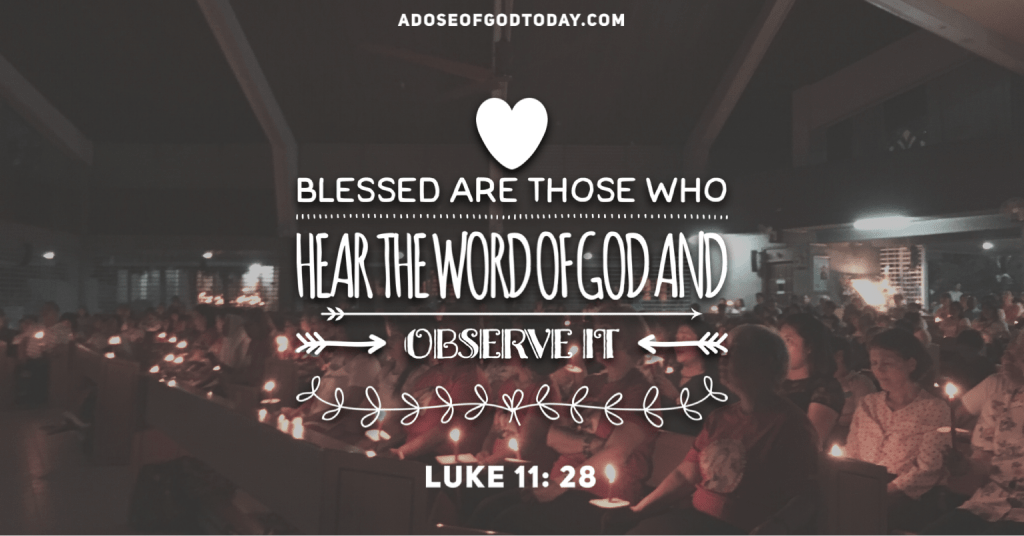
    Thus, the Gospel tells us how faith transforms a person. And so, the woman in the gospel praised Mary, the mother of Jesus for having a great son like him. Likewise, Jesus even praised Mary not just on this basis of her motherhood, but rather for being able to listen to the Word of God, pondering upon it and observing it.

    St. Anselm even affirmed that because of the great devotion of Mary to the Word of God in listening and pondering everything in her heart, the Word was made flesh within her.

    This tells us that Mary’s devotion to the Word of God did not only stop in mere hearing but the word spoken by God transformed Mary herself. Accordingly, Mary has become our best example of a person who did listen, accept and embrace God’s word. It was in that way that Mary found her joy, her peace and her freedom as a person, as a woman, as a wife and as a mother.

    Today, we, who received the gift of faith and the Word of God, through the Holy Scriptures, through the Sacraments, through our community, are also being invited that our devotion to the Word of God will not just remain a mere obligation or not just a part of our speech but will also transform us. Like Mary, let the Word of God and (faith) our human response of love to God become concrete and life-giving.

    let the Word of God and (faith) our human response of love to God become concrete and life-giving.

    Jesus invites us that as we listen to him, who is speaking to us now, we too will be able to accept and embrace His words. His words may become difficult and challenging, risky and time-consuming but also comforting and inspiring, life-changing and liberating. We will surely then find that as we listen and ponder the Word of God in our heart, our actions, thoughts and speech and our person will also be transformed into what God desires us to be.

    Let our experiences of difficulties, anxieties, confusion and fear in this age of pandemic lead us to listen more and deeper to God’s word and to God’s everyday invitations for us.

    Let us be conscious about to the Word of God revealed in this Eucharist and in the Holy Scriptures so that its inspiration, its warmth and power will give light and life in our relationships with our families and friends, and in the many efforts that we make in our studies and in our work. Hinaut pa.

    Jom Baring, CSsR

  • The difference between a demon-possessed and ego-possessed person

    The difference between a demon-possessed and ego-possessed person

    Advertisements

    October 9, 2020 – Friday of the 27th Week in Ordinary Time

    Click here for the readings (https://bible.usccb.org/bible/readings/100920.cfm)

    Homily

    What is actually the difference between a demon-possessed person and an ego-possessed person? Today’s Gospel tells us of the encounters of Jesus between these two. There is a much interesting response between these two groups of people.

    The “demon-possessed person,” because of God’s presence in Jesus, was driven out. The demon cannot withstand the power of God. The mere presence of Jesus was too powerful that they become restless. At Jesus’ command they come out at once and free the person.

    The person who was being possessed by a demon is not himself/herself anymore. The person’s mind and heart was being hijacked and taken over by the demon. Because of the possession, the person does things to harm the self, yet, not of his/her own freewill but according to the dictate of the demon. This makes, indeed, the person a prisoner, manipulated and controlled.

    In such situation, when we are being possessed by a demon, then, we are being denied of freedom, denied of joy, and denied of the light. Thus, we cannot help or save ourselves alone. Only through the help of another that we will be saved and be healed.

    Thus, what is more interesting is, a demon-possessed person recognizes God because demons fear God. A demon is afraid of the light because demons hide, becomes insecure with joy because demons are always sad, and losses its grip and control when the person realizes that he/she has the freedom to be freed and to be healed.

    The very presence of Jesus is the light that uncovers and brings into light those sins and pain hidden. Jesus is the joy that takes away our sadness. Jesus empowers and gives us the freedom to choose God and be freed.

    Consequently, a demon trembles at the presence of Jesus and frees the person from its control. This tells us that, indeed, a demon-possessed person recognizes God and kneels before the Lord because he/she is aware of God’s tremendous power of love.

    However, an “ego-possessed person” is filled with self-importance and self-entitlement. An ego-possessed person worships the ego. This kind of person only thinks what is good, what is beneficial and what is profitable for himself/herself. This person constantly seeks approval and praise from others. This person too believes that everything around him/her must serve him/her. He/she is more concerned of his/her personal importance.

    Accordingly, an ego-possessed person acts violently to people around him/her who will try to confront the failures and the wrong in him/her. When we become ego-possessed person, we become always suspicious, malicious and vicious towards the presence of those who will try to confront us. Ego-possessed persons feel threatened at the goodness and honesty of others. Ego-possessed persons feel threatened at the goodness and honesty of others.

    “Ego-possessed persons feel threatened at the goodness and honesty of others.”

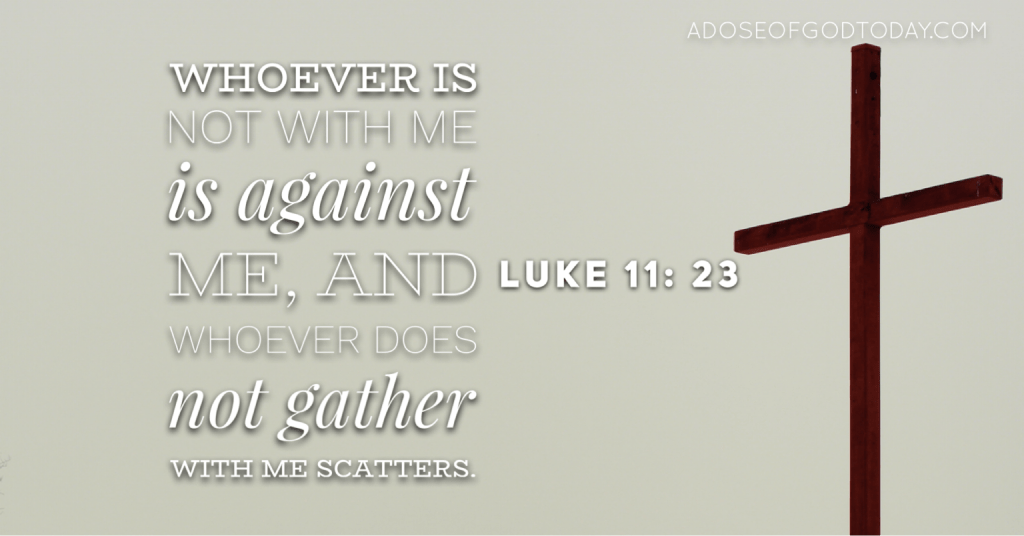
    This was the treatment received by Jesus from those who were ego-possessed people. These people who pretended to believe in God through their elaborate prayers and meticulous observance of the law, were more concerned of themselves and not of those in need and even of God’s presence. Jesus’ presence was a threat to them that is why they tried to destroy Jesus, to eliminate God from their life, and Jesus knew their thoughts (Luke 11:17).

    No matter how much Jesus wanted their conversion but their denial of God’s presence and power, prevented them. Their arrogance blinds and paralyzes their awareness of God’s presence.

    Nonetheless, the Lord never surrenders to reach out to us whether we are demon-possessed or ego-possessed persons. Remember what Paul tells us in his letter to the Galatians, “Christ ransomed us from the curse of the law by becoming a curse for us” (Gal 3: 13).

    It is God’s initiative by offering us eternal life. God actively confronts us and offers us the light, the joy and the freedom of living in God and with our community. We, who have been gifted with faith like Abraham, may always allow Jesus to confront us, to disturb us and to liberate us from whatever possessions we are being possessed. Hinuat pa.

    Jom Baring, CSsR

  • Ask, Seek and Knock

    Ask, Seek and Knock

    Advertisements

    October 8, 2020 – Thursday of the 27th Week in Ordinary Time

    Click here for the readings (https://bible.usccb.org/bible/readings/100820.cfm)

    Homily

    Is prayer an obligation? Many of us must have felt that prayer is an obligation, that it is some kind of a to-do list item or like a house chore that one must observe and follow. When I was young, I was taught that I “must and should” pray so that I become a good boy and God will not get angry. Many of us have developed ways of praying and different devotional practices like praying the rosary and the various novenas to the saints. Yet, many of us would always believe that prayer is indeed an obligation.

    Moreover, for us religious (priests, consecrated brothers and nuns) are actually obligated to observe our prayer schedules as defined by our Constitutions and Statutes. No wonder, that because of this “obligation to pray” we become guilty when we are not able to observe our prayers. People come to confession because of the guilt feelings of not being able to observe faithfully their prayers.

    However, did Jesus really mean that we are obligated to pray?

    Today’s Gospel on the “persistence in prayer” is a continuation of yesterday’s Gospel. Yesterday, the disciples asked Jesus to teach them to pray. This means that it was the disciples’ desire to learn how to pray. Never did Jesus impose it to the disciples. The disciples recognized the importance of prayer because they realized that this was a way of developing a closer relationship with God, to a deeper friendship with the Lord. This is the invitation for us today.

    On these particular verses of Luke’s Gospel, Jesus elaborated on how one should dispose himself/herself in prayer in order to develop ones friendship with God. Indeed, Jesus teaches us to be persistent in prayer and to continuously develop our closeness with the Lord. Jesus gives us these three attitudes in praying.

    ASK. Before we can truly ask the Lord, we also need to recognize and identify our need. Recognizing what we need means acknowledging our limitations, our emptiness, our failures and our powerlessness. This also needs an amount of humility to bow our heads and recognize that God truly fulfills and satisfies our hearts. This brings us into a deeper awareness of ourselves and to become more accepting of ourselves. Only then, that we can truly ask the Lord to satisfy the deepest desire of our hearts, and we shall surely receive the grace. Therefore, stop for a moment and pause.

    Seek. In the process of asking the Lord for the grace we need, there will be surely a time of becoming weary and anxious. We might feel that God is taking too long to answer and grant our prayers. Doubts may hit us thinking that we might have been forgotten. Thus, prayer also involves “seeking” as in “searching.” Prayer, then, is also a form of searching what is hidden and what remains undiscovered in us, waiting to be found. We don’t search for God for God has not been lost. We continuously seek and search ourselves and to let God find us. Thus, seek for a deeper insight, seek for understanding and wisdom because God answers us not outside of us but within our own context, experiences and relationships. Open the scriptures and seek God’s wisdom.

    KNOCK. God always waits for us to come closer and to dwell in God’s presence. When everything else in life will seem to be burdensome, we long for comfort. As demands from work, from home and from our relationship, and expectations from others begin to suffocate us, we long for a break. When failures, pains and guilt begin to take hold of us, we long for an embrace that will give us assurance of love and mercy. To pray is to come closer to God in order to knock the door of His heart. When we come and knock at God’s door, God is most willing to embrace us with His presence, with his forgiveness and mercy. To pray, then, is to seek entrance in God’s heart and to be welcomed by Him. Thus, never be afraid to knock because God is ready to open up His arms to embrace us. Come to the sacraments and be embraced by God’s grace.

    With these three attitudes in praying, these tell us now that prayer is never an obligation but more than that. To pray is a privilege given to us to build our friendship with God. When we pray, then, we embrace that opportunity to grow in the knowledge of ourselves and knowledge of God. The more we pray, the more we see ourselves. The more we become persistent in praying, the more we recognize the Lord’s presence in our life, both as individuals and as a community.

    Hence, move beyond obligation and instead, pray maturely and freely as we build deeper and intimately our friendship with God and with one another. Hinaut pa.

    Jom Baring, CSsR

  • In Praying the Rosary

    In Praying the Rosary

    October 7, 2020 – Memorial of Our Lady of Rosary

    Click here for the readings (https://bible.usccb.org/bible/readings/100720.cfm

    Homily

    The rosary has become a popular devotion to us. It has a rich history and miracle stories for the past hundreds of years. This repetitive form of prayer is not unique to us Catholics, but other religions too have their own similar to our rosary. Saints and ordinary faithful have been drawn to this form of prayer and have been passed down from one generation to the next.

    Many have become accustomed to wearing or bringing rosary beads and keeping them in wallets, bags, or cars. Some would consider it a spiritual weapon. Others would even believe that it is their amulet or their lucky charm.

    As we celebrate the feast of Our Lady of Rosary today, we are reminded of the significance of this ancient and popular devotion. The rosary which come from the words “rose,” is not just any amulet or lucky charm that we could carry around. It is not a way of bargaining with God that in praying the rosary God will be indebted to us that God has to grant our petitions. This is not a mere decoration of our identity but a tool for us to contemplate the life of Jesus.

    The rosary has its own history and indeed developed into a religious instrument for us to carry and pray easily the mysteries of our faith. In fact, the rosary reminds us of the life of Jesus and of Mary’s participation whose life is so significant in the story of our salvation.

    The mysteries assigned in each decade allow us to reflect on the actions of God within our human context, within human experiences. Take for example the joyful mysteries.

    The Annunciation of the Angel to Mary allows us to see how God fulfills his promise through us. Mary’s participation tells us that humanity can be pregnant with God and that we can bring God’s presence to others.

    The Visitation of Mary to Elizabeth reminds us of God visiting us in an ordinary but surprising way. When we are mindful of God’s presence, we would leap with joy just like the baby John in the womb of Elizabeth. This kind of excitement tells us how our heart and soul really long for God.

    The Birth of Jesus tells us that God is not far out there but He is here living among us. God tells us that He is not a God of anger, or punishment and condemnation but of peace and gentleness. God shows compassion to the humble and sinners for He has come to live among us.

    The Presentation of Jesus to the Temple reveals our innate desire to be with God, to dwell in the house of God, where God wants us to be.

    The Lost and Finding of Jesus reminds us of our anxieties and worries that may distract us. As Mary were so worried about Jesus, she pondered all those things in her heart that allowed her to encounter God even in a seemingly confusing situation.

    Other mysteries would certainly, also bring us deeper into the mysteries of the life of Jesus and also into our own lives. Praying the rosary is a life-journey to take with Jesus and Mary, to be able to make ourselves present in the life of Jesus. Consequently, this allows Jesus through Mary to be present in our everyday life and experiences.

    Thus, just as the disciples asked the Jesus to teach them to pray, pray the rosary also with the intention to change our heart and mind according to God’s desire for us and not the other way around. Pray the rosary and develop it into a habit but not merely to just murmur prayers, but a way to realize God’s manifestation in our life. Pray the rosary with Mary who is our powerful companion that we may also clearly see Jesus, and discern clearly His desire for us.

    Let us remember this, that as we pray the rosary, let us also allow God to be ever present in our life so that as we take our steps, we will be assured that God truly journeys with us. Hinaut pa.

    Jom Baring, CSsR