Category: Year 2

  • Friendship brings comfort in our distress

    Friendship brings comfort in our distress

    Advertisements

    November 7, 2020 – Saturday of the 31st Week in Ordinary Time

    Click here for the readings (https://bible.usccb.org/bible/readings/110720.cfm)

    Homily

    When we are in distress, in pain and in great confusion because of some difficult situation in our life, the people who come to share our troubles will surely bring comfort in us. Even when our friends cannot be present with us physically, but, their expression of being with us spiritually also brings confidence in our distressed hearts.

    While Paul was in prison, the people who became his friends never left him. The Philippians who were converts of Paul’s mission travels, remembered him. They had been Paul’s supporters in joys and sorrows. And when Paul was captured by those who were hostile against the Christians, the Philippians made sure to bring aid to Paul in whatever way they can. Paul was being persecuted. His prison cell must had been a terrible place to stay. However, to be alone in there could have been more lonesome and grim.

    That is why, Paul expressed in his letter to his friends, the Philippians, his gratitude to them. Indeed, his friendship with them brought comfort in his distress. Paul said, “It was kind of you to share in my distress.” To be remembered by friends and to have friends who are ready to empathize with us certainly brings confidence in us. Thus, more than the material gifts he received, Paul rejoiced for the gift of friendship with them.
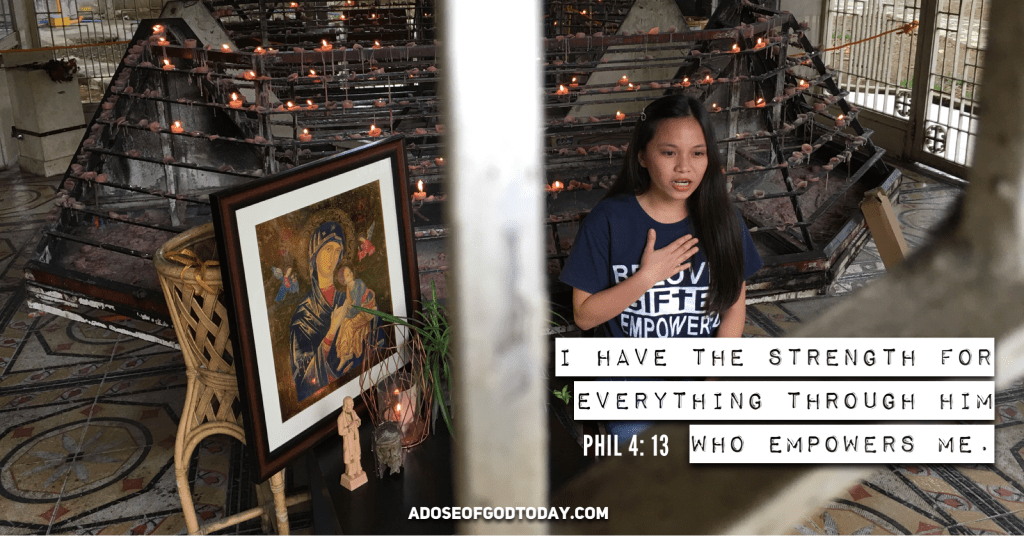
    Moreover, Paul also recognized that what gave him more strength was his friendship with the Lord. Paul expressed with confidence, “I have the strength for everything through him who empowers me.” This is also Paul’s invitation to the Philippians, that they too will grow more in their friendship with the Lord Jesus who shall give them the strength for everything.

    The Lord, indeed, gives us the strength for everything. Paul learned how to adjust in every situation in his life and how to make every difficult situation bearable because of his faith and confidence in Jesus, the Lord.

    This is the invitation for us today, that we become generous givers and gracious receivers of gifts. The Philippians became generous givers to Paul because they had been gracious receivers from Paul’s teaching and preaching. Paul, as well, became a gracious receiver of friendship from them because he had been a generous giver to them.

    This is the very value that Jesus reminds us in today’s Gospel, that we may not be possessed by our resources but become charitable. To become truly charitable is to become trustworthy even in small matters because we do not allow our hearts to be corrupted by the desire to have more and to keep more for ourselves alone.

    Hopefully, we may grow in our consciousness of becoming aware of the needs of others and to be more generous in giving our ourselves to those friends who need help. We may also grow to have a welcoming and humble heart to receive the help from our friends and become grateful more of our friendship. Hinaut pa.

    Jom Baring, CSsR

  • The Prudence of the Dishonest Steward

    The Prudence of the Dishonest Steward

    November 6, 2020 – Friday of the 31st Week in Ordinary Time

    Click here for the readings (https://bible.usccb.org/bible/readings/110620.cfm)

    Homily

    We have a puzzling gospel reading today. The master in the story praised the dishonest steward. But does it mean that Jesus also praises those who are dishonest? Certainly, no! It was not the dishonesty of the steward that was praised neither by the master in the story nor by Jesus but rather the ‘prudence’ of the steward.

    Let us look again how the steward acted prudently. The steward faced with a crisis, he was about to lose his job for being dishonest to his master. In his mind he couldn’t go on by becoming a labourer by digging or by begging. What he did, then, was to take away the commission that he would usually get from the debtors of his master. That is why he asked one debtor to make 50 for the one who owed 100 measures of oil and 80 for the other who owed 100 bushels of wheat. Surely, those debtors would be very happy of being unburdened of such debt. The steward had just thought about his future so that when he will be fired, there will be people who would hire him for a job out of gratitude to him.

    This is what Jesus tells us today, that as Christians, we are challenged to be prudent enough. We are challenged particularly in using and spending our material possessions in the hope of making our relationship with other people to be better. For this reason, we are called to be careful that we may not be ‘possessed’ by our own possessions which will only bring us into the danger of indifference and oppression towards the lowly and the poor.

    Consequently, we are also called to be fair and to be generous enough as we deal with those who are economically struggling. Thus, it would be a big help to support local vendors and local businesses, to buy products from local peddlers and show fairness with our own business too. Our material possessions can be best employed also in reaching out to others by feeding the hungry and clothing the naked especially those who are being affected recently by the super typhoon Rolly.

    Indeed, these are ways of recognizing God as the generous giver of graces. By being grateful to the Lord, may it move us then to be generous also to the needy. This is a way of building relationship with one another, building friendship and helping one another as a community of believers. Hinaut pa.

    Jom Baring, CSsR

  • God is Loving and Forgiving

    God is Loving and Forgiving

    November 5, 2020 – Thursday of the 31st Week in Ordinary Time

    Click here for the readings (https://bible.usccb.org/bible/readings/110520.cfm)

    Homily

    I find it disturbing that while Jesus was trying to bring people to conversion, to freedom and closer to God, there was a group of people also who grumbled and complained because of Jesus’ actions. The parable of the lost sheep and of the lost coin are images of God searching for those who along the path of life have lost their way, distanced from the community and from God. Yet, God longs and desires the presence of those who lost their way. Thus, these two parables tell us really how dear each of us in God’s heart. God will not rest and will not surrender until God wins us back and finds us again.

    However, such image and nature of God, was received with hatred by those who wanted to control God. The Pharisees and scribes complained and grumbled because Jesus was eating with sinners and being friendly with them. They did not want a God who forgives and redeems sinners and the lost. They wanted a God who condemns.

    This was the reason of their grumbling because they wanted a condemning God. Having this kind of God, then, they can easily incite fear among the people and control people according to their agenda and selfish intentions.

    That is why, Jesus’ presence was indeed a threat against these people, because Jesus was turning the table against them. Jesus revealed the true face of God, a loving and forgiving God.

    Hence, while Jesus tells us of God’s embrace and God’s longing for us, we too are reminded of our tendency to reject God. The Pharisees and the scribes represent that tendency in us to reject whatever is of God’s. However, just as the shepherd never stopped until he found the lost sheep and just as the woman searched carefully until she found the lost coin, God also continues to call and invite us, to search and to find us until we allow God to embrace us.

    This is something that Paul also realized. His letter to the Philippians recounted his past where he thought that he was already in the right path. Yet, Paul was a lost soul believing that righteousness based on the law was enough. However, when Jesus found him, Paul also found himself and gained everything in Christ.

    May these parables always remind us of this God who longs and desires for our presence, for our conversion and for our freedom. Moreover, may it move us too to be more embracing, accepting and welcoming of our brothers and sisters who need a lot of understanding and loving because of unfortunate circumstances in their life. Hinaut pa.

    Jom Baring, CSsR

    Please take more doses of God today. The only side-effect is for you to become holier.

    SPIRITED

    February 15, 2026 – Sixth Sunday in Ordinary Time Click here for the readings (https://bible.usccb.org/bible/readings/021526.cfm) “Do you believe in chain letters? or nowadays we may call it as Copy-Paste & Post OR-ELSE…. Facebook, Messenger, or Twitter posts?” At times, I have been asked about this, & I find myself giving the same answer. I say:…

  • Towards a healthy and holy human relationships

    Towards a healthy and holy human relationships

    November 4, 2020 – Wednesday of the 31st Week in Ordinary Time

    Click here for the readings (https://bible.usccb.org/bible/readings/110420.cfm)

    Homily

    Why do some human relationships cause more pain and harm than joy and peace in us? Why do some human relationships fail and eventually hurt us for the rest of our life? We have seen how broken human relationships bring people towards desperation, loneliness, bitterness, anger and hatred. The jealousy, unfaithfulness, insecurities, betrayal and irresponsibility can cause havoc and damage to our human relationships whether at home, at work, among lovers and couples, among friends and communities.

    But if we would really look at its roots, we will surely find “selfishness” as the active agent that corrupts our human relationships. Our tendency to advance our personal agenda, to prioritize what is only good for ourselves, to secure benefits for ourselves alone and to satisfy our personal desires above others will eventually make us very toxic to our relationships.

    Thus, a selfish lover or spouse will turn out to be abusive and emotionally manipulative. A self-centered parent can become controlling and even violent in words and actions towards the children. A self-centered friend can be constantly seeking recognition and praise from others or could be insisting to always consider his or her comfort but unwilling to compromise for the sake of others. These are just few examples of possible actions and tendencies of selfishness that can certainly destroy and cause damage to our relationships.

    That’s why, we also long for a relationship that will truly help us as persons and mold us to become better persons. The readings today have very important message for us and for our human relationships.

    For our human relationships to have a grounding and a better foundation, our relationships must be rooted in God not to our personal preferences and selfish intentions. This means that becoming a disciple of Jesus leads towards a healthy and holy human relationships. This is what Jesus meant as he said, “If anyone comes to me without hating his father and mother, wife and children, brothers and sisters, he cannot be my disciple.”

    Though hating one’s family member seems to be so harsh for us today, but Jesus did not mean the English word “hatred.” This is a Jewish idiom that meant for “preferences.” Thus, Jesus meant that when we give more preference or priority to others than God, then, we cannot be his disciple. Our human relationships too will lose a good foundation.

    Hence, Jesus also said, “everyone of you who does not renounce all his possessions cannot be my disciple.” The possessions, which could be our wealth and material things, self-image and fame, position and influence, achievement and status in the community, may possess us to the point that they become our priority rather than God and loving others through service.

    God asks us today to make Him as our priority over our other priorities. What is more beautiful here is God’s invitation for us to make our relationship with Him as the “life and soul” of our human relationships. It is from our relationship with God that, hopefully, we will become responsible and generous persons especially as we relate with others as a parent, sibling, a child, a friend or as a professional or whatever work, profession and status we have now.

    This is what Paul also expressed in his letter to the Philippians. A community that lives in the presence of God and rejoices in God’s presence “will shine like lights in the world.” Therefore, giving priority to God and making God the very center of our human relationships will transform us like lights in the world.

    Consequently, we will also witness how a couple whose relationship is grounded in God becomes loving and inspiring to others. A family whose relationship prioritizes God becomes a source of comfort, security and joy, becoming a true home. A friendship where the Lord plays the most important part among friends becomes welcoming and discerning.

    This is how the Lord moves us as we make God the very priority of all our human relationships. We may all work on this so that we will also become less and less self-centered and selfish and become more self-giving and life-giving. Hinaut pa.

    Jom Baring, CSsR

  • God has so much to offer for us

    God has so much to offer for us

    Advertisements

    November 3, 2020 – Tuesday of the 31st Week in Ordinary Time

    Click here for the readings (https://bible.usccb.org/bible/readings/110320.cfm)

    Homily

    God has so much to offer for us. In God’s infinite love for the world and for every creature, God became man and expressed in a loving service the love that redeems and gives the fullness of life. The Letter of Paul to the Philippians contains this early Christian hymn to Jesus, the Lord. In this hymn, God’s desire for us to have the fullness of life, the Son became man and lived a human life. The Lord “emptied himself” to show us how Jesus did not cling to his divinity so that we will be able to see his face.

    God broke the barrier that separated us from him. Because we cannot come near to God, and God came to be with us. This is how the loving service of Jesus became more life-giving. He was most willing to offer his life so that we may have the fullness of life.

    This is what our Gospel also reminds us today. The parable that Jesus gave reinforces this desire of God to offer us the fullness of life. As the master of the house also called the presence of the poor and the crippled, and blind and the lame and of those living in the highways and peripheries, God also invites us the wounded and the brokenhearted, the sinners and guilty. All of us.

    God, certainly, has so much to offer us. However, just as the invited guests found excuses not to go to the banquet, we could also become dismissive and indifferent to God’s daily invitations for us. Our lame excuses of having other affairs, of having fears and anxieties, of having other priorities, in overwhelming our hearts with anger and hatred, in filling up our mind with selfish intentions,  and in clinging to our habitual sins will surely prevent us to joyfully accept God’s invitation.

    God calls us to empty ourselves from all these unnecessary distractions and to fill our hearts and mind with God’s presence so that we may grow in that desire of God to experience the fullness of life in the here and now with our community. Hinaut pa.

    Jom Baring, CSsR