Here in our gospel today, Jesus summoned his disciples, gave them authority to heal every disease and sickness. He made his disciples share his authority and mission to preach the good news of salvation to all. He commissioned them and gave them the tasks to be preachers and evangelizers of God’s kingdom. Jesus added however that they should start, not elsewhere, but at home.
Since then and until now, as followers of Christ, we share the same authority and commission with the disciples to preach and witness the reign of God’s kingdom to all in our world today. And in the same way, we are to begin in our own homes, families, and communities.
In doing our tasks and mission as evangelizers and preachers of God’s kingdom, there is always a tendency or even a temptation for us to blame the evil in the world on others, and to reach out for our poor brothers and sisters in need who are far-away from us. But as Jesus would insist, we start to live our faith and practice what we preach in our own homes, in our own neighbors and communities. In other word. Charity begins at home.
For who are our neighbors? Our neighbor is the immediate person we live with, who needs our immediate attention and care. We don’t have to go out to help others; we start with our kasambahay, kapamilya. We start to correct and clean the evils and sinfulness in our homes before we deal with our world outside. Remember it was only later, during Jesus’ ascension that the disciples where sent to all the nations of the world. Start locally and then globally. Begin in your own homes nearby and then, into the world.
Being called & sent to be His missionaries today, with Our Mother of Perpetual Help, let this be our prayer : “Lord, grant me the grace to be what You want me to be, and to do what You want me to do, not there & later, but here & now at this very moment.” Amen.
Exercising authority in our community gives us the opportunity and capacity to serve others. This is how we understand it in a Christian perspective. This means that when we have authority over other people, this does not give us the right to belittle or put people down just because we have power over them.
Thus, in any community, organization or even in our workplaces, when we are given authority, it is rather meant to give us the ability in empowering others and facilitating others to be more productive, growing and maturing.
The giving of authority is what we have also heard in today’s Gospel. Jesus gave authority to his Twelve disciples. This authority has two functions. First, to drive out unclean spirits that terrifies and imprisons people. Second, to cure every disease and every illness of the people to whom they were sent. Through the authority given by Jesus to the Twelve disciples, the Lord gave them the opportunity and capacity to serve others by setting people free and bringing healing to the sick.
The Gospel tells us now that authority is a gift. It is given to us as an opportunity and giving us the capacity to serve others and not to serve ourselves or to serve those who are only close to us. Thus, exercising authority is a form of a loving-service. And we will know that it is a loving-service when in exercising authority it sets people free, inspires freedom, brings healing and creates a space for growth.
However, when authority is also used as a means to serve oneself by manipulating and overpowering others, then, authority discourages and oppresses people just like unclean spirits or demons would do. Moreover, in this case, authority will also be the cause of divisions, wounds and toxicity in our community or organization just like a disease or illness would bring suffering to a person.
Hence, Jesus calls us today that as we exercise authority in our own context and life-situations whether at home, at work or in our communities and organizations, we may always be able to inspire freedom, to allow others to be free and be agents of healing and growth. Kabay pa.
What would usually stop us from dreaming and hoping? What would usually prevent us from learning new things, from adapting change, from being creative and innovative? What would usually hinder us from fully committing ourselves and fully giving ourselves for others? What stops us from being truly free?
There could be more similar questions like these in your mind. Questions and concerns that limit us, hinder us and make us prisoners of our own fears. Yes, what we might find deep within us is this fear that shackles our spirit, our heart, and our very person to be truly free and life-giving.
Thus, Fear of being not accepted, of being rejected, and thus, of being hurt prevents us from being free, from sharing and opening up ourselves to and for others.
This is how we find that a traumatic or a painful experience of abuse in whatever form that is, or of betrayal, of failures, shame and guilt, or of separation and death – can paralyze our relationships, damage our self-esteem and hinder our maturity in all aspects of life that basically include the emotional-mental, spiritual and social aspects of life.
However, God desires that we become fully human according to God’s image, and that is by being truly free and having developed our full potentials as persons in all aspect of our life.
St. Irenaeus whose memorial we celebrate today, was bishop and a martyr in the Second Century. According to him, creation including us, every man and woman is not sinful by nature but only distorted by our sins. Moreover, he also said, that “the glory of God is to see every man and woman fully alive.” This means that indeed it is God’s desire that we will live life to the fullest expressed by being free, by being mature and by being able to develop our full potentials and building healthy relationships.
Yet, we are also aware that there could be hindrances in this vision of living life fully. Hence, it is good that we acknowledge them so that we will also be able to know on how we shall address them, healthily and maturely. And it is good that we do this, as all of you guys are about to end your academic year and move up to the next level of your academic studies. So, allow me now to bring you deeper into our readings today and let us discover together how God calls us today to become free from fear.
The Gospel of Matthew that has been proclaimed to us today tells us about the terrified situation of the disciples. “Why are you so afraid, you of little faith?” Jesus asked his disciples when they woke him up because they were terrified by the storm that was sweeping their boat. They were terrified because they thought they would all perish at that moment. The violent storm was too overwhelming for them that they did not know what to do anymore. The boat was being swamped by waves. And they were filled with fear.
This tells us that fear can actually paralyze us. Fear can prevent us in making movements and in making sound decisions.
Consequently, fear can also breed two unhealthy attitudes of the heart. First is STAGNATION. The second is COMPLACENCY.
There will be times that we become stagnant in life that we do not know what to do. The failures that we experience, the pain and the hurts that we are enduring could make us become stagnant especially, when these things are all being experienced at home, with our friends and with our community. Stagnation is not being able to move and go ahead. This tells us that when we become stagnant in life, we too become lifeless because we stopped from being creative and imaginative.
Second, we may become complacent, not wanting to move and go beyond, and not wanting to grow and mature perhaps because we have become comfortable to the point that we do not want to be challenged. Complacency is an attitude that settles to what is only minimal, staying always to what is only safe and easy for us. Though, it seems that complacency is not that bad, however, when complacency also affects our perspective in life and ways of thinking, then, it also affects the way we relate with others and the way we share our life with others. In fact, when we become complacent, we will refuse to do more, to be more and share more of ourselves to others. Being complacent will make us then, cold, unmoved and indifferent to the needs around us because we become self-centered.
These two unhealthy attitudes of the heart caused by our fear could also make us controlling and demanding in our relationships to the point that we direct others on how they should treat us, or accommodate us and love us according to how we want it to be. We do not think of others then, because we do not want any compromise. We only think of ourselves, locked in those painful past but terrified of the present.
Furthermore, the fear in us is also God’s entry point to bring renewal into our terrified hearts, to bring true comfort and freedom in us. Thus, going back to the Gospel story, Matthew also tells us that while the storm was sweeping the boat and the disciples were terrified by it, Jesus was fast asleep. Jesus was there in the boat with his disciples but sleeping. It seemed that Jesus was not so concerned with the violent storm. He was actually confident that they would arrive at their destination safe and sound. Therefore, the Lord calls us today to take these two important lessons that are also your take aways today.
First, do not forget that the Lord is with you. The forgetfulness of the disciples that Jesus was with them brought them tremendous fear and anxiety. They forgot that Jesus was in the boat and that their Lord was with them on that journey. Consequently, they have actually taken for granted the very presence of Jesus in their life. This is an invitation for the disciples to always recognize the presence of Jesus.
To each of us today, this is an invitation to recognize Jesus in our journey. The Lord is not distant. He is to be found and He is journeying with us, with you guys, to each of you! Thus, unawareness of God’s presence in us will only bring us fear, anxiety and uncertainty. When we become fearful, anxious and uncertain, then, we will be paralyzed mentally and spiritually. It will be very difficult for us to move on and to find opportunities for growth because we will tend to focus on the storm, on our fears rather on Jesus who is with us.
Second, the Lord confronts us with his presence. Because of the terrifying situation of the disciples, it became an opportunity for Jesus to reveal Himself as Lord and Savior. At this revelation Jesus assured his disciples that his presence brings comfort and peace, calmness and confidence. At the same time, the Lord’s presence also is confronting. Jesus confronts the fears and the little faith of his disciples. This is the reason why it was not only the wind and the sea that calmed down but also the terrified and anxious hearts of the disciples.
This reveals to us now that the presence of Jesus brings assurance and confidence in us. The disciples calmed down and found peace because at last, they have recognized the presence of Jesus who was there in that boat.
This invites us again to recognize the comforting and peaceful presence of Jesus in our life. Let us also allow Jesus to confront us especially our doubts and fears, and even our selfish, unkind and ungenerous actions and words. Do not walk-out and hide when we are confronted of our sins and failures, those are opportunities for growth. By being able to recognize Jesus and confront ourselves then we shall certainly find peace and calmness, confidence and assurance in Jesus. Kabay pa.
The laws and decrees of the Lord are important and essential in the life of the people of God. In fact, the whole Bible talks about this importance that indeed, it is in following the precepts of the Lord that we shall find fullness of life. Hence, every law and decree of the Lord is expressive of the covenant with God that gives life to the people.
This is what the first reading tries to tell us in the Second Book of Kings. When the King was made aware of the covenant with God and the unfaithfulness done by his ancestors, he realized how far they have gone away from the Lord. This made the king to recognize those sins and to repent which was symbolized by tearing off his garment. From that repentance, the king led the people to renew once more the covenant they had with God by following ordinances, statutes and decrees of the Lord with all their hearts and souls.
This is an acknowledgement that no matter how affluent or comfortable we can be in life, but when we are far from the presence of God, then we find life empty and full of sadness. Life is being lived fully through the grace of God.
Meaning to say that the covenant with God with its laws and decrees are ways of achieving the fullness of life and being fruitful in life. And being fruitful in life means living in peace, in freedom, in inspiring and giving life for others.
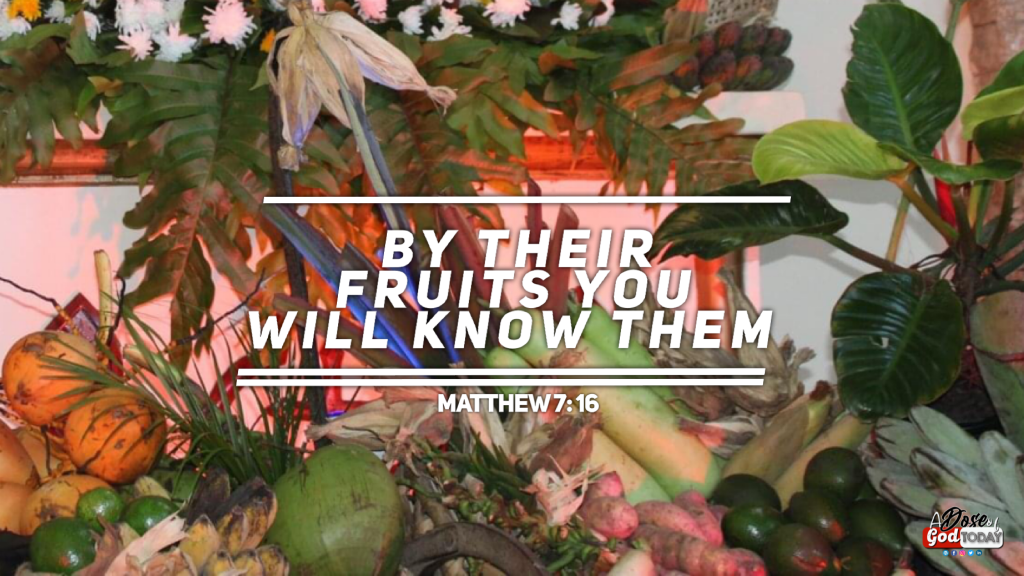
This is what the Gospel reminds us today. Jesus calls us to be fruitful in life and at the same time to be careful of false prophets who seduce us with empty promises of fruitfulness.
The main intention of false prophets is to bring us away from the covenant with God, and to ultimately keep us away from the fullness of life and leading us instead into the corruption of life.
False prophets can appear to us as a real or virtual person who may persuade us to believe in false hopes, false alarms, fake news and disinformation especially with what is happening around us today. The intention of persuading us to believe has certainly contained hidden political or religious agenda. But beware of these and be discerning because these will only bring away from reality and from our community.
Moreover, such false prophets can also take the form of empty promises from various addictions. Gambling, alcohol, drugs, sex, shopping, gadgets, or even excessive internet usage may promise to fill our empty and broken hearts that long for attention and care, recognition and acceptance, affection and love. These forms of false prophets may also seduce us to believe that these addictions and unhealthy coping mechanisms can provide relief from the pain that we feel, from the pain of losing a loved one, from a heartbreak, from rejection, or from failure, shame and guilt. However, this is not true at all. Succumbing ourselves into these empty promises will only bring us deeper into ruin and corruption of our life and of life around us.
When we realize that this kind of person, media site, or attitude and perspective in life does not bring us closer to God but away from Him, away from our true selves and from other people, then, beware because that will only bring us to bad fruits being produced and to corruption of life.
Thus, as Jesus calls us to live life fully by following his desire for us, may our actions and words, our relationships and encounters with people may truly produce life-giving fruits of love, of understanding, and of peace and reconciliation in our communities. Kabay pa.
Many of us would certainly find ourselves worrying about tomorrow, about our future especially when we are already experiencing difficulties today. This is how we would make plans for our dreams for ourselves and for our families because we want a future that is secured.
However, aside from these worries, we could also experience worries at home, at school, at our workplaces and even with our relationships. And when these worries become overwhelming for us, they affect our relationships. In addition, when we experience failures in our dreams or in our relationships that the worries become more intense.
Yet, in today’s Gospel, Jesus comforts us by reminding us, “do not worry about tomorrow, do not worry about your life.” Jesus first reminded his disciples who at that times became worried on what they would have and on how their future be like by following the Lord. St. Matthew, the author of this Gospel, wrote this story to also remind the early Christian Community during his time, not to worry too much with material things in life.
This is an invitation to be more trusting in God, in His divine providence. God, indeed, takes care of everything even the smallest creature on earth, how much more to us who are all dear to the Lord. God takes care for us.
Thus, we embrace today and claim this comfort from the Lord, not to worry too much, but to be more trusting in God and in his ways of doing good and wonderful things for us. This also teaches us to be more trusting with people around us, those who work with us and those who accompany us in this journey of life. Kabay pa.







 A DOSE OF GOD TODAY