Category: Year 2

  • LIFE? WHAT IS IT? 

    LIFE? WHAT IS IT? 

    September 22, 2022 – Thursday of the 25th Week in Ordinary Time

    Click here for the readings (https://bible.usccb.org/bible/readings/092222.cfm)

    Life? What is it? What do we have in life? Life can pretty be difficulty and overwhelming when one races to what only gives him or her pleasure and satisfaction. We may search for the meaning of our life, for the purpose of our life and mission of our life. Yet, life can be puzzling and confusing especially when we are faced with the painful realities of life.

    This is what the author of the Book of Ecclesiastes wants to tell us. All things in life is vanity, meaningless like a vapor that disappears in the wind. He may have sound pessimistic yet, true in his perspective. Nothing remains under the sun for everything passes away even life itself.

    However, not all actually. There is more in the suffering of life, there is more in the pains of life. But this is neither found in pleasure, in comfort, in riches, in power nor in any material possession we have accumulated.

    This was something Herod the tetrarch was after and looking for. He too was puzzled and perplexed at what life was revealing to him precisely because he was after vanity. He was after power and wealth. He was after pleasure and comfort. Such attitude made his heart hardened and cruel. As a result, John the Baptist who called him to repent and embrace life as it is, was beheaded by Herod. Thus, Herod became uncomfortable with the presence of Jesus whom he must have believed would take away his pleasure and privileges.

    What limited Herod was his belief that he will be satisfied with what he possessed and can accumulate in his life. Nevertheless, everything is vanity. Qohelet also says, “What profit has man from all the labor which he toils at under the sun?” All that Herod had vanished like a vapor.

    What is rather more in life is in giving life itself to others which we can find there in the relationships we have built, in the friendships we have created, among our families, communities and friends.

    As Herod kept trying to see Jesus, we may also keep trying to meet Jesus, to encounter Jesus in our human relationships, in our many encounters with people and have the courage and faith to give life as Jesus does. Kabay pa.

  • Love

    Love

    August 19, 2022 – Friday of the 20th Week in Ordinary Time

    Click here for the readings (https://bible.usccb.org/bible/readings/081922.cfm)

    Surely, we are all familiar that the greatest commandment is to Love. But perhaps we may consider why is love the greatest commandment. Why do we have to love, then?

    However we experience it in life, ultimately we realize that Love is our great response to the great Gospel that God is with us. Love is our most appropriate & productive response to the revelation of Emmanuel (God-with-us). Not only out of obligation & as commanded, loving God wholeheartedly is our response to the Good News that God is with us. We love because God is with us, and we are with God. Because God is with us, we come to love God by loving one another and ourselves. And we come to love one ourselves and one another by loving God wholeheartedly.

    Perhaps this can be described clearly in the quote that says: “The greatest thing you will even learn is to love & be loved in return.”

    Here we can highlight to two things.

    First, love is something we learn in life. For us to live in life, we must learn not only to breath the air, to eat food, to sleep and move to grow, but also we must learn to love to communicate with others. Love then is (like any other), the basic language we must learn in life in order to grow in our relationship with others. For us to grow, we must learn the personal, cultural, universal & spiritual language of love. Beyond science, math, survival & others, the greatest capacity we must learn to grow in life is the language of love.

    Second, to love & be loved is the greatest experience we may have in life. Love is not only a noun, but above all, both an active & passive verb. It is active experience -something we do & being done to us. Same way with a child, for us to be loved by others is life-giving & nurturing; and for us to love others in return is self & other-enriching.

    In love, being with God, others & oneself is Great. But without love, being with God, others & oneself is limited.

    So, since God is with us, not only as commanded but in response, we love Him wholeheartedly as we love ourselves & others; and we come to love ourselves & others by loving Him wholeheartedly. And how we love and be loved in return is all that matters in God & in life.

  • RSVP

    RSVP

    August 18, 2022 – Thursday of the 2oth Week in Ordinary Time

    Click here for the readings (https://bible.usccb.org/bible/readings/081822.cfm)

    In the parable of wedding banquet today, Jesus describes to us the Kingdom of Heaven as a celebration party where everybody is invited to attend & participate.

    Imagine it is your special day – perhaps your debut or your 50th birthday where you invited all your family, relatives & friends. As the day arrives, somehow you can deduce all your invited guests into these categories. First, the excellent guest who are invited, attended & participated in your celebration day. Second, not-so good guests: those who are invited but did not attend, however valid or invalid their excuses may be. Third, the unworthy guests: those who are invited & attended but did not participate. These are guests who came with their own self agenda rather than yours, not properly dressed for the occasion, avoid to socialize with other guests, stays mostly outside, decline to partake in the meal, late to arrive-early to go, & worse, even expect to bring something home from the party.

    Funny, it may be, but we do have experienced these types of invited guests: the excellent (angayan), the not so-good (way ayo), and the unworthy (way angay) guests. So, what kind of invited guest are you?

    Perhaps we may also ask: What kind of guests are we in the Lord’s Eucharist? As foretaste of God’s Kingdom, the Eucharist is our Lord’s celebration of faith & life. We are all invited to attend, participate, & celebrate in His Eucharist. On these pandemic times where & when we are somehow restricted & limited to partake in the Holy Mass, perhaps we examine ourselves as what kind of Eucharist guests we have been & we should be. Have we been & are we an excellent-worthy guests, irresponsive & not so-good guests, or unworthy guests?

    Jesus may have said in our gospel today: “Many are invited, but few are chosen”, not because they are discriminated but because they have been unworthy & irresponsible guests.

    Many times, I was asked: “Father, do we need to, have to and ought to Go to mass every Sunday?” I usually answer this with an advice: “Next time, before you go to mass, listen to yourself first and ask these questions: Who are you before God now? What do you truly long for in life? What are the graces and blessings that you receive this past week? What should you do to thank Him for all these?” In other words, before going to Mass, as preparation, acknowledge first how blessed you are, and these will move you to come and celebrate. Not out of obligation, necessity, convenience, and preference, we come and attend Eucharist to celebrate and give thanks to God for all the blessings He has given, showered, and continually offering us today.

    Though unworthy we may be, Blessed are we always for God still invites us to participate & celebrate in the banquet of Life with Him. May we be God’s excellent & honorable guests to be chosen worthy of His Kingdom & of His sacred banquet. Amen. 

  • Beyond Justice

    Beyond Justice

    August 17, 2022 – Wednesday of the 20th Week in Ordinary Time

    Click here for the readings (https://bible.usccb.org/bible/readings/081722.cfm)

    It is once said that: “Justice is getting what you deserve. Grace is getting what you don’t deserve. Mercy is not getting what you deserve.”

    In our gospel today, all hired-laborers got justice from a just wage for an honest day’s work. However, those who are hired-later received Grace & blessing for a chance to work though undeservingly late & last to work. And they also received Mercy for though deserving of rejection for hiring, they were given a chance for work & just wage instead.

    Judging from the merits of their work, the early-hired laborers complain & ask for Justice based on reward & punishment reasoning. However, not only justice but also grace & mercy are given to the late & last-hired workers, because of and based on God’s generosity & their faith.

    We are reminded here that God judges & sees us beyond our merits, reward & punishment reasoning, & justice.  In His grace & mercy, God loves us out of His generosity along with our faith in Him.

    Now in our relationship with God, are we IN only for His Justice, & our merits – our reward-punishment? OR are we more into His grace & mercy, His generosity & our trusting faith in Him?

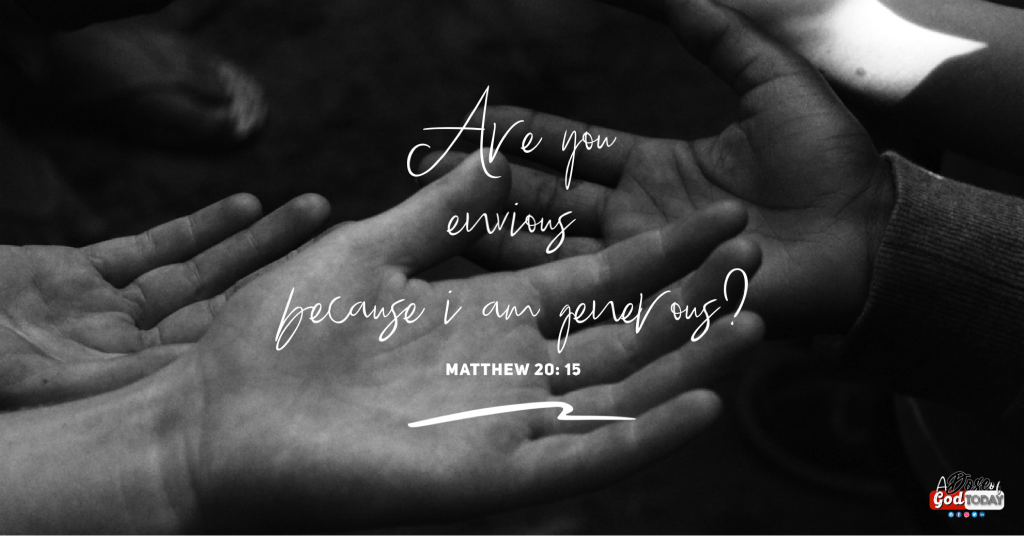
    Be reminded then of these words: “Friend, I am doing you no wrong; did you not agree with me for the usual daily wage? Take what belongs to you and go. I choose to give to this last the same as I give to you. Am I not allowed to do what I choose with what belongs to me? Or are you envious because I am generous?

    In your generosity, grant us Your Grace & Mercy O Lord, deserving or undeserving we may be. Amen

  • LIKE SERPENTS AND DOVES 

    LIKE SERPENTS AND DOVES 

    July 8, 2022 – Friday of the 14th Week in Ordinary Time   

    Click here for the readings (https://bible.usccb.org/bible/readings/070822.cfm)

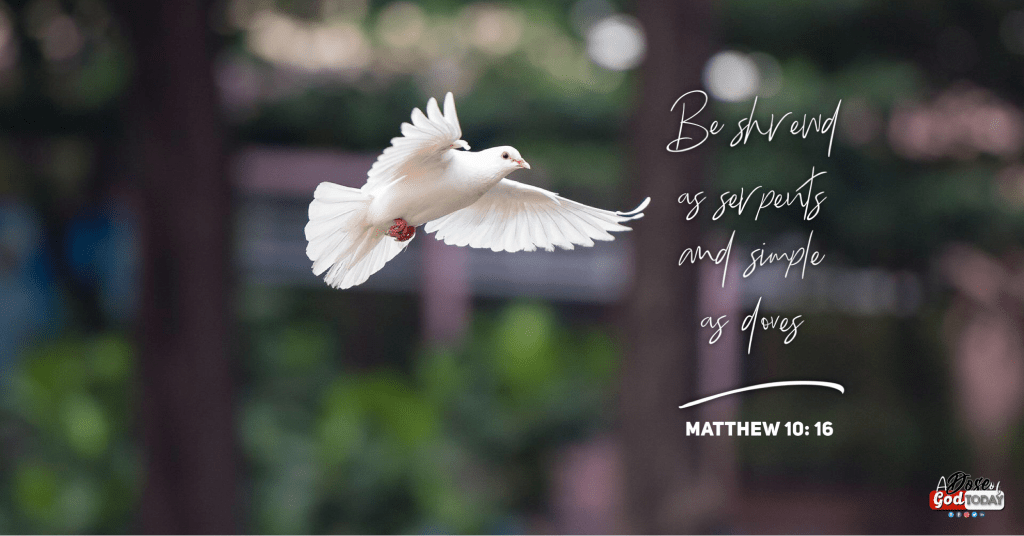
    “Be shrewd as serpents and simple as doves.” This is what Jesus said to his disciples and now addressed also to us. What does Jesus really mean about this?  In biblical understanding, the serpent is an image of Satan or of the devil. We remember, that it was the serpent that tempted the humanity to commit sin as told to us in the Book of Genesis. However, there are also other characters that the serpent possesses. The serpent is also believed to be wise, resourceful, flexible, adaptable, observant and cunning.

    This means that a serpent adapts to its situation in order to survive. It finds ways as it observes its environment. It is in this way that Jesus invites us to be wise as the serpent, that is, to have the character in us that is wise, resourceful, has the quality to adjust to a given situation, observant and discerning. Like the serpent, Jesus invites us not to react immediately out of our emotions only, or to make decisions imprudently.

    The dove is also understood to have the characters of being innocent, gentle, relax, peaceful, understanding and meek. The dove also represents the Spirit of God that brings comfort and peace, enlightenment and freedom. The dove reminds us of the gentle presence of God, never intimidating yet powerful, never imposing yet forceful.

    It is in this way too that Jesus invites us to be as innocent and simple as the doves. Like the doves, we are called to keep calm and to always claim our peace so that we may be able to respond to life with wisdom. We are also called to be gentle and to be simple in order to bring encouragement and hope to others around who are already troubled and anxious. Kabay pa.