Category: Year 1

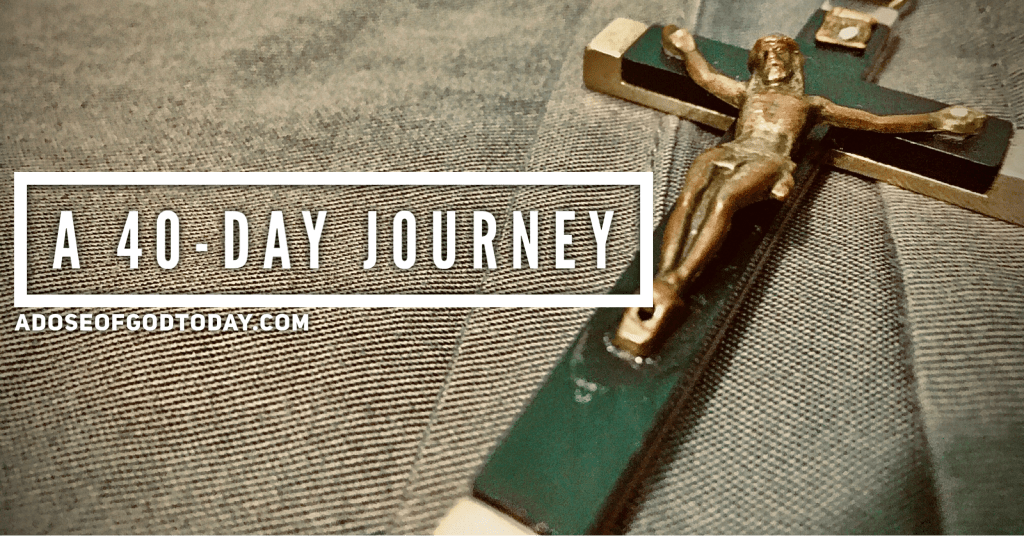
  • THE 40-DAY JOURNEY

    THE 40-DAY JOURNEY

    February 17, 2021 – Ash Wednesday

    Fr. Manoling Thomas, CSsR

    Click here for the readings (https://bible.usccb.org/bible/readings/021721.cfm)

    This day ushers in, the beginning of the Season of Lent in our Catholic Liturgical Calendar. “Lent” comes from an old English word for “spring” one of the four seasons in colder countries. For those of us living in the tropics, we may not appreciate much the noticeable change or transition from “winter to spring”. We can then focus on the practice in the early church before the “infant baptism”. Those preparing for baptism on the Easter vigil, begin their “instructions or catechesis on the faith” today. They were called the “catechumens”.

    How about us, who are already adult, baptized Christian Catholics? How can we creatively envision the Season of Lent? We can liken it to Jesus inviting us to embark on a 40-day journey or pilgrimage with him! We will be with other disciples of Jesus, whom he has also invited! Our destination: Jerusalem. Expected day of arrival: on Palm Sunday, the start of the “holiest week of the year” [Holy Week].

    What possible activities we can engage in during these “40 days”?

    1)  With the help of the Holy Spirit, to discern what “repair work” has to be done in a specific area of our life. Will it entail a repair, or a remodeling, or a cleansing and healing? Discus this matter with Jesus! 

    2)   Select a good book that is simple, readable, and will be helpful for the purpose of your journey with Jesus.

    It will be helpful if during this journey, you will find a fellow Christian also in the journey, with whom you can prayerfully and freely share your realizations. Encourage and help each other as you journey with Jesus!

    The Holy Spirit may suggest to you other nourishing and fruitful ways to do this 40 days journey! Be open to the Holy Sprit!

    If you have decided to accept Jesus’ invitation, then step forward to receive the ashes. This will indicate your willingness to join the 40 days pilgrimage! Although you are doing this with other disciples of the Lord, this journey is “a walk on a very personal road” from where you are at present to where Jesus invites you to go!

    If this invitation is late in reaching you, you can still catch up!

    [source: Daily Homilies vol. 3, Krempa]

  • WHAT INFLUENCES YOU?

    WHAT INFLUENCES YOU?

    February 16, 2020 – Tuesday of the Sixth Week in Ordinary Time

    Click here for the readings (https://bible.usccb.org/bible/readings/021621.cfm)

    Each of us is being influenced by many things and people around us. Sometimes, we may not be aware what really influences our thoughts and hearts because we are not aware of our environment. The popularity of the Social Media, of Facebook, YouTube and Instagram especially brought so much influence into our individual lives. These sites have reshaped cultures, social status, age, even beliefs and values.

    However, when one is not also aware of the kind of influences that he or she is welcoming, those influences may bring the person into better or into worst. Moreover, even our own words, spoken or written, can also influence others to become better or to become worst. The rise of fake news entertained by many has been very damaging into our culture and relationships. People who are not aware of the sources and the credibility of the report, are being deceived and in effect brought more damaged to the community by spreading them.

    Such is the warning that Jesus reminded to his disciples. The Lord firmly warned his friends, “Watch out, guard against the leaven of the Pharisees and the leaven of Herod.” The leaven being used to make the dough to rise, was used as an image by Jesus to depict the silent but cunning influence of the Pharisees and of Herod. The passive yet indifferent, aggressive and oppressive attitudes of the Pharisees and of Herod can become alluring to people who tend to seek recognition and praise and those who tend to worship the powerful and the corrupt, the arrogant and the aggressive.

    These tendencies were also present among the disciples. This was the reason why Jesus reminded them when they began to worry of having not enough bread with them. Even until that moment, they have not yet recognized that the Lord was with them and had already worked wonders by feeding thousands of people.

    Today, like the disciples, the Lord also calls us to watch out of those distractions that may lead us away from the grace of God. God is working wonders in us and through us.

    Thus, recognize today those wonders that God is doing to you. Let not our hearts be influenced by passivity, by indifference, by arrogance, by aggressiveness or by any fake news about God, about ourselves and about others. Rather, look always of those many wonders that God is doing in our lives. Be influenced by God’s grace in our sacraments. Be influenced by His words in the bible. Be influenced by the Holy Spirit. Hinaut pa.

  • Beyond Signs

    Beyond Signs

    February 15, 2021 – Monday of the Sixth Week in Ordinary Time

    Click here for the readings (https://bible.usccb.org/bible/readings/021521.cfm)

    Once we happened to be night driving from Sagada to Baguio City. As we were fast approaching the city at around three o’ clock in the morning, we got lost looking for traffic signs. We happened to see a police outpost & we asked the police: “Sir, where is the road going to Baguio?” And the police officer replied: “This is already Baguio.” We realized how foolish we are looking for signs that we missed what is obvious – that we are already in Baguio.

    In our gospel today, the Pharisees try to test Jesus by asking for a sign from heaven. It seems they have missed a lot of signs & miracles already revealed, like the healings of people, casting out of demons, feeding of thousands, & countless of people following Jesus. Great things have been already happening in their presence but they still look for signs. They are yet to recognize God is in all things, already surrounding us with signs of His presence & love.

    Somehow during these pandemic times, like the Pharisees, we may have found ourselves searching for a sign from heaven. We may have asked & looked where God in all these things going on & happening to us.

    Be as it may. Jesus however said: “Why does this generation ask for a sign? Truly I tell you, no sign will be given to this generations.”  Beyond his frustration & exasperation, Jesus is telling us here that we don’t need anymore signs, for His presence is better enough than what we are looking & searching in life. All we have to do is just to look, recognize & believe in Him who is God’s way, will, & plan for us.

    True indeed, we may concern & worry ourselves with signs, that we may have missed the obvious presence & blessing already upon us.  Remember that God’s graces are not only about the blessings we ask & look for in life but moreso about Jesus, the source of our blessings already given us & have with us – better & beyond than what we ask for, though yet to be recognized & accepted into our lives.

    So, stop looking for signs, rather, Start looking at Jesus.

    In other words: “If you cannot sleep, stop counting sheep. Talk to the Shepherd.”

  • A CLENCHED HAND OR AN OPEN HAND

    February 15, 2021 – Monday of the Sixth Week in Ordinary Time

    Fr. Gibo Dandoy, CSsR

    Click here for the readings (https://bible.usccb.org/bible/readings/021521.cfm)

    When it comes to giving and offering to God, do you take a clenched hand or an open hand?

    We all have different attitude or take on the call of generosity. Some are loose and generous; others are tight and stingy. Some give from their surplus; others from the meager they have. Some give gladly, while others grudgingly.

    Allow me to reflect on our first reading from the Book of Genesis, particularly because it has provided us two (2) models of giving to ponder on ourselves:

    The first model is that of Abel. Abel is a shepherd, and he brings the best firstlings of his livestock and some fat as well and offer them to Lord;

    The other model is that of Cain. Cain is a farmer, who brings the fruits of the soil as an offering to Lord.

    Now let us pay close attention to the Lord’s response to their individual offerings? “Now Yahweh was well pleased – ‘looked with favor’ – on Abel and his offering, but towards Cain and his offering he showed no pleasure.”

    What’s wrong? What’s the difference?

    Yes, both have offered to the Lord. However the Lord was so pleased or delighted with Abel and his sacrificial offering because Abel did the right thing by giving or offering what the Lord so deserved. He gave the best and choiced portions of his produced. Not the surplus nor the least.

    But with Cain, the Lord was displeased because Cain was very reluctant in offering what was due to the Lord.

    Today, God has given us one of the secrets of living a blessed and full life, that is by way of giving God generously: from the best and the choiced portion of our produce. For He is able to multiply our blessings beyond human estimation.

    And so, when it’s time to give, “Let not your hand be open to receive and clenched when it is time to give. (Sir. 4:31.)”

  • The Cycle of Blaming

    The Cycle of Blaming

    February 13, 2020 – Saturday of the Fifth Week in Ordinary Time

    Click here for the readings (https://bible.usccb.org/bible/readings/021321.cfm)

    “No, not me! It was her!” The Man must have pointed his judging finger to the woman who gave him the fruit. Yet, the woman too responded, “Not me either. It was the serpent!” Both of them denied responsibility of eating the fruit and realized that they were naked. Both succumbed to the blame-game to deny full responsibility to their disobedience.

    However, what was really the issue in this story? Was it because of eating a desirable fruit? Was it because of the presence of the serpent that tempted them? Or the presence of evil around?

    Both of them, the woman and the man, were tempted not just by the desirable fruit to eat. The fruit was only a symbol of a greater temptation. The serpent that was very cunning, engaged the woman in a conversation by asking, “Did God really say that you will die?” It was only an opening of the serpent’s temptation for both man and woman to believe that they can become like God. This means that the temptation was in believing that they will be in complete control of everything. They must have believed too that they did not have everything in paradise. And so the unquenchable desire to have everything must have consumed them. They can only have everything if they too will become like God.

    Yet, the moment they tasted the fruit and came to know what is good and what is evil, they too realized their smallness before God. This was how they hid from the Lord God. They knew that they have sinned and that sin led them to fear. Fear is filled with guilt and shame. This is the reason why Adam and Eve were hiding. Their nakedness tells us of their guilt. Yet, their guilt never assumed the responsibility that they have sinned. As a result, they became trapped in the cycle of blaming. Adam blamed Eve. And Eve blamed the Serpent. And perhaps, we as readers, might also blame God for putting the serpent among them.

    Because of this, the intimacy between man, woman, and God was shattered. In the same way, man and woman lost their closeness with God. It was them who distanced from God. Thus, sin, without acknowledgment makes us hide yet, it leads to destruction and to death.

    However, this is also how God intervenes. God calls us and God continues to find us not to condemn us or to destroy us but to renew us, to recreate us, to give us the fullness of God’s grace and presence. This is how the Gospel tells us also of the heart of Jesus. Jesus felt the hunger of the people. Jesus felt their need to be filled and be satisfied.

    That is why, God calls and finds us when we try to hide because of shame and guilt. God does that because as the Gospel said, the “heart of Jesus is moved with pity.”

    Let us also remember, when we ty to separate and distance from God, God initiates to come to us to invite us to come closer to Him in humility and to end the cycle of blaming. Thus, let not our fear, guilt and shame prevent us from seeking God’s mercy. God offers the abundance of grace through the sacraments, let us come and be renewed, be recreated and be given the fullness of God’s grace. Hinaut pa.