Some of us know this very attitude or tendency in us of “Sakto lang” (just enough). This means that we do what is required and nothing more. At work, we come on time but never earlier. We finish what is assigned but we do not go the extra mile. Even in relationships, sometimes we keep things safe, friendly, polite, but not too involved or invested.
Even in our faith, this can happen as well. We attend Mass on Sunday, we fulfill our obligations, and we feel that is already enough. There is nothing wrong with doing what is required. But today, the Word of God asks us a deeper question, “Is my love only at the bare minimum?”
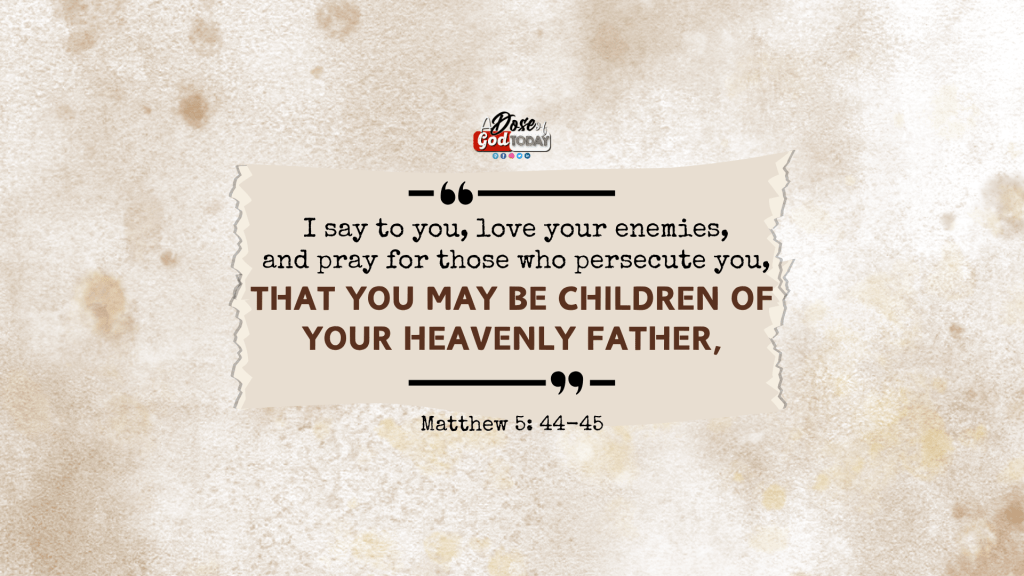
In today’s Gospel, Jesus asked, “If you love those who love you, what is special about that? And if you are friendly only to your friends, what is so exceptional?” These words are challenging. Because loving those who love us is easy. Being kind to those who are kind to us requires little effort.
Yet, Jesus is not calling us to the easy kind of love. He is calling us to something more, that is, to love even our enemies, to pray for those who hurt us, to go beyond what is comfortable and safe.
Sometimes we live life at the minimum level. We do only what is expected. We avoid extra effort. We keep our relationships shallow to avoid risk. We stay within what is convenient and beneficial for us.
However, when life becomes only “minimum,” something slowly happens. We too become complacent. Then, indifference follows. And when we become indifferent, our hearts grow cold toward others and even toward God.
This is what Jesus is warning us about. Because love that stays at the minimum stops growing. And so, we lose our warmth. We lose our passion.
We actually see the opposite of this kind of love every day. Parents who sacrifice so their children can study. Couples who stay faithful despite differences and struggles. Teachers, nurses, and workers who go beyond their duty to serve others. Real love does not count the cost. And real love goes the extra mile.
In the first reading from Deuteronomy, God reminds His people to follow His commands with all their heart and all their soul. And God promises that they will be His people. This is not just about rules. It is about relationship. God gives Himself fully to us. In return, the Lord asks for a wholehearted response not half-hearted, not minimum, but complete.
That is why Jesus ends the Gospel with these strong words: “Be perfect, just as your heavenly Father is perfect.” This does not mean being without mistakes. It means loving the way God loves us generously, patiently, and without limits.
This Season of Lent calls us now in going beyond the minimum in our love.
This could mean “forgiving someone we have been avoiding; giving time to a family member who needs attention; being patient with a difficult co-worker or classmate; helping someone even when it is inconvenient; or serving the Church or the community, not only when it is easy.”
Yes, there is beauty in minimalism in many things. But not in loving. When it comes to love, we are not called to be minimalists.
Because God did not love us in a minimal way. He gave His time, His mercy, His patience. And He gave His Son for us.
So this Lent, let us ask ourselves honestly: Am I only doing the minimum in my faith? Am I loving only those who are easy to love? Where is the Lord asking me to go the extra mile?
Indeed, may we love as much as we can, as God has loved us generously, concretely, and wholeheartedly. Hinaut pa.
Today we celebrate Red Wednesday, a day when we remember, honor, and stand in solidarity with Christians around the world who suffer for their faith. We remember and pray for those who are silenced, displaced, threatened, and even killed because they follow Jesus. For most communities, Red Wednesday is a solemn reminder of a suffering happening “somewhere else.” But for us, this day carries a deeper weight and meaning.
We do not remember persecution as something distant. We remember it as something you have survived. You carry scars in your minds, in your bodies, and in your hearts. These are the scars of the 2017 Marawi Siege, and more recently, the 2023 bombing, when violence interrupted our prayer, our peace, our Advent hope.
And yet, here you are. Still praying. Still gathering. Still believing. And still choosing Christ. If the color red symbolizes the blood of martyrs, then the red we wear today also symbolizes your courage, your endurance, and your unbroken faith.
Hence, we are all here because hope, no matter how wounded we are. This is what today’s theme proclaims, “Living Hope Amidst Suffering.”
In the first reading from Prophet Daniel, King Belshazzar holds a feast of arrogance and disrespect. In the middle of his pride and extravagance, a mysterious hand appears and writes on the wall, “You have been weighed in the balance and found wanting.” Belshazzar used sacred things for selfish purposes. He mocked what was holy. He exalted himself instead of God.
Indeed, persecution anywhere in the world often comes from the same attitude. This is the arrogance that refuses to respect human dignity, a pride that rejects God, and a heart that worships violence more than life. And this may come politically and ideologically motivated.
But while Belshazzar was “found wanting,” you, the people of faith, the survivors, the steadfast disciples, you have been weighed in the balance and found faithful.
You did not give up your faith, even when fear tried to choke it. You did not stop praying, even when prayer became dangerous. You did not stop loving, even when hatred and suspicion tried us.
If the writing on the wall declared judgment on Belshazzar, the writing on your lives declares something else entirely that “You have stood firm in the Lord.”This is hope found alive in us, in each of you.
Moreover, in the Gospel, Jesus warns His disciples that persecution will come. Not “maybe,” not “possibly,” but certainly.
Jesus said, “They will seize you.” “They will hand you over.” “You will be hated because of my name.” Jesus does not sugarcoat discipleship. He does not hide the cost of faith. He does not pretend Christianity as a path of comfort and power.
Indeed, these words are not theoretical for you. You know their truth. Yet, Jesus is not giving this warning to frighten us. The Lord gives it to strengthen us. And so, Jesus now gives us two promises. These promises are born from His own suffering love.
The First Promise is “I will give you words and wisdom.”Jesus assures us that in difficult times, we are never alone in our fear. The Holy Spirit is with us, guiding, strengthening, whispering courage into our trembling hearts. And indeed, this community has spoken words of hope when silence seemed safer. You have shown kindness when anger felt easier. You have extended forgiveness when hatred tried to dominate. You have lived this promise.
The Second Promise is “By your perseverance you will secure your lives.” Perseverance, that quiet, stubborn faith that refuses to give up, is what saves us. Not the absence of suffering, not forgetting of memory, but the courage to rise again despite everything.
The siege tried to break us, but you stood. The bombing tried to silence worship, but you returned. Fear tried to isolate you, but you gathered again at the table of Christ.
This is what living hope looks like. A hope that limps but keeps walking. A hope that trembles but keeps believing. And a hope that cries but keeps loving.
Today, Red Wednesday invites us not only to remember suffering, but to remember how God works inside our own suffering.
Hope is not pretending everything is fine. This is merely optimism. Yet, hope is not about being optimistic. Hope is believing that God is working, even when nothing feels fine. Hope does not erase ours tears. It accompanies them. Hope does not deny wounds. It transforms them. And hope does not avoid danger. It gives courage to stand, to remain and be still before the presence of God.
And so, this day is more than commemoration. It is a call to deepen our faith, to widen our compassion, and to strengthen our mission as disciples of the Crucified and Risen Christ.
Because those who have suffered greatly are the very people that God sends to become witnesses of hope for the world. And you, brothers and sisters, are living proof that the Christian story is not a story of defeat, but of resurrection. Our Christian story is not a story of darkness, but of dawn. Not a story of violence, but of victory. This is the victory of love.
Now, Red Wednesday does not simply ask us to remember. It rather invites us to respond. We are asked…
How will we honor the suffering of others if we do not let our own suffering teach us compassion?
How will we carry the memory of our wounds if they do not lead us to deepen our prayer, widen our love, and strengthen our commitment to peace?
How can we claim to follow a crucified King if we refuse the path of forgiveness, reconciliation, and hope?
Indeed, suffering can make us bitter or better. It can harden our hearts or open them. It can close our hands or make them instruments of healing. Being persecuted, certainly, does not give us permission to hate. It gives us a mission to love even more dearly. Being hurt does not give us the right to close our hearts. It gives us the grace to open them wider. Being attacked does not mean our story ends in fear and trauma. It means Christ calls us towards courage, healing, unity, and peace.
We now realize that living hope amidst suffering is not passive. It is a choice. A daily, brave, exhausting, and holy choice. And so, I leave you now three takeaways to make hope alive in us.
First, pray intentionally this week for those who have hurt you. Even a simple prayer: “Lord, bless them. Heal them. Change their hearts.” This maybe a difficult prayer to make for those who have hurt us but also powerful in transforming our hearts.
Second, reach out to someone who suffers in silence. A neighbor who is afraid. A young student who is traumatized. A parent who is struggling or sick. Sit with them. Listen to them. And be a small beam of Christ’s light and love.
Third, commit one concrete act of peace-building. Repair a relationship. Start a dialogue. Help rebuild a broken community bond.
Friends, you have passed through fire, but the fire has not consumed you. Let is refine you. On this Red Wednesday, may your courage shine, your wounds speak truth, and your faith stand as a beacon of hope for a world that desperately needs it.
May this Red Wednesday remind you that you are not just survivors, you are now bearers of living hope. Hinaut pa.
Tomas loved collecting shiny things. He had always new gadgets, loud toys, and flashy decorations. His small house sparkled with many things, but nothing he owned actually ever lasted. One day, his old neighbor Nanay Cita invited him for snacks. He saw how her house was plain. Yet, something was different. It was rather filled with laughter, stories, and warmth from her family members and other neighbors. Tomas realized that her joy came not from flashy material things, but from people and moments lovingly shared.
Recently, when a typhoon hit and flooded their community, his many shiny items broke and gone. While he felt devastated, Nanay Cita and other neighbors came to help and brought hope to others. This was how Tomas finally understood that what truly lasts are relationships, kindness and simple joys.
Today, in our first reading, Prophet Daniel interpreted the vision of King Nebuchadnezzar. It was a dream of a great statue made of different materials. Yet, all of which eventually crumbled when struck by a small stone. Daniel told us that this stone represented the Kingdom of God. It seemed small and humble. Though it was unnoticed by the world, it was the only thing that lasts forever. Indeed, kingdoms rise and fall, powers come and go, but the Kingdom of God stands firm through all ages.
Jesus, in today’s Gospel, echoed this truth. While the disciples admired the beauty of the Temple, Jesus reminded them of an important lesson. Even the most impressive earthly things will one day pass away. What endures, Jesus said, is not the expensive stones of the Temple. What lasts is the steadfast trust of those who remain faithful. They stay committed in the midst of trials, challenges, and uncertainties in life.
Today these readings also speak deeply to my heart as I celebrate my 8th Anniversary of Priesthood. As I look back, I see many moments of weakness. There were many moments of unworthiness. I felt pains and hurts. There were times when I felt like that fragile statue in the king’s dream. It was easily shaken and easily broken.
And yet, by the grace of God, I remain and still finding joy. Not because of my strength, not because of my abilities and potentials but because of God’s faithfulness. The stone that never crumbles is the unwavering goodness of God to me and to everyone whom I have encountered in my journey as a priest. This has been the foundation of my priesthood.
If there is anything my eight years have taught me, it is this – God uses weak instruments. He chooses broken vessels. He works through imperfect servants so that His glory and not ours, may shine and bring life. This is what I witnessed, every time I felt tired, God renewed me. Every time I felt unworthy, God reminded me that the call is His, not mine. Every time I doubted, God remained faithful.
I realized that certainly, this is not just my story. It is the story of every believer who tries, fails, rises and hopes again, and continues to walk with God.
In fact, the world tells us that we must be strong. We must be impressive. We must be powerful like the mighty statue in the vision of the King Nebuchadnezzar. However, God tells us, “Just stand on the Rock. Stand on Me.” This is an invitation to find God as our true strength, our refuge and our security.
Now, as we near the end of the liturgical year, these readings invite us to reflect: What in our lives is temporary, and what truly lasts? Are we building a kingdom that will one day crumble? Or do we place our trust in the Kingdom of God that cannot be shaken?
Today, I thank God for eight years of priesthood, not as a journey of perfection, but a journey of God’s unwavering mercy. I ask you to continue praying for me. Please pray that I remain faithful to the Kingdom of God that lasts forever. May I always find joy in my ministry and bring life to others.
May the Lord strengthen all of us to trust not in the passing things of this world, but in the enduring goodness of God. I leave you now two simple and practical takeaways.
First, build your life on what lasts. Spend more time each day on prayer, kindness, forgiveness, and love. These are the things that remain.
Second, trust God even in your weaknesses. Whenever you feel unworthy or discouraged, whisper a simple prayer, “Lord, You are my strength. I stand on You.” Hinaut pa.
A parent’s touch truly brings relief and comfort to a sick child. A lover’s touch also brings affection and assurance of love. A therapist’s touch certainly brings healing to our aching muscles.
There is, indeed, life in human touch. Yet, this only happens when our touch is gentle and expressed in kindness and love. When touch is filled with malice and bitterness, then, touch also becomes violent. This touch causes pain and could even abuse life, prevent life and take away life.
In today’s Gospel reading, we are reminded of the wonder and power of a gentle touch. This is a touch that cares, heals and gives life. Jesus showed this many times in his healing miracles. Moreover, this time, Jesus manifested his gentle and powerful touch in a different level.
Jesus, as he saw the grief and sorrow of a widowed-mother who lost his only son, was moved with pity. His pity was filled with concern and compassion to a woman who had become hopeless. In a patriarchal society, women had no rights. Her only son was her only hope in life after losing her husband. With both men dead, she was like a “double-dead” person, died twice over again.
Jesus saw this and felt the seemingly hopeless situation of the mother. Further, Jesus also witnessed how things can be unfair. The young man, who must have died of an illness, lost hope towards maturity. He was deprived of the opportunity to discover and hone his potentials as a young man. He also missed the chance to live life to the fullest.
The coffin was somehow the very box that deprived both the mother and her son of hope and life. This greatly moved Jesus. As a response, Jesus did not just remain a passerby. “He stepped forward and touched the coffin.”
“Young man, I tell you, arise!” These words of Jesus renewed hope and life both to the mother and her son who was dead, but was given back the gift of life.
Jesus touched the coffin! He dared to touch that box that tells us of the deprivation of life. Jesus touched the coffin to renew life and renew hope.
We may not be dead yet, but, we too might be already in a coffin, limited in a box of pain and trauma, of loneliness and sadness, of anger and sin. Like the mother, we too might be grieving because of our frustrations and failures, unable to see hope and life. Life can be so unfair for us, leading us to our overwhelming burial of suffocation.
Yet, life is not hopeless at all. There is always hope. Jesus sees and feels our own pain and difficulties. In the same way, the Lord desires to touch our own coffins. He wants to bring life to whatever is preventing and depriving us of living fully.
Let us allow the Lord to gently touch us through the sacraments of the Church. These sacraments truly bring grace of peace, healing, and life. Allow the Lord to touch our hearts through the Holy Scriptures, through His words that will challenge and move us towards hope and life. We allow the Lord to continually touch us through the concern and love of our friends and family members.
For each of us, once again, let us be more conscious that our own touch may always be gentle that definitely expresses care, brings healing and life. Hinaut pa.
Our interactions with one another, whether with friends, family members and other people around us create potential friction and conflicts in our relationships. Relationships are strained and broken apart when we also lose the patience to listen and understand one another. When we too are trapped in the temptation to take revenge and generate violence in whatever form, the more we are buried into pain.
Yet, when selfishness and hatred slowly fade, then, we also begin to repair and reconcile damaged relationships.
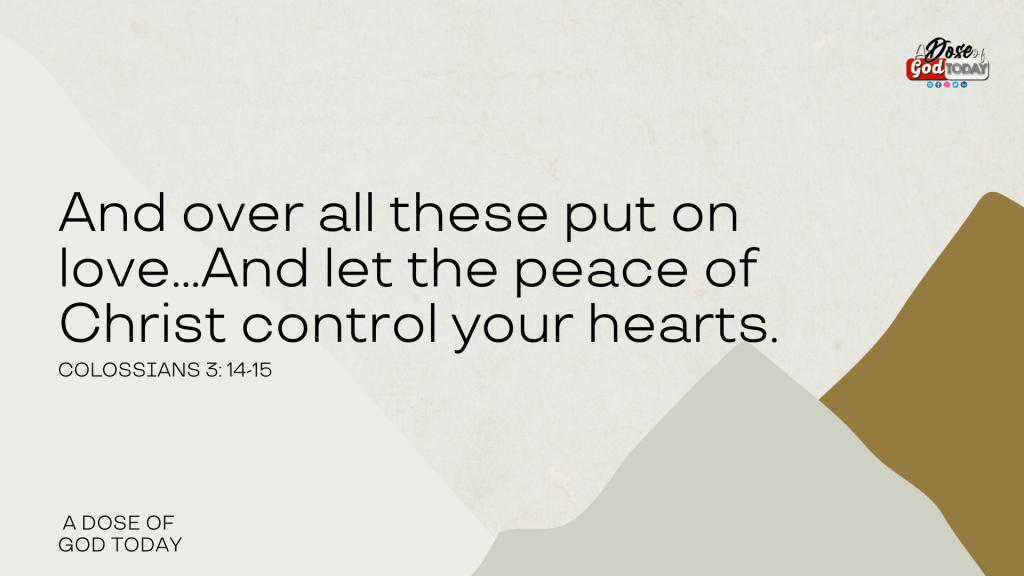
Paul in his Letter to the Colossians expressed thoughtfully and wonderfully how our relationships must be taken cared. He said, “put on… heartfelt compassion, kindness, humility, gentleness, and patience, bearing with one another and forgiving one another.”
As a father and brother to the Christian Community in Colossae, Paul was very concerned how relationships among the Christians must be formed. Thus, Paul continued to remind them, “over all these put on love, that is, the bond of perfection. And let the peace of Christ control your hearts.”
The spirit of the relationship in our homes and communities, indeed, must be centered on love, of the love of Christ. This brings peace and healing into our heart troubled by hurts and pains, disappointments and frustrations.
Jesus, in the Gospel, radically calls us as well, “To you who hear I say, love your enemies, do good to those who hate you, bless those who curse you, pray for those who mistreat you.”
The call to love, to truly love, is first a transformation of our own hearts. This means that our heart, when centered on Christ and his peace, releases hatred and aggression. This heart embraces the courage to forgive and expresses kindness to those who have hurt us.
This is truly difficult especially to a person bruised many times by others. Yet, true freedom lies in the heart that rests on Christ, for he is peace.
And so we pray, “that in whatever we do, in word or in deed, we do everything in the name of Jesus our Lord, giving thanks to the Father through him.” Hinaut pa.




 A DOSE OF GOD TODAY