Category: Weekday Homilies

  • God’s promise of salvation and restoration is fulfilled through our participation

    God’s promise of salvation and restoration is fulfilled through our participation

    March 25, 2020 – Wednesday – Solemnity of the Annunciation of the Lord

    Click here for the readings (http://www.usccb.org/bible/readings/032520.cfm)

    Homily

    The first reading relates to us a story of a person who refused God’s offer. Ahaz who was King of Judah was told to ask a sign from God. Yet, Ahaz refused. Why? He was asked so that he may believe in God’s faithfulness and salvation. This refusal of Ahaz was a show of not believing in God and a refusal to trust the Lord. Rather, Ahaz sought help whom he thought was another god, the King of Assyria. 

    Assyria at that time was politically and militarily powerful. Ahaz thought that by going to Assyria then he will have the certainty of protection and salvation. Judah at that time was threatened by other nations. Ahaz feared that his kingdom will end and his people will perish.

    However, despite the refusal of Ahaz, God still promised a sign of salvation. This will be through the participation of a virgin who shall conceive a son, who shall be called, Emmanuel, meaning, God is with us.

    This is tells now that even in our unbelief or refusal to believe and indifference to the Lord’s invitation, God is still in our midst. God remains faithful to us. 

    This is a message to us as we celebrate this Solemnity of the Annunciation of the Lord, to take comfort. Yes, take comfort, brothers and sisters, no matter how much fear, sadness, depression, worries, desperation and anxiety we are feeling at this very moment, God is with us!

    Moreover, this prophecy in the Book of Isaiah was fulfilled through the participation of a young woman who took the risk of trusting God despite the confusion, fear and suffering that she was to undergo. 

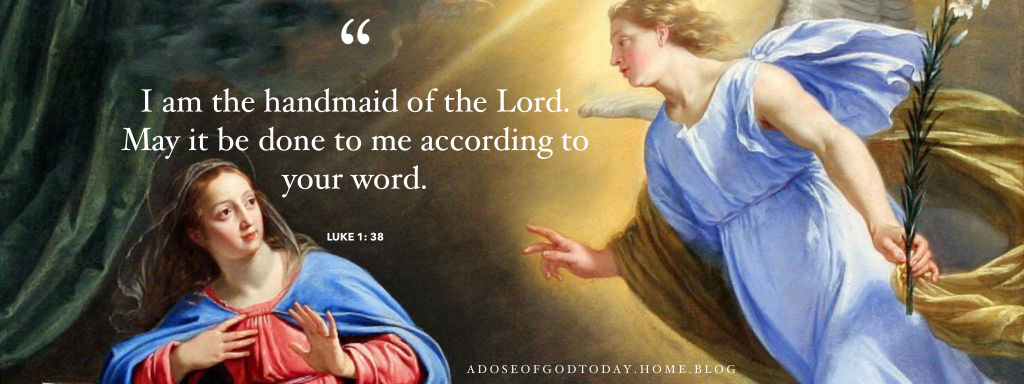
    The angel Gabriel, whose name means, “God is powerful,” assured this young woman not to fear for God is with her. The very presence of Gabriel was an assurance to Mary that God was working powerfully and wonderfully with her.

    This encounter has become the space for Mary to receive God’s invitation for her, to be that virgin who shall conceive a son, the greatest sign of God’s promise. The refusal of king Ahaz to God’s invitation was now being countered and redeemed through the acceptance of a simple young woman.

    Mary’s response saying, “Yes, I am a servant of the Lord, let it be done to me according to your word,” was her full expression to participate in God’s action to become closer physically with the whole creation. 

    And indeed, through the generous response and participation of Mary, the promise was fulfilled. God is truly with us!

    This tells us now that our participation is very important for God to fulfill the promise of salvation and restoration, of healing and freedom. Without our participation, God cannot also work with us and through us. God cannot just impose even though God is powerful. God is not an imposing God. This has been shown to us throughout the history of salvation. God always seeks and desires a human response so that the Divine Plan will be fulfilled.

    On this Solemnity of the Annunciation, through the person of Mary and her participation, each of us too is called to respond to God’s invitation, to participate in God’s action of fulfilling the promise of salvation, of healing and restoration particularly in these times of great crisis with the pandemic corona virus that has plagued our communities.

    This is the invitation for us today. We may ask ourselves, how is God calling me now to participate in God’s plan of healing and bringing salvation to all? We do not have to think of big things or big projects. As we stay at home at this moment, in what way I could help to control the spread of the virus? In what way I could be of help for others or bring blessings to those who are most in need particularly those who have lost their jobs, the hungry and the homeless? Or in what way I could inspire hope and give comfort to those who are afflicted, to those who sick, those who are grieving, depressed and lonely?

    These are the questions that I would like you to dwell for today and like Mary, let us also ponder and keep in our hearts God’s invitation so that we too will be able to participate in our own capacities in bringing healing and blessings to others. Hinaut pa.

    Jom Baring, CSsR

  • Do you want to be healed?

    Do you want to be healed?

    March 24, 2020 – Tuesday of the 4th Week of Lent

    Click here for the readings (http://www.usccb.org/bible/readings/032420.cfm)

    Homily

    The reading from the Book of Ezekiel tells us about the flowing water from which life, abundance and healing spring forth. It says,

    Wherever the river flows,
    every sort of living creature that can multiply shall live,
    and there shall be abundant fish,
    for wherever this water comes the sea shall be made fresh.
    Along both banks of the river, fruit trees of every kind shall grow;
    their leaves shall not fade, nor their fruit fail.
    Every month they shall bear fresh fruit,
    for they shall be watered by the flow from the sanctuary.
    Their fruit shall serve for food, and their leaves for medicine.”

    It clearly states that God created the world and everything in it and God has found them very good, as the Book of Genesis reminds us. However, in the face of the great crisis that we have now with the pandemic corona virus, it seemed that nature has turned against us. What have we done?

    This calls us as individuals and as a human community to look deeper at our own lifestyle and on how such lifestyle endangers nature. This calls us to recognize our sins committed against the earth from which the poorest of the poor in our communities suffer the most.

    Pope Francis has reminded that each of us is called to pro-actively protect the whole creation, our environment, and not to cause harm to the earth for the sake of the next generations after us.

    This event in our history is surely a wakeup call that there is a need for conversion of both personal and social, individual and community conversion. Indeed, healing can only be possible when we begin to open ourselves for others and for God. Opening ourselves also means recognizing our sickness, our sins, of what is wrong with us

    With our limited movement today because of the Community Quarantine, we have become like that sick man in the Gospel of John waiting to be healed. As of the moment, we could not yet reach the pool of the healing and cleansing water. We are lame and cannot move. Like that man who had been ill for 38 years, we too are desperate to find cure, to find healing and fullness of life.

    However, the Gospel also reminds us that God is not blind and indifferent to our desperation and need for healing. Jesus sees us as he saw the man lying flat because of his illness. In the same way, Jesus asks us, “Do you want to be healed?” 

    Yes, we want to healed. For us to be healed, there is also a need that we take responsibility for ourselves rather than blaming others because of our condition. This was what happened to the sick man, his response to Jesus was giving reasons of why he remained sick because no one could put him into the pool. 

    In the same way, in whatever sickness we have at this moment, Jesus calls us for a personal commitment, that we respond actively to his invitation of healing. This is the reason why Jesus asked the sick man to stand up, to take his mat and walk. 

    Do you want to be healed? Yes, and as we seek healing for ourselves, for our relationships, for others and for the world that is sickened with the deadly virus ,then, we need to stand up, meaning, to take courage, to have faith and to trust Jesus. We need to take our mat too, to roll up and to let go those things, attitudes, lifestyle, and even beliefs that only prevent us from walking. Just like that healed man, the mat the he had become so comfortable with has to be left behind. He had to let that go for him to walk and embrace God’s healing.

    In this way, then, hopefully, we shall all experience that flowing water that gives life, abundance and healing and to experience that from the very source himself, who is Jesus, the source from which the healed man was able to experience. Hinaut pa.

    Jom Baring, CSsR

  • Called to pray. Called to believe.

    Called to pray. Called to believe.

    March 23, 2020 – Monday 4th Week of Lent

    Click here for the readings (http://www.usccb.org/bible/readings/032320.cfm)

    Homily

    In our desperation and great difficulties, to whom and to where do we go?

    Others because of confusion for what happened in their life would go to depression or to self-pity, or guilt. This sometimes would develop into unhealthy coping mechanisms that later on would progress into habit and forms of addiction. For instance, a drinking habit or alcoholism could have started through a painful or difficult memory in the past, a death of loved one or a financial crisis. Online game addiction or too much time spent on social media could have started through boredom at home and disconnection from intimate family relationship. A gambling or drug addiction could also have been caused by a traumatic experience or broken relationships.

    Yet, there are also those who in their desperation and great need went to ask help from other people whom they believed could help them.

    The very Gospel story that we have today conveys to us this kind of encounter. A non-believer who was royal official went to see Jesus. He was desperate and indeed was in great difficulty because of his dying son. As an official, somebody who had power over others, he must have already sought the best doctor he could find at that time, yet, there was no remedy. His son was not healed but dying.

    As a father, this Royal Official, showed to Jesus how he loved so much his son. His son must have been everything to him and this was the very reason why he sought to see Jesus and begged him to come with him in order to heal his son. 

    For him, as a Royal Official, asking a Jesus to heal his son, was a humbling experience. In his desperation to seek healing for his son, he did not give up. He was hoping for a miracle even when his son was already at the point of death.

    This tells us now to hope and not to give up. The encounter of this official with Jesus would tell us what kind of God we have. Through the humility of this man, Jesus saw and felt the desperation of this man. Jesus felt the love of this father to his dying son.

    Jesus witnessed the life of prayer and the faith of this man despite being a non-believer himself. The official had that confidence to trust in Jesus’ words that his son will surely recover. “Go, your son lives!” – We were told in the Gospel that this man had faith in the word Jesus spoke to him.

    But let us also remember, there is so much risk in believing. The royal official went home and risking everything by trusting the words of Jesus. However, it was also in that attitude that Jesus showed how his presence and words could bring healing and change life. True enough, the son was healed and the official became a believer of Jesus and all his family.

    This is what is wonderful and powerful here. This is also the message for us today, for each of us who are in desperation and in great difficulty in whatever aspect that may be in our life. This is also the message for us as a community today, facing this global crisis caused by the pandemic corona virus that brought chills of fear and anxiety in us.

    Thus, there are two aspects that we are particularly called for today. 

    First, we are called to pray and to humbly beg for God’s mercy. Our prayer just like the official, is not just of ourselves, for our own salvation, but also for others. Yes, we are called to pray for those who are infected by the virus, for those who have died and their families, and also for the doctors, nurses and other medical staff that are ministering the sick. We also pray for the medical experts tasked to create a vaccine that through them God’s healing will be revealed. We pray for them out of our true concern and love. Certainly, Jesus shall also feel that in us. 

    Second, we are called to believe. Like that official and father who believed in the presence and words of Jesus, we are also called to put our confidence completely in the Lord, meaning, to have faith in Jesus, in his presence among us and his words so that God’s wonder and healing power will also be unfolded in us.

    May I invite you then now that we all stay in silence for few moments, to pray and to beg the Lord’s mercy and to believe that God will bring us healing. Let us all bow our heads and pray in silence (as you read this, please observe a 2-minute silent prayer).

    Brothers and sisters, God shall protect and heal us and in faith, we will all pass this through. Hinaut pa.

    Jom Baring, CSsR

  • Be merciful to us, Lord

    Be merciful to us, Lord

    March 21, 2020 – Saturday 3rd Week of Lent

    Click here for the readings (http://www.usccb.org/bible/readings/032120.cfm)

    Homily

    Being judged because of what you have done before, or of a mistake, or failure or sin that you have committed is a devastating experience. This becomes  overwhelming too especially when we are “put in a box,” that, as if there is nothing more in us except our sins and failures.

    Aside from being judged by others, each of us too can be the one who judged others because of their mistakes and failures in life. We could have played to be the righteous individuals who scrutinize people searching for their faults. We could be that mean person whose main intention is to bring other people down by shaming and gossiping their weaknesses in order to hide our own sins. This happens among our families, circle of friends and even in our workplaces.

    The Gospel story that we have heard today conveys this message to us. To become self-righteous only blinds us. Thinking highly too much of ourselves will even prevent us from asking God to show his mercy upon us because we already think that we do not need God’s mercy. The righteous person actually thought of himself so highly that God is as if obliged to be good to him. In his thoughts, God has to pay him for being good and righteous. 

    What happens here is a reversal of relationship. God is as if the servant of this righteous person. Although he might be after of rewards in his life for being righteous, yet, he was actually seeking to control God through his righteousness. Thus, this attitude leads us to build invisible walls that separate us from others.

    We might still have that idea of condemning our brothers and sisters who were considered terrible sinners. We too might have that attitude of separating those people whom we consider as unclean for fear of being contaminated and be associated with them.

    Thus, Jesus invites us now to rather look closely at ourselves and to examine better our intentions, our thoughts and actions so that it may also lead us to that recognition of our failures and sins. This realization will hopefully lead us to also join the tax collector in praying, “O God, be merciful to me, a sinner.” 

    We are invited to be more understanding of those who failed but not in the sense of condoning such failures and sins. We are invited to be merciful rather than to be condemning.

    Let us remind ourselves that to both the righteous and the sinners, God does not condemn but God rather desires healing, reconciliation and fullness of life for all.

    This calls us, then, to see more in the person of our brothers and sisters, to stop our harsh judgments and condemnations, to stop our gossiping and image shaming that only destroy the image of our brother or sister.

    What is its invitation now for us as we face such difficult situation amidst this deadly Covid-19. Even during this challenging times, we are called to show compassion and generosity to our brothers and sisters, particularly those who are most in need. And since we are called to “stay home” as a form of prevention of the spread of the virus, let us also not spread malicious gossips about our neighbors or friends. To stay at home is also an invitation for us to pray for each other and to show our true concern for one another. Hinaut pa.

    Jom Baring, CSsR

  • Responding in gratitude

    Responding in gratitude

    March 20, 2020 – Friday 3rd Week of Lent

    Click here for the readings (http://www.usccb.org/bible/readings/032020.cfm)

    Homily

    Policies, regulations or laws are essential elements in our society. They govern and guide us as we live our life and relate with one another. Our lawmakers in this country are expected to make laws that will promote life, protect life and develop the life of every Filipino. That is how a law is very important.  As good citizens, we strive to follow the law of the land.

    Because of the pandemic Covid-19 our lawmakers and key government leaders are now giving directives and executive orders to us citizens in order to protect the population and prevent the spread of the virus.

    Talking about laws, our religion has also laws of which we are expected to follow. We have the Ten Commandments from the Old Testament and the Code of Canon Law that guide our Roman Catholic Church. In fact, there are plenty of laws being conceived and promulgated year after year. 

    The image of many laws reminds us of the Jews especially of the Pharisees and other teachers of the Jewish law at that time of Jesus. In Jesus’ time, there were about 613 laws that a good and faithful Jew must know and observe. Laws are designed to guide a person but since laws are man-made they too are prone to imperfection. Laws are designed to give and preserve justice, fairness and make direction and guidelines as people relate with one another . However, many laws can also be a burden. And there were many laws of the Jews that were quite burdensome.

    We have heard a scholar of the Jewish law asking Jesus on what was the greatest law? Jesus responded with two that are inter-related. The first is, “to love God, with all your heart, with all your soul and with all your mind.” And second, “to love your neighbor as yourself.”

    Our Christian faith must be rooted in these two commandments. However, following these two greatest commandments we need the right attitude. And what is that right attitude? 

    The failure of many of us in practicing our faith is when we limit our faith within church laws. Limiting ourselves within these laws or commandments will only bring us into a legalistic attitude. This attitude believes that Christianity is about fulfilling laws. When we break a law or a rule we feel guilty. This attitude is not what God wants. God does not want us to feel guilty of the wrong we did in breaking God’s law. Rather, God wants us to feel sorry because our response to Him is lacking and ungrateful.

    We may have laws but God wants us to look what is behind these many laws. This is what Jesus said to the teachers of the law. Jesus revealed to them what was behind these laws, and that was love – to love God and to love our neighbor as ourselves.

    How shall we do this? We are only able to respond to God with love when we ourselves are conscious of God’s love for us, his goodness and generosity in us. This is what we find in  the Book of Hosea. The first reading tells us how God shows mercy and compassion to the erring people. God has promised, “I will heal their disloyalty and love them with all my heart.” God as if speaking in human language, shows God’s faithfulness to us despite our unfaithfulness.

    This experience of forgiveness, mercy, love and faithfulness from God moves us now to respond to God, to respond in “gratitude.” This is the right attitude that we are called to develop.

    This is how Jesus is inviting us today – that as we live our lives as Christians, our response to God should be out of “gratefulness” not out of fear or mere obligation. Thus, faith is beyond obligation, it is a human response of love to the God who first loved us, as Pope-Emeritus Benedict XVI said.

    Our love for God will then be shown in our words as well as in our actions. We shall be generous to those who are in need because we are grateful to God who is generous to us. We shall show our concern and affection to our friends because God shows his love to us in many ways. We shall forgive those who hurt us because God has forgiven us first. 

    Today, we are also called to follow the directives set by our civil and church leaders as our act of gratitude in protecting and serving us and also as our act of charity to people who are now at the frontlines in fighting against the Covid-19. Hopefully, by our collective effort in following the guidelines for our community, God may also deliver us from this disease. Hinaut pa.

    Jom Baring, CSsR