
Category: Weekday Homilies

  • Be captured by the Power of Resurrection

    Be captured by the Power of Resurrection

    April 13, 2020 – Monday within the Octave of Easter

    Click here for the readings (http://www.usccb.org/bible/readings/041320.cfm)

    Homily

    The Gospel story from Matthew presents to us how truth can be manipulated by people who desired to advance their personal agenda. The soldiers who were witnesses of the Resurrection were paid not to tell what really happened but to create another story. These soldiers must have been filled with awe and wonder in the event of the resurrection. Light must have pierced into their unbelieving hearts. However, what was sad in their story was when they were presented with the immediate comfort of money.

    They were willing to cover the truth of resurrection and create fake news for the sake of money. They accepted a corrupt offer to spill the untruth to people rather than to tell others of God’s power and mercy.


    Why was that? Is money more powerful than God? Certainly not. It is just deceiving.

    Nevertheless, apart from this sad story, we still have the women who showed to us how the resurrection of Jesus changed their life. The Gospel tells us that they were still fearful yet “overjoyed.” This means that despite the seeming darkness they have experienced in the past days and the fear that enveloped them, the presence of Jesus filled them with so much joy.

    The women did not succum to despair and fear unlike the soldier who succumbed to money and corruption. The women continued to believe in Jesus in spite of the confusions and even pain and suffering that they witnessed. They never lost their hope in Jesus.

    This kind of attitude in them was showed in their action as they went to the tomb early in the morning. The tomb surely would remind them of the death of Jesus, meaning, of sadness and failure, of pain and disappointment. However, even in the midst of all of these, they found a reason to find light in the midst of darkness, to find hope in the midst of hopelessness and to find life in the midst of death.

    And true enough, as they desired to see Jesus, they indeed saw and witnessed the glory of resurrection. This was how they also found their mission, and that was to be Jesus’ witnesses to others.
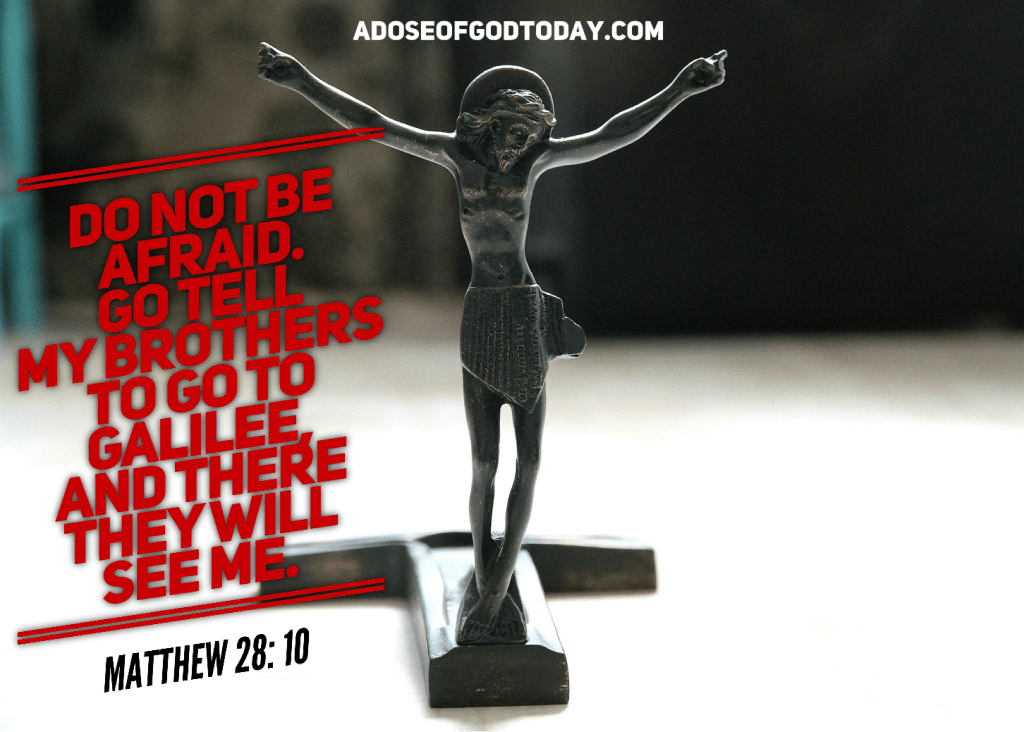
    Now, as Jesus called them to tell other disciples about him, each of us now too is called to tell others of Jesus’ presence in our very life. Galilee, then, is very important here. Galilee, indeed, was a very symbolic place. 

    The people in Galilee were the excluded, the poor, and the marginalized where only bad news were heard and imposed. And Jesus grew up in this environment. He indeed belonged to this marginalized-second-class people who were systematically oppressed by oppressive powers. And Jesus identifies himself with them. With them Jesus shared food, drinks and stories. Moreover, Jesus called his disciples who were mostly Galileans, in the poor and marginalized people. 

    Galilee now represented the world where people continued to suffer, to be marginalized and oppressed. It is in this place where Jesus will be found by the disciples and where the good news of the resurrection will also be preached. 

    As disciples and modern day apostles of Jesus, we are to seek also the marginalized and the oppressed in our society. We are to bring hope and good news to those who are troubled and in despair. It is to be faithful to the mission of Jesus entrusted to us his believers that we shall also meet the risen Christ. This mission is surely radical and demanding, thus, it must always be motivated through the person of Jesus with the power of the Holy Spirit. Yes, only through the person of Jesus and not in money, in benefits or comforts for ourselves. 

    As we respond to the call of the Risen Lord, may we find him more in our efforts in making difference in the lives of our brothers and sisters especially in this difficult times brought by the pandemic Covid-19. Hinaut pa.

    Jom Baring, CSsR

  • WHAT MAKES GOOD FRIDAY, GOOD?

    WHAT MAKES GOOD FRIDAY, GOOD?

    April 10, 2020 – Tenebrae: Morning Prayer of the Passion of the Lord

    Sermonette Shared by Bro. Vincent Chloe Que, CSsR

    “And have faith in the resurrection, have faith that better days will come in God’s perfect time.”

    Greetings of Peace!

    We are in the liturgical time called Holy Week, and today is Good Friday. But what makes this week Holy? Or this day Good? Is it not that were are reminded today of a terrible suffering, an unimaginable fate that befalls Jesus, our Lord? In fact, this morning’s prayer is called Tenebrae, which is a Latin word that means “darkness.

    Brothers and sisters, what makes it holy and good is precisely presence of Jesus, even in darkness, even in suffering. Suffering is a human reality that many have tried to explain. Yet Jesus never explained it, instead he willingly suffered so that in our suffering we will meet him there. Amidst this Pandemic, we find ourselves vulnerable and in great suffering:

    • As we are confined in our homes, under quarantine, we may experience anxiety and fear. Yet last night we remember Jesus in the garden sweating blood in deep anxiety and fear for death is lurking around.
    • Because of physical distancing and travel bans we may be separated from our loved ones or unable to hug and kiss our elderly parents and young ones, we may feel lonely. Yet we remember how lonely Jesus was when his friends abandoned and even denied him.
    • Our “frontliners” come face to face with danger on a daily basis, their burden is compounded by the lack of support for them. Yet we remember Jesus facing Pilate, scourged, mocked, and sentenced to death.
    • When our daily-wage earners are forced to stay home even if it means losing their means of sustenance, today we remember Jesus forced to carry his heavy cross.
    • And when we are sick or when we feel God has abandoned us, the voice of Jesus reechoes: “my God, my God, why have you forsaken me.”
    • And yes, even in death, Jesus is there.

    But also, two days from now, Jesus is also present in Easter: in our recoveries, in the heroism of our frontliners and our daily victories in fighting this pandemic. Yes Jesus is present in our Joys and in our triumphs! Indeed the cross would not make full sense without the empty tomb. 

    Today we begin the paschal triduum. Pascha or Pesach means passage. A capuchin priest, Fr. Cantalamessa referred to this as: “the passage of the Jewish people from slavery to freedom, the passage of Christ from this world to the Father, and the passage from sin to grace for those who believe in him.”

    John the evangelist also sees the passion, death, and resurrection as one event, one moment. Let us bask in Hope, something that these days’ celebration brings. Hope, Pope Francis says, is not an illusion, if we put our hope in Christ, it is never wasted.

    Therefore, brothers and sisters, a great invitation is before us in these trying times and as we celebrate the Holy Week, let us unite our suffering with the suffering of Jesus, allow these to purify us and bring us back closer to God, let us entrust to him our anxieties… rest assured that He understands us. And have faith in the resurrection, have faith that better days will come in God’s perfect time. This is what makes this week holy and this day good, we are celebrating a perfect act of Love by our God who, even in our sinfulness, will never ever abandon us. 

    Have a blessed days ahead!

  • Jesus thirsts

    Jesus thirsts

    April 10, 2020 – Good Friday, the Passion of the Lord

    Click here for the readings (http://www.usccb.org/bible/readings/041020.cfm)

    Homily

    How would you feel when you are left alone to suffer? Could you imagine yourself, hanging on to your life, to every gasping of air? 

    I could imagine it when my papa was dying last year. I was not there when he died for I was assigned then in Iloilo at that time. But, I could hear how papa gasped for air until he departed. It was agonizing.I felt helpless as a son, listening from the phone knowing that my father was dying.  It must have been excruciating for papa even as he struggled for his last breath on earth.

    Same experience of pain and loss must have been felt too by those who have lost their loved ones and witnessed personally their passing. These days, we have been told also how the patients of covid-19 would struggle to breath as the virus attacks the respiratory system of the human body.

    Jesus who died on the cross must have felt more pain and struggle. There were no doctors and nurses around him to help him ease the pain for gasping for air. There was no medical help given to him by the people around him. An innocent man was left hanging on the cross to die with his lungs restrained together and his weight pulling him down. However, the nails that have pierced his hands stuck him to the wood of the cross.

    As he was dragged to be flogged, carried his cross and crucified, many people around him just looked at him. Many have shouted condemnation against him as if they were righteous and he was the sinner. Many others too remained indifferent to his cries, indifferent to his pain.

    Moreover, his friend betrayed him and sold him, another friend denied him three times and the rest of his friends run away and hid themselves, except for the youngest of them and few women. With all of these, Jesus endured everything. We did not hear him curse and even expressed dismay over those people who left him alone and those people around him who remained indifferent to his cries.

    However, what we have heard from him while on the cross that I find powerful was when Jesus said, “I thirst.”

    Physically, Jesus longed for something to drink, to quench his dry throat and lips. The loss of blood, the tensions in his bones and muscles and exposure to heat on that day generated loss of water in his body. The soldiers beneath the cross gave him a common wine to ease his suffering.

    This tells us how Jesus endured the suffering physically. The Lord has suffered and that statement, I thirst, conveys to us how the weight of human sin caused agony to Jesus.  

    But more than what was physical, this short statement of Jesus, I thirst, also tells us of God’s desire for us. Jesus thirsts for our presence with him, for our friendship. Imagine, how could he not be thirsty when people who are close to him run away and hid themselves? How could he not be thirsty when bystanders just looked at his pain and suffering? How could Jesus not be thirsty when many of those who gathered around him felt indifferent towards the suffering of God?

    As Jesus was publicly condemned by the crowd who merely believed in gossips and lacked the ability to be critical against their powerful leaders and wanted to kill him, Jesus thirsts. 

    As we remember solemnly today the passion and death of Jesus on that gruesome cross, may we also heed his call for us today. Let Jesus’ words reverberate into our hearts and move us to satiate the thirst of God.

    As the (Enhanced) Community Quarantine has been imposed for the safety of all, let it be an opportunity for us as Christians to be more sensitive of Jesus’ thirsts. The thirst of Jesus is also present through those brothers and sisters who need special attention and assistance. 

    Let the words of Jesus, I thirst, be heard from a neighbor who seek your help, from a friend who need your comfort because of anxiety, from a family member who is sick, from a colleague who is worried of his/her family at home, from a poor-homeless person who is being blamed for not observing “home quarantine.”

    As we respond to Jesus’ thirst, may we in return thirst for more of God’s presence. May that thirst bring us closer with one another and closer to the Lord. May that thirst for God too make us ever hopeful that suffering and death is not the end, but only the beginning of God’s ultimate sign of love and compassion. May our thirst for God bring us to experience as a community the gift of healing and restoration from sickness and pain, the grace of peace and reconciliation from sin and division, and the glory of resurrection that renews and transforms us. Hinaut pa.

    Jom Baring, CSsR

  • Making the Memory of Jesus ever alive in us

    Making the Memory of Jesus ever alive in us

    April 9, 2020 – Holy Thursday, Evening Mass of the Lord’s Passion

    Click here for the readings (http://cms.usccb.org/bible/readings/040920-lord-s-supper.cfm)

    Homily

    This mass and in fact every time we celebrate the mass, it is so special because it has something to do with “our memory “that has been handed down to us from the first generation of disciples of Jesus. And not just “our memory” but also of “God’s memory of us.” 

    The Eucharist, which actually means “Thanksgiving,” was made by Jesus in order to celebrate friendship. He was with his disciples to eat the Passover Meal, a ritual that remembers and reenacts the ‘passing over of the Lord’ when the blood of the lamb was applied at the door posts of the Hebrews. Because of that blood, the Lord passed over the houses of His people and stroke down the oppressive Egyptians. 

    With this celebration which Jesus made his relationship with his disciples into a new and higher form of relationship. This was Jesus’ way of being more intimate with his friends by becoming food for them and now for us.

    There are three points that I would like to invite you to reflect on. Let us see and discern then, on how Jesus calls us on this celebration of the Last Supper.

    First, “what we eat is what we become.” It is the desire of Jesus that as we receive him as our food in word and flesh (in the form of bread and wine) that we become more like him. 

    Second, it is also the desire of Jesus that as he becomes part of us, and one in us, then, hopefully, each of us will recognize his presence among ourselves – that is, by being able to recognize in my sister and brother the person of Jesus.

    Third, it is also the desire of Jesus to make him not just a mere memory of a distant past but to make him a powerful memory that transforms our present. Jesus asks us, “Do this in memory of me!” or basically means, “Always do this to remember me.”

    Here is the power of memory or of our consciousness. As humans, we always treasure our memories. We take photos or videos of events in our life to preserve those important moments.

    Our memory is also what makes us more human and even on what makes us “who we are today.” My memory of the past, is what makes me ‘who I am today’ because my very identity, culture, belief, relationships and history are all there in the treasured memories. However, if I will lose my memory, then, I will also lose myself. I will be a madman who is detached from what is in the present because of a lost memory.

    However, more than our own human memory, we are also in God’s eternal memory. Indeed, by doing what Jesus asks us, God also remembers us. Yes, God remembers us as his people whom he loves and cherishes despite our failures and unfaithfulness. God remembers us because we are part of God and God is among and with us.

    These three desires of Jesus for us bring us into his invitation today and that is to be able to serve one another through a self-sacrificing, loving and generous service. This is symbolized in the washing of the feet where it was the master himself who washed the disciples’ feet. 

    Jesus showed to us that loving entails humility, by bending down towards the level of those whom we might think as lower than us. By washing the feet of his disciples, Jesus showed that loving is not “power-over.” Jesus tells us then, that in loving we do not take control over the other, not even to exercise manipulation. Jesus shows us that loving is a form of sacrifice where we need to strip ourselves with those things that might prevent us from truly relating with others.

    Jesus removed his outer garments and had a towel on his waist. We too are invited to let go of our biases, judgments and condemnations against others, whoever they may be – a family member, relative, friend, co-worker, employee or stranger.

    Thus, by washing the feet of his disciples, Jesus empowers them and us today to become his presence in the very context where we are at this very moment. It means that if you are a parent, husband or wife, a son or daughter, you are called to exercise such love and service in your family. Are you a professional or student? Then you too are called to love and serve others within your environment. Are you exercising authority or a leader in a company or community? Then, you too are called to become Jesus’ presence in your own sphere of influence.

    The very situation we are in now can be a wonderful opportunity for us to serve and love others. Thus, we commend and express also our gratitude to the many medical frontliners who have given their lives for others. There are already many doctors, nurses and other medical staff who lost their lives from fighting the virus. The many sacrifices of these people make the presence of Jesus alive in our community.

    Hopefully, by becoming the presence of Jesus to one another, then, we too shall be able to fulfill also the call of Jesus in his Last Supper, “Do this in memory of me.” In this way, we make Jesus ever alive in us by allowing the grace of Eucharist to transform us including our thoughts, words and actions, the very sign that God is with us because He himself always remembers us. Hinaut pa.

    Jom Baring, CSsR

  • THE HOLY EUCHARIST

    THE HOLY EUCHARIST

    April 9, 2020 – Holy Thursday, Evening Mass of the Lord’s Supper

    Click here for the readings (http://cms.usccb.org/bible/readings/040920-lord-s-supper.cfm)

    Homily

    Typically, around four in the afternoon, I usually go to the kitchen. I customarily look and eat for a little bowl of rice as well as any dish left from our lunch. Yet, in this time of quarantine due to COVID 19, we have limited stocks. And, we rarely have leftover from lunch. It is quite a struggle for me, as I would feel hungry.  : )

    Nowadays, it is common to see in the news people cueing long lines just to buy food. Others are waiting to receive food packs from the ration. If not, they would go to their barangay halls and would ask their officials for it. Hence, this limitation to have sufficient food makes us realize its importance. Food is life, right?

    This situation also happens in our Eucharist. Our churches don’t have public masses due to COVID 19, a lot of people now realize its importance. A number of them crave for it, especially in this time of Holy Week. Recently, I become aware that some of my friends would set their notifications to know the schedules for our live streaming masses. (Kaya, wag na nating hintayin na tuluyang mawala pa para malaman mo na mahalaga pala. #hugot.) 

    Indeed, the Eucharist is food. It is our food for our soul. That is why, among the seven major sacraments, it is the only one that we celebrate daily. It is for the reason that it is the source of our Christian life. It energizes our mind and spirit. (So, Eucharist is lifer, diba?)

    Tonight we celebrate the Holy Thursday Evening Mass of the Lord’s Supper. At this moment, we commemorate the mystery of the institution of the Eucharist.  We don’t only remember the tradition of the new Passover of Jesus, but we also make it a present reality. It is because, in the Eucharist, Jesus himself becomes the sacrificial Lamb. It is his own body and blood being offered for our salvation. Jesus also becomes the bread, as we have heard in the Second Reading, from the first letter of Paul to the Corinthians. He clearly said, “This is my body that is for you. Do this in remembrance of me.” 

    True enough, the Eucharist is Jesus Christ himself. So, every time we take the Eucharist, we received the source of life and grace. Every time we take the Eucharist, we received the source of our growth in faith, hope, and charity. Every time we take the Eucharist, we share the divinity of Christ Jesus, who humbled himself to share in our humanity. So, you and I become one with Jesus. We are in communion with Him.

    Yet, we don’t just stop there receiving Him. In today’s gospel, as Jesus instituted the Eucharist, He also instituted priesthood together His commandment of service and love. We have heard how Jesus humbled himself and washed the feet of the disciples. This act serves as a reminder for us to love and to serve one another, as he said: “I have given you a model to follow so that as I have done for you, you should also do.” 

    My brothers and sisters, we are commissioned by Jesus to become priests and servants for His people in His kingdom. By our baptism, we shared the office of the priesthood of Christ. It means you and I are called to pray, to serve, and to pastor others. In this trying times, Jesus invites us to pray for those afflicted with COVID disease that they may have hope and experience healing. We are also called to generously serve for those who are exhausted in helping others, such as medical frontliners and government workers. Further, we are called to pastor for those who have lost their faith because of suffering and of death of their loved ones.

    In this mass, we ask for the grace of becoming like Jesus, the Eucharist. We pray that we, like a little bowl of leftovers, may still become a nourishing sacrament that brings faith for those broken-hearted, brings hope for those who are sick, and brings charitable love for those living in darkness. Amen.

    Shared by Rev. Joey Valross Trillo, CSsR